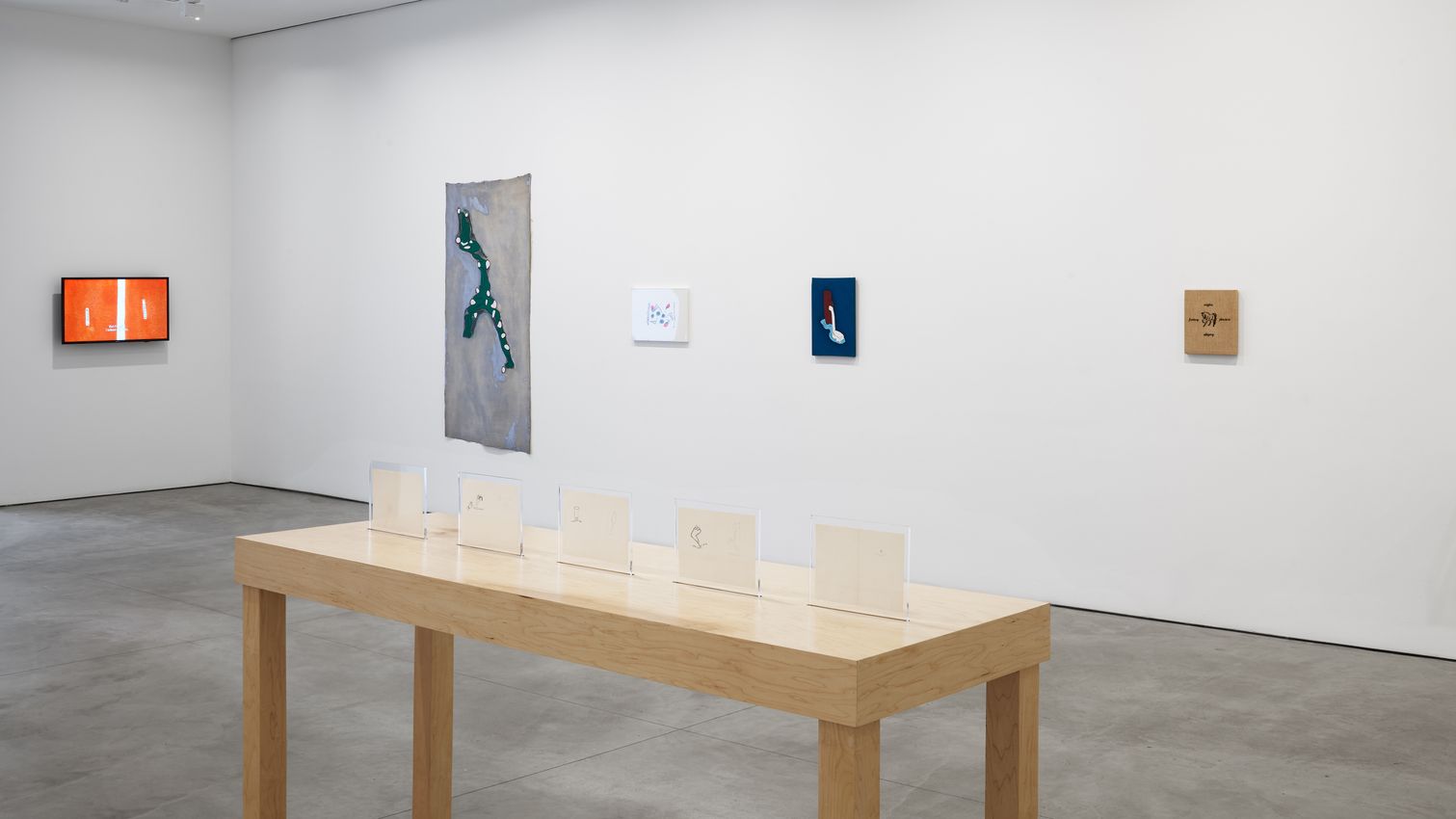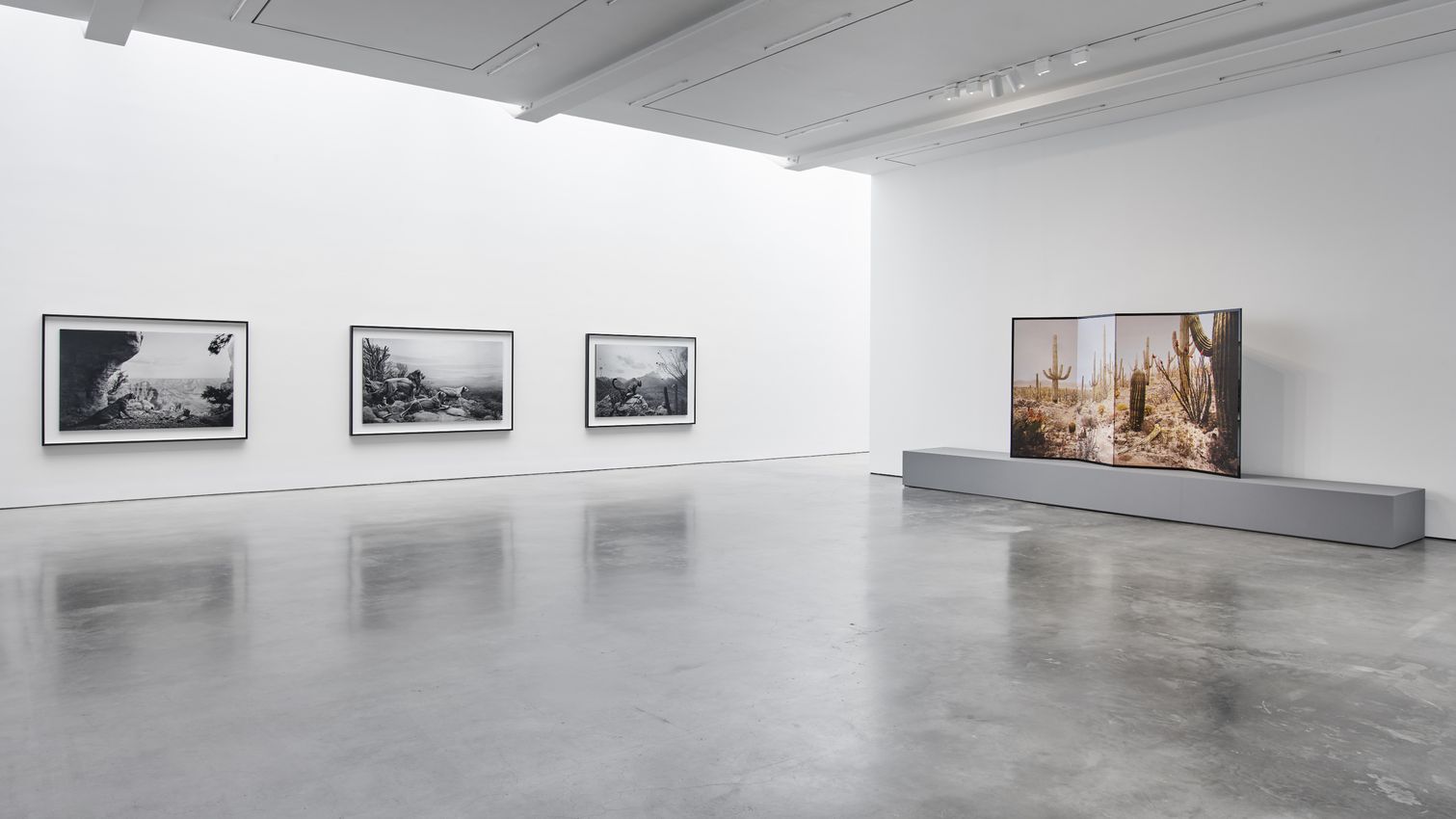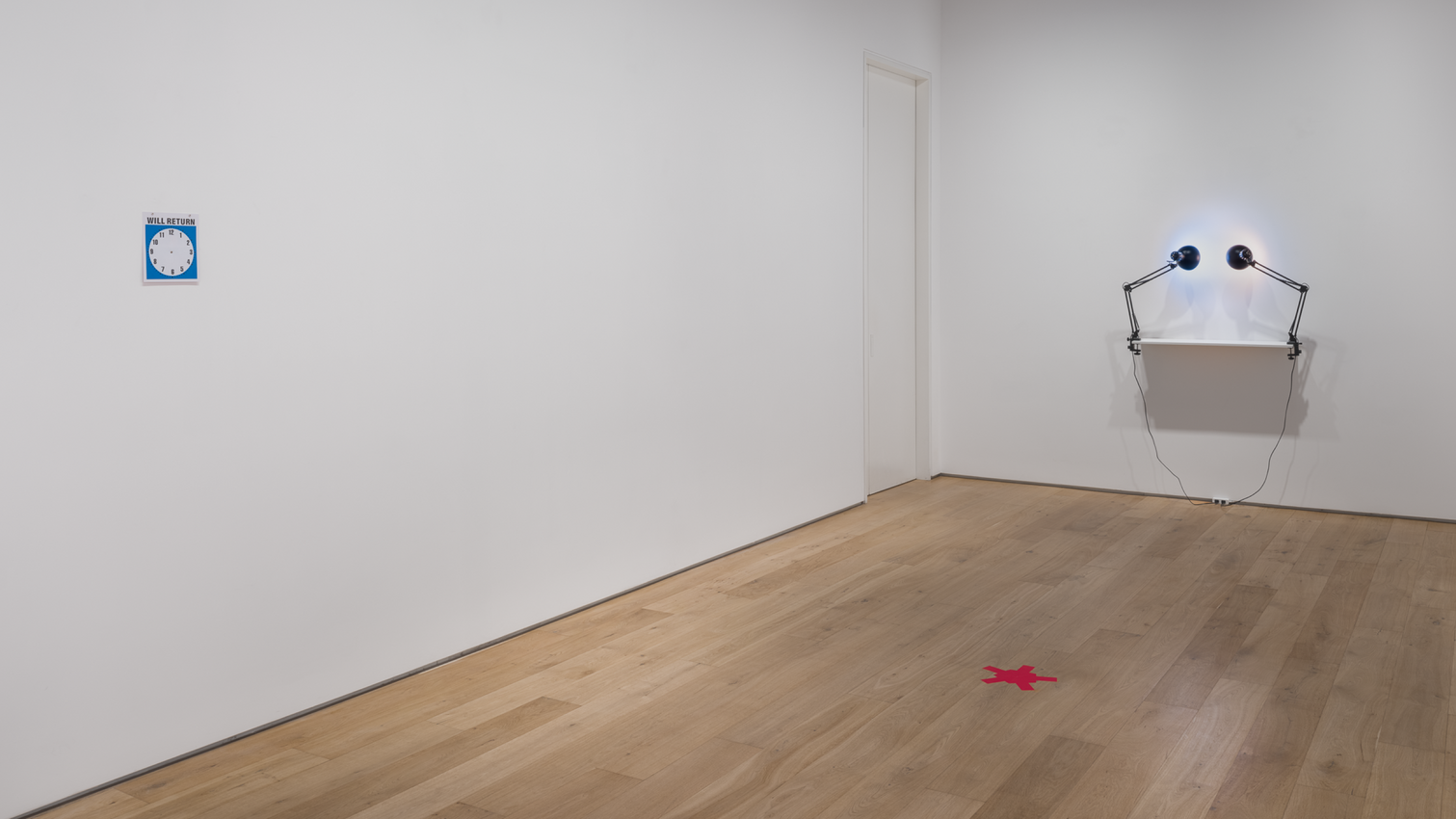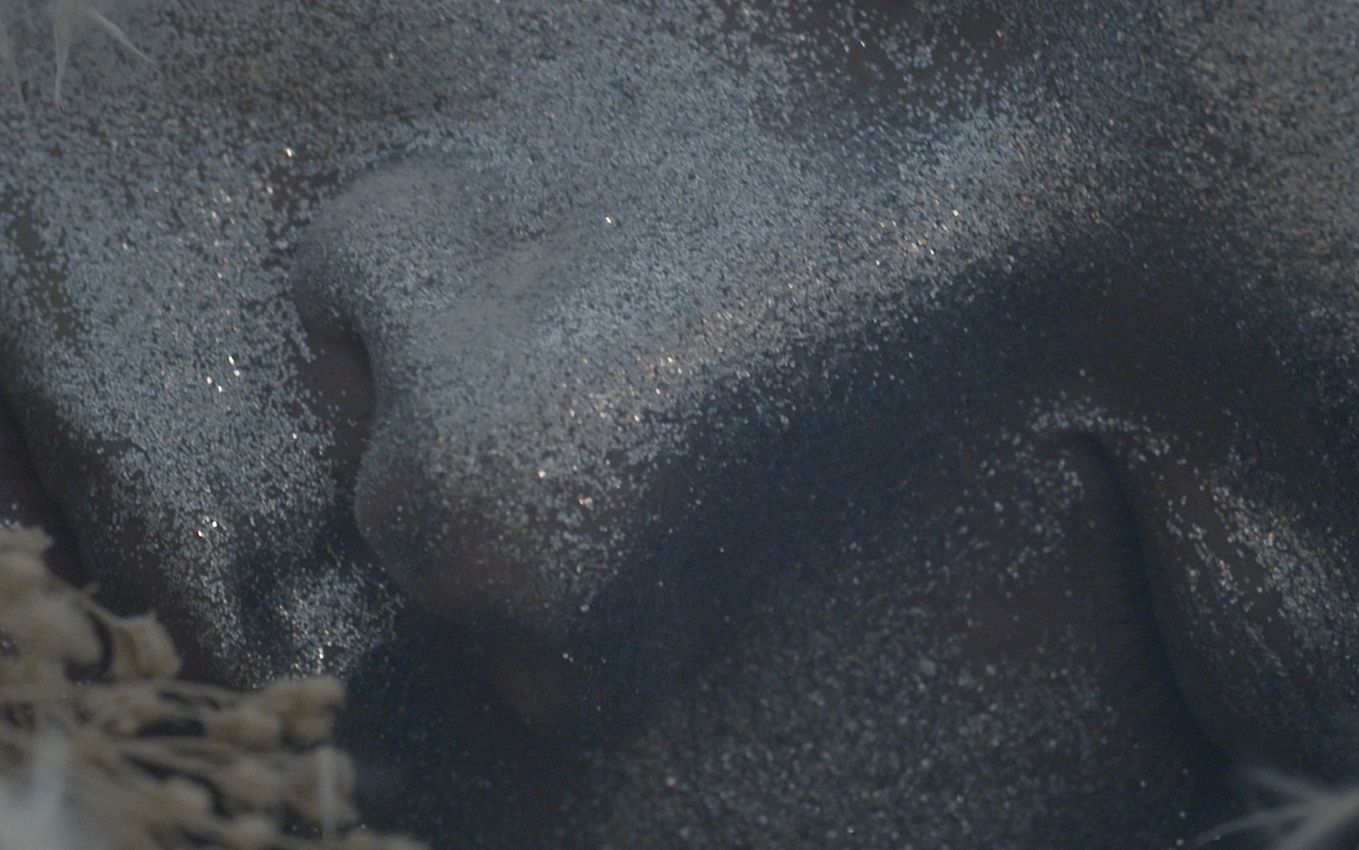
Haroon Mirza presents a solo exhibition of new works, entitled |||, forming a constellation of installations around the so-called ‘Holy’ or ‘Divine’ frequency of 111 Hz, which provides a sonic bathing experience that permeates the gallery spaces. Individual works incorporate light, moving image, sound and sculpture, while a living ecosystem deriving from one of Mirza’s solar-panel works ‘powers’ an ant colony and a fungus farm. This is his fifth solo show with the gallery and follows major museum and biennial presentations in 2022 such as the Lofoten International Art Festival in Norway and lille3000 in France, with a new commission also being unveiled during the first Islamic Art Biennale in Saudi Arabia that opens on 23 January.
In the main room at Lisson Gallery, Mirza presents a new video work in collaboration with filmmaker Helga Dóróthea Fannon, continuing his ongoing ‘modular opera’–a malleable system of interconnected video and performance works – in which a tea ceremony is conducted using the active ingredient of the amanita muscaria mushroom. Also known as Fly Agaric, this deliriant strain of mushroom is associated with toxicity, dizziness and loss of coordination, rather than with the hallucinations of the psylocibin or magic mushroom. Its red-and-white, domed cap has a rich history and mythology, both in popular folklore associated with the poisonous toadstool that shrinks Alice in Wonderland and in its ritual usage by Saami and Siberian shamans, as a healing aid or a portal to another universe. Combining these themes of childhood make believe and mystic soothsaying, Mirza’s immersive installation intermixes vocals by soprano Sarah-Jane Lewis, a two-channel film featuring ingestion of the tea by a group of children (the artist’s included) on the night of Winter Solstice, alongside two tabla drums beating out a shamanic rhythm, representing another of the modular elements borrowed from previous bodies of work.
Sound acts as another connective thread, linking the entire show through the staging of an electro-acoustic ‘gong bath,’ for which Mirza has approximated the sonic frequency of 111 Hz using synthesisers and traditional instruments such as a Tibetan singing bowl and a bespoke harmonium from India known as a Shruti box. In addition to the meditative effect associated with vibrational group meditations, the 111 Hz frequency is said to have numerous therapeutic and healing effects, as noted in various medical studies. It also been discovered at prehistoric sites and ancient temples that once hosted spiritual events (for the Frieze Live programme in 2020, Mirza staged MindFlip during 111 hours of performance). This low, droning bass note continues in an LED floor work in the front gallery that flickers imperceptibly at the same frequency.
Upstairs, Mirza continues his series of Solar Cell Circuit Compositions that act as scripts to the film below, as well as another new work incorporating three glass chambers containing an ant colony and a fungal bed of organic matter for the leaf cutters to harvest themselves, while an array of halogen lamps provide heat and light to ensure the ecosystem’s survival and illuminate solar panels that activate sounds created by the ants’ movements. While our societies and social networks are meant to be horizontally structured, but are ultimately governed from the top down by the state, ants live and work in non-hierarchical colonies, with the queen as the solitary, benign figurehead. Rather than following her orders, ants are known to locate sustenance and organise mass movement using pheromone trails, much like the mycelial network that links plant life below the earth’s surface. These sentient paths have gone to influence optimisation algorithms, suggesting that the order found in the teeming chaos of natural systems may be driven by a heady combination of psychoactive substances and superorganisms, connecting divine and spiritual impulses of a collective consciousness with the rational and progressive urges of the technologically-networked individual.
Haroon Mirza has won international acclaim for installations that test the interplay and friction between sound and light waves and electric current. He devises kinetic sculptures, performances and immersive installations, such as The National Apavillion of Then and Now, 2011 – an anechoic chamber with a circle of light that grows brighter in response to increasing drone, and completely dark when there is silence. An advocate of interference (in the sense of electro-acoustic or radio disruption), he creates situations that purposefully cross wires. He describes his role as a composer, manipulating electricity, a live, invisible and volatile phenomenon, to make it dance to a different tune and calling on instruments as varied as household electronics, vinyl and turntables, LEDs, furniture, video footage and existing artworks to behave differently. Processes are left exposed and sounds occupy space in an unruly way, testing codes of conduct and charging the atmosphere. Mirza asks us to reconsider the perceptual distinctions between noise, sound and music, and draws into question the categorisation of cultural forms. “All music is organised sound or organised noise,” he says. “So as long as you’re organising acoustic material, it’s just the perception and the context that defines it as music or noise or sound or just a nuisance” (2013).


Established in 1967 in London, Lisson Gallery is one of the most well-known galleries operating globally. Boasting an influential and continuing legacy, including playing a pivotal role in the careers of many pioneers of historically important art movements, the gallery works with some of the most significant contemporary artists today.

A respected voice in contemporary art discourse.
Focusing on ambitious storytelling and insightful art-world commentary. Ocula Magazine publishes in-depth interviews, critical essays and timely analysis on the artists, exhibitions and ideas driving the global art world.
Learn more about Ocula Magazine
Showcasing the best of the art world.
Ocula partners with galleries from around the world to highlight their artists, artworks and exhibitions. Gallery membership is by application and invitation, with each member vetted by an independent panel.
Learn more about Ocula Membership

Specialises in the sale of major artworks.
Led by a team with deep ties to the world’s leading auction houses, galleries and collectors. Ocula’s advisory team offers bespoke services to high-net-worth clients from around the world who are looking to acquire the best of contemporary and modern art.
Learn more about our team and services