Press Release

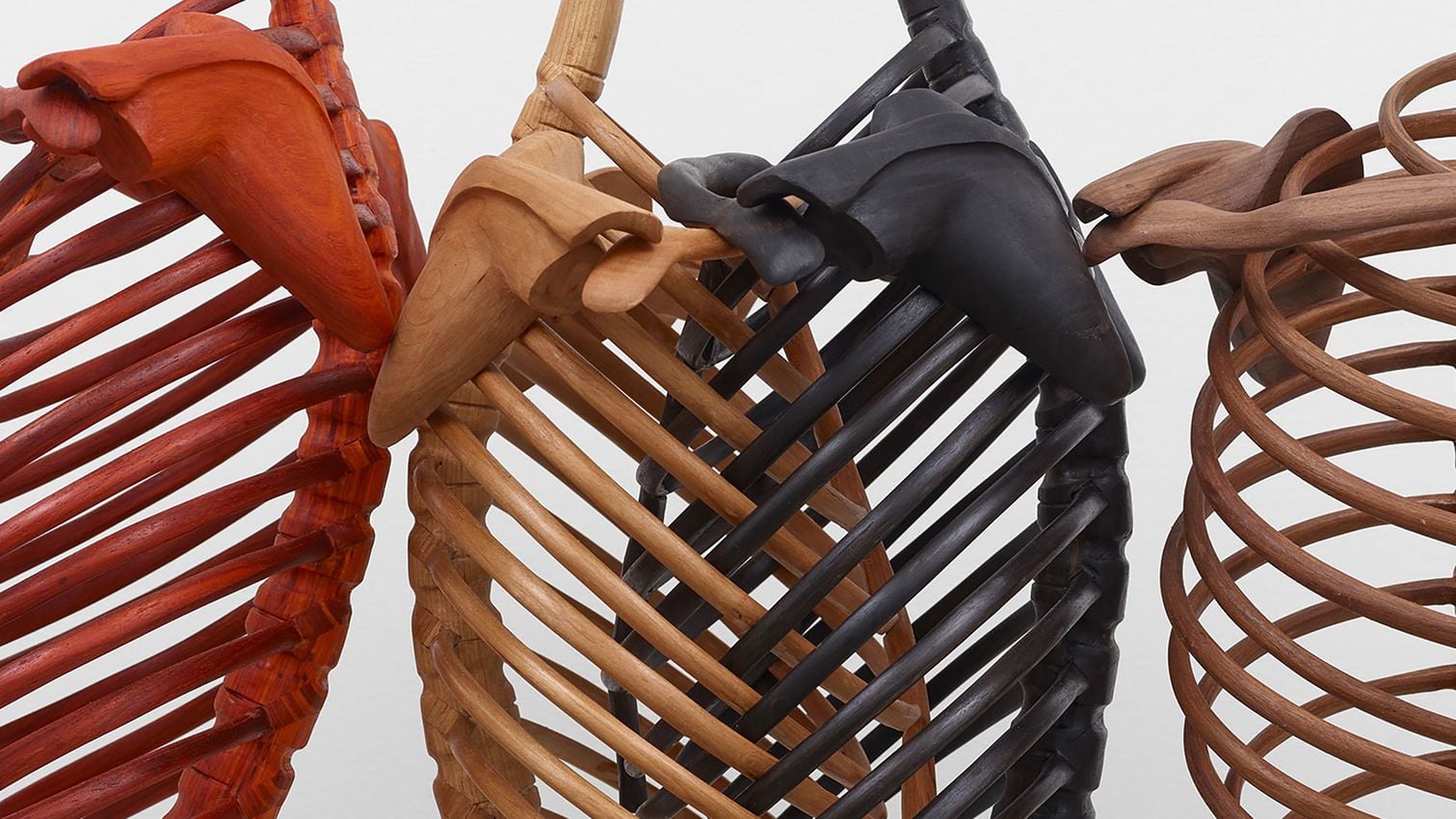
A dining table engulfed in flames, a lifeboat lined with thorns, a child’s dress fashioned from tree bark—these areamong the striking new works featured in Hughmanity, Hugh Hayden’s first return to London since his 2020debut with the gallery was abruptly closed just days after opening due to COVID-19 restrictions. Now staging hisseventh show with Lisson Gallery, the Texan-born artist expands upon his ongoing investigation of congregation,passage and assimilation through the transformation of familiar cultural symbols into allegories of community,rupture, and belief. These new works, meticulously crafted from trees through a series of techniques like felling,milling, carving, and laminating, extend Hayden’s sculptural language, while the introduction of painted surfacessignals a significant new expanding element within his practice.

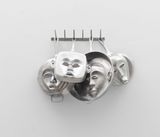
At the center of Hughmanity is The Last Supper (2025), a stretched table encircled by flames and renderedunreachable. Dining tables, he reminds us, are not only sites of joy and communion but also of fraught familygatherings, unspoken grief, or absence. The flames that rise from its surface also echo religious and art historicalprecedents, from Leonardo da Vinci’s composition of the same name to Ed Ruscha’s Burning Gas Station.Suspended nearby, 13 cast-bronze skillets embedded with African masks extends the allegory. First conceived as”melting pots” in his previous London exhibition, American Food, these diasporic skillets now embody Jesus andhis disciples. Their specialized forms and polished surfaces suggest both individuality, purpose and collectivity.Together, the fiery table and its floating counterpart form a pairing that questions the conditions under whichcommunion, whether spiritual, social or cultural, can occur.

Tension between refuge and danger shapes The Good Samaritan (2025), a dinghy lined with thorns carved fromChristmas-tree branches that point inward toward the boat’s center. Partially navigable with its two oars left clearof protrusions and a small smooth space remaining at its core, the boat hovers between promise and threat. Thevessel recalls Hayden’s earlier Gulf Stream (2022), inspired by Winslow Homer’s painting of a lone fishermanadrift at sea. Here, though, the narrative shifts toward an allegory of possible survival despite treacherousconditions.

Elsewhere, painted wooden flags punctured by cigarettes, pencils or fragment patriotic imagery into narratives ofanxiety, erasure, and defiance. One flag adorned with fifty wooden cigarettes in place of stars, presents a portraitof a nation under strain. Another, Gone with the Wind (2025), is studded with erasers seemingly caught in motion.In Medusa (2025), the fifty stars are replaced with carved and painted timber rattlesnakes, their writhing presencecasting the banner as both myth and menace. These works collapse the line between patriotism and critique,underscoring how a nation’s or a person’s identity can be rewritten through conflict, erasure, and resistance.

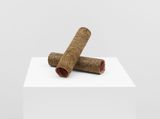
Nearby, a sharply tailored blazer lined with thorns recalls the traditions of English suiting and emphasizes howsuch markers of status can also torture. Other works, including Pinocchia (2025), a bark-covered child’s dresslayered with pink tulle, men’s dress shoes and a set of Mary Jane flats all encased in bark, highlight the tensionbetween blending in and being defined, or even being consumed, by the very structures that promise acceptance.

Taken together, these works lend Hughmanity a spiritual undertone that oscillates between Biblical allegory andcontemporary critique. As in earlier public projects—from Brier Patch (2022), a forest of branched school desksin Madison Square Park, to The End (2025), a skeletal form slowly dissolving into the New England woods—Hayden turns familiar forms into metaphors for entropy, exclusion, and renewal.

Courtesy Lisson Gallery.

Read More
About the Artist

Hugh Hayden’s practice considers the anthropomorphisation of the natural world as a visceral lens for exploring the human condition. Hayden transforms familiar objects through a process of selection, carving and juxtaposition to challenge our perceptions of ourselves, others and the environment. Raised in Texas and trained as an architect, his work arises from a deep connection to nature and its organic materials. Hayden utilizes wood as his primary medium, frequently loaded with multi-layered histories in their origin, including objects as varied as discarded trunks, rare indigenous timbers, Christmas trees or souvenir African sculptures. From these he saws, sculpts and sands the wood, often combining disparate species, creating new composite forms that also reflect their complex cultural backgrounds. Crafting metaphors for human existence and past experience, Hayden’s work questions the stasis of social dynamics and asks the viewer to examine their place within an ever-shifting ecosystem.

View Artist Profile

Also Exhibiting at Lisson Gallery

About the Gallery

Established in 1967 in London, Lisson Gallery is one of the most well-known galleries operating globally. Boasting an influential and continuing legacy, including playing a pivotal role in the careers of many pioneers of historically important art movements, the gallery works with some of the most significant contemporary artists today.

View Gallery Profile
Address
27 Bell Street
London
United Kingdom
Opening Hours
Tuesday – Saturday
11am – 6pm
(1)
London 27 Bell Street
Lisson Gallery
27 Bell Street, London, United Kingdom
+44 207 724 2739
http://www.lissongallery.com

Opening hours
Tuesday – Saturday
11am – 6pm
The art world in focus