


One and Some Chairs/Camouflages is an original exhibition showcasing works by visual artist Cildo Meireles, revisiting a series of projects conceived in the 1980s and 1990s.
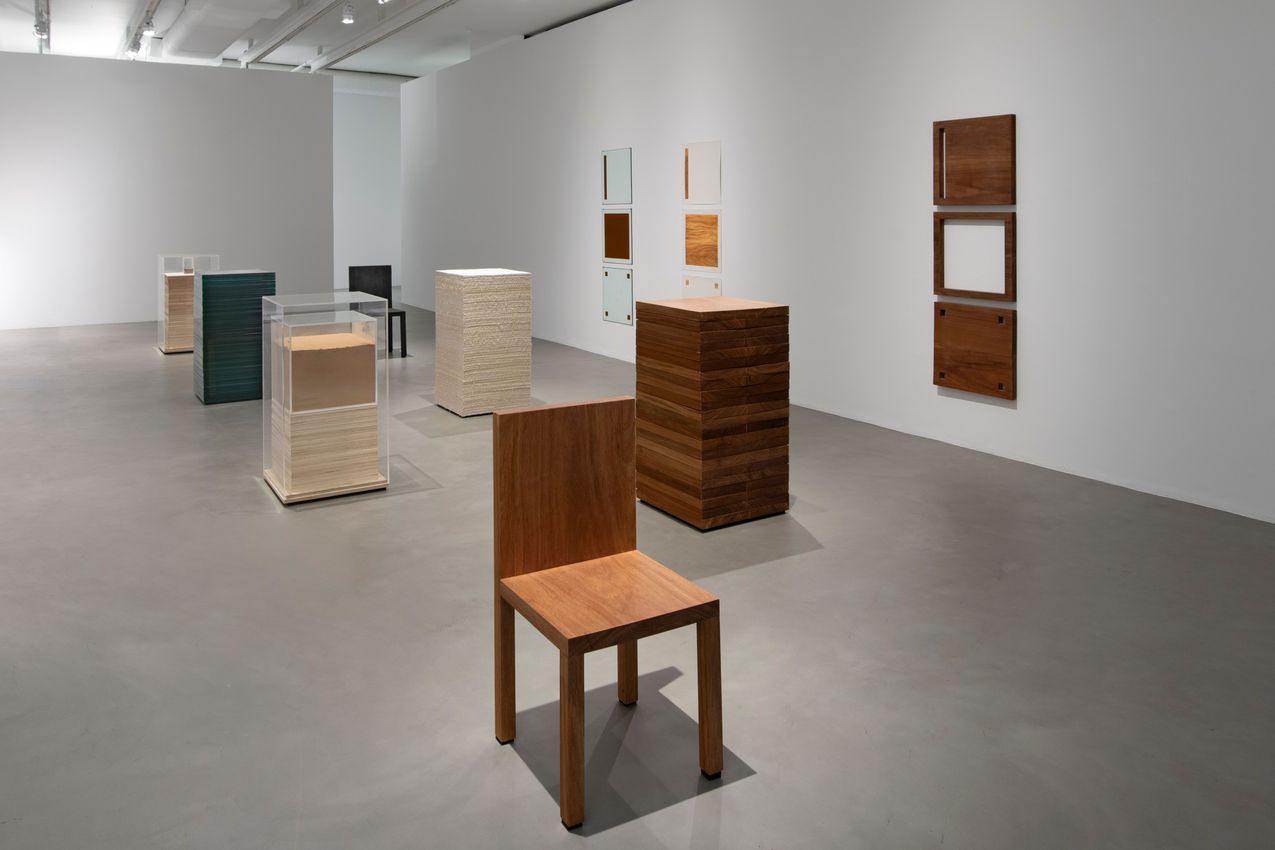
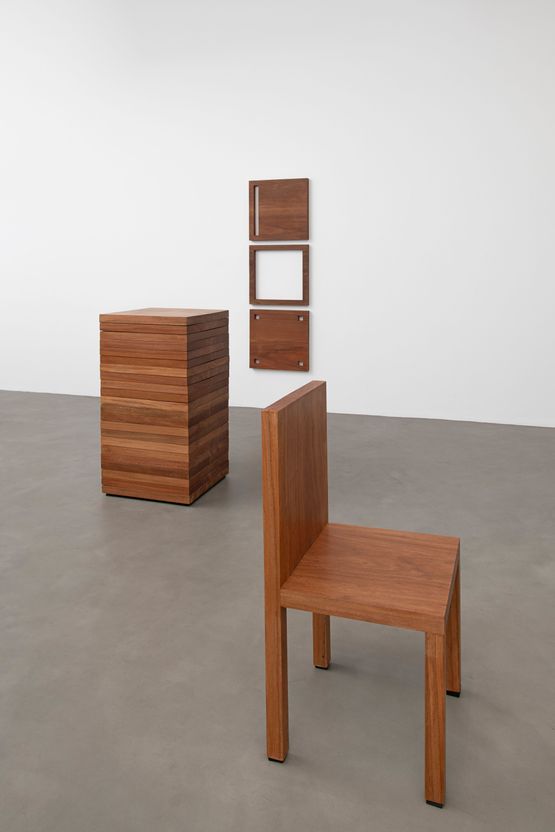
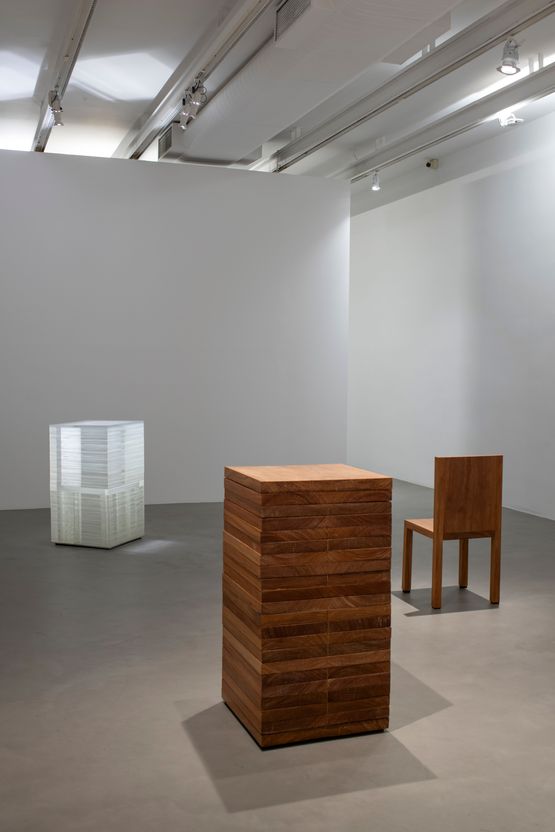
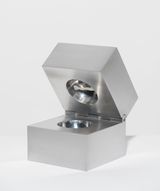
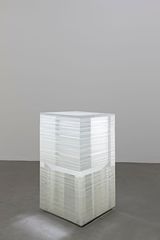
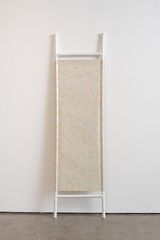
The installation One and Seven Chairs, a 1997 project first exhibited at the Lelong Gallery in New York, pays homage to fellow artist Joseph Kosuth. The installation comprises seven elements, using assorted materials and techniques. A solid wooden chair opens the installation, followed by six towers offering different interpretations of the same chair. One tower contains 110 glass sheets reflecting the image of a chair, while another, of identical shape, is made up of 1,100 canvases painted with acrylic, with the painting also alluding to the form of the chair.
Emptiness is a recurring theme, previously explored by the artist in works like Invisible Sphere and Disappearances. The exhibition includes an acrylic tower whose interior reveals the emptiness of the chair itself. “I’m interested in this evanescent thing, a kind of dissolution of the object. There’s a desire to play with the faculty of seeing through a sort of invisibility of invisibility. These works possess an almost semantic autonomy as objects. Invisible Sphere deals with an existence made up of non-existences,” Cildo explains.
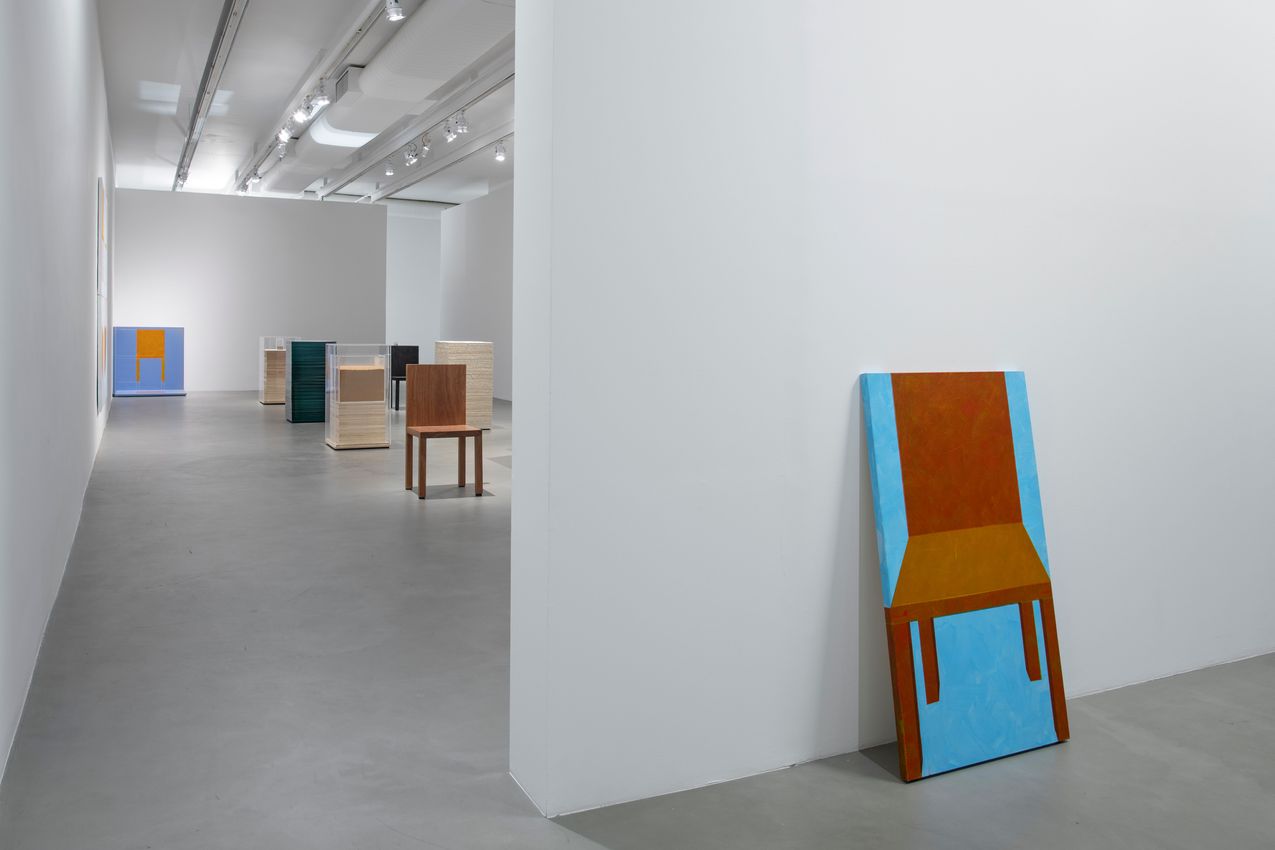
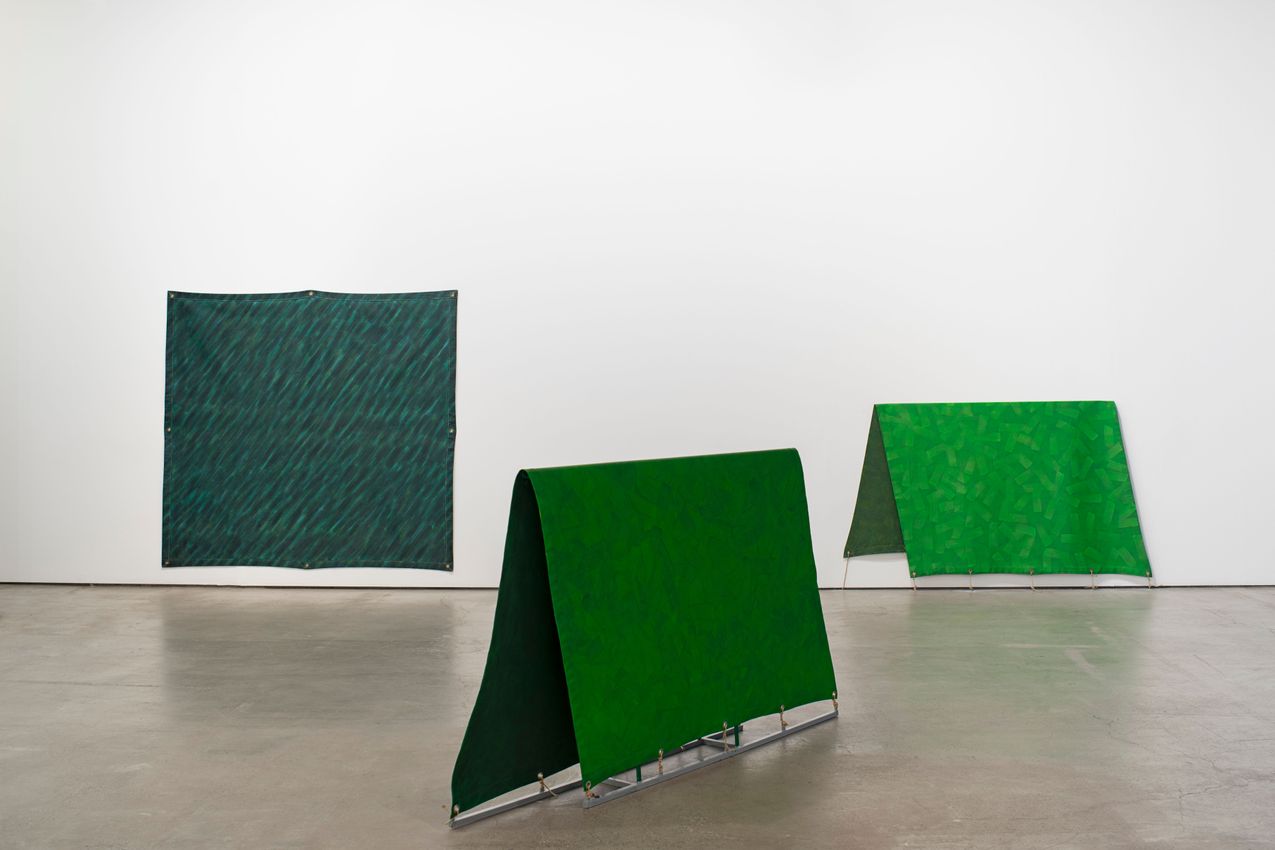
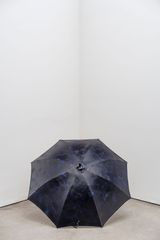
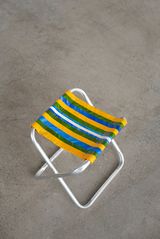
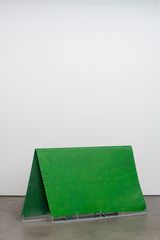
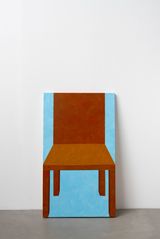
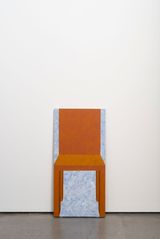
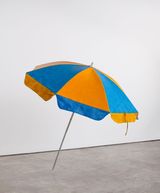
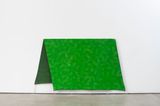
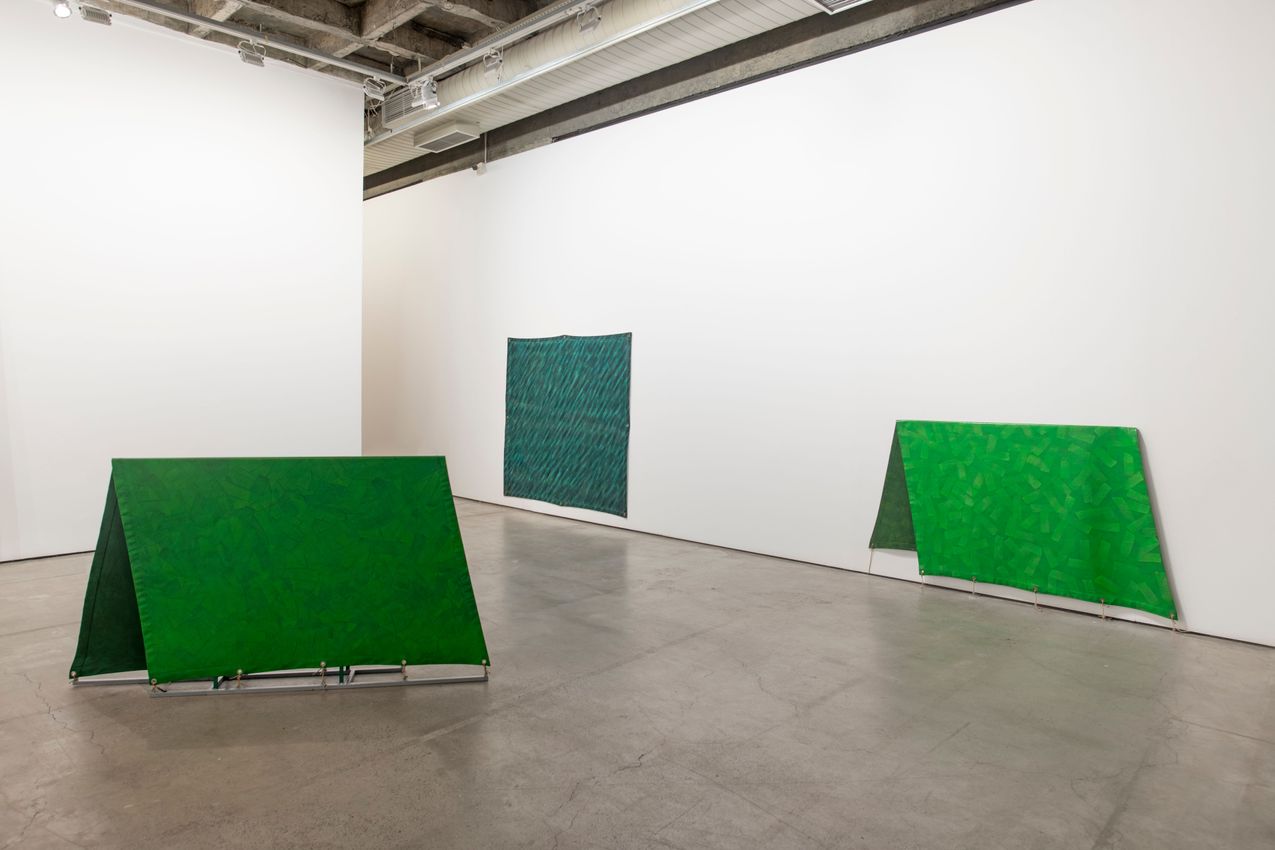
Cildo Meireles will also present in this exhibition a series of paintings on various supports, mostly unpublished: ”Camouflage is a project predating the One and Seven Chairs installation, now being completed 36 years later. These are essentially paintings on different frames, which reference functionality. Camouflaged paintings on benches, chairs, umbrellas, common objects for daily use —always involving an object that consists of fabric and structure.”
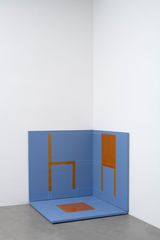
Among the paintings in the Camouflage series, the chair reappears, alongside a bench, a parasol, an umbrella, a stretcher, and tents—one of them resting on a metal structure on the floor. The artist adds: “This part of the exhibition, which I call Camouflage, could have another name, namely floor painting, because all the works are resting on the floor.”
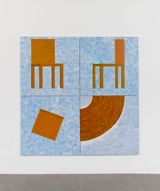
The artist also exhibits a series of hyperrealistic paintings—two-dimensional geometric representations of three-dimensional shapes. White brushstrokes on blue compose the Épuras, also placed on the floor. Two épuras accompanied by two studies of chairs convey Cildo Meireles’ artistic thinking, connecting painting with mathematical rationality. Here, the artist uses descriptive geometry as the artwork’s constitutive tool, employing two perpendicular planes where two views of the object are represented—one from the front and the other from above. These paintings portray views from frontal and horizontal projection planes, along with an intersection that makes up the épura.
One and Some Chairs/Camouflages began production in 2020 and includes 13 works in which Cildo returns to painting, paying homage to his great masters, including the Brazilian artist Alfredo Volpi.
— Text by Diego Matos
Curatorial Text:
One and some chairs/ Camouflages
The Juggler is a synthesis of the concept of territory. It is someone who manages three objects in a space meant for only two. In this case, the concept of time must be introduced. In truth, the juggler is the one who finds a place within time.
- Cildo Meireles
Before we delve into the details of this exhibition of new works by Cildo Meireles (Rio de Janeiro, 1948), I invite you to reflect on some aspects that are key to the conceptual and poetic understanding of the artist: first, to keep in mind that not everything we see is what it truly is. In other words, we must reject the lasting dominance of vision. Secondly, we must embrace the ongoing challenge of subverting language—both in terms of signs and codes, as well as the materiality of objects. And thirdly, to recognize that art is, ultimately, a derivative of the space-time experiences we live through daily. Finally, all of this comes together through the power and persistence of memory, which Meireles considers to be our most precious resource.
Moreover, still on the subject of time measuring, it is important to consider it as a more elastic element, moving vertiginously between what is immediate and imperative and what decants over long periods. It is in this decanting process that functional rationality itself begins to melt away, creating openings for more lateral thinking, something that seems to persist, even in the face of a common current or path. It is, more often than not, a long period of decantation of an idea that, as the artist would say, “crossed our minds,” but will only flow out in a time over which we have no control.
The artworks aren’t about providing immediate solutions, and the same goes for all the pieces in his new exhibition Uma e algumas cadeiras/ Camuflagens [One and some chairs / Camouflages]. If you take a close look, you’ll see that decades separate the first spark of an idea from its formal and material realization. Perhaps that’s why, when stepping into Cildo Meireles’ world, you find this ongoing journey of exploring memory, archives, and conversations with others. His studio itself is a reflection of this. Nothing sums it up better than the famous statement he made in a 1977 interview with his friend and critic Frederico Morais: “The artist, like the prospector, lives by searching for what he hasn’t lost.” There’s always an act of searching behind every work. Right now, for example, the “chair” as an object and “painting” as a medium are the latest subjects to be dug into, explored, and subverted.
Another aspect that deserves our attention when discussing the contingency of time is the fact that the artist has a contextual and historical awareness that eloquently permeates his works. This is reflected in both the title of the work (title and date) and the materiality he proposes. It is not about illustrating key issues in art history or even the scientific reasoning of humanity, but rather appropriating certain meanings explored by artists and scientists and, in a bold manner, subverting them.
Thus, this exhibition of previously unseen works presents a set of initiatives that highlight one of the many divergent paths in his already unmissable trajectory: the subversion of the most ordinary objects of our daily lives, subjecting them to a restructuring of their signs, both in linguistic terms and in the objects themselves. It is as if the artist is creating his own grammar of objects. Just as his thousands of drawings produced over the years provide us with a dreamlike grammar of the artist, the drawing dissects the object-based language shaped by human rationality.
At the same time, he updates one of the earliest discussions brought forth by contemporary art debate: the concept, idea, and materiality of the Readymade, proposed by Duchamp over a century ago. With astuteness and an awareness of his historical affiliation, Cildo Meireles evokes in this exhibition the importance of two artists who have influenced his work over more than six decades: Marcel Duchamp (1887–1968) and Piero Manzoni (1933–1963), both of whom have been honored in his career.
Together, this brings the omnipresence of painting closer to the context of art history and, indirectly, cites and honors artists who were fundamental not only to the lexicon of art but also to his own trajectory. One need only observe the titles of the pieces arranged throughout the gallery space and immediately correlate them with the pictorial influence that is evident in each object: Kazimir Malevich, Jasper Johns, and Alfredo Volpi.
Ultimately, something that provides unity to the various works, seemingly divided between the derivatives of the chair and the pictorial camouflage, is the emphasis on the idea that the artist is always playing with vision, leading us to be deceived by the primacy of sight. The allure of the work lies precisely in the confusion that arises between the notion of artwork and that of ordinary objects, those trivial elements of everyday life. These are objects we recognize through their signs, both in conceptual terms and in their phonological form, but which have become dysfunctional, useless—in other words, devoid of any utilitarian meaning.
The operation of extraction or object destitution by the artist occurs in two ways: first, it completely removes the functionality of the object, and then, so to speak, it camouflages its surfaces as entities of painting. Moreover, in the case of the chair, there is a dive into the sign (meaning and signifier) and its representation, a kind of investigation that pays homage to the practices and theoretical incursions of the American artist Joseph Kosuth, known for his work Uma e três cadeiras [One and
three chairs] (1965). More than merely borrowing a literal reference from the title, Cildo initiates a circuit of irony by shifting the thought toward a set of Uma e sete cadeiras [One and seven chairs], an installation project dating back to 1987.
***
The artist’s operation consists of making an incursion, a true raid, on certain series —such as the relationship between use value and exchange value of commodities, geographical boundaries, the history of art, and history itself—and operating an inversion within these contexts. In other words, it involves rereading as interpretation the meaning that is given as natural and, from there, subverting it—this is his way of interpreting it.
It is auspicious to consider that it was during the 1980s that Cildo Meireles presented a foundational set of his Artigos definidos [Defined articles] e Objetos semânticos [Semantic objects] at Galeria Luisa Strina, sculptures that raised questions very similar to those of his current camouflage works. Today, nearly four decades later, the artist brings to the present one of the loose threads of his conceptual and formal thought, presenting a series of new works that collectively resonate with the coherence of his political-aesthetic practice.
Here, as in the exhibition of 1983 (or even in his exhibition of Artigos denifidos and Cantos [Corners] at Galeria Luisa Strina in 1981), the artist employs reason to establish a chain of conceptual relationships that expose paradoxes, ironies, and contradictions: it is an ongoing game between title and work, between one work and another, and between title and the history of art; this continues cyclically, moving through infinity. As the writer João Moura Jr. precisely defined in his essay Metamorfose do círculo [Metamorphosis of the circle], Cildo Meireles is capable of promoting “a true raid.”
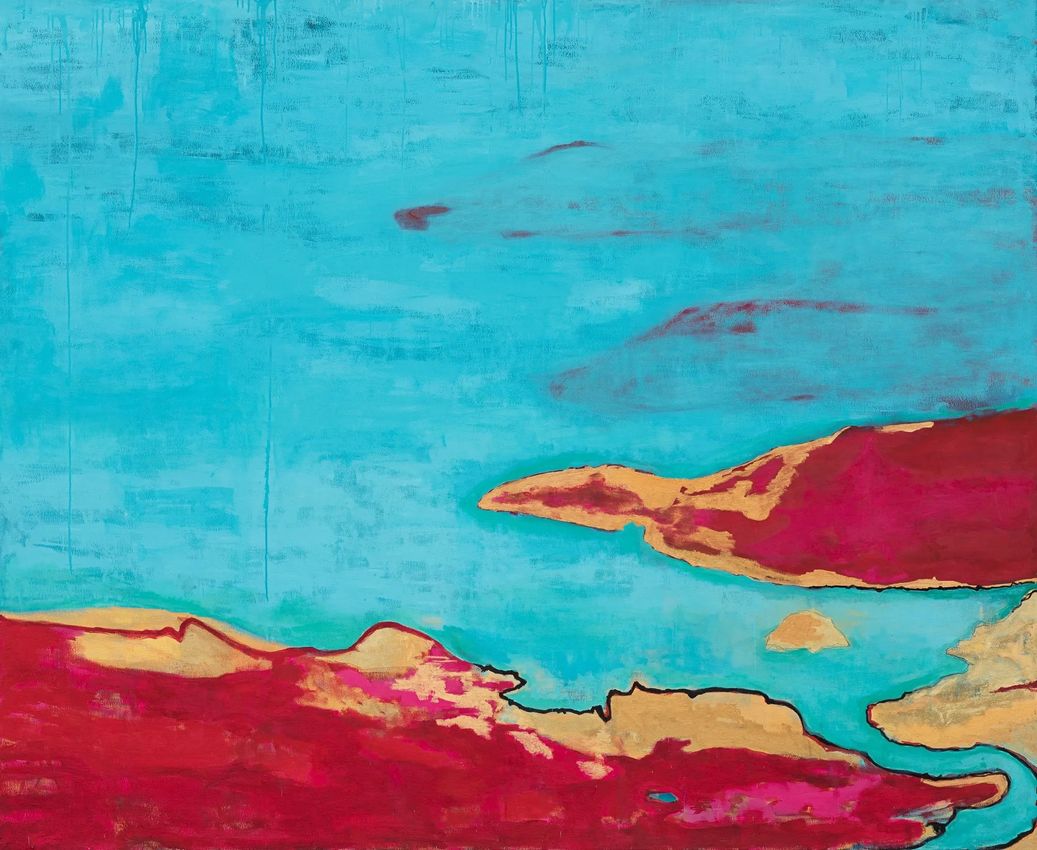
Thus, what has been stated above takes on a sense of urgency as we navigate the spaces of the gallery interspersed with the artist’s objects. It is this continuous movement that seems to lean toward disappearance, which provides an inevitable and coherent unity to the work: one refers to another, which refers to yet another; thus, the circumference expands, a movement that appears endless. In this insistence on a movement that leads toward infinity, one may eventually encounter emptiness. In fact, the notion of emptiness is also a recurring theme in this exhibition and in past practices. As the artist himself has told us, there is an objective relationship between revealing and obliterating certain things in the installation Uma e sete cadeiras [One and seven chairs]. This suggestive play is also present in works like Desaparecimentos Disappearings and Esfera invisível Invisible sphere. On the other hand, the Camuflagens [Camouflages] lead me to a historic work in his trajectory that functioned as a statement of an idea: Pastel de pastéis Pastel of pastels. In this work, a painting made with pastel on paper is contained within an object made of tracing paper shaped like an edible pastel. This work, in turn, is part of the series Objetos semânticos.
In understanding the work Uma e sete cadeiras [One and seven chairs], it is important to observe the exercise of accumulating materials produced in each structure, emulating the sign of the chair. These small towers of Babel accumulate painted canvases with acrylic, etched glass sheets, among other materials. From one to another, there is always a disposition to reveal or empty. Collectively, they all, with their respective two-dimensional reflections, provide a circular reading of the object and the material chair. Immediately, upon encountering this work, I was reminded of one of his earliest initiatives based on classical sculpture: Árvore do dinheiro Money tree. This work features one hundred one-cruzeiro bills folded and held together by crossed rubber bands. Additionally, the work includes the text, “Title: 100 one-cruzeiro notes. Price: 2,000 cruzeiros.” We could now discuss the theme of value and diverge into another path of the artist’s propositional adventure.
No less important, the exhibition comprises two sets of paintings that reproduce the technical-scientific resource of the Épuras Epures, through which some geometrized entity is reproduced on a plane using orthogonal projections. However, the artist subverts the use of the plane by positioning it on the floor or in the two-dimensional corner of the wall. Here, as in so many other works, our eyes are once again drawn to the mystery of corners. It should be noted that throughout his career, the artist has maintained a fascination with Euclidean geometry and the practice of descriptive geometry: for him, this represents a potential poetic encounter between art, mathematics, and philosophy.
The art of Cildo Meireles is the permanent proposition of instant enigmas, a kind of tautological question that momentarily disrupts our primary senses, also calling upon our perceptual capacity through experience and repertoire. The very idea of tautology is presented when we observe the apparent repetitions in the physiology of a chair or even in the rhetorical and material gesture of constructing the camouflage works. Just like the juggler, the artist is always finding a possible existence for a new entity where only two would actually fit. Therein lies the juggler.
Diego Matos, September 2024.


The history of the oldest contemporary art gallery in São Paulo, Luisa Strina, is mixed with the professional career path of Luisa Strina herself. In 1970 Luisa began as an art marchant for friends and artists such as Wesley Duke Lee, Fajardo, Baravelli, Jose Resende and Babinski. In 1974 she opened Galeria Luisa Strina at Baravelli´s old studio with a well defined strategy: to show the work of national and international artists, both here in Brazil and abroad.

A respected voice in contemporary art discourse.
Focusing on ambitious storytelling and insightful art-world commentary. Ocula Magazine publishes in-depth interviews, critical essays and timely analysis on the artists, exhibitions and ideas driving the global art world.
Learn more about Ocula Magazine
Showcasing the best of the art world.
Ocula partners with galleries from around the world to highlight their artists, artworks and exhibitions. Gallery membership is by application and invitation, with each member vetted by an independent panel.
Learn more about Ocula Membership

Specialises in the sale of major artworks.
Led by a team with deep ties to the world’s leading auction houses, galleries and collectors. Ocula’s advisory team offers bespoke services to high-net-worth clients from around the world who are looking to acquire the best of contemporary and modern art.
Learn more about our team and services