
Press Release

Marguo is pleased to present (Nice Dream), Alexandre Yang’s debut solo exhibition in Paris, opening 17 September 2026. Borrowing its title from the 1990s Radiohead song, the exhibition conjures a fantasy in which the protagonist dreams themselves at the centre of their loved ones’ lives, cherished and adored, yet remains, in reality, isolated in a reverie from which they never wake.

Working in the language of auto-fiction, Yang stages his personal history and intimate dramas in meticulous paintings set within medievalised worlds, threaded with references to the art of the Middle Ages and the Renaissance in addition to the role-playing games, video games, and television series he holds dear. His detail and texture are rendered with painstaking precision, yet the landscapes and architectures they describe are deliberately skewed and warped, populated by curious figures of strange proportion, more vulnerable than heroic, each an avatar of the artist and those close to him.

Across the works in (Nice Dream), Yang reimagines the mediaeval epic. In place of heroic feats of knights and noblemen, the artist offers a tender, introspective narrative in which solitude takes centre stage. Following the loss of his father, Yang felt compelled to return to his hometown and care for his mother, retreating into a near-monastic existence. From this seclusion emerged a language dense with metaphor and imagery, one that extends even to the carved wood that frames and completes his compositions.

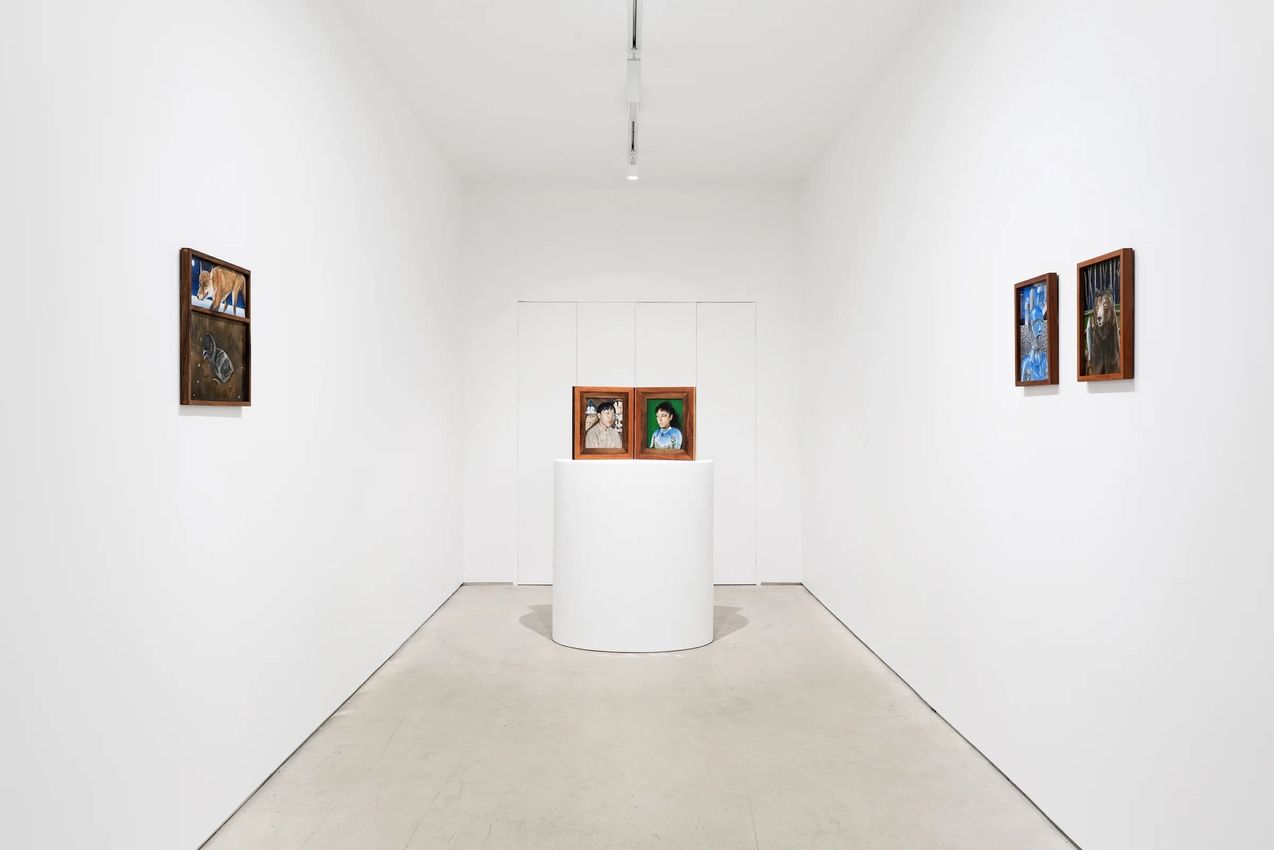
The works gathered here reflect a state of suspension and latency. Seeking to reclaim agency over a life that seems to have slipped beyond his control, Yang retreats into an imaginary world of his own making. Le Dernier moment avant la fin du Monde (The Last moment before the end of The World) portrays him as a puppet, his own features faintly surfacing, absorbed in a game of Dungeons & Dragons, the role-playing game that sets the fiction of the surrounding paintings in motion. Echoing the composition of Flemish painter Robert Campin’s Annunciation Triptych (c. 1427–1432, held at the Metropolitan Museum, New York), the painting foreshadows the tormented bodies and postures that recur throughout the series.

In a landscape steeped in lethargy, where winter seems to stretch on forever, the self-portrait Les Fantômes (The Ghosts) depicts a knight the artist invented and embodied in a game of Dungeons & Dragons. Flanked by the spectres of the hen and chicks he once raised, he appears languid and passive in gleaming armour, far from the valiant, proud, and virile figure the knight has traditionally embodied.

His partner Shiraz, from whom he was separated during this period, is the central figure of the heroic composition Le Lion et Le Léopard. Like an avenging force, she bears down upon an allegory of conformism: a grotesque lion stripped of any royal bearing. While the painting draws on Bartolomé Bermejo’s Saint Michael Triumphs over the Devil (1468, National Gallery, London), it also nods to pop culture, the fictional heraldry on her shield borrowed from Duncan in A Knight of the Seven Kingdoms, the Game of Thrones prequel. Duncan, who struggles to be recognised as a knight, invents his own coat of arms from scratch, knowing nothing of heraldic code and tradition. Through his story, Shiraz’s own fight to free herself from convention quietly surfaces. The mediaeval aesthetic becomes a setting, a vessel for exploring deeply contemporary concerns, or simply timeless ones.

Placed in dialogue, these two paintings describe an artist at a standstill, held captive by a fate he did not choose, while his partner grows in autonomy and strength within a world set against her. Overturning the gender conventions of the fairy tale, Shiraz becomes the heroine who wakes the knight from his torpor, releasing him from an endless wait as the snows finally melt.

In oneiric, mannerist works that stand as a metaphor for the search for self, Yang gives form to the events he lives through and the people he holds dear. They lay bare the fantasies and imagined mediaeval world into which he has withdrawn, a way of confronting the intimacy of grief and the powerlessness to alter life’s course. In these, Yang touches on something universal, the passages of loss and acceptance that each person comes to know in time.

Text by Camille Minh-Lan Gouin, translated from the French by Marguo.

Courtesy Marguo.

Read More

Installation Views

About the Gallery

Founded in late 2020 by art world veterans Vanessa Guo and Jean-Mathieu Martini, Marguo is a Paris-based contemporary art gallery nestled in the Marais, dedicated to championing emerging and early-career artists from around the globe. Drawing inspiration from the founders’ rich cultural heritages and global perspectives, Marguo bridges Eastern and Western artistic sensibilities, amplifying voices often sidelined by mainstream institutions. Embracing a spirit of hybridity, Marguo weaves together local, international, and digital narratives, reflecting an unwavering conviction that art and life are intricately entwined. At its heart lies a dynamic exhibition program—strengthened by participation in major art fairs and bold off-site initiatives—that propels its mission forward. This vision is enriched by complementary endeavors: Casa Marguo, an artist residency and salon set within a historic townhouse on the Balearic island of Menorca; Marguo Books, a platform for editorial projects; and Bar Saka, an artisanal mixology bar adjacent to the gallery in the Marais (launched in 2024), reimagining the fusion of art and hospitality.

View Gallery Profile
Address
4 rue des Minimes
Paris
France
Opening Hours
Tuesday – Friday,
10am – 6pm
Saturday
1 – 6pm
(1)
Paris 4 rue des Minimes
Marguo
4 rue des Minimes, Paris, France
+33 7 66 76 18 98
https://www.marguo.com/

Opening hours
Tuesday – Friday,
10am – 6pm
Saturday
1 – 6pm
The art world in focus