



The art world in focus
Subscribe to our newsletter for news and insights on artists, galleries and exhibitions.

Gagosian sold all six of its colourful abstracts by Albert Oehlen. Gagosian booth, Frieze London 2026. Photo: Linda Nylind. Courtesy Frieze
What does the art market want in 2026? If you asked the mega-galleries exhibiting at Frieze London this week, the answer might be: big colourful, abstract paintings. Ideally ones with some sort of advertised connection to art history.
On the fair’s preview day, Gagosian sold all six of its colourful abstracts by Albert Oehlen, a continuation of a long series remixing motifs borrowed from American modernist painter John D Graham. Each carried an (undisclosed) asking price of around €1.2 million.
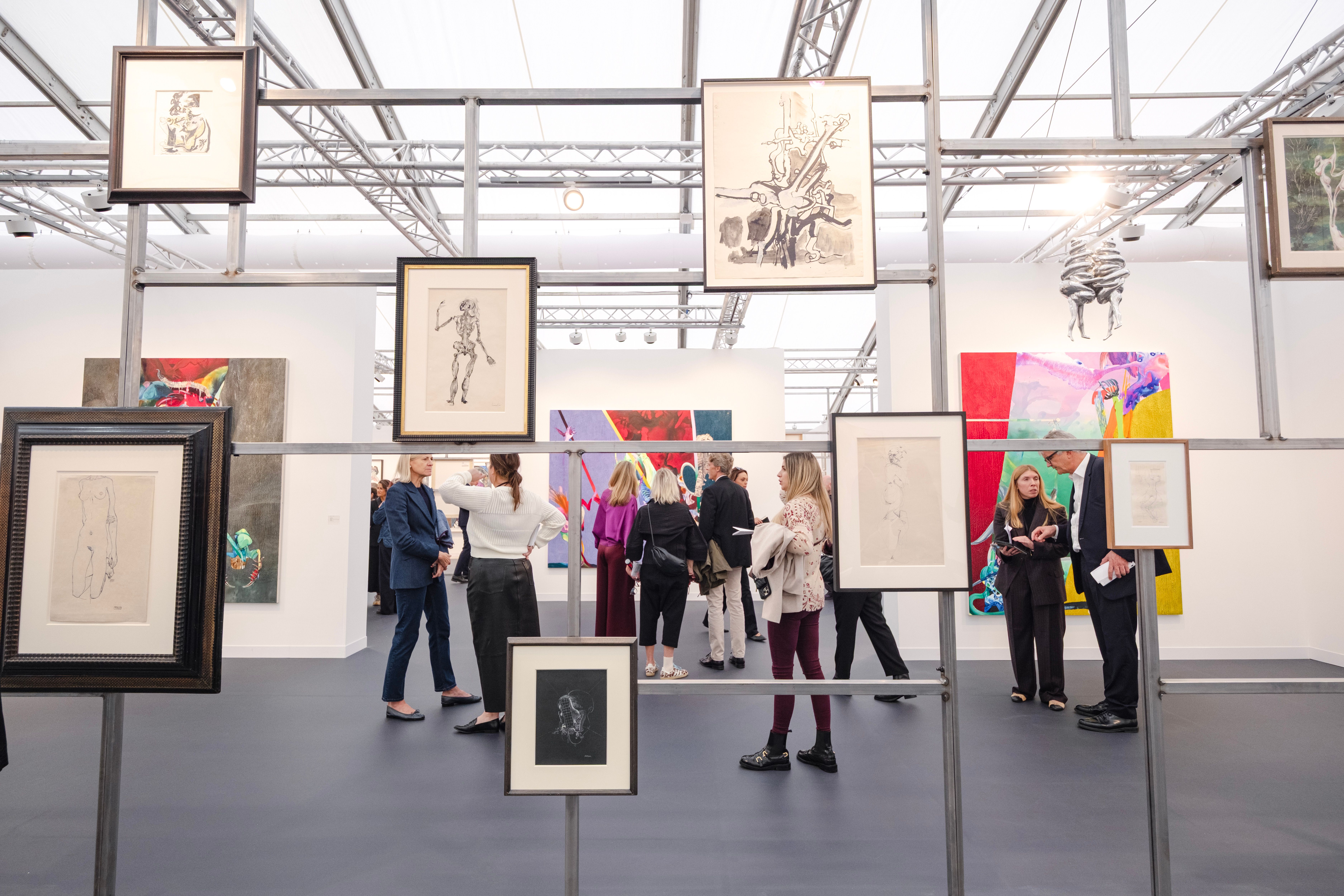
White Cube, meanwhile, sold five vibrant acrylic, oil and beeswax paintings by Ilana Savdie ranging from $110,000–$175,000, as well as three works on paper priced at $20,000–$35,000. All are displayed at a booth scaffolded with historic works by artists who have similarly explored “the psychological and material boundaries of the body”, including works on paper by John Banting, Marlene Dumas and Leonor Fini, which the gallery also sold.
“I think there is a deep connection between the contemporary and historic now,” Zoe Sperling, partner and senior director at Hauser & Wirth, told Ocula. “Collectors who have been buying more historic works are looking at what the response is within contemporary, maybe younger artists, and—vice versa—a younger generation of collectors who had been looking at their generation are thinking about how to contextualise that with the masters.”
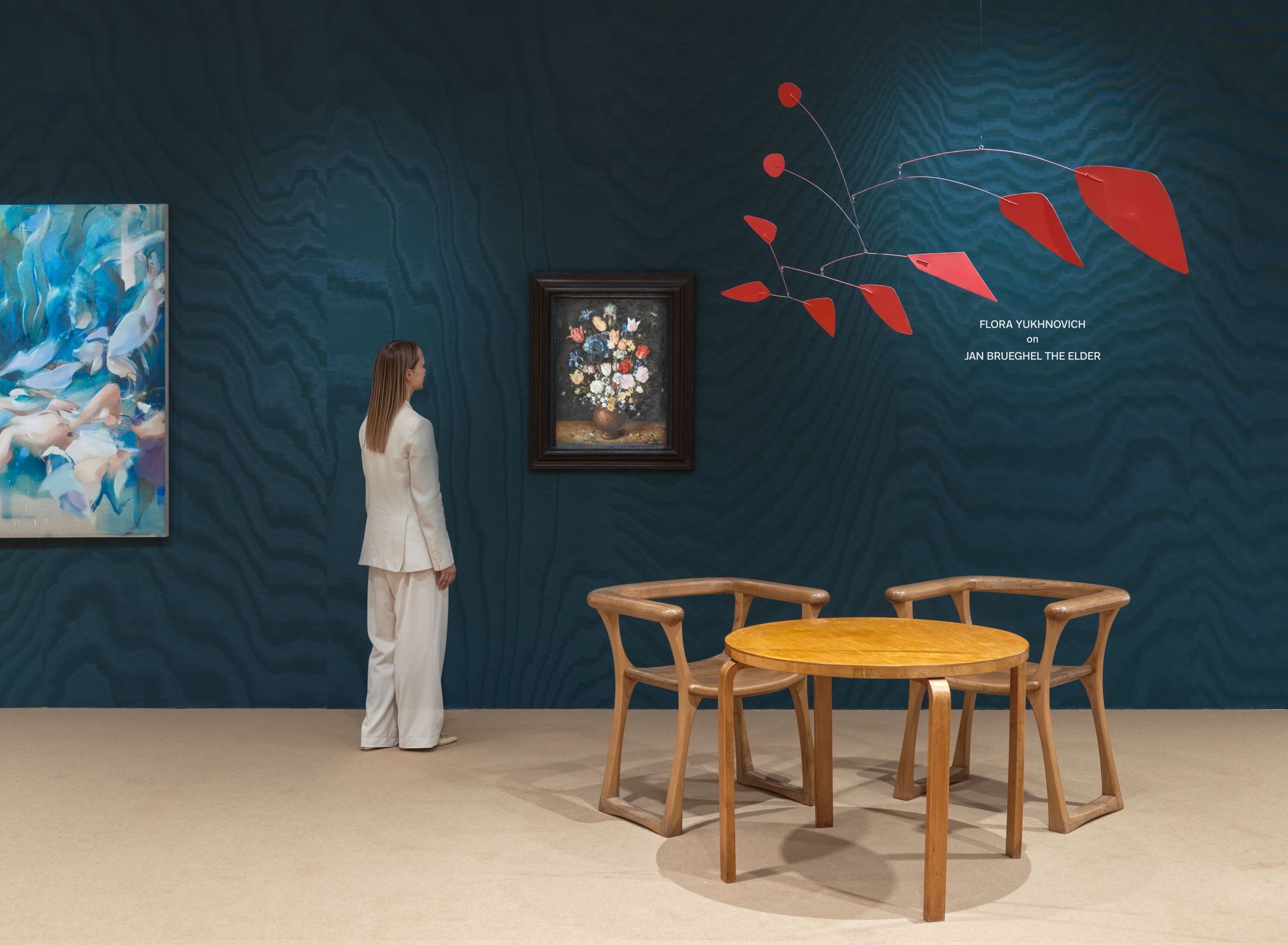
Indicating perhaps that there is currently more value in converting collectors in one of these directions, the gallery’s head honchos, Iwan Wirth and Marc Payot, unusually spent the first part of the day in the Frieze Masters tent. There, the gallery showed a floral still life by Jan Brueghel the Elder, Still Life of Flowers in a Stoneware Vase (1607–1608) next to a new (yes, colourful, abstract) painting, Perfume (2026) by Flora Yukhnovich. The decision paid off with an around £5 million agreement on the Brueghel masterpiece by day’s end, notching up the fair’s headline sale.
The “colourful abstract” theme partially continued at Pace, which reported selling “nearly every” one of its $250,000 meditative abstractions by Marina Perez Simão. References to art history also abounded among star contemporary figurative painters elsewhere, with a European museum purchasing Exit (2025–2026), Sasha Gordon’s surreal bathhouse scene, with a stretched perspective referencing Hans Holbein, from David Zwirner for $400,000. Other first-day sales highlights included contemporary interpretations of early modern British landscape paintings by Sholto Blisset, Rachel Rose and Georg Wilson at Pilar Corrias.
The global art market is slowly rebounding after four years of decline, with its recovery led by the secondary market, while primary galleries are still visibly struggling across the price spectrum, from Pace Gallery’s 50 percent contraction in June to, most recently, the closure of 15-year-old Brussels gallery Super Dakota last week.
Still, buying activity at Frieze London was encouraging, with advisors and dealers on the ground confirming sales throughout the day. “Collectors are more price-sensitive, better informed and increasingly considered in what they buy,” advisor Lucy-Anne Garnett told Ocula. Assisted by greater access to market information from various data technology platforms, they “increasingly want to understand whether an artwork genuinely represents value, rather than simply accepting the asking price”. Garnett added that this is particularly true in the primary market, where there are fewer secondary-market data points to compare.
A key question heading into the fair was whether collectors would even show up, especially with the more glamorous Art Basel Paris on the agenda for next week. “My time-poor clients are becoming much more selective about which fairs they attend and how long they spend at them—often no more than a few hours,” Garnett confirmed.
Dealer James Cope put it more bluntly. “Collectors aren’t going to fairs anymore. They are sending their advisor, or buying off a preview the week before.” Cope is bringing his own boutique alternative fair, The Invitational, to a fancy hotel on Grosvenor Square this week, to test the allure of a more luxurious experience than is offered by the big white tent in Regent’s Park.
But turn up, collectors did. Greek collector Irene Panagopoulos, a member of Tate’s International Council who is showing works from her collection at the nearby Hellenic Centre, said that while she has been going to fewer fairs since the Covid-19 pandemic, Frieze remains one of her “favourites”.
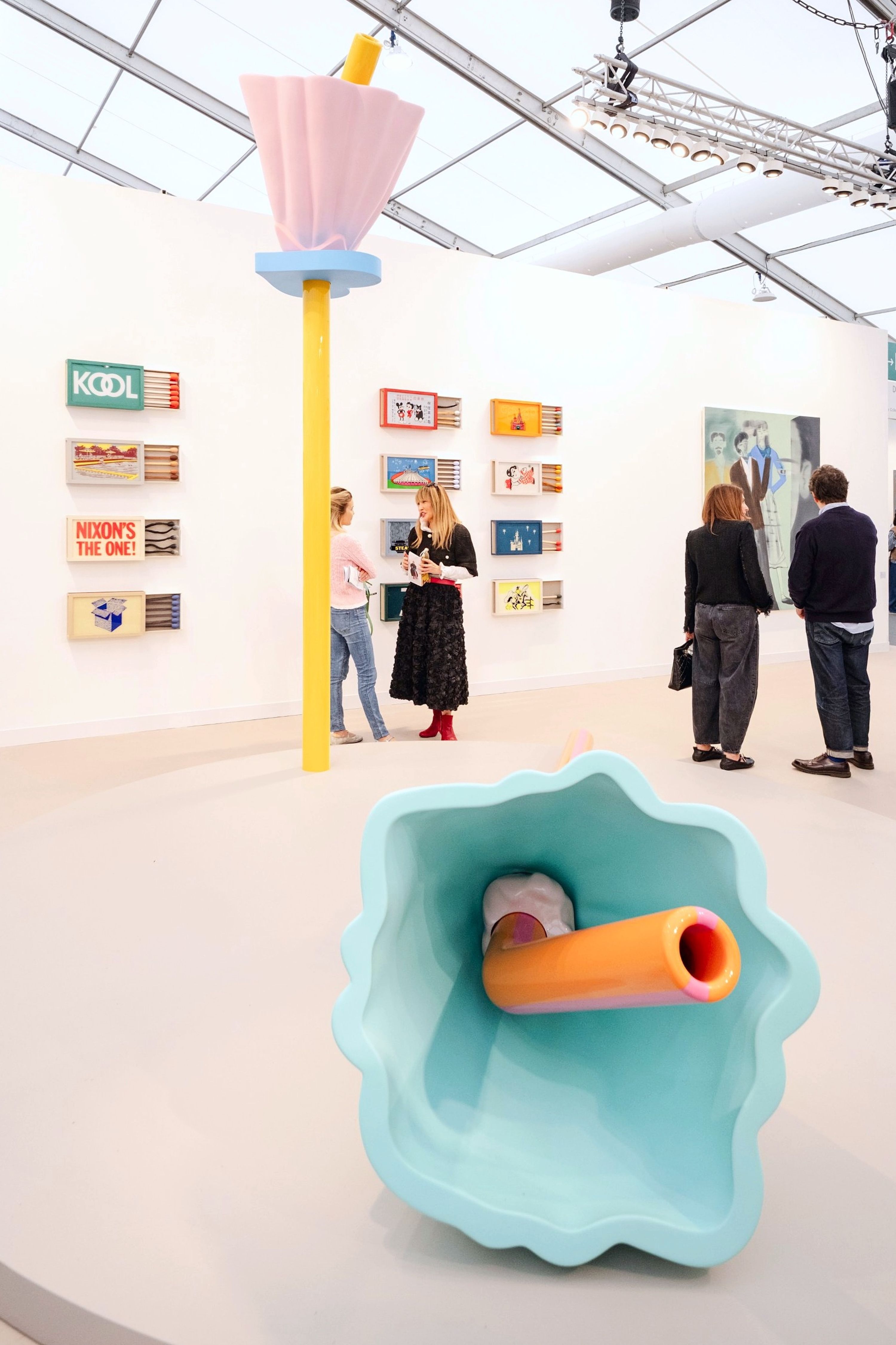
Ocula spotted local heavyweights Paul Ettlinger, Valeria Napoleone, and Olga and Eugenio Re Rebaudengo—who were radiating with the afterglow of a purchase from Sadie Coles HQ—and international visitors including the New York-based Tiffany Zabludowicz, and Swiss billionaire Maja Hoffmann. Underscoring the point, Frieze circulated a list of nearly 100 collectors in attendance with the press at the end of the day.
Oliver Evans, senior director and partner at Maureen Paley, told Ocula he was meeting new collectors and was “happily surprised” to see clients from New York and Los Angeles that he had not expected to encounter. Evans was actively conducting business from a busy booth and by mid-way through the fair had sold work ranging from a painting by rising star artist Mary Stephenson (if you have to ask, yes, it was colourfully abstract) as well as a piece by Wolfgang Tillmans, among others.
A recurring point of discussion throughout the day was the recently published Art Basel and UBS Survey of Global Collecting, which found Gen-Z to be emerging as a collecting force among high-net-worth spenders. The finding was confirmed by dealers at the top end of the market (Hauser & Wirth) and the emerging sector (Harlesden High Street), but others suggested this activity is not a universal experience, particularly in the established middle market. “Send them our way!” Evans joked.
Regardless, the middle segment, where the majority of galleries sit, was performing, with a slim majority of reported first-day sales under £50,000 and most of the rest falling between £50,000 and £250,000. These included a woven screen by Rachel Mica Weiss for $22,000 at Frieze London first-timers Carvalho, and a standout installation by Ella Fleck from Los Angeles gallery Ehrlich Steinberg. The latter received the Camden Art Centre Emerging Artist Award, which comes with a solo show at the London institution.
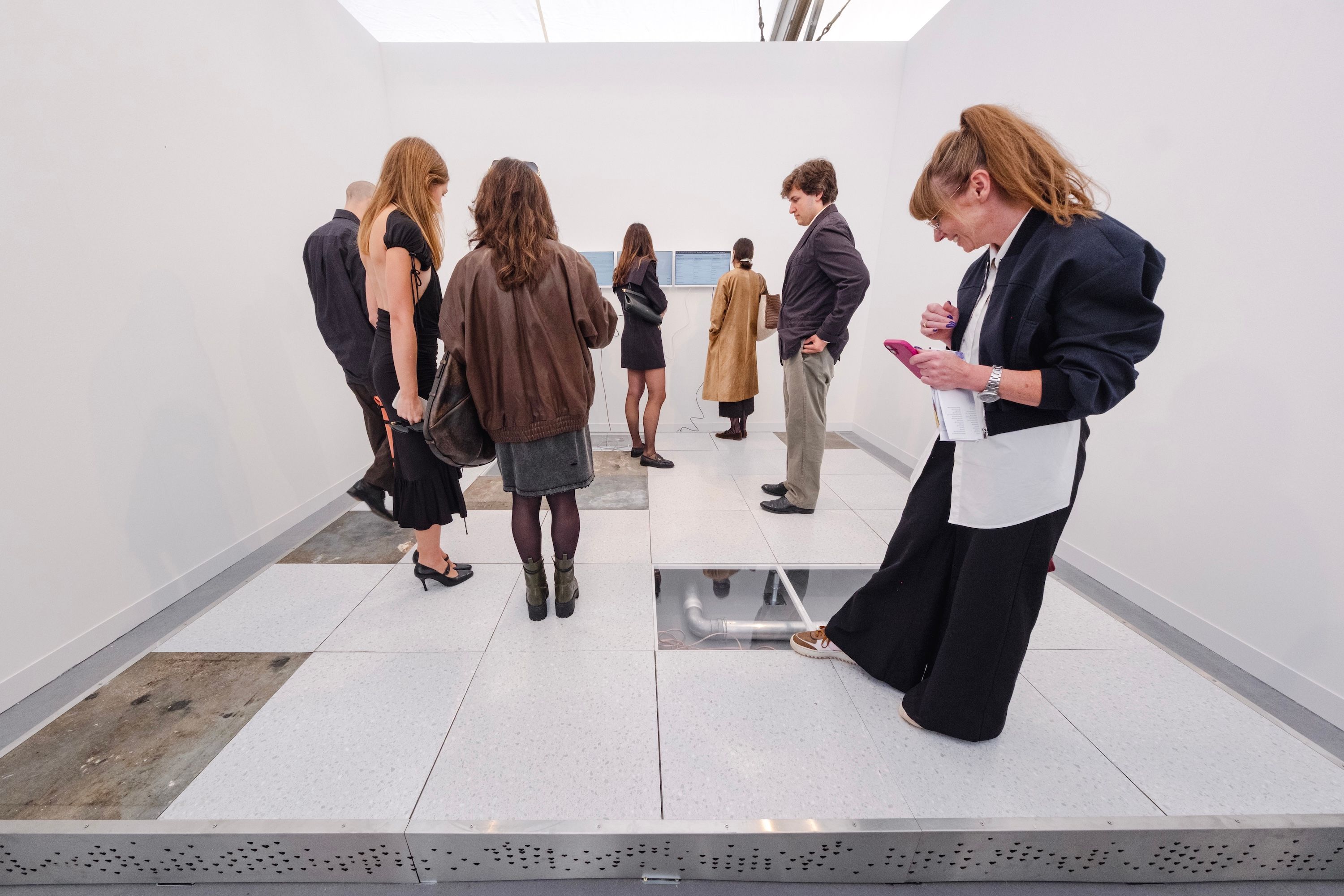
Called training material (aria) (2026), Fleck’s sound installation drew on her research training as a “chatter” at a third-party agency that employs people to converse with subscribers on behalf of OnlyFans creators. The full installation was priced at £14,000 and the gallery placed two editions with “institutional-level European collectors”, and had earmarked the third for “the right institution”, gallery cofounder Ace Ehrlich said. Belgian collector Alain Servais confirmed he was one of the buyers, predicting “a good future” for the artist.
All told, sales at Frieze London point to a brighter outlook for the broader art market, too.
A respected voice in contemporary art discourse.
Focusing on ambitious storytelling and insightful art-world commentary. Ocula Magazine publishes in-depth interviews, critical essays and timely analysis on the artists, exhibitions and ideas driving the global art world.
Learn more about Ocula Magazine
Showcasing the best of the art world.
Ocula partners with galleries from around the world to highlight their artists, artworks and exhibitions. Gallery membership is by application and invitation, with each member vetted by an independent panel.
Learn more about Ocula Membership
Specialises in the sale of major artworks.
Led by a team with deep ties to the world’s leading auction houses, galleries and collectors. Ocula’s advisory team offers bespoke services to high-net-worth clients from around the world who are looking to acquire the best of contemporary and modern art.
Learn more about our team and services