The force that through the green fuse drives the flower
Drives my green age; that blasts the roots of trees
Is my destroyer.
And I am dumb to tell the crooked rose
My youth is bent by the same wintry fever.
—Dylan Thomas
In 2019 Tim Maguire began revisiting the historical Dutch and Flemish pictorial genre he had made his own in the early 1990s, reviewing it through the filter of his pictorial explorations over the intervening decades.
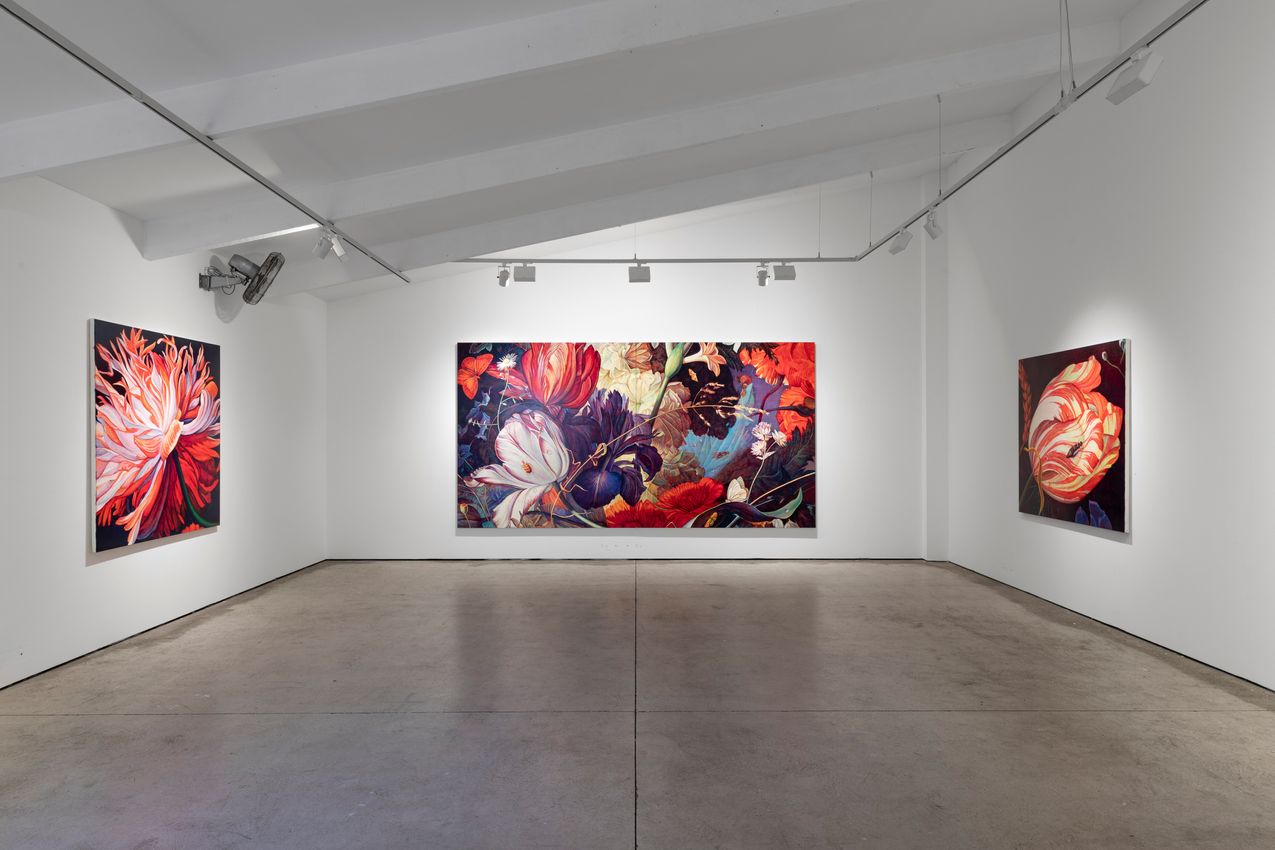
This recent suite of paintings of 2023-2024, entitled Lost and Found, inflates the lush visuality of the earlier 1990s floral still-lifes yet is reframed by radical differences in their photographic sourcing, production and pictorial outcomes. These are driven in turn by the continual revisions and tensions of Maguire’s hybrid, genre-crossing painting practice, with its innovative interleaving of contemporary media forms from analogue to digital technologies.
The seventeenth and eighteenth century floral still life genre, popular in the affluent good times of the Dutch ‘Golden Age’ or Dutch Baroque, offered lavish and unlikely arrangements of cut flowers (from all seasons) as precautionary signifiers of life’s transience. These abundant bouquets of visual pleasure served as precisely naturalistic reminders to wealthy patrons that the days of wine and roses were not long or lasting.
Maguire had gravitated to the genre in 1989 on his return to Australia after several years of restless travel and exhibiting in Europe and America. Settling in the Blue Mountains with his artist wife, Adrienne Gaha, for the birth of his son, Max, then a daughter, Lilly, these new lives countered his own early history: the sudden loss of his father as a young child, and a traumatic night train accident in January 1976, shortly after finishing high school.1 This tragic event, and his long recovery, changed the presumed course of Maguire’s life as a teacher. It had led in 1980 to art schooling in Sydney, a formative postgraduate year at the renowned Kunstakademie Dusseldorf in 1985, and on to an artist’s life, initially enacted through self-impaired experimental performances, and then through alternating, apparently disparate, series of landscape and abstract representations, all ‘rubbing up against each other’ in an energetic pictorial exchange.2
So by 1989 the cool objective gaze of the historical still life genre, with its sumptuous visual presence and quiet exhalation of life embalmed, held both creative and personal appeal for Maguire as ‘a site of possibilities’. It chimed with his early recoil from 1980s’ abstract expressionism and with his ‘preoccupations with mortality’ at the time. It also allowed him the freedom to work from found photographic source imagery, firstly extracting a small detail, then enlarging it, like a cinematic close up; breaking down the original before reconstructing the image through his interventions of scale, gesture, thin layers of colour wash and splashed solvent—all of which animated the painting’s surface and introduced ‘elements of chance’.3
By asserting the pictorial process (and its representation) over the reproduced historical source, Maguire found “his own paintings within somebody else’s”.4 It was an ‘effacement’ process of image and self—at once contained and improvised—he described as ‘a delicate interplay between control and randomness’, to be experienced rather than explained, like his early performance work, or a game of golf, a favoured pastime.5
As Maguire mined the still life genre’s pictorial possibilities—its alluring tension between the real and the artificial, nature and naturalism, reality and illusion—he would claim no special allegiance to its symbolic meaning, prioritising instead the painterly process, ‘the event’ of its production, (‘If the flower paintings mean anything, it’s to do with the way they are made.’)6 To further detach from any assumed allusions to the genre’s symbolism, Maguire’s paintings by 1992 were identified only by numbers. The evocative themed solo exhibition titles of the 1980s were abandoned, only reappearing in 2008 and continued ever since.
Over the last two decades, Maguire’s practice has responded to nature or nature in extremis, working from his own or found digital photographs, through different media forms: panoramic digital pigment prints of snowflakes, lightbox works of fire-ravaged landscapes, paintings from digitally sourced almond blossoms, and his own videos of light playing on water. This focus on images of destruction and regeneration, the fragility and fabulous persistence of life, drew on Maguire’s own photographs of the destructive aftermath of natural catastrophic events, the burnt-out landscapes of Victoria’s 2009 Black Saturday bushfires and those of 2019-2020.
Maguire’s return to the historical still-life genre in 2019, first shown at Martin Browne Contemporary in his 2020 exhibition Small Worlds, expanded on these concerns, encouraged by his sense of ‘a new resonance between the morality tales of the original painting and the current threats to our natural world.’7 This revived focus offered different stylistic opportunities for Maguire’s re-take on the genre, along with his persistent interest in the aesthetics of life’s transience and the no small matter of beauty, ‘visual pleasure’, ‘the language of visual affect,,.the rhetoric of how things look...the iconography of desire.’8 For, over the years, Maguire’s figurative vocabulary, one way or another, has gravitated towards the light in the dark, to the ‘bracelet of bright hair about the bone’, rather than to ‘the bone’, a reliquary image coined by the 16th century poet, John Donne (1572-1631), as if predicting the later symbolic aesthetics of the Dutch floral still-life painters.
For this exhibition’s new iteration of the historical genre, entitled Lost and Found, Maguire has enlisted the late Baroque paintings of Jan van Huysum (1682-1749), called by his contemporaries ‘the phoenix of all flower painters’. Van Huysum’s refined compositional and secretive technical skills drew on the example of the earlier painter, Jan Davidsz de Heem (1606-1684), for instance, with his inclusion of insects. As one of the last active (and most successful) floral and fruit still life painters in the Netherlands, van Huysum unusually worked from his own sketches of rare flowers, sourced from summer visits to Haarlem’s herbarium. His profuse floral set pieces, for all their seeming spontaneity, featured flowers from all seasons in states of bloom and decay, with equally exquisite renderings of insects and dewdrops on petals and leaves.
Distinguished by their bright light backgrounds, swirling arabesques and dense efflorescence, van Huysum’s paintings, with their confected style and lavish content, are reimagined through the lens of Maguire’s evolved technical skills and pictorial priorities. With the ‘hi-fi’ advances of digital reproduction at his disposal, Maguire could focus on pieces of visual information he ‘would have glossed over in the past—bugs, butterflies, water droplets’, signs of life all present in the Lost and Found paintings.9
Like their historical sources, Maguire’s current paintings offer an abundance of dazzling detail, all charged with visual information, if not emotion. By emulating the inflated stylistic flourishes, glazed visual theatrics and convoluted forms of the original, they seem to accentuate and enhance the genre’s pictorial vocabulary, rather than disperse and dissolve it, as he had in the
past. Where once the haunting chiaroscuro effects of Maguire’s early 1990s flower ‘portraits’, as they were then described, mutely reflected the aura of their age and ‘lo-fi’ reproduction, these new pellucid, hyper-real forms emerge from the impassive ‘hi-fi’ gaze of a computer for activation by the artist’s painterly interventions.10
In this exhibition, Untitled 20230201 (2023) and Untitled 2024302 (2024) the two most expansive paintings, are sourced from a small detail of a digital reproduction of Jan van Huysum’s Still Life with Flowers and Fruit, (c.1715), in the collection of the National Gallery of Art in Washington, DC. Here, and in other smaller paintings, Maguire sets up the tiny against the vast; the minute detail against the sumptuous spectacle, enacting the high-pitched intensity and arrested tumbling of the historical model’s floral effulgence. Viewed up close, the painterly flourishes and splattered solvent of Maguire’s brushwork unravel the precise rendering of the whole digital image, asserting, as ever, the dynamic exchange between his abstracting and figurative representations.
Maguire’s new flowers, as with their historical precedents, may be from nature but they are not natural (blue leaves, red wheat!). The single floral paintings—a striated tulip, hydrangea or peony, historically ‘hothouse flowers’—are ‘strangely familiar’, weirdly unlikely, perhaps botanical specimens from a fantasy world.11 Visually engulfing and suspended in an airless liminal space between full bloom and decay, these flower paintings achieve their hallucinatory effects by Maguire’s pictorial overlapping of virtual and physical worlds; and they embody his ongoing conflation of image and surface, production and reproduction, presence and effacement, to dislodge our viewing expectations. If Maguire regards a painting as ‘a frozen moment in time’ then these flower works allow our close encounter with the ineluctable embrace of the past and the present.
NOTES
(1) Glenbrook, NSW, 16 January 1976, at around 22.45 a goods train ploughed into the rear of a stalled electric passenger train with 40 passengers near Glenbrook station, in the Blue Mountains, killing one person and injuring 10 others.
(2) The term used by Lakin, S., Painting under duress: Tim Maguire’s Colour Separations 1998- 2003, Bendigo Art Gallery, Victoria, 2003
(3) Maguire read George Cockcroft/Luke Reinhart’s book The Dice Man (1971) in 1976, about a psychiatrist who makes daily decisions based on the casting of a dice so that his life becomes sequences of chance, taking himself out of the equation. Maguire said that was his approach to painting. Cf., Lakin, ibid.; See also Tim Maguire quoted in ‘What is it ‘as it really is?’, Maguire T., Godfrey T., and Watkins J., Tim Maguire, Piper Press, Sydney, 2007, p. 119. Maguire’s Dice Abstracts exhibition, Tolarno Galleries, 2019 directly explored this action with a computer dice.
(4) Maguire, ibid. p. 131.
(5) Maguire, ‘I identify very much with the golfing analogy Chuck Close makes in reference to his own paintings, that you don’t know you’ve made a really good drive until you get to the putting green.’ ibid. p. 135. See also http://jnack.com/blog/2021/06/12/chuck-close-on-golf-creativity/
(6) Maguire, ibid. p. 100
(7) Maguire, T., S__mall Worlds, exhibition introduction, Martin Browne Contemporary, Sydney, 2020
(8) Hickey, D., ‘The Invisible Dragon: Four Essays on Beauty’, Art issues Press, Los Angeles,1995, p.12
(9) Maguire, T., HI-FI, LO-FI, exhibition introduction, Tolarno Galleries, Melbourne, 2023
(10) See Searle, A., Tim Maguire, Moet & Chandon, Epernay, France, 1994, p. 3 ‘A close-up portrait of a bloom, far larger than life and bursting beyond the confines of the painting’s edge...’.
(11) See Hickey, D., op.cit. p. 18. (‘As Baudelaire says, “the beautiful is always strange”, by which he means, of course, that it is always strangely familiar.’)

Since 2006, Tim Maguire has worked in London and the United Kingdom. Critically acclaimed and acknowledged internationally, Maguire is one of Australia’s most successful artists, exhibiting large-scale paintings that impress in their photo-realist imagery and in the detail of their painterly construction.
Martin Browne Contemporary is dedicated to showing the finest in Australian and International modern and contemporary works of art. The gallery combines a program of new work by its exhibiting artists with curated exhibitions of selected works from the secondary market.
Complementing its exhibition program, Martin Browne Contemporary produces an extensive range of publications. The gallery's comprehensive mailing database ensures these publications reach all major Australian and New Zealand public museums and private institutions as well as over 3000 private collectors in Australia and abroad.

A respected voice in contemporary art discourse.
Focusing on ambitious storytelling and insightful art-world commentary. Ocula Magazine publishes in-depth interviews, critical essays and timely analysis on the artists, exhibitions and ideas driving the global art world.
Learn more about Ocula Magazine
Showcasing the best of the art world.
Ocula partners with galleries from around the world to highlight their artists, artworks and exhibitions. Gallery membership is by application and invitation, with each member vetted by an independent panel.
Learn more about Ocula Membership

Specialises in the sale of major artworks.
Led by a team with deep ties to the world’s leading auction houses, galleries and collectors. Ocula’s advisory team offers bespoke services to high-net-worth clients from around the world who are looking to acquire the best of contemporary and modern art.
Learn more about our team and services