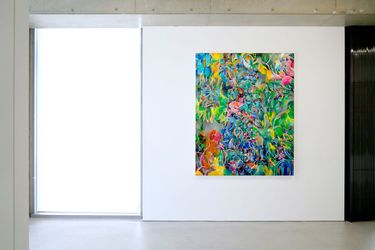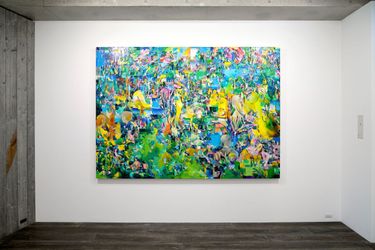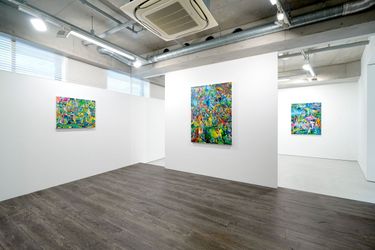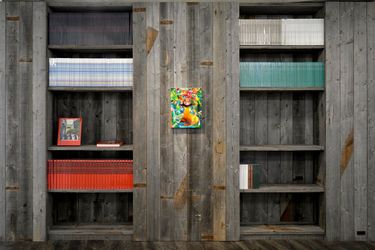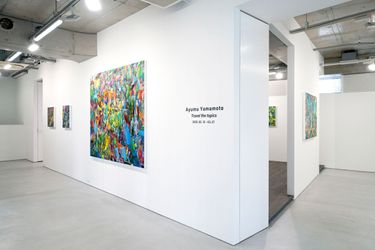
MAKI Gallery is pleased to present Travel the topics, its first solo show with Japanese artist Ayumu Yamamoto, at Omotesando, Tokyo. While Yamamoto has exhibited internationally in group shows and art fairs, this marks the first time the gallery will devote an entire show to the emerging artist’s work.
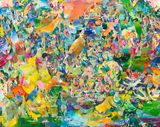
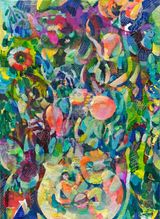
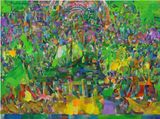
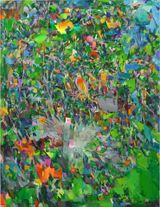
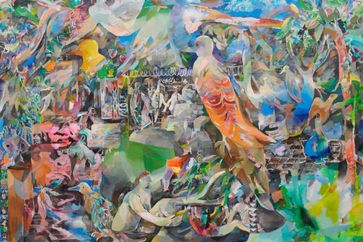
Focused on the contrasting themes of intimacy and conflict, Yamamoto’s work captivates the viewer’s attention with a striking and intricate use of color that emphasizes the artist’s own sensibilities instead of realism. The textural complexities of her paintings recall Fauvism, the early twentieth-century movement spearheaded by such artists as Henri Matisse and Maurice de Vlaminck. Fauvists embraced bold primary hues and dynamic brushwork, prioritizing instinct over intellect in their approach. They believed color should be used freely to express an artist’s subjective sensations, rather than be confined by the rigid rules of naturalistic depiction. While Yamamoto’s paintings are characterized by densely packed compositions and vivid palettes, they also exude a gentle warmth and emotional depth that are subtly reminiscent of Nabis painter Pierre Bonnard’s work. Yamamoto’s fantastical, elaborate imagery carries mixed sentiments, bringing forth a whimsical, enigmatic atmosphere.
The artist’s vibrant works frequently feature interior spaces, flora and fauna, and stylized figures—often lovers—surrounded by lush landscapes. At first glance, they appear to capture moments of bliss, yet beneath the surface lies a multitude of conflicting emotions and narratives; opposing elements such as familiarity and discord, light and shadow, and order and chaos coexist in the picture plane. This sense of duality extends to her technique as well—Yamamoto develops a wide range of textures by applying thick and thin layers of acrylic and oil paint, combining both glossy and matte finishes. Furthermore, she incorporates scenes from various times and places within a single frame, disregarding conventional spatial logic. The resulting works, with their multidimensional structure, waver between abstraction and representation, exuding a compelling aura that entices the viewer into the artist’s eclectic world.
At times, the figures that populate Yamamoto’s paintings affectionately lean toward one another; at others, they turn away with apparent displeasure. Despite this seeming concurrence of affection and antipathy, the essence of the artist’s pictorial universe is fundamentally rooted in intimacy—seeking warmth through connections with people, animals, and nature.
Yamamoto harbors similar contradictions in her own mind, as evidenced in her artist statement:
I enjoy interacting with people, yet at the same time, I find it terrifying. Sometimes, I may feel relatively indifferent, while at other times, I want to know everything about everyone. I can’t help but be consumed by thoughts of others. . .
What may initially appear as discord to the objective eye is often shaped by the viewer’s own perspective and the psychological undercurrents that accompany human interaction. In this way, moments of outward detachment paradoxically serve to highlight the presence of intimacy in Yamamoto’s work.
The exhibition title, Travel the topics, reflects how Yamamoto’s paintings invite the viewer to embark on a journey through a multifarious realm rendered in rich, dreamlike colors—one comprised of a medley of male and female figures, domestic objects, and flora and fauna. The artist shares in her statement: “I tend to express anything positive or affirmative in a roundabout way.” True to these words, Yamamoto’s infinitely layered brushstrokes lead the viewer along a winding path that delves ever deeper into a vast labyrinth. By the time they finally arrive at whatever emotions or narratives the artist has embedded, the viewer may realize just how intimate their relationship with the artwork has become.
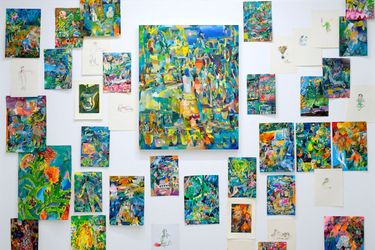
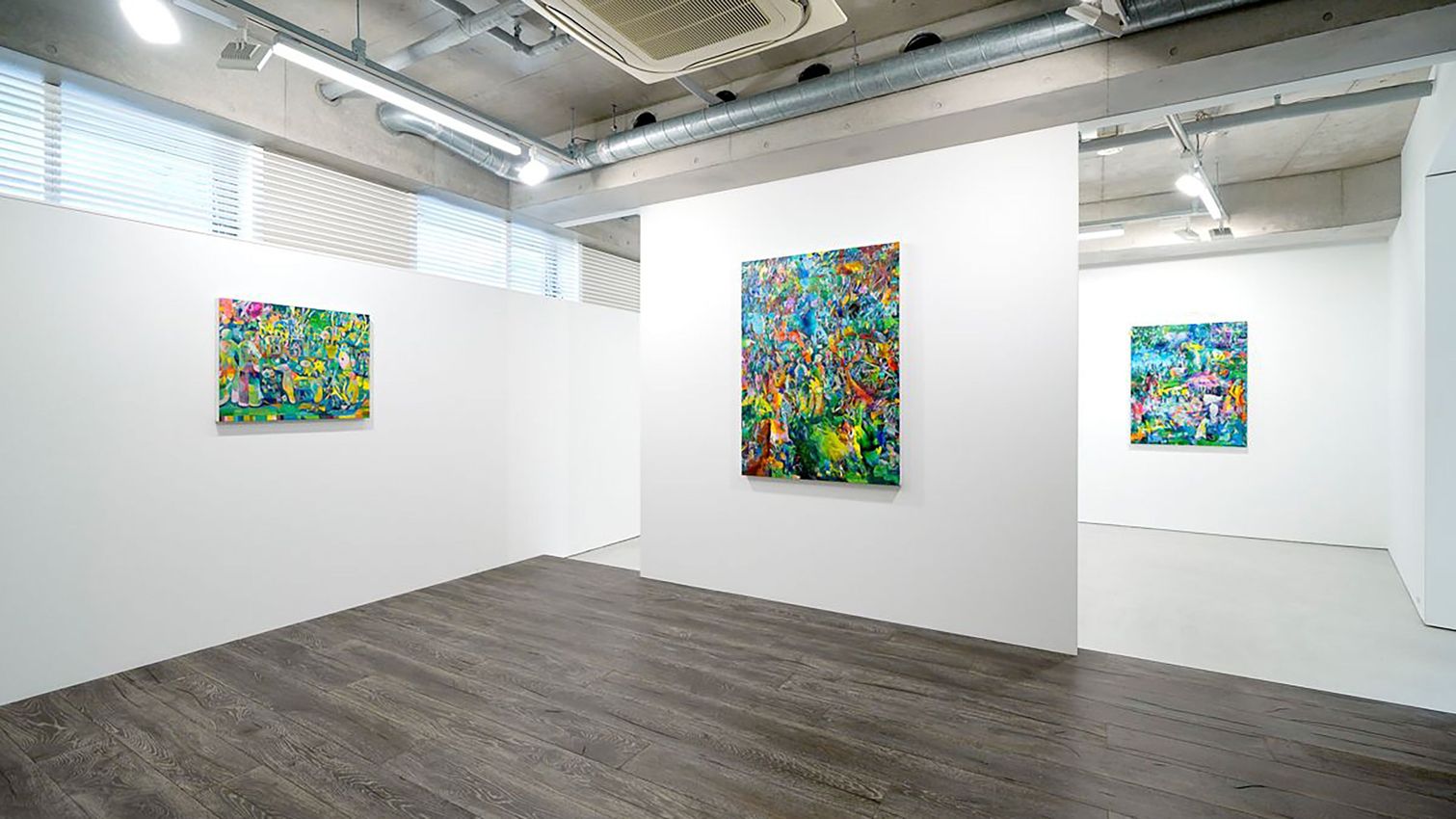
The show features a broad array of work, from large-scale paintings that envelop the viewer in a flurry of chroma to smaller yet powerful pieces that focus on a single subject, as well as an installation—composed of countless drawings—that brings the free-flow energy of Yamamoto’s studio to the gallery space. We hope the holistic experience of this exhibition will allow you to immerse yourself in the artist’s uniquely intimate worldview.


Born in 1995 in Tokyo, where she continues to live and work today, Ayumu Yamamoto received both her BFA and MFA in Oil Painting from Musashino Art University in 2018 and 2020, respectively. The human figure, as well as various flora and fauna, are recurring motifs in the artist’s pictorial universe. While Yamamoto’s paintings seem to depict jaunty and blissful moments, such as lovers spending time together amid lush greenery, a myriad of contradictory emotions and narratives are prevalent in her work, exuding an unsettling atmosphere. Palpable tensions are created within the frame through the coexistence of opposing elements—intimacy and discord, light and shadow, balance and instability—drawing the viewer deeper into a fantastical labyrinth. Hovering between representation and abstraction, the paintings attempt to depict the “real” world and its complicated nature through the artist’s unpredictable application of oil paint.

MAKI Gallery was first established in Tokyo in 2003, with the aim of promoting works by seminal avant-garde Japanese artists of the 1950s-60s. The gallery has since gradually shifted its focus to working with emerging contemporary artists. After opening a location in the bustling, high-end shopping district of Omotesando in 2014, MAKI Gallery opened an expansive, museum-caliber space in the growing gallery hub of Tennoz in 2020. Across these two outposts, MAKI Gallery presents a broad range of works by internationally active artists, including Mungo Thomson, Miya Ando, Susumu Kamijo, and Marius Bercea, while also introducing younger Japanese artists, such as Anne Kagioka Rigoulet, Keisuke Tada, and Takuro Tamura, to a global audience. The gallery has also participated in various international art fairs such as Frieze New York, The Armory Show, Asia NOW, and West Bund Art & Design.

A respected voice in contemporary art discourse.
Focusing on ambitious storytelling and insightful art-world commentary. Ocula Magazine publishes in-depth interviews, critical essays and timely analysis on the artists, exhibitions and ideas driving the global art world.
Learn more about Ocula Magazine
Showcasing the best of the art world.
Ocula partners with galleries from around the world to highlight their artists, artworks and exhibitions. Gallery membership is by application and invitation, with each member vetted by an independent panel.
Learn more about Ocula Membership

Specialises in the sale of major artworks.
Led by a team with deep ties to the world’s leading auction houses, galleries and collectors. Ocula’s advisory team offers bespoke services to high-net-worth clients from around the world who are looking to acquire the best of contemporary and modern art.
Learn more about our team and services