

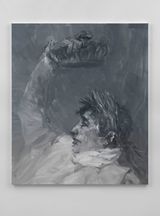
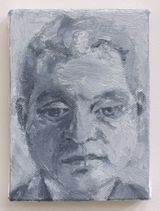
MASSIMODECARLO Pièce Unique is pleased to present xxx, an exhibition by Yan Pei-Ming centred on a new painting made for the space. The Franco-Chinese artist has built one of the most recognisable bodies of work in contemporary painting: monumental canvases, almost always held to a single colour, made with wide brushes and the momentum of the whole body. At the heart of the exhibition is a canvas of 200 × 250 cm that returns to Édouard Manet’s The Execution of Emperor Maximilian and, for the first time, renders it in red, bringing a nineteenth-century scene of political violence into the present.
Yan Pei-Ming has always painted the faces through which history is made and remembered. Mao and Bruce Lee, figures of his Shanghai youth, sit next to popes and today’s heads of state. Dictators and victims taken from the news share space with skulls and tigers. Power and death, the public and the intimate, run through the work in equal measure.
The history of painting belongs to the same conversation. Leonardo’s Mona Lisa became Les Funérailles de Monna Lisa, shown at the Louvre in 2009. Courbet’s A Burial at Ornans became Un enterrement à Shanghai, shown at the Musée d’Orsay in 2019. Goya, Manet and Velázquez have all passed through his studio.
Within this dialogue, executions form a cycle of their own. “I like tragic subjects because I find them eternal,” Yan Pei-Ming has said. The cycle began in 2008 with Exécution, après Goya, painted in red two hundred years after the executions of 3 May 1808 in Madrid. Four years later he revisited Goya in black and white, and in the same year turned to Manet for the first time. In 2017, for A Short History of Power and Death at MASSIMODECARLO London, he took on the fragmented version of Manet’s canvas held by the National Gallery. The painting at Pièce Unique is the fifth in the cycle.
Yan Pei-Ming‘s move from Goya to Manet retraces a path Manet himself had taken. When news of Maximilian’s death reached Paris in 1867, Manet drew on Goya’s The Third of May 1808 to compose his own firing squad, and worked on the subject for almost two years, producing four paintings and a lithograph. In 1951, Picasso looked back at both in Massacre in Korea. Yan Pei-Ming joins this lineage of painters who have turned to an earlier image to confront the violence of their own time, and to make others look at it too.
Red has long been part of Yan Pei-Ming‘s vocabulary, the counterpart to blue, black, and white. Here the shade is “rouge sang” – blood red. It saturates the entire surface: soldiers, victims, wall and smoke share a single field, and the blood is no longer confined to the wounds but becomes the substance of the image.
In 1869, Manet’s Execution was kept from the French public: the censor banned the printing of his lithograph, and Manet was warned unofficially that the canvas would be refused at the Paris Salon. Today none of his painted versions is in a French collection. Yan Pei-Ming‘s painting gives the subject a new presence in Paris, in a space built around a single work. When he last showed at Pièce Unique, in 2022, it was with a roaring tiger that faced the viewer head-on. Here the position changes: we stand at the side of the firing squad, at the moment of the shot. In a present crowded with violent images, Yan Pei-Ming holds one scene still, and paints it at the scale of a life.
Famed for his monumental monochrome portraits and visceral engagement with history, artist Yan Pei-Ming is known internationally for his emotionally charged works that straddle the personal and the political.


MASSIMODECARLO Pièce Unique opened in a historical building at 57 Rue de Turenne on February 2021. It has been renovated by acclaimed Japanese architect Kengo Kuma in collaboration with PiM.studio Architects. MASSIMODECARLO Pièce Unique offers a flexible, dynamic, and upbeat program of single-work exhibitions, visible day and night through its glass window. The gallery is born from the purchase of the “Pièce Unique” brand, an adventurous space by iconic gallerist Lucio Amelio that he opened in Paris in 1989 designed with Cy Twombly. MASSIMODECARLO Pièce Unique will respect and recast into the 21st Century the legacy of this historical project, renewing its original idea, infusing a new perspective, and offering an alternative exhibition model for the contemporary art system.
A respected voice in contemporary art discourse.
Focusing on ambitious storytelling and insightful art-world commentary. Ocula Magazine publishes in-depth interviews, critical essays and timely analysis on the artists, exhibitions and ideas driving the global art world.
Learn more about Ocula Magazine
Showcasing the best of the art world.
Ocula partners with galleries from around the world to highlight their artists, artworks and exhibitions. Gallery membership is by application and invitation, with each member vetted by an independent panel.
Learn more about Ocula Membership

Specialises in the sale of major artworks.
Led by a team with deep ties to the world’s leading auction houses, galleries and collectors. Ocula’s advisory team offers bespoke services to high-net-worth clients from around the world who are looking to acquire the best of contemporary and modern art.
Learn more about our team and services