




It is the province of art to contain multitudes that need not (thank god) look precisely like the real world, whatever that is. At Sadie Coles HQ, ten new works (all 2026) by the French-born U.S. artist Nicole Eisenman are most prodigiously united by their incredible variety in form and subject, her singular painterly attention to surface and texture, and a compositional awareness of how many universes (spaces, lives, sensibilities, dimensions) one canvas can hold.
There is the time of the world and there is the time of painting and, in spite of the static seeming nature of oil and pigment on canvas, neither is entirely fixed. For instance: a large work that unfolds over multiple canvases may show a phalanx of bodies writhing and roiling in shared bliss — a toe here, a rounded knee there, a pair of legs spread here, a hand reaching in between there. Or: each canvas might be a freeze-frame, like animated cells, and maybe it is only two bodies folding and unfolding, left to right, but we apprehend each moment at once, which is how ecstasy feels in any case.
Or perhaps painted time, how it moves and travels, is more about style — the how of art — and the ways in which form can look backward and forward at once: a fusion of realism and abstraction; a sense of history bearing down on the present, past and future inseparably yoked (as life and art) like Promethean anvils; a figure rooted to the earth but looking out, far out, into space.
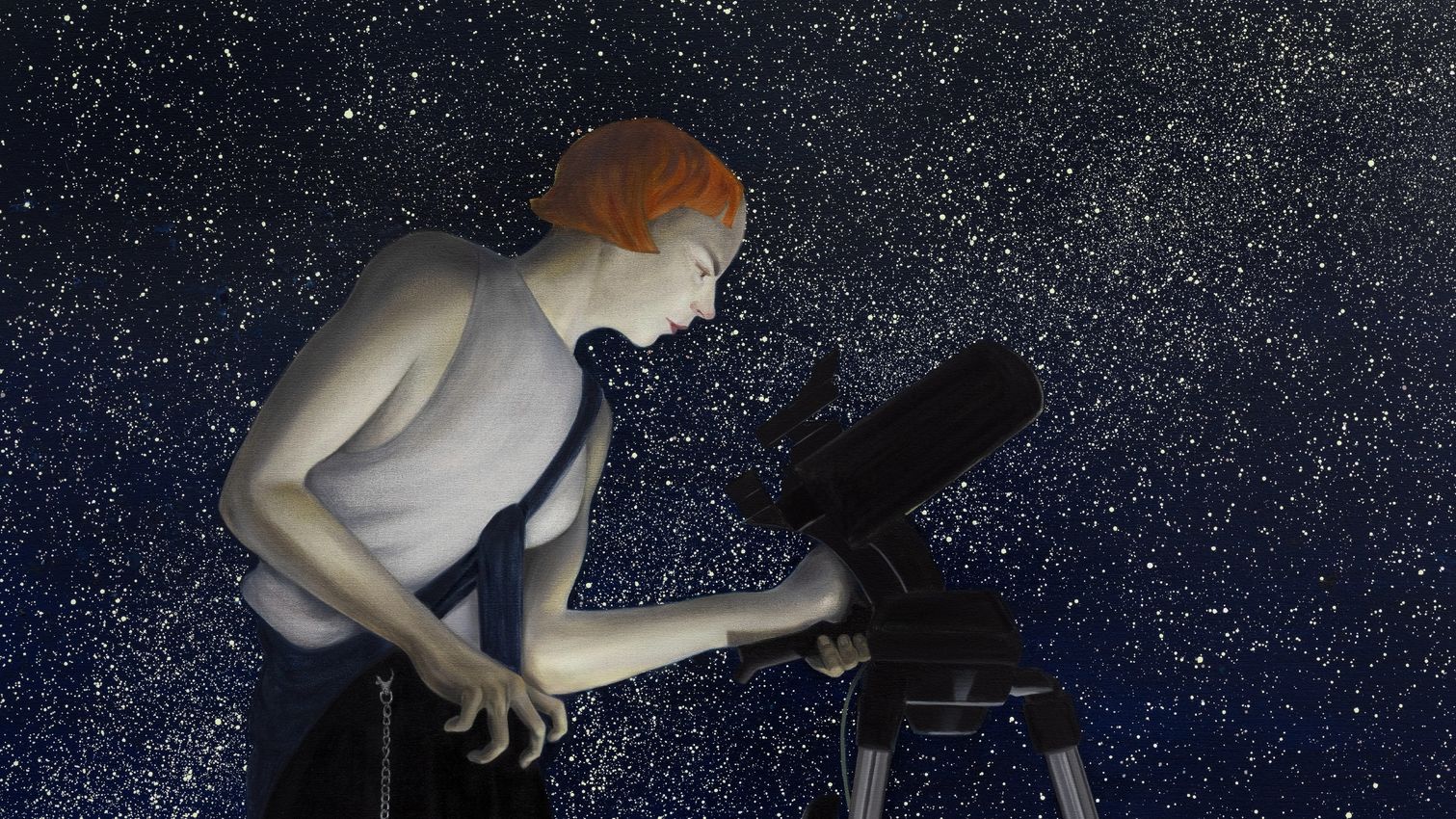
Shape-based paintings like Orgy and Togetherers, with their fleshy colours and Duchampian-descending-nude geometries, may seem to possess a more interior logic than the realist The Waiter and Lissy on a Night Without Cloud, but Eisenman says she paints her life and how she feels, assigning images to emotions. The ultimate time of an artwork, of course, is the time of making, which includes the time of conceiving, central to which is the time of living — a state both painfully long and short. (To reassure, said emotions are not always so serious: “Orgy makes your eyes feel good,” she says, and who could disagree.)
And yet she (we) are not alone. Companions flicker in and out of paintings, like the kaleidoscopic Me and G under the J and the seductively amorphous Walking Through the Wind (Edie). We assume it is Eisenman who is “me,” and doing the walking, but who knows, it could be you (or me). Eisenman grasps, like few other painters, the real truth of the now too-oft used word, relational. Not just that everything is connected, but that we have every responsibility to others. So: Lissy beholds the impossibly clear, glittering night firmament — which is also splatters and tiny, painstakingly applied dots of white paint against deep blue — in search of a star (a planet, a visitor from beyond?) that she may or may not be able to make visible with her elaborate technological setup (a frame within a frame, a perspective within a perspective to make the invisible visible). But what else is painting, and looking, but waiting to see what might never be?
With Eisenman, we wait with The Waiter, who seems to have stumbled through the wrong stage exit, but will remain here (where?), forever, transfixed. We understand that we too are collapsed into one visual plane with Stonehenge and a swirling galaxy, tray in hand like an orb ejected from the sky. In these paintings, temporality exceeds the rules of the earthbound to show how many dazzling, disturbing, sometimes desperate emotions can be felt, and imaged, all at once.
– Emily LaBarge
Courtesy Sadie Coles HQ.
New York-based artist Nicole Eisenman (b. 1965) is a leading figure in contemporary figurative painting and sculpture, known for addressing gender, sexuality, race, labour, violence, and inequality with raw emotion and dark humour. The artist’s work spans painting, drawing, printmaking, and sculpture, and is recognised for its blend of historical references, queer politics, pop culture and satirical social observation.


A respected voice in contemporary art discourse.
Focusing on ambitious storytelling and insightful art-world commentary. Ocula Magazine publishes in-depth interviews, critical essays and timely analysis on the artists, exhibitions and ideas driving the global art world.
Learn more about Ocula Magazine
Showcasing the best of the art world.
Ocula partners with galleries from around the world to highlight their artists, artworks and exhibitions. Gallery membership is by application and invitation, with each member vetted by an independent panel.
Learn more about Ocula Membership

Specialises in the sale of major artworks.
Led by a team with deep ties to the world’s leading auction houses, galleries and collectors. Ocula’s advisory team offers bespoke services to high-net-worth clients from around the world who are looking to acquire the best of contemporary and modern art.
Learn more about our team and services
