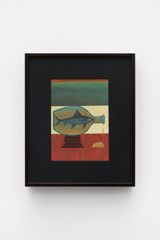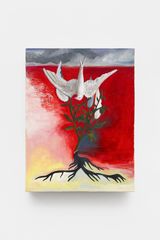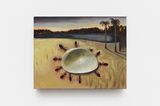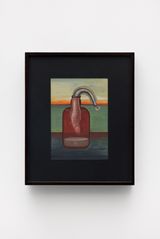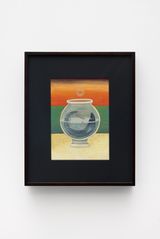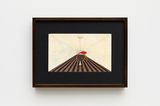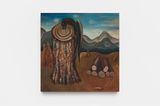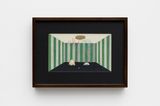
Engaging viewers with a deviant logic, a set of oneiric rearrangements where a fish may fly or grow legs like a spider, and where a bloodstain on a sheet links to a starlit sea, Anna Livia Taborda Monahan traces her paintings back to a single texture: porosity. Recently, her visual language, which incorporates graffito_,_ has gravitated toward a shell gone soft with holes, sand that lets light through, and skin with more openings than it should have. “When I say I’m interested in porosity, in holes, in grainy texture, in drops of water, and in surface tension, it seems very dry and analytical,” she says. “But what attracts me to these elements is the feeling that they give me.” She works through what she calls synaesthesia, allowing an idea, a memory, and a fact to overlap, sand’s grandiosity, a childhood sunburn, and the plain fact that, in her words, “heated, it becomes glass.” The same logic runs through multiple lenses: Surrealism’s insistence that an image can be true without being literal, psychoanalysis’s attention to accident, the exacting eye of zoological illustration, and memory, which recedes and returns tidally.
Water runs through the paintings as salt, as a fish’s scale, as krill, as plankton, fluorescent against black water. “Droplets falling from a whale’s spout,” Taborda Monahan says, “repeat the roundness of pearls,” small and shiny, suspended between air and water, echoed in a recurring blue whale, “huge” and “wise”.
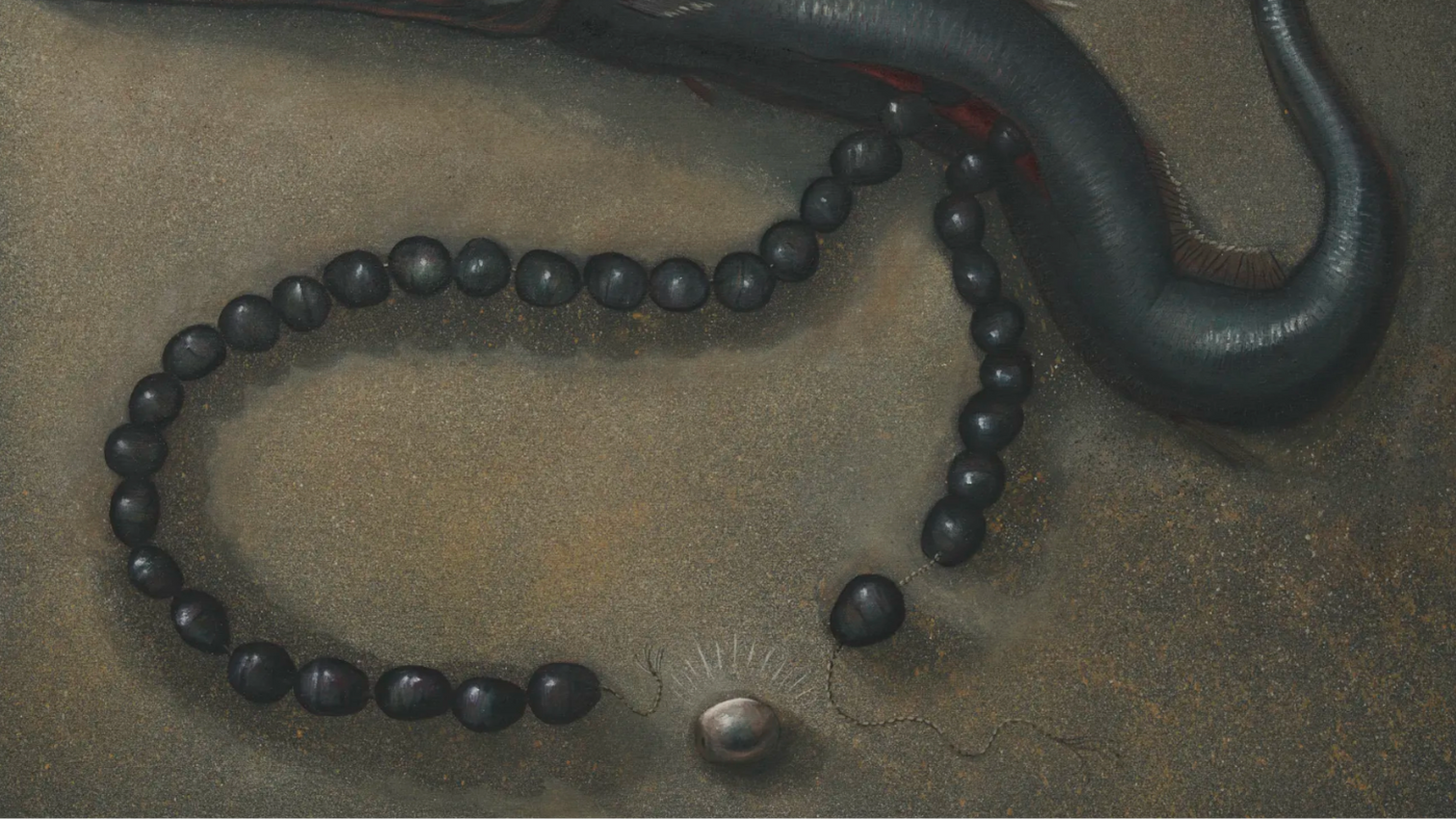
The artist turns to fish to blend science and fantasy. She counts the procedural, perspective-driven animal studies of the fifteenth-century Florentine painter Paolo Uccello among her touchstones, alongside pre-Renaissance sources, Aloys Zötl, Edgar Ende, Max Ernst, and Leonora Carrington. Teeth recur as a motif, jaws caught open in profile like naturalists’ specimens. In Precious Inside, a needle-toothed fish trails a strand of black pearls from its opened belly, one white pearl broken free, ferocity and preciousness set as equals.
Born in New York, Taborda Monahan spent her first four years there before moving to Brazil. She draws on Jung, who linked the ocean’s scale to the unconscious mind; in her words, the memory of that early stay “seems deeply hidden”. Producing work as an artist-in-residence at Speciwomen’s Magnet Residency brought her back to New York, known until then mostly through family stories and old photographs. This distance and return find expression in Elizabeth Bishop’s 1947 poem “At the Fishhouses”, which touches on memory, landscape, interiors, and exteriors. Its closing lines widen the ocean into a figure for the vastness of what one can know, and its late image of water transmuted into fire that burns finds a counterpart in the very real fire extinguisher in Fire Exit, where the object stands ready for danger. Taborda Monahan’s own fish house is a hallucinatory building, a brownstone she painted as Little Memory, a fish occupying the building instead of the usual traffic of a home, and a stream of water pooling at its base.
She turns danger toward warning elsewhere too. “Deep-sea creatures surfacing seem like premonitions of the earth warning humanity of its trespasses,” she says, thinking of recent flooding as the ocean “taking its space back.” It is a worry she has tied to real news coverage of flash flooding and one with precedent in the older tradition of illustrated omens like the sixteenth-century Book of Miracles. The same imagery draws at once on natural history, the coelacanth or lungfish argument over our aquatic ancestor, a debate that has moved through its own eras of classification, surfacing almost literally in Ancestor’s fish-shaped bloodstain, like a fossil pressed into cloth. A tideline is where two currents meet; it is also the mark a retreating tide leaves on sand past its highest point, the sinuous line of seaweed and foam.
Taborda Monahan started this body of work in black and white before a connective cord began recurring across her paintings. Where porosity lets one thing seep into another, the cord unites. For example, the artist paints a shell and a chambered fleshy form joined on wet sand by two looping strands, red and blue, close as an artery and vein. Twins repeats the structure, two silver fish flanking a luminous egg webbed with red veins, a small curled form at its centre. Elsewhere, a single red branch of coral stands apart from the thorned subject of Blowfish, as if the cord logic elsewhere were incomplete. She frames the work as “worlds meeting, ripping, breaching, leaking, and reaching out”.
Courtesy Mendes Wood DM.


A respected voice in contemporary art discourse.
Focusing on ambitious storytelling and insightful art-world commentary. Ocula Magazine publishes in-depth interviews, critical essays and timely analysis on the artists, exhibitions and ideas driving the global art world.
Learn more about Ocula Magazine
Showcasing the best of the art world.
Ocula partners with galleries from around the world to highlight their artists, artworks and exhibitions. Gallery membership is by application and invitation, with each member vetted by an independent panel.
Learn more about Ocula Membership

Specialises in the sale of major artworks.
Led by a team with deep ties to the world’s leading auction houses, galleries and collectors. Ocula’s advisory team offers bespoke services to high-net-worth clients from around the world who are looking to acquire the best of contemporary and modern art.
Learn more about our team and services