

The art world in focus
Subscribe to our newsletter for news and insights on artists, galleries and exhibitions.

The new machine will dispense, at random, one of 10 miniature prints. Courtesy of the Guggenheim New York.
In November 2024, Maurizio Cattelan’s Comedian (2019) sold at Sotheby’s for $6.2m (with fees). Thanks to a newly installed vending machine at the Solomon R Guggenheim Museum in New York City, for the same price, fans of the duct-taped banana can now purchase more than six million artworks offering a “playful nod” to the infamous installation.
The project is the brainchild of Inciardi Prints, a printmaking studio founded by Brooklynite Anastasia Inciardi. For just $1, the new machine will dispense, at random, one of 10 miniature prints. Nine depict New York City icons—the Statue of Liberty, the Empire State Building, a pigeon, a yellow cab, a hot dog—and the tenth the banana.
Inciardi came up with the mini print vending machine format in 2020 to collect coins for the launderette after finding she was continually running out of quarters. There are now more than 200 mini print vending machines, mostly installed across the US, although the one at the Guggenheim is a one-of-a-kind model.
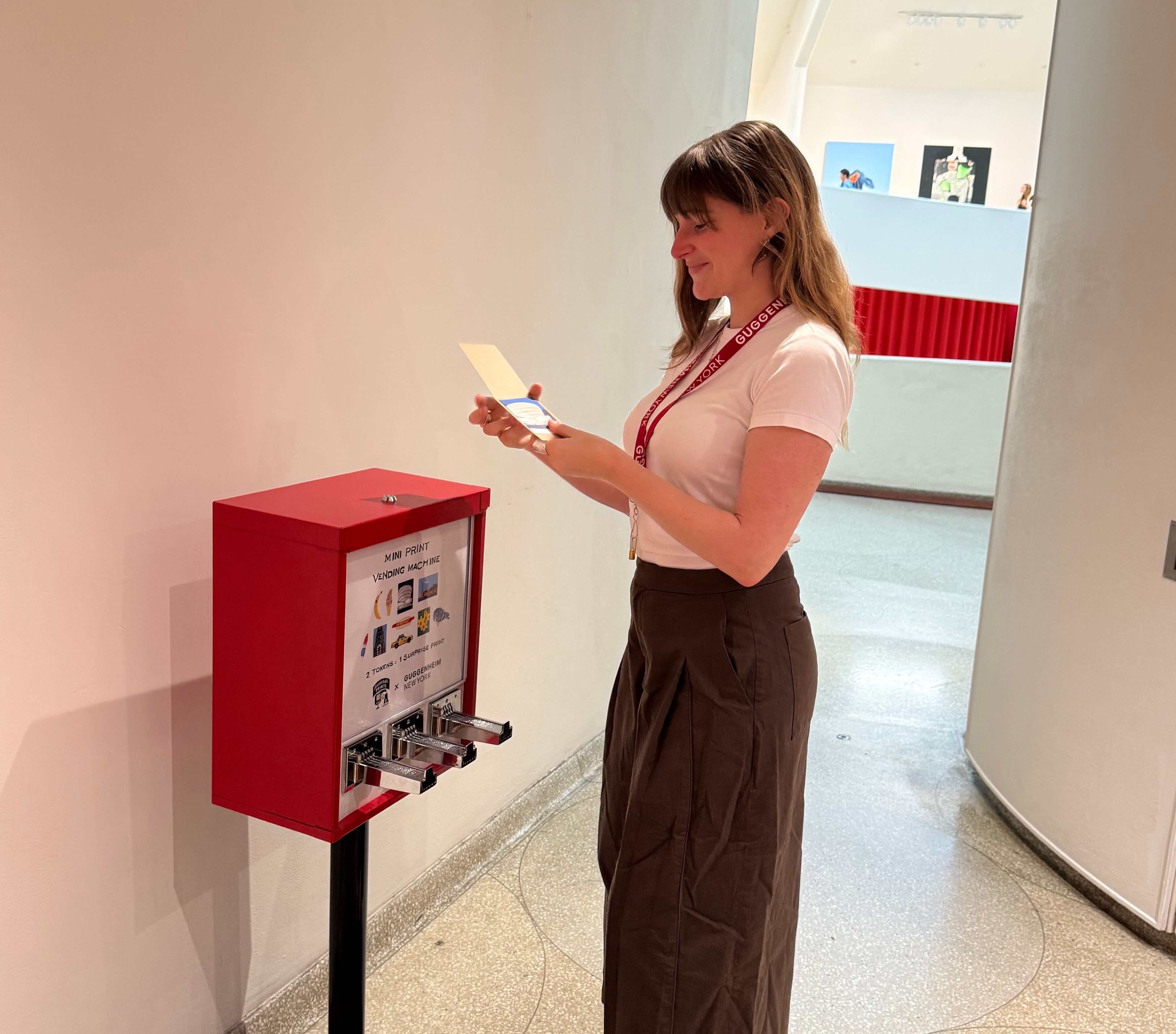
The mini prints have already gained a cult following across the States, with a subreddit dedicated to those who collect them. In a 2025 interview with NPR, Inciardi joked that the prints were “Pokémon cards for women”, owing to their highly desirable nature and the nostalgia factor inherent in having to track them down in-person, rather than purchasing them online.
The Guggenheim installation represents a new opportunity for avid collectors, but Inciardi implores them not to be overly acquisitive. “Leave some for others,” reads one of the vending machine “rules” on her website. “If there is a line, consider the people behind you.”
The sought-after prints originate as linocuts, hand-made by Inciardi, and are reproduced by risograph. The linocut is turned into a master for the risograph machine by the application of thermal heads, which create small holes on a master sheet.
Ink is then forced through the holes from the ink drum on each pass through the printer, with layers of colour added until the image is whole. Variations in the process mean that no two prints will ever be exactly the same.
Inciardi’s method of sharing her work was inspired by the bodega vending machines of her childhood that dispensed one-off Batman and Spiderman temporary tattoos. Yet the history of the art-dispensing machine goes back to the 1800s, when bookshop owner Richard Carlile introduced an automated vending machine to dispense seditious books.
Artists have also returned to the form more recently. During the early 1960s, Yoko Ono created Sky Machine, a vending machine that sold “pieces of sky”—small, handwritten cards bearing the word “sky”.
A respected voice in contemporary art discourse.
Focusing on ambitious storytelling and insightful art-world commentary. Ocula Magazine publishes in-depth interviews, critical essays and timely analysis on the artists, exhibitions and ideas driving the global art world.
Learn more about Ocula Magazine
Showcasing the best of the art world.
Ocula partners with galleries from around the world to highlight their artists, artworks and exhibitions. Gallery membership is by application and invitation, with each member vetted by an independent panel.
Learn more about Ocula Membership
Specialises in the sale of major artworks.
Led by a team with deep ties to the world’s leading auction houses, galleries and collectors. Ocula’s advisory team offers bespoke services to high-net-worth clients from around the world who are looking to acquire the best of contemporary and modern art.
Learn more about our team and services