In a global context saturated with visual stimuli and devices that hold an unlimited number of images, Peter Shear literally leans over the painting to grapple with the multiplicity of the practice. In doing so, he gradually and progressively reveals a symbolic value that accrues meaning as the image is created. His work is continuous and sets action in motion – at times unchanging, at times at rest – without a formula or predetermined path leading to a closed, immutable result. It is as if by revealing part of the decision-making process and leaving room for what is yet to come, the work opens space for the repertoire of images each viewer brings with them.
Like chords that at times complement one another and at other times clash, the works in Voice Leading were brought together based on the artist’s perception that there were many pairs among his paintings. Motifs that insisted on reappearing – each time slightly different – give rise to a kind of linear progression among the works, whether through colors, gestures, compositions, or forms, fostering mutuality and fluidity. A term from music theory, “voice leading” describes the way each melodic line moves smoothly and linearly from one chord to the next.
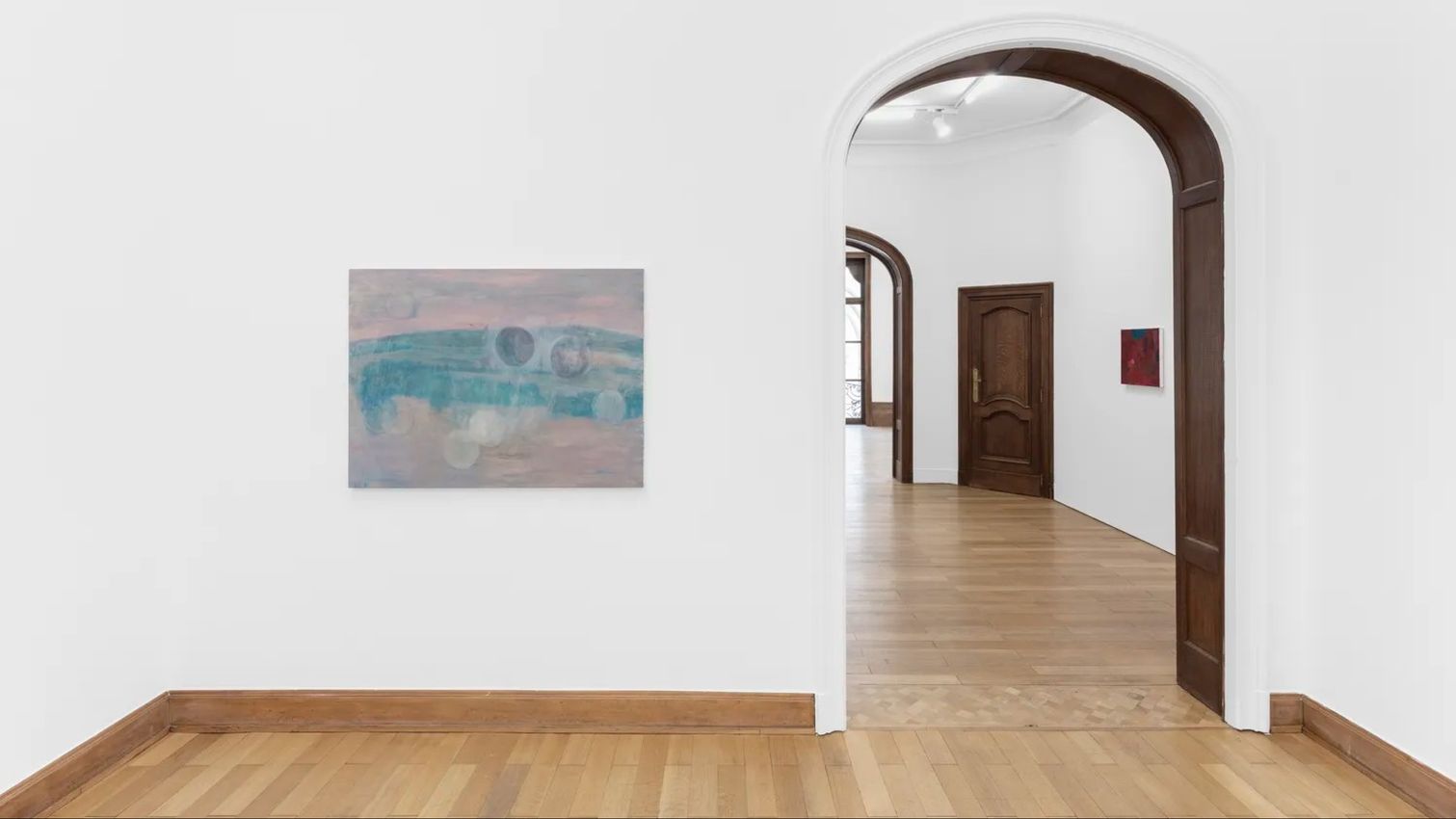
Displacement and Tempting Ideas (all works from 2026), for example, feature well-defined vertical brushstrokes that interrupt the linearity of the landscape and offer a new way of reading the work and a new compositional approach. The artist has also drawn on earlier works as a starting point for new paintings, whether to distance himself from a composition, focus on a detail, or salvage an interesting aspect that did not work on another canvas.
By bringing to the canvas a record of a moment in time – or of different moments brought together – Shear captures the movement beneath the surface and makes it explicit to the viewer, as a form of dialogue and connection with others. Although his brushstrokes often suggest an abstract plane, Shear acknowledges that they can be read figuratively; recently, he has allowed himself to embrace this legibility and consider the canvas finished even when it appears more recognizable.
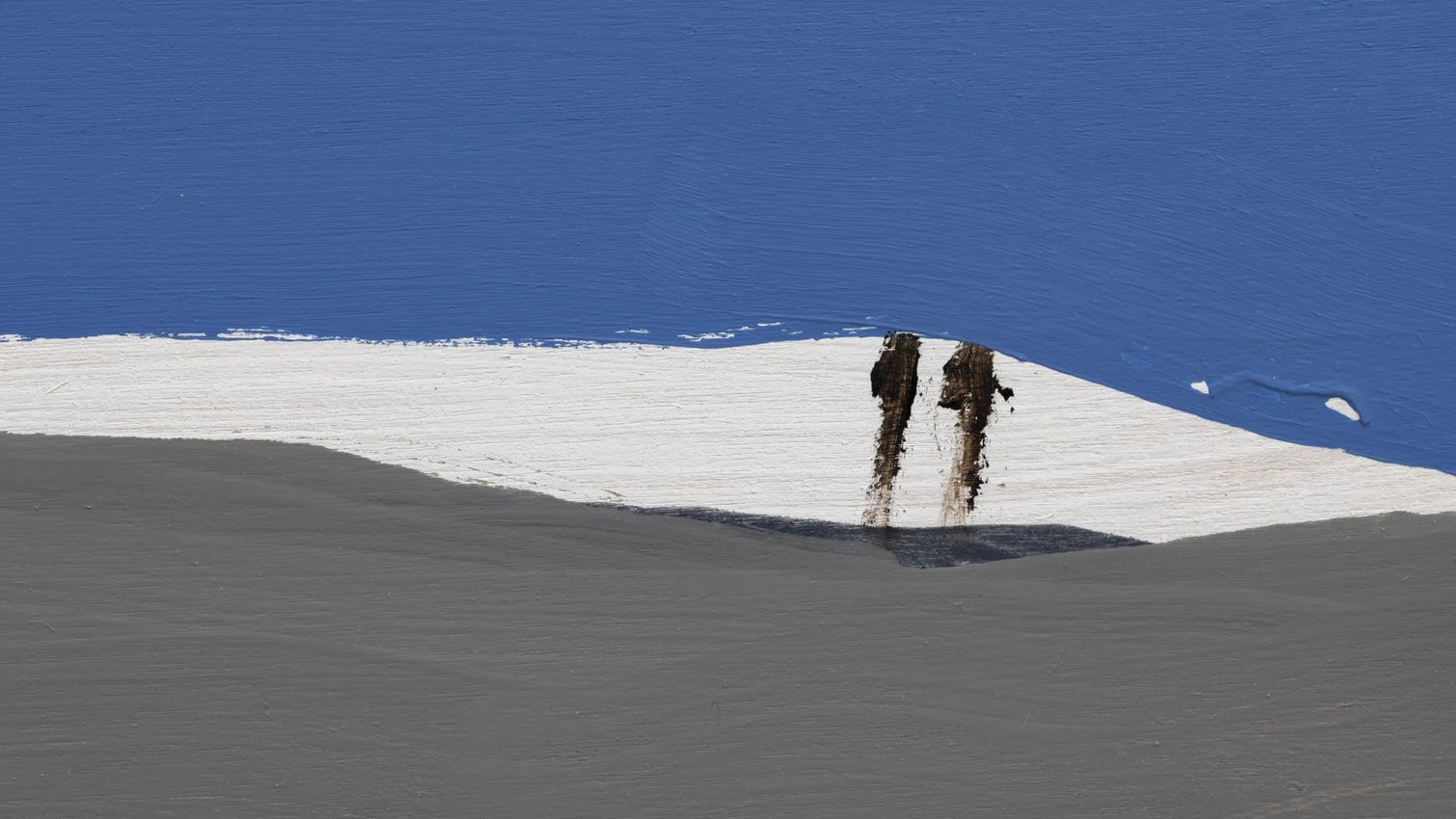
In Losing Streak, the artist constructs, in his own words, “a dangerously sentimental image,” using horizontal lines in shades of light and dark blue, gray, and white that evoke a landscape. In the lighter-colored area, two vertical lines resemble human figures. This ambiguity between landscape and figure awakens a certain vulnerability in Shear in the face of a possible misreading, leaving him exposed to unpredictable interpretations – a prospect that interests him and leads him to stick with the result, in part to observe how people react to it.
The titles add another layer to the works. By establishing a deliberately oblique relationship with the image, Shear plays with verbal language and places both himself and the viewer in a disconcerting position, as if off-kilter. The artist jots down words and phrases throughout the day that strike him as evocative or poetic, and when putting together an exhibition, he carefully revisits these notes, assessing what goes well with what. Drawing from fields such as culture, the financial world, and botany, these words act as a sliver of light that makes each work more intriguing, while not offering an analogy to figuration. In Match, a singular compositional element runs precisely through the center of the canvas, in different shades of pink, and converses with the meaning of the word, increasingly present in the virtual world, especially in dating apps.
For Shear, his visual and verbal lexicon has no practical value beyond what the viewer brings to it, functioning as a sort of renewable energy source that depends on the viewer to awaken what is familiar and what may seem strange or new. Working with multiple possibilities, the artist allows the works to develop almost on their own, while he tries to “step out of the way.” Elements even change orientation or are set aside. Shear, in his digressions, pays attention to whatever is within reach, without losing sight of the distraction and of the breaking of his own pacts, which in the end is what keeps the work resonating.
Courtesy Mendes Wood DM.
A self-taught painter, Peter Shear was born in 1980 in Beverly Farms, Massachusetts, and grew up in Valparaiso, Indiana. The deeply hued canvases in this exhibition were made on a human scale, most of them mounted on panels measuring 11 x 14 inches. Their overriding characteristic is a distinct absence of dogma: elusive and spare, they hover in an interstitial space between abstraction and representation, often incorporating elements of both. They can suggest figures, landscapes, or architecture, or simply exist as spontaneous configurations of lines and colours.


Intellectually rigorous, politically active, and highly conceptual, the programme of contemporary art gallery Mendes Wood DM places an emphasis on critical conversation, working to embrace the individuality of each artist while also supporting the discovery of intersections between practices that might initially seem disparate.

A respected voice in contemporary art discourse.
Focusing on ambitious storytelling and insightful art-world commentary. Ocula Magazine publishes in-depth interviews, critical essays and timely analysis on the artists, exhibitions and ideas driving the global art world.
Learn more about Ocula Magazine
Showcasing the best of the art world.
Ocula partners with galleries from around the world to highlight their artists, artworks and exhibitions. Gallery membership is by application and invitation, with each member vetted by an independent panel.
Learn more about Ocula Membership

Specialises in the sale of major artworks.
Led by a team with deep ties to the world’s leading auction houses, galleries and collectors. Ocula’s advisory team offers bespoke services to high-net-worth clients from around the world who are looking to acquire the best of contemporary and modern art.
Learn more about our team and services