

The art world in focus
Subscribe to our newsletter for news and insights on artists, galleries and exhibitions.

Leaving behind the established white cube booth model, the fair has assigned each participating gallery an identical aluminium table. Courtesy Prospect Cologne.
Amid the recent surge in alternative art fair models, Prospect Cologne, opening today and running until 7 November, aims to do things a little differently.
Leaving behind the established white cube booth model, the fair has assigned each participating gallery an identical aluminium table. Confined to a tabletop—measuring only 2 metres x 1 metre—and with just one freely positionable light source, presentations demand meticulous curation and invite careful looking.
This whittled-down approach is deliberate, as co-founder Manoucher Khoshbakht explained, and is intended to reflect the often constrained “conditions under which these galleries operate”. Talking to Ocula, Khoshbakht said: “Participating galleries actually used it very differently—on the table, underneath the table—as they are showing all genres including performance.”
Across the Rhine, the 59th edition of the city’s long-established art fair, Art Cologne, also opened today, boasting a line-up of 164 galleries. Yet as Khoshbakht made clear, Prospect Cologne does not aim “to compete with the existing fairs”.
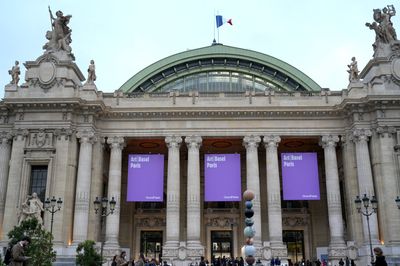
The new fair instead echoes the micro-boutique concept of Post-Fair, founded by LA gallerist Christ Sharp in 2025, and charges exhibitors a flat, more affordable participation fee—particularly when set against the five- and six-figure booth prices at, for example, Art Basel Paris. Sharp brought Post-Fair to Paris last month, located in two residential buildings in the French capital’s Marais district.
October also saw the launch of London Invitational, an intimate, invitation-only fair that drew visitors to the Chancery Rosewood hotel, just a stone’s throw from Frieze’s entrenched tent set-up.
An alternative fair in Tokyo, running alongside Designart Tokyo this week, is also based in a hotel. The inaugural edition of Tokyo Jazz Club—launched by the founders of the longer-running alternative art fair Basel Social Club—spans eight floors of a former capsule hotel, reimagining the traditional art fair format through a programme of performances, music and food.
Following in the footsteps of these nascent projects, what does Prospect Cologne bring to the table? “It’s a boutique fair—but the display, the gallery roster etc is way more conceptual, more experimental,” Khoshbakht told Ocula. “At Prospect we are dedicated to creating a community that sustains.”
The new fair’s founding team—collectors Antonia Nolte, art producer Lilli von Bodman, culture professional Carola Seher and gallerists Manoucher Khoshbakht and Max Mayer—also served as the selection committee, determining and inviting the inaugural edition’s roster of 19 galleries.
Emerging international spaces—including London’s a. Squire, King’s Leap from New York City and Rio de Janeiro’s Portas Vilaseca—share the fair floor with the city’s homegrown galleries: Galerie Nagel Draxler, Drei, Galerie Khoshbakht, Galerie Gisela Capitain and Galerie Buchholz.
The latter two, both founded in Cologne in 1986, are among the surviving remnants of a golden era for the city’s art scene, whose influence once extended beyond neighbouring Berlin to rival that of Paris and London.
Indeed, the West German city was recognised in the 1980s as one of the world’s most important hubs for contemporary art outside New York City, home to the renowned Walther König bookshop, Art Cologne (established in 1967), and the former base of blue-chip gallerists such as Max Hetzler (who was based in Cologne between 1983–1993) and Monika Sprüth (who opened a space in 1983).
However, the recession and the fall of the Berlin Wall at the end of the decade saw an abrupt shift to Berlin as the officially reinstated capital of reunified Germany.
Perhaps in a nod to the region’s heyday, Prospect Cologne occupies the Modernist premises of the former State College of Photography. “After all, everything is actually here,” as co-founder Antonia Nolte put it. “We want to show that the Rhineland is once again an internationally interesting scene.”



A respected voice in contemporary art discourse.
Focusing on ambitious storytelling and insightful art-world commentary. Ocula Magazine publishes in-depth interviews, critical essays and timely analysis on the artists, exhibitions and ideas driving the global art world.
Learn more about Ocula Magazine
Showcasing the best of the art world.
Ocula partners with galleries from around the world to highlight their artists, artworks and exhibitions. Gallery membership is by application and invitation, with each member vetted by an independent panel.
Learn more about Ocula Membership
Specialises in the sale of major artworks.
Led by a team with deep ties to the world’s leading auction houses, galleries and collectors. Ocula’s advisory team offers bespoke services to high-net-worth clients from around the world who are looking to acquire the best of contemporary and modern art.
Learn more about our team and services