The Kabbalists believed there are ten creative forces that bridge the infinite and unknowable beyond with our world here and now. Ten faces of God turned toward our material reality. Ten aspects of divine omnipresence intersecting with our everyday. Ten emanations pouring forth that divinity’s ineffablelight—the imagery foregrounds forms of illumination, luminosity, glow, and light. Each of the ten sefira, or emanations, represents a set of many abstract concepts with associated imagery and notions. The Kabbalists organized these ten sefirot into a geometric diagram of relations called the Tree of Life, with each force represented as an orb or node or knot in it. There are channels connecting adjacent sefira, positioning different aspects of divine manifestation in various relationships. Of course, it is a tree that structures how the divine presents itself to us or how we understand it. Of course, it is plant-life that will contour a mystical understanding of our existence. Being so devoted to the aesthetics of the garden and basing so much of her practice on the close study of flora, Lauter wouldn’t have it any other way.
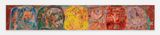
Within the Kabbalists’ tree, the sefirot are ordered in three columns with those on the right representing concepts gendered masculine, the left ones gendered feminine, and the center column representing the ideal balance of mercy and justice, an androgynous amalgam pitched between fem and masc. The particular association of genders with certain sefira is surprising to modern sensibilities, not only for the reductiveness of assigning such binaries at all but for the refreshing if unexpected and perplexing alignment of values such as mercy and compassion with masculinity, while justice, power, punishment, and fierceness are tagged feminine. Weird and provocative. At the center top of the tree is Keter, the Crown, flanked on the left and right by Bina and Hokhmahrespectively. As the headiest sefira, Keter represents primordial ether and a negation of thought, almost Zen-like. Bina encompasses understanding, discernment, and analytic thought as well as the mother, womb, redemption and language. Hokhmah is wisdom, synthetic aspects of divinity and the idea of beginnings in the sense of something growing out of seeming nothingness or a seed and, in this way, it is associated with Eden. Lauter unites these three in a large diptych loosely divided into a block of three rectangular regions containing two large circles on either end joined together across the top as though by embracing arms, the overall form of which has a striking resemblance to an anatomical view of ovaries,fallopian tubes, and womb. The bottom third foreground of the painting is spotted with red like a field of the wild red poppies that grow across southern Israel, seen in perspective getting smaller in the distance.
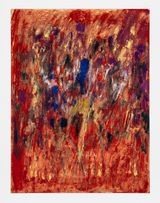
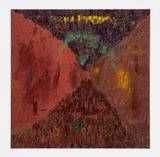
Descending down the tree is Din (judgement, power, punishment, fire, night, cloud) and Hesed (mercy, love, kindness, compassion, grace). Lauter’s painting, Hesed Sefira, has several clear figurative elements arranged symmetrically like a partial walled structure—two severed arms and two severed legs, all blackened as though charred. A shower of gray, white, yellow, and blue marks rains down. Black soft pastel has the effect of soot and smoke. Meanwhile, Dina Sefira is a symphonic blare of red in shades of blood, wine, dirt, scab, bruise, and viscera with a large eyebrow-shaped cloud form of slathered white floating in the upper half. A right-hand handprint presses against or through the surface in the lower half, ripple lines extending out and flecks of green underpainting surfacing throughout. Indeed, this whole body of work in”Sefirot” came together in the crushing aftermath and under the shadow of the attack of Oct 7th.
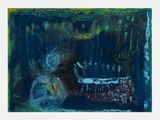
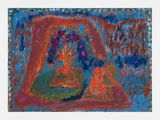
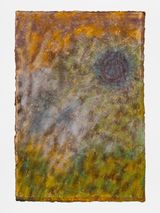
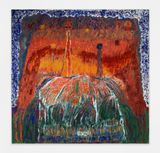
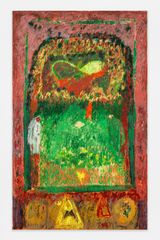
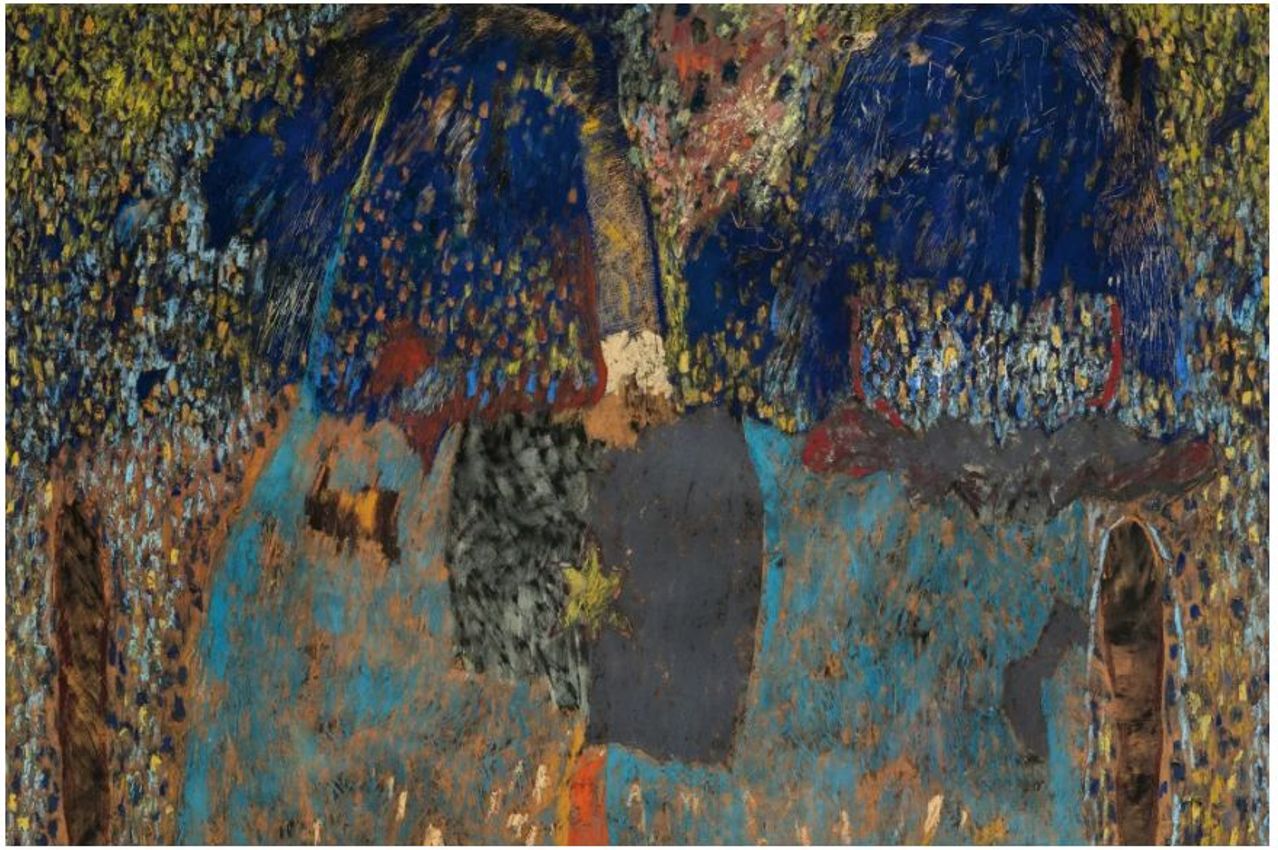
Tiferet, which represents beauty, truth, and the ideal balance of justice and mercy that holds the universe together, is painted as a kind of rectangle of lush green garden surrounded by pinks, with framing border—as though a door from the body opening onto the garden. A flapping, airborne kind of infinity figure-eight hovers above the center of the picture like a levitating, winged spirit. Moving down the Tree of Life, the next pair of concepts are Nezah (eternity, endurance, victory) and Hod (majesty, prophecy), both renditions of blue monochromes, the former full of deep dark blues that could be sea or evening sky and the latter a tall, thin pool of shimmering light aquas. Below and between them is Yesod at the base of the tree, meaning foundation and associated with peace, the rainbow covenant, commandments, remembrance and redemption, and the phallus. She paints it as a blue window or portalin the manner of her “Exquisite Corpse within a Landscape” works, a vaguely stratified and bordered smaller painting collaged into the center of the larger painting which surrounds it with a green field carrying red blooms on both sides and gold ones below like a carpet and above like a chuppah canopy.Below Yesod, Shekinah is rooted in the earth, which literally means in-dwelling, as in the in-dwelling of god’s presence in this world. The Shekinah is the cosmic feminine aspect of divinity, associated with queens, brides, and mothers as well as the spirit of the land of Israel. It is also linked to the Garden of Eden with the tree of knowledge and humanity’s expulsion following its breach—in fact, exile and diaspora are woven into this sefira. In Lauter’s rendition, Shekinah Sefira is pictured as a cluster of onion-dome-shaped mountains or hills with spires rising upward which are actually outstretched arms with hands reaching toward a small red Star of David emergent in thick relief. Dominated by reds and oranges, all of it is seen as though through a parting of blue clouds still visible around the edges.Beckoning, this exquisite and fraught beautiful Eden continues to cast its ancient origin spell on us all.
— Sarah Lehrer-Graiwer
Mimi Lauter (1982, San Francisco, USA) lives and works in Los Angeles.
Intellectually rigorous, politically active, and highly conceptual, the programme of contemporary art gallery Mendes Wood DM places an emphasis on critical conversation, working to embrace the individuality of each artist while also supporting the discovery of intersections between practices that might initially seem disparate.
Rua Iramaia 105
São Paulo
01450-020
Brazil

A respected voice in contemporary art discourse.
Focusing on ambitious storytelling and insightful art-world commentary. Ocula Magazine publishes in-depth interviews, critical essays and timely analysis on the artists, exhibitions and ideas driving the global art world.
Learn more about Ocula Magazine
Showcasing the best of the art world.
Ocula partners with galleries from around the world to highlight their artists, artworks and exhibitions. Gallery membership is by application and invitation, with each member vetted by an independent panel.
Learn more about Ocula Membership

Specialises in the sale of major artworks.
Led by a team with deep ties to the world’s leading auction houses, galleries and collectors. Ocula’s advisory team offers bespoke services to high-net-worth clients from around the world who are looking to acquire the best of contemporary and modern art.
Learn more about our team and services