Press Release

Pace Gallery is honoured to present Sam Gilliam: Existed Existing, the artist’s inaugural exhibition with the gallery since joining it in July 2019. Opening on November 6, 2020 at both 540 and 510 West 25th Street in Chelsea, the exhibition features three new bodies of work that include large-scale paintings, some titled as tributes to influential Black contemporary and historical figures; a series of geometric colour-drenched wood objects; and monochromatic paintings on Japanese washi paper. Accompanying Existed Existing is a fully illustrated monograph that includes a new interview between the artist and curator Hans Ulrich Obrist, as well as commissioned essays by art historian and curator Courtney Martin and scholar and poet Fred Moten.

Gilliam’s new sculptural works take the form of geometric objects—pyramids, parallelograms, and circles made from stacked and stained plywood and aluminium. These new sculptures developed following Gilliam’s extended stay in Basel, Switzerland, for the installation of his exhibition at the Kunstmuseum Basel in 2018, where he noticed that the city’s population had grown more international through an influx of immigrants, primarily from Africa. Inspired by this urban change and African influence, Gilliam returned to his studio and began to revisit the elemental forms of ancient African architecture.

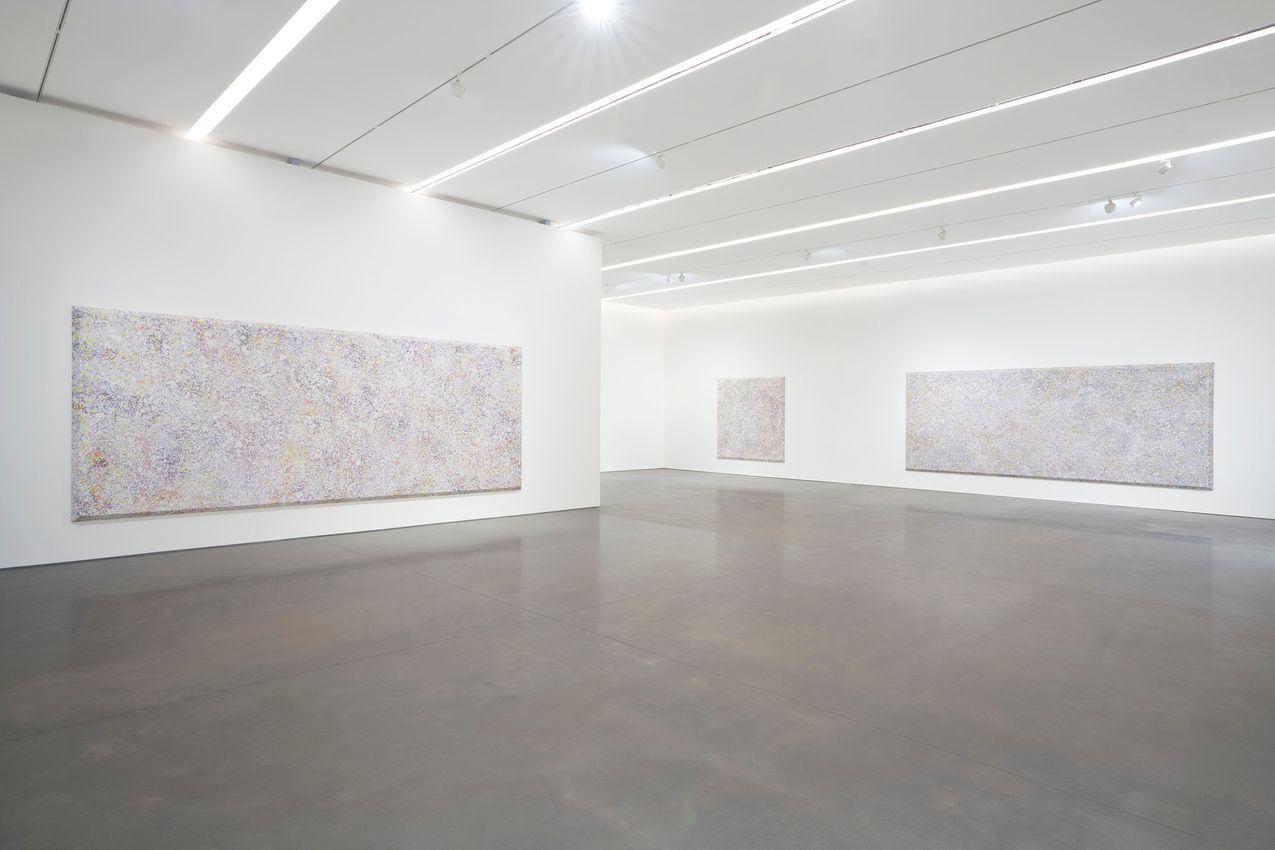
At the centre of the exhibition is a series of new large-scale paintings, measuring from six-by-eight feet to eight-by-twenty feet, that further meditate on the physicality of colour. Several of these works pay homage to Gilliam’s Black heroes, from singer-songwriter Beyoncé and tennis player Serena Williams to Senator John Lewis, the late civil rights leader who passed away this year. Densely layered and mixed with sawdust and other detritus from the studio, Gilliam flings, spatters, and throws paint to create fields of colour interrupted by impressions of the artist’s hand, the mark of a palette knife, or the traces of a garden rake dragged across the wet surface. Continuing his series of signature beveled-edge paintings, which began in the 1960s, these canvases at first appear to emerge from the wall toward the viewer. The density of the paintings at first disguises the depth of the canvas’s bevel, giving the illusion of flatness. As if offering an infinite space in their depth, each painting seems to oscillate between liquid and solid when viewed from different distances.

Complementing Gilliam’s new large-scale paintings and sculptural structures is a series of monochromatic paintings on traditional Japanese washi paper, handmade from the inner bark of specific trees and and plants. To make these works, Gilliam drenches the paper repeatedly in applications of rich, monochromatic colour. The intensity of the saturation is such that the painting can no longer be seen as paper holding colour but becomes colour in and of itself.

Gilliam’s three new bodies of work are unified by a performative sensibility: the relationships between music, art, and dance that are fundamental to his practice. Music has always been a grounding presence in the artist’s life and a strong influence on his creative output. Growing up amid the rich musical culture of Tupelo, Mississippi, Gilliam was exposed to Billie Holiday and Muddy Waters at a young age and most of his family members were musical, including Gilliam himself, who sang and played the harmonica. He credits jazz saxophonist John Coltrane for teaching him how to paint: ‘It’s time that matters: listening and realising what happened with the music, my experience of sound established these references in painting.’ For EXISTED, Gilliam has carefully choreographed the placement of each work; relationships emerge in the architectural space created by the sculptural elements, unfolding rhythmically as viewer moves through the installation.

Works from Pace’s presentation will be included in Gilliam’s solo exhibition at the Hirshhorn Museum and Sculpture Garden in Washington, D.C. in spring 2022, the artist’s first museum retrospective in the United States in fifteen years.

Read More
About the Artist

Sam Gilliam (b. 1933, Tupelo, Mississippi) is one the great innovators in postwar American painting. He emerged from the Washington, D.C. scene in the mid 1960s with works that elaborated upon and disrupted the ethos of Color School painting. A series of formal breakthroughs would soon result in his canonical ‘Drape’ paintings, which expanded upon the tenets of Abstract Expressionism in entirely new ways. Suspending stretcherless lengths of painted canvas from the walls or ceilings of exhibition spaces, Gilliam transformed his medium and the contexts in which it was viewed. For an African-American artist in the nation’s capital at the height of the Civil Rights Movement, this was not merely an aesthetic proposition; it was a way of defining art’s role in a society undergoing dramatic change. Gilliam has subsequently pursued a pioneering course in which experimentation has been the only constant. Inspired by the improvisatory ethos of jazz, his lyrical abstractions continue to take on an increasing variety of forms, moods, and materials.

View Artist Profile

Also Exhibiting at Pace Gallery

About the Gallery

Pace is a global art gallery of and for the future, modeled on a set of core values established during its founding in 1960 and designed to serve its artists, estates, and collectors in a way that is focused, responsive, and aligned with its enduring mission.

View Gallery Profile
Address
540 West 25th Street
New York
United States
Opening Hours
Tuesday – Saturday
10am – 6pm
(1)
New York 540 West 25th Street
Pace Gallery
540 West 25th Street, New York, United States
+1 212 421 3292
http://www.pacegallery.com

Opening hours
Tuesday – Saturday
10am – 6pm
The art world in focus