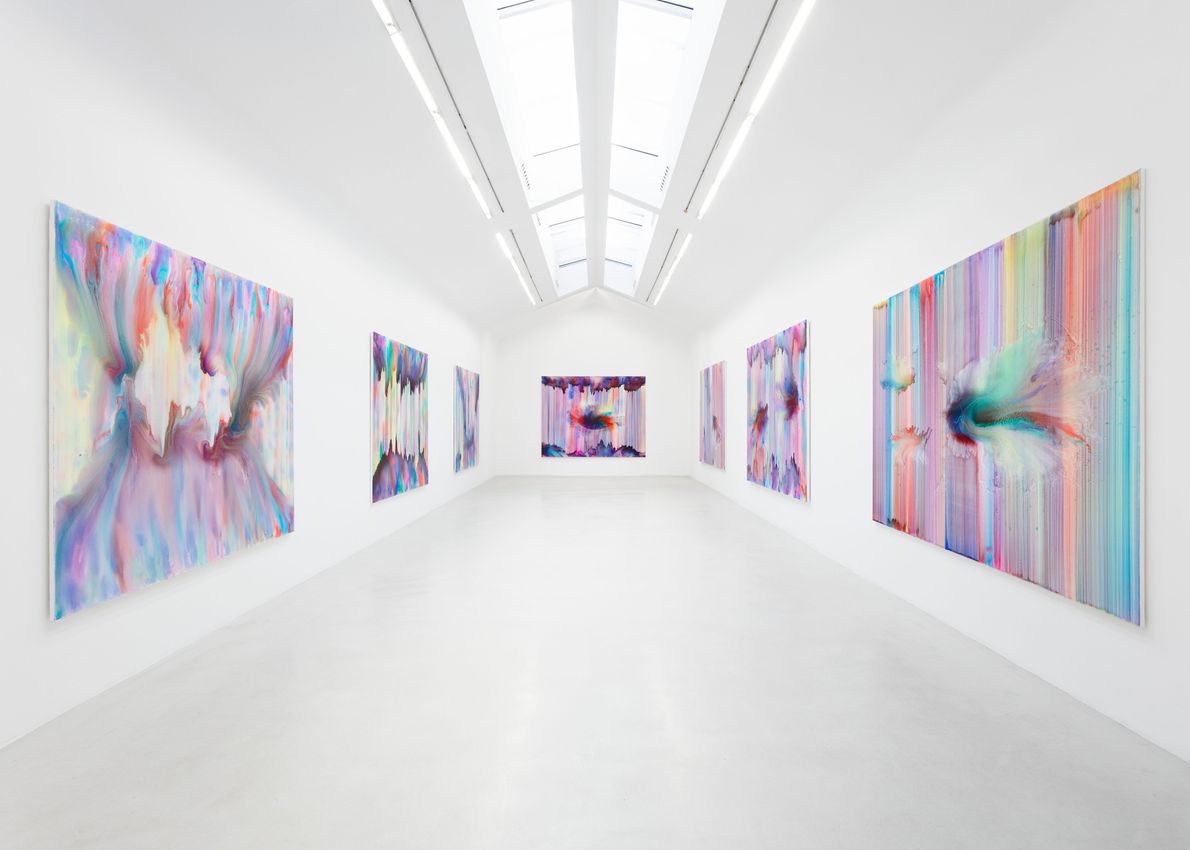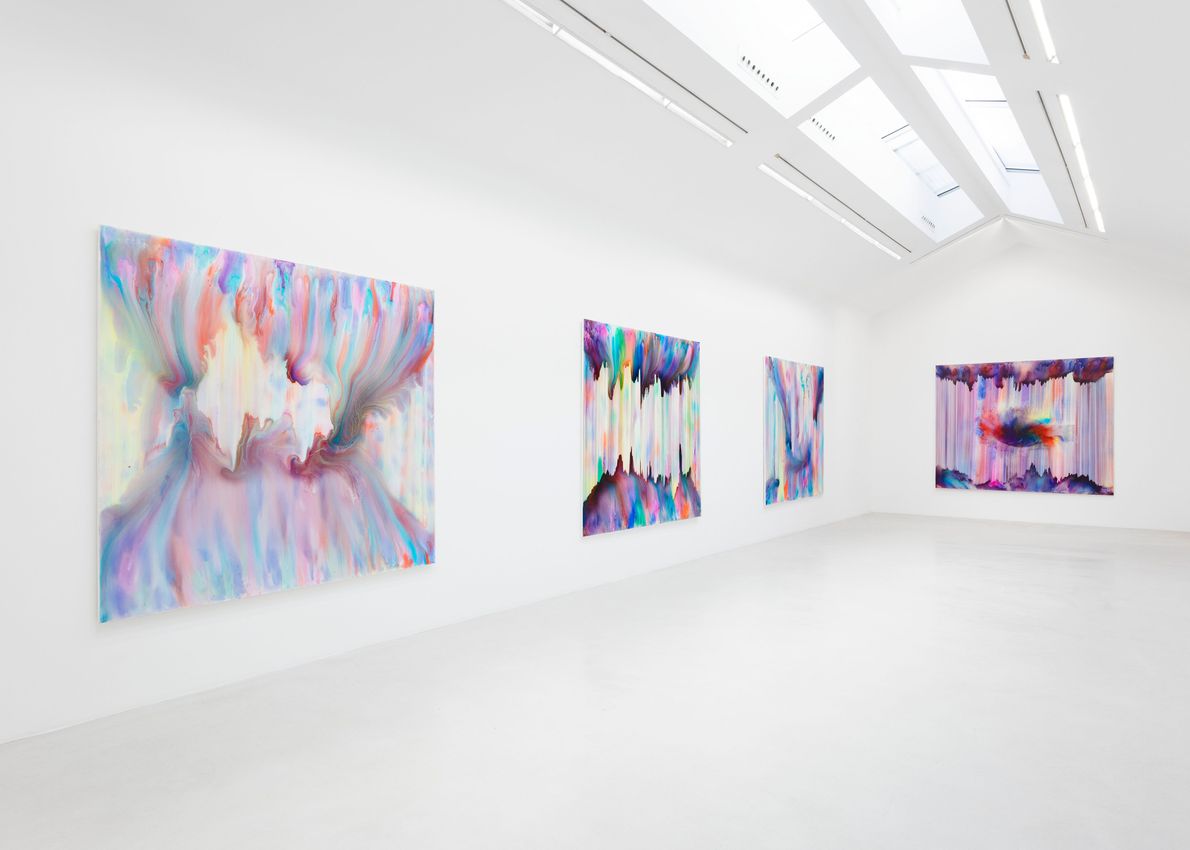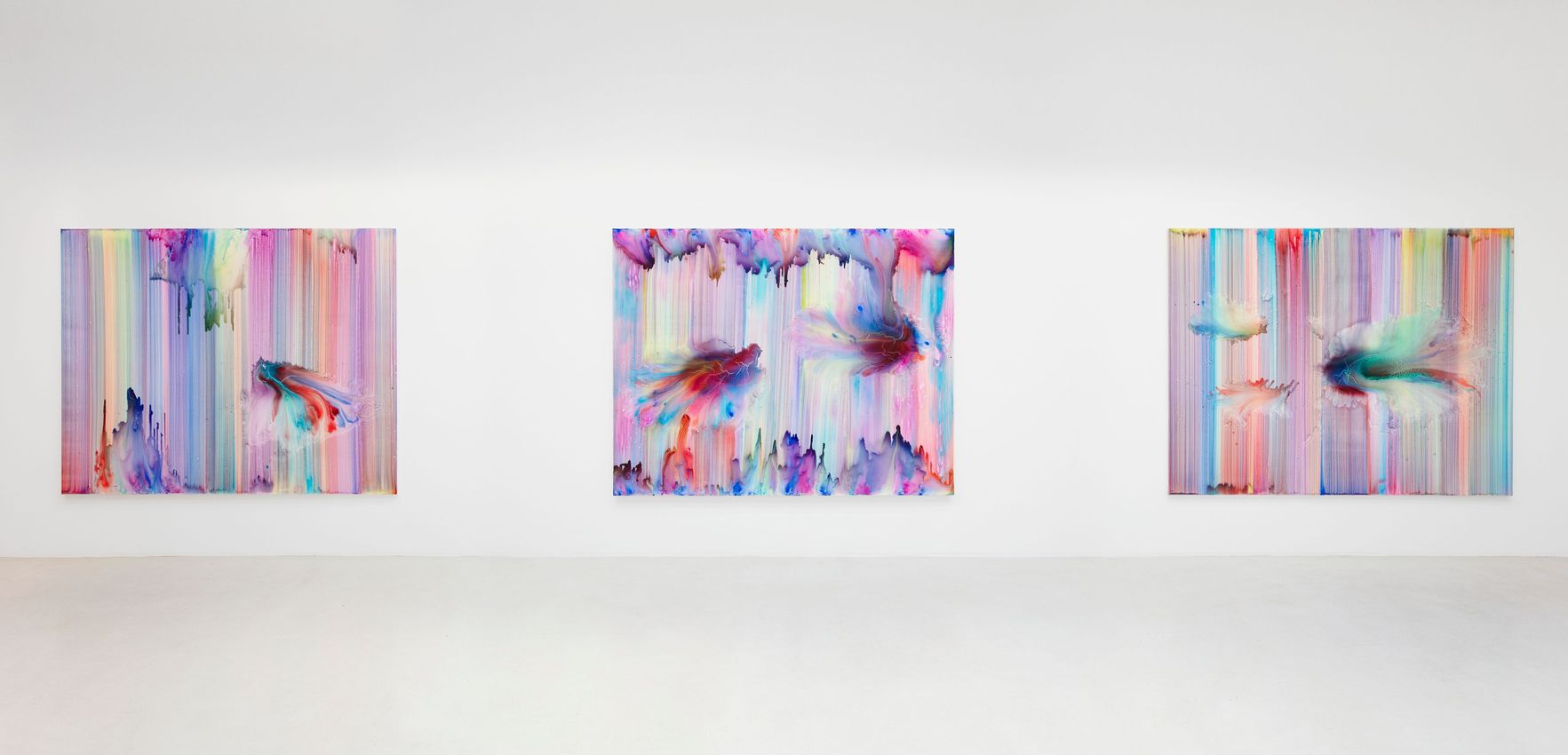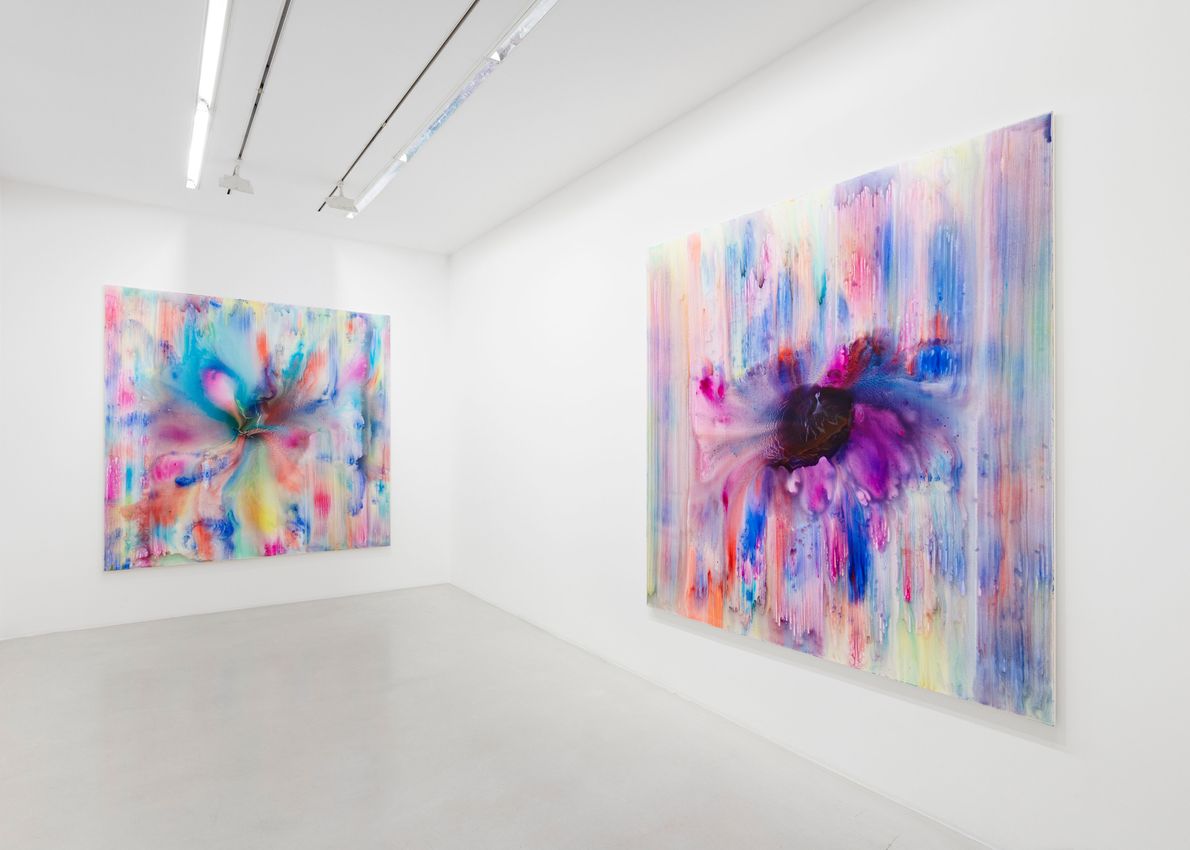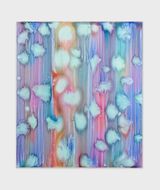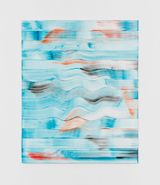
For over forty years Bernard Frize has been inventing proceduresfor making paintings without exactly knowing or predicting thevisual outcome. He has explained that the process of painting ismore important than whether the final result is aesthetically plea-sing, although it turns out that they often are. By establishingprocedures he removes himself as best he can from the work, toreduce the sense of self-expression to the barest minimum. As anartist who began working in the 1970s, at the height of minimal andconceptual art, he was, of course, aware of such artists as SolLeWitt, whose ‘Paragraphs on Conceptual Art’ first appeared in Art-forum in Summer 1967, but Frize’s approach was different. LeWitt,for the most part, did not execute his work but left it to assistants.
Frize required assistance in executing one series of paintingswhen he needed many hands to manipulate brushes simultaneously, but mostly he makes art on his own. His hand is there-fore involved. Whereas LeWitt described his work as emotionallydry, because from his point of view it was executed as though bya machine, Frize’s work is cool but can provoke an emotional response. LeWitt’s art was manufactured industrially or drawn on awall. Frize makes paintings on canvas with visible brush markswhere colour is embedded in a resin surface. It has the illusion offacture, although none whatsoever. Moreover there is a strongsense of wit and the absurd in Frize’s work. LeWitt was not immuneto absurdity – think of his Location pieces where the text describing the actions to be taken to execute a simple geometric figure,such as a triangle or a square, is so complex that it requires quitea strong logical mind to decode it. The mental effort required todraw a simple form is enormous. This mixture of complexity andsimplicity, of detail and ludicrous outcome was comparable inmany ways to the novels of the nouveau roman movement.
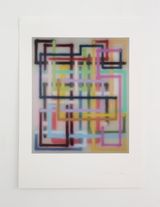
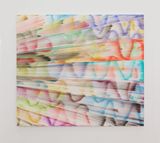
Frize’s absurdity is somewhat different, more Beckettian. Generally theproposition is a simple one and reasonably easy to execute once themovements are worked out. The titles of his works, chosen by otherpeople, are themselves absurd and tongue in cheek. For exampleDrexel Burnham Lambert, named after the investment bank, and for-mer sponsors of the Turner Prize, whose illegal trading in junk bondsforced them into bankruptcy, or Uitr which is an acronym for Unem-ployment Insurance Tax Report, or Ydin which is either Finnish for mar-row (of bones) or the name of a Finnish political magazine. Whilelinguistically rich–Frize’s work has many different appearances - it isessentially repetitive. It carries no overt symbolic meaning, little external reference, no apparent metaphor. Centred on repetition and variations on the same theme, it is full of silences, muteness, random colourcombinations that may at best suggest a mood but little more thanthat. There are no highlights, it is generally even (there are someexceptions), and though there are incidents where lines and coloursmerge or change directions they tend to abjure drama. They just are.There can be blemishes that Frize retains as evidence of the process.Like Beckett’s characters in Waiting for Godot, the viewer may wait formeaning to be revealed but for some it will be a long time coming, if atall. The surface is dead pan. There are times when what is depictedlooks as though it has been squashed flat. Take Mescali (2014) or Pulvérisée (2001) for example, the latter’s title reinforcing this suggestion,as though Frize has beaten the life out of any kind of resemblance..
What meaning can we derive from these strategies? How can weinterpret these paintings? Frize has deliberately avoided expressionismand self-expression; he has eschewed symbolic narrative at a time ofits resurgence; he has to some degree critiqued the tendency in theseventies and eighties towards minimalism–his highly colourful, somemight say jazzy works are far from minimal–and if he has adoptedconceptual strategies it is to divorce them from the domain of linguistics and structuralism in favour of something that can be sensuous,sexy, psychedelic, dizzying, and impure. His works can be alternatelysimple and baffling, posing conundrums and questioning the status ofthe artist painter. One of the fundamental questions he asks is, do weneed a painter to make a painting? Absurd as this might seem, we areentering an age when artificial intelligence may well replace the artistin the making of works of art. Although pleasurable for some to exe-cute, the work of art is a useless product of human intelligence andhand. Why not replace it with a machine? Will this develop into one ofthe tragedies of our times? That something from which we mightderive creative pleasure becomes redundant? If AI becomes or hasbecome an essential improvement to the conduct of medical operations will the use of AI really enhance the making of painting?
This might not be an answer to that question but in all Frize’s workthere is personality. He is a witty man and his humour cannot help butintrude. So if he has failed in the task of depersonalising the work it isan heroic failure. Anyone visiting his 2019 retrospective exhibition atthe Centre Georges Pompidou could not fail to notice that he has asignature style. A Frize painting is instantly recognisable even if thereare a multitude of appearances. The surface is always smooth (theFrench word lisse seems to describe it better than the English) andflat, although the illusion of space may emerge in the end. The paintings can be seductive, their colours brilliant, generally clear but alsosometimes gradated, at times pure at others intermingled. But they canalso be somewhat alienating. Beauty overspills into kitsch. Paintingsthat are abstract cannot help but conjure references to the outsideworld. Frize lures you into a non-referential zone and then abandonsyou. Is it sustainable that the work is exclusively about process, aboutitself, self-referential? Can the viewer remain in this pure state? Thereare definitely times when chinks of the outside world intrude. Is it acoincidence that the oil paintings Jacob, Terah and Isaac (all 2004)resemble the patterns found in Bargello embroidery or that _Emir_(1993) has landscape overtones? Such paintings as Lescilia (2014)evince memories of playing with kaleidoscopes as a child, those longtubes that one turned to create magnificently coloured patterns. Theyare perhaps the unintended outcomes of the painting process but theimages resonate in the world and, as he explains, Frize ‘enjoys themisunderstanding of the painting working on several levels. I’m interested in an abstract painting not being pure, reminding you ofsomething you have already experienced.’ That is something beyondhis control.
The exhibition at the Centre Pompidou allowed Frize to pause and toreflect. He realised that over the years he had done very few large-scale paintings, unlike many of his European and American contemporaries. For years he had wanted to make what he calls ‘humble’ paintings. He rejected the cult of personality, the god-like status of thecanonical artists that pervaded the 1980s and 90s and just wantedthe paint to do the talking. It seemed to him inappropriate to the ageto paint vast machines that might suggest certainty, that might turn outto be bombastic, empty vessels for highfalutin thoughts about life, des-tiny or history. Thus his painting strategy could be said to be the resultof a political decision.
The era of the heroic is long over. Much as he admires the work of sayBarnett Newman, and especially his writings, Newman’s approach topainting, involving the re-presentation of tragedy and myth abstractly,and on a massive scale, as a positive response to the destruction ofcivilisation, an attempt to rebuild and to rehabilitate myth and the spiritual out of the ashes of war and the holocaust, was no longer viable toa younger generation. If Newman was one of the few painters of hisgeneration to mask feelings in his paintings by adopting a deadpan surface–notwithstanding the bleeds and stains that occur in the ‘zips’that reveal frailty and humanity–his heroic, almost declamatoryapproach was bypassed by subsequent generations. ‘I always dislikeddogmatism’, Frize explains. ‘Painting is a philosophical research withits own means, not a production of commodities. An exhibition is anexhibition of ideas embodied in canvases.’ But now in his seventiesFrize is coming around to making paintings on a public scale that suggest he has more to say than just about painting.
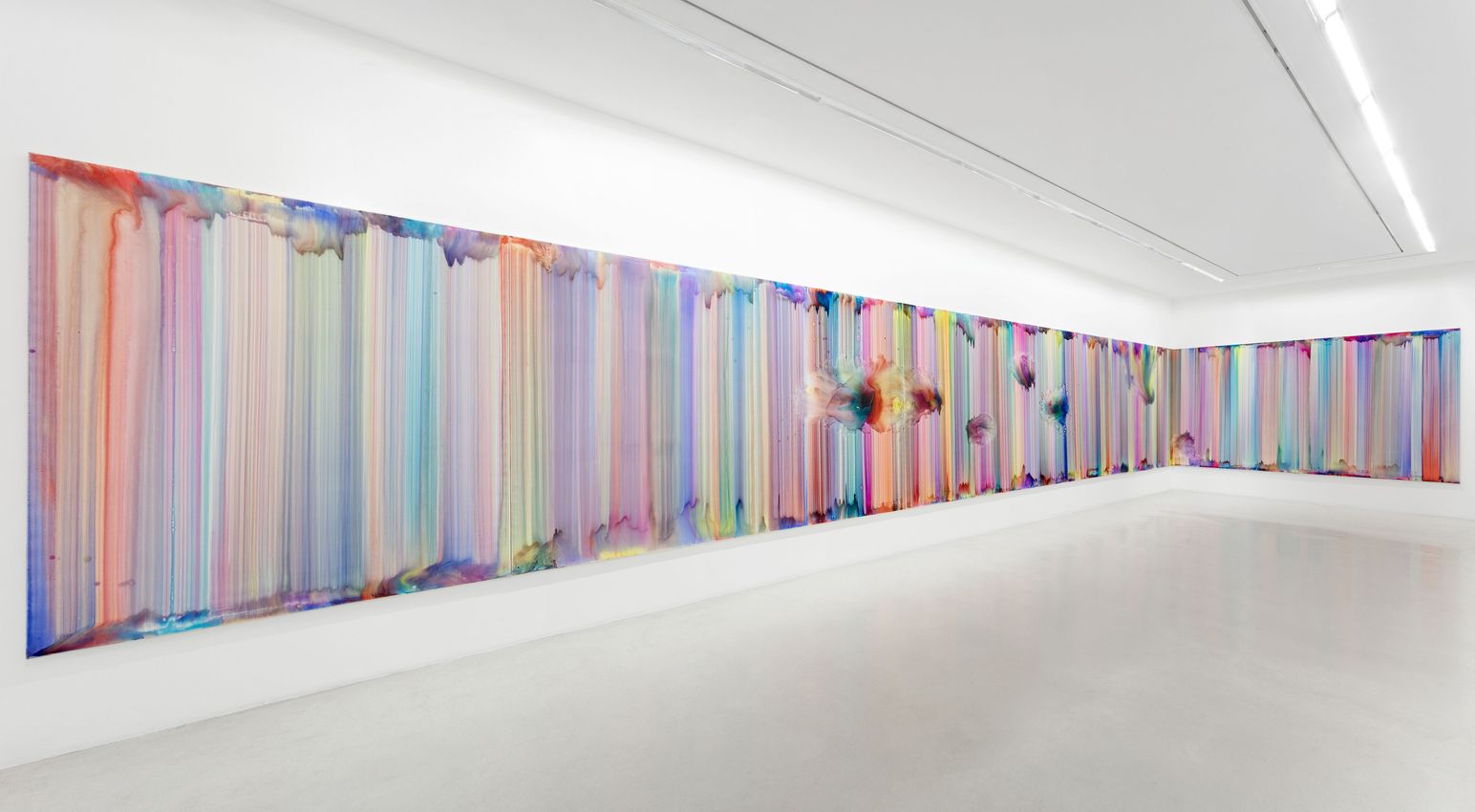
Pelodisag (2022) is the largest painting that Frize has made to date.Over sixteen metres long, consisting of nine abutting canvases, it iswider than Claude Monet’s paintings in the Orangerie, and more thanthree times wider than Newman’s Vir Heroicus Sublimis (1950–1951).Painted in a sequence of nine panels that abut, Frize has never had theopportunity to see it assembled in his studio, which is far too small. Hepainted the canvases two at a time to ensure continuity. As he nearedthe edge of the second canvas, he would set aside the first and abutthe third and then carry on over the edge of the second to the thirdcanvas and so on. Thus although he knew what the preceding canvaseslooked like he never had a sense of the whole. It is an episodic way ofpainting, perhaps a way of constructing a narrative in time. With impishwit he states that he was ‘trying to make a painting that will be hard tosell’. How absurd is it that an artist wants to make an unsellable pain-ting? And yet there is a tradition of artists who have wanted to circumvent the market. Think of Fluxus or early conceptual works, orperformance art, although the market eventually finds ways to commodify everything.
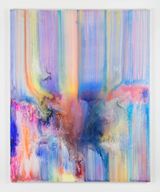
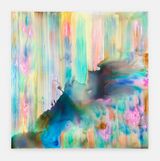
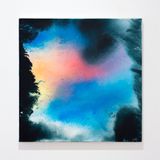
Frize executed this painting, like all the others in the show, flat on trestles. Each canvas is of a scale that accommodates his reach. He flooded the canvas with liquid resin, dotting blobs of paint randomly all overand, drawing a large brush through the paint from the centre to theouter edge and back to the centre, allowed the paint to flood back.What emerges from this method is essentially an auto-destructive pain-ting, one where the marks of the brush are disrupted and obliterated bythe pooling of paint. The process of making the painting–brushing –is overcome by the properties of the liquidity of the paint. Notwithstanding that the paint is drawn back, it pools because, although the canvasis perfectly flat, it sags under the weight of the materials. There is thusa great regard for the truthfulness of the materials, which act accordingto their properties. He refuses to negate the liquidity. What results is animperfection, a breakdown of order, a corruption of perfection. Intentionality is ultimately overpowered by the accidental, and the materialsbecome co-author of the work. The pools become eruptions to the status quo.
There have been previous occasions when paintings have disintegrated, but they are rare. In Spitz (1991) the serpentine lines decompose and, more recently, in Oude (2018), blotches obscure the vertical,linear traces. It seems there have been times when Frize has neededto purge himself of the perfect outcomes of his strategies, when he haswanted to be disruptive, but none more so than in this new sequenceof works. If most of the outcomes in previous works were foreseen the
outcomes here are unpredictable, unstable. Perhaps this was the resultof seeing so much work assembled together at the Centre Pompidou.Maybe he sensed a need to negate the perfection of his work. Frizehas remarked that ‘There are periods of construction, expansion, andperiods of corruption.’ Corruption helps him to create ‘new settings’, in order to start again.
But I think more is at stake here. We are living in uncertain, unstabletimes, when civilisation as we have known it over the last seventy years,following post-war reconstruction, is breaking down. We exist in apost-truth world, where lies are validated and truth dismissed, wherecorruption is rife, military conflicts are fought for spurious reasons andwith no regard for the conventions of war, where human values areabandoned in favour of the harshest asylum and immigration policies,where moral values are imposed by superior force, and where the environment is so compromised that we are on the verge of a catastrophicclimate change. If these themes are perhaps too onerous for these newworks to carry, they were in my mind as I looked at them. They areexplosive, almost apocalyptic paintings, full of incident in a way thatFrize’s previous work seems to avoid. Far from being meaningless theirabsurdity represents the world we inhabit.
Press release courtesy Perrotin. Text: Jeremy Lewison.

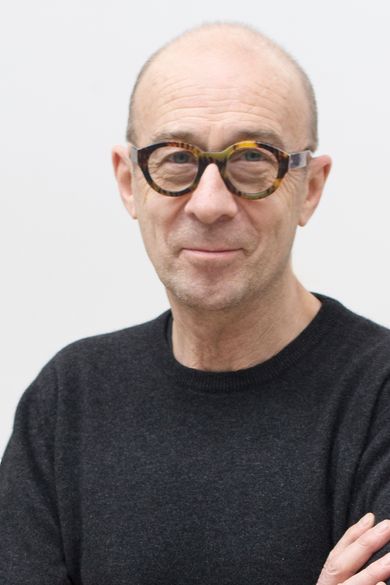
Bernard Frize’s abstract painting is decisively process-oriented. Working in series, he explores all the possible visual outcomes of precise protocols, which he conceives beforehand. These pre-established conditions and constraints usually pertain to the use of very conventional tools and materials, the almost mechanical execution of seemingly simple gestures, and sometimes the simultaneous assistance of other painters. While they each record the peculiar dynamics of a predetermined technique, his vibrant abstractions are also arenas for chance to operate. By outsourcing some of his creative power to contingency (starting with his highly distinctive yet random colour palette), he allows for painterly events or disruptions to unfold on his canvases. At once calculated and random, conceptual and organic, his aesthetics portends an automatic ideal of painting. With much humour, Bernard Frize actually describes his most successful works as the ones that required minimal intervention from him and thus realised themselves to some extent autonomously.


Emmanuel Perrotin founded his first gallery in 1989 at the age of 21. He has opened since then over 17 different spaces, with the aim of continuing to offer increasingly vibrant and creative environments to experience artists work. He has worked closely with his roster of artists, some since more than 25 years, to help fulfil their ambitious dreams and projects.

A respected voice in contemporary art discourse.
Focusing on ambitious storytelling and insightful art-world commentary. Ocula Magazine publishes in-depth interviews, critical essays and timely analysis on the artists, exhibitions and ideas driving the global art world.
Learn more about Ocula Magazine
Showcasing the best of the art world.
Ocula partners with galleries from around the world to highlight their artists, artworks and exhibitions. Gallery membership is by application and invitation, with each member vetted by an independent panel.
Learn more about Ocula Membership

Specialises in the sale of major artworks.
Led by a team with deep ties to the world’s leading auction houses, galleries and collectors. Ocula’s advisory team offers bespoke services to high-net-worth clients from around the world who are looking to acquire the best of contemporary and modern art.
Learn more about our team and services