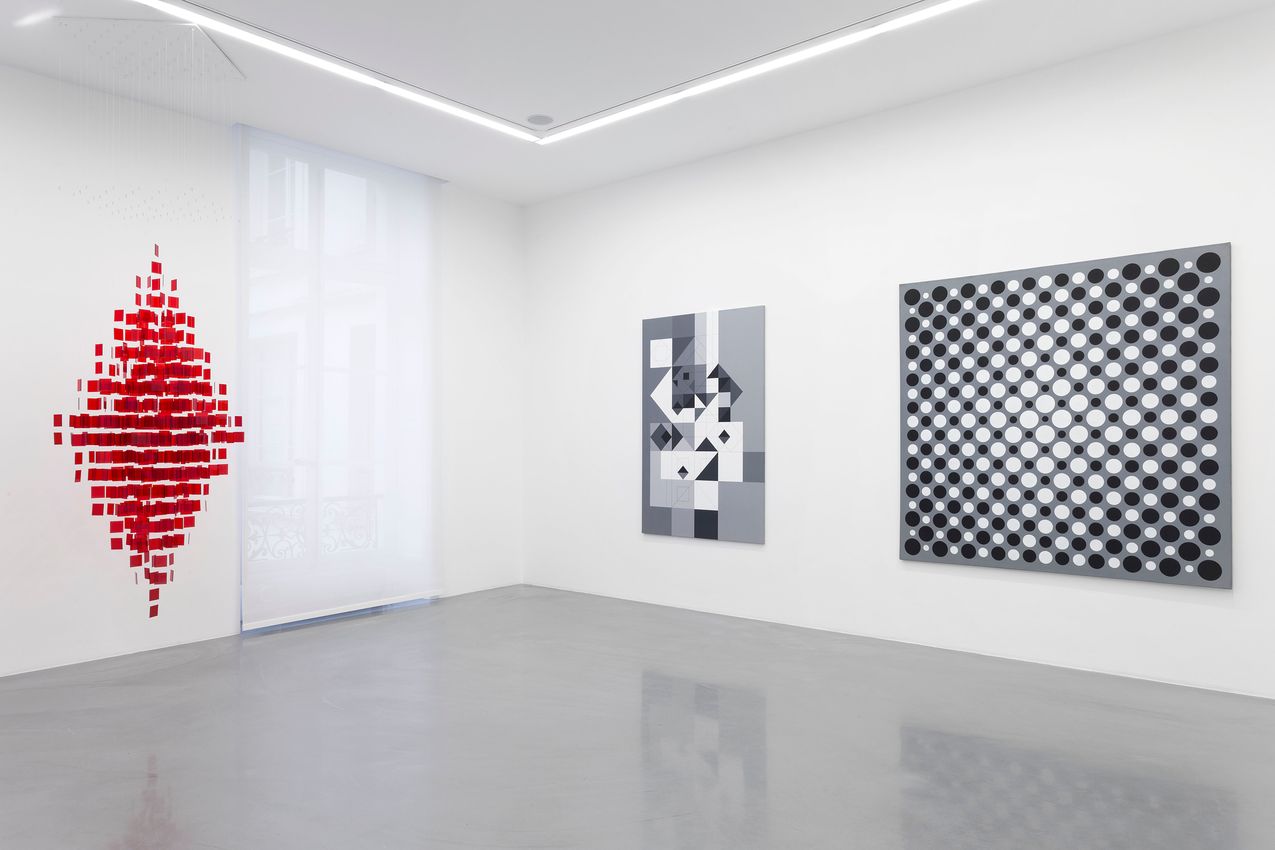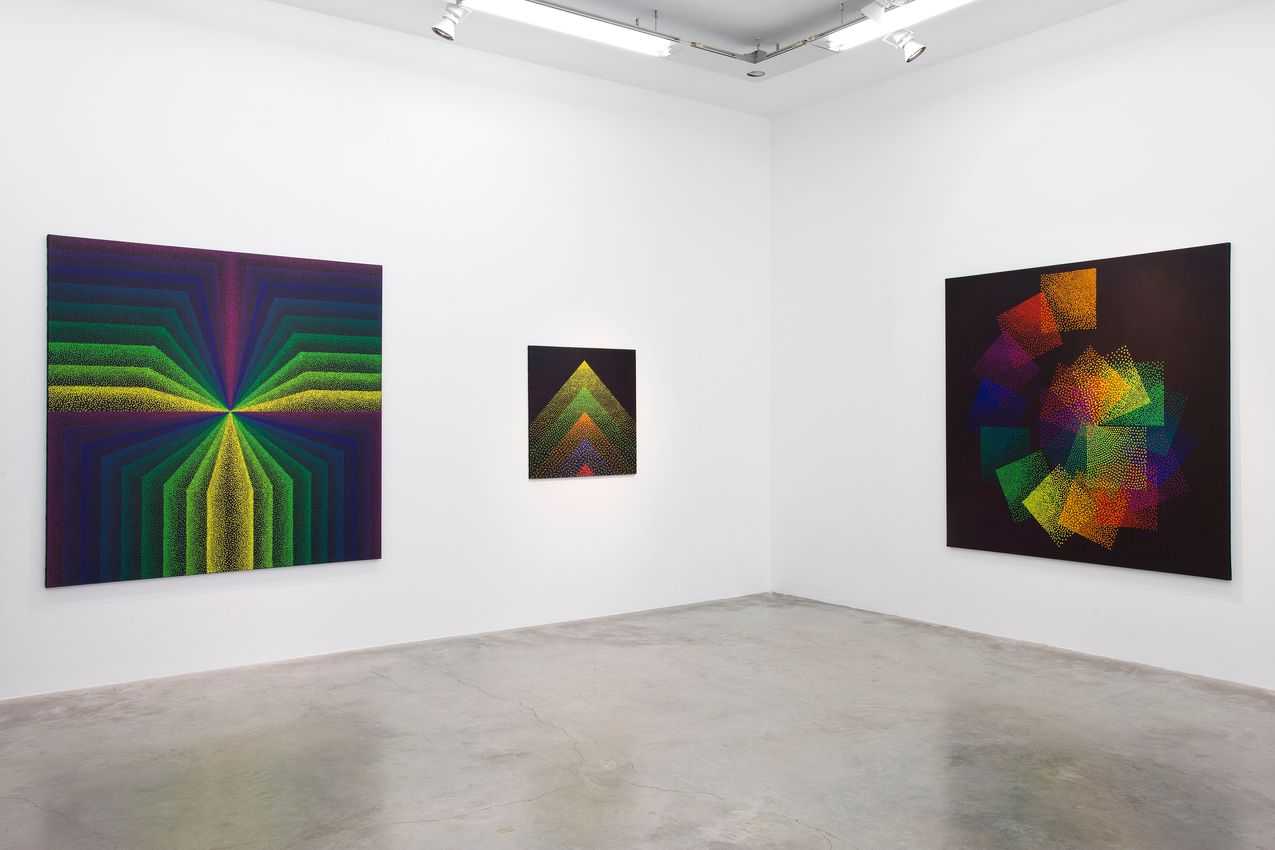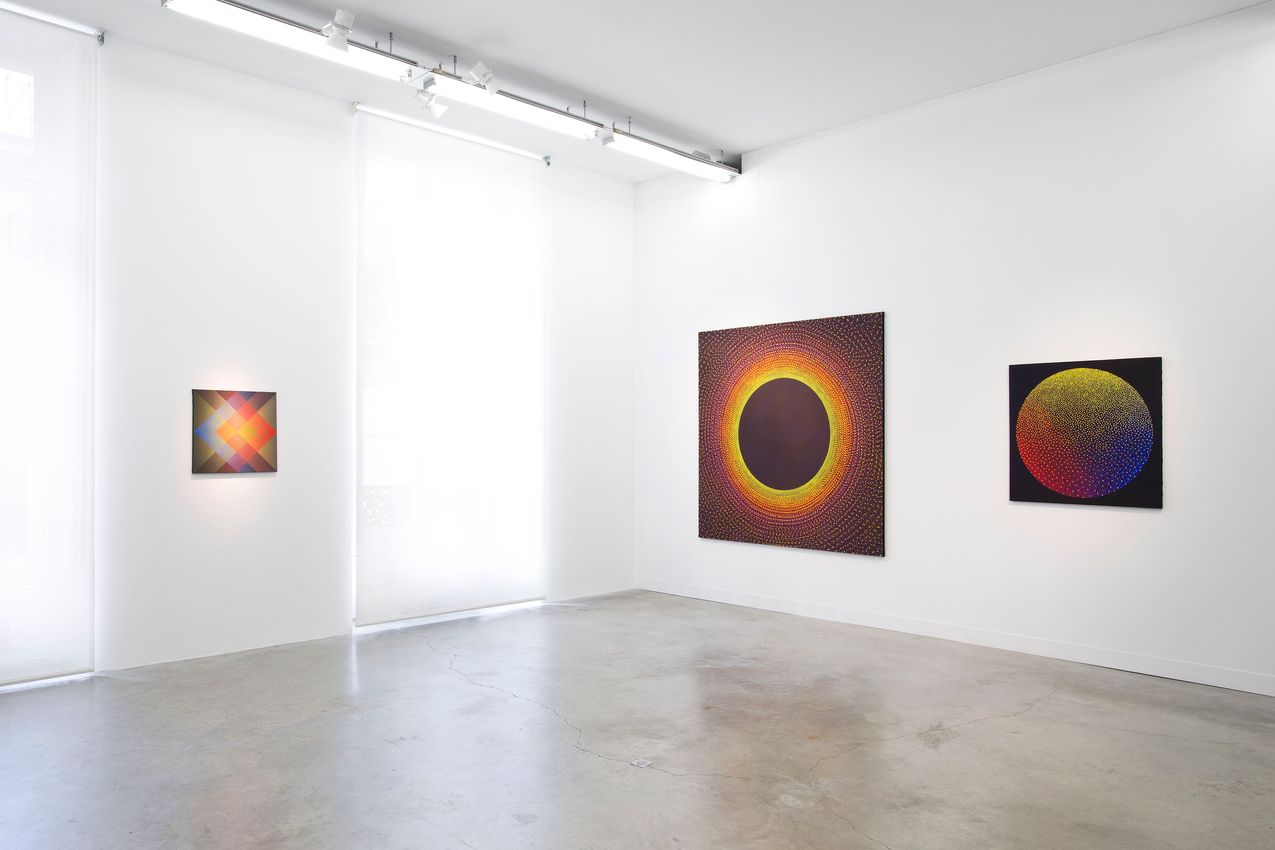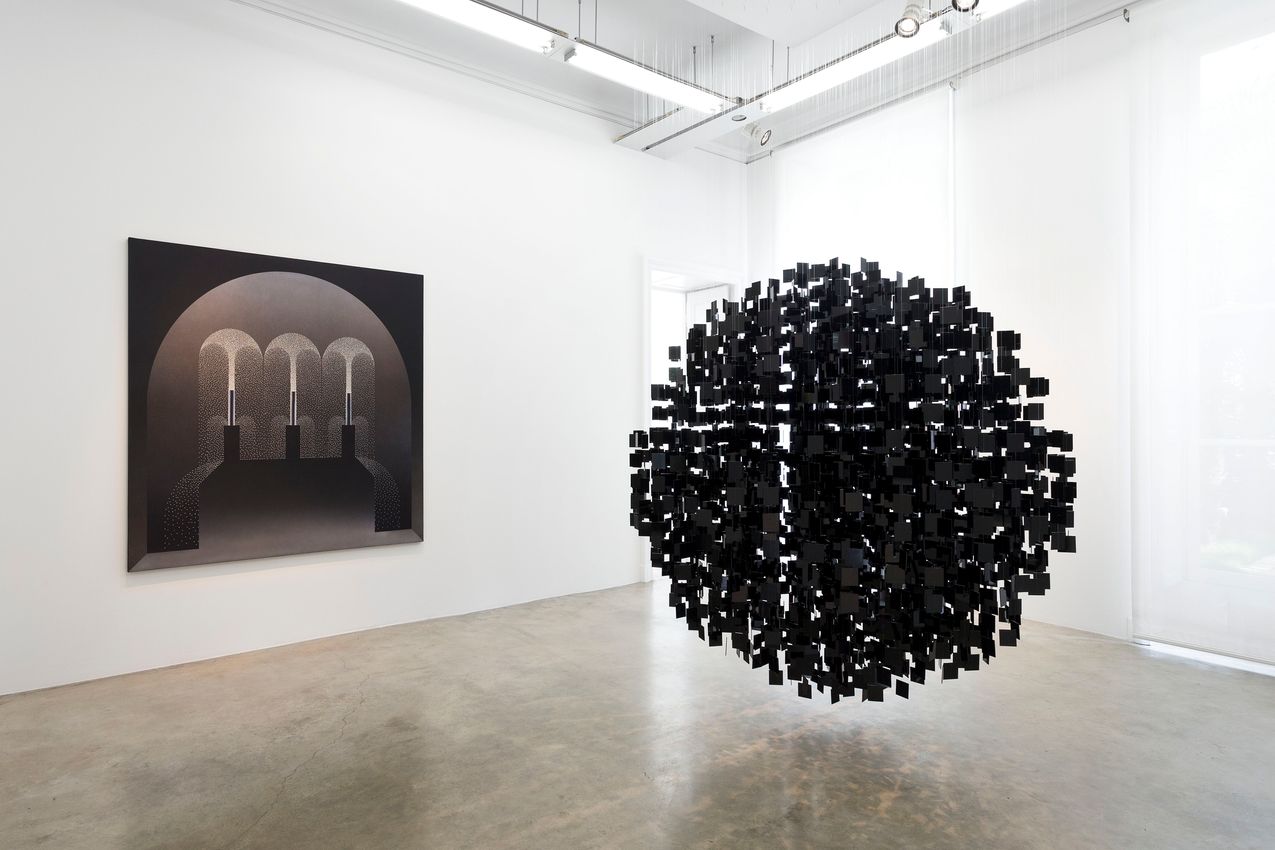
Following his major retrospective at the Perez Art Museum, Miami and his concurrent exhibition at Perrotin New York, Julio Le Parc, 89 years old,returns to Paris with an exhibition of recent and historic works.
Both floors of the gallery will be dedicated to new installations and mobiles that will be exhibited alongside recent paintings. Shown for the first time,these works will create a dialogue with the historical paintings, sculpturesand installations from the 70’s to the 90’s. Lastly, a virtual reality artwork,designed with his son Juan Le Parc, will offer an insight into the artist’s work.
On the occasion of the exhibition, Perrotin will publish a comprehensive bilingual book, which will include a text by Hans-Ulrich Obrist and an interview betweenthe artist and Jérôme Sans.
Extract of the catalog “Julio Le Parc, Bifurcations”, Perrotin, 2017
********Julio Le Parc’s art burst with boundless energy. Encountering him in his studio in the Paris Cachan suburb, he exudes a sense of youth and constantexperimentation. Born in Argentina in 1928 and living in France, he is knownfor using projected, moving and reflected light to create works of art in constantflux which are as vibrant today as they were at the time of their creation.At the heart of his practice is a desire to experiment with our engagement and perception of art, thereby altering our perspective on the roles of the artist, the spectator and the institution, as well as a firm belief in the seditious potentialof art. A note he wrote for Instagram at the time of his exhibition at the SerpentineSackler Gallery, London in 2014 read: “Optimismo siempre” (optimism forever),a sentiment echoed by his playful and irreverent oeuvre.
Through his experimentation with light, Le Parc creates situations of visualinstability, in the work and in the viewer’s experience. These immersive and interactive installations are often activated by the viewer’s participation—shifting the focus of his work from the hand of the artist to the spectator.When I visited him in his Paris studio in 2013, he told me, “In my practice,people see what they see. A form of mystification comes into play when thereare intermediaries, from art critics to art historians, texts, museum directors,galleries and also the market.”
Early on in his formation, as he attended the Fine Arts School of Buenos Aires in the 1940s, Le Parc became immersed in a movement that reflected upon the political engagement of artistic forms. In many of our interviews we discussedhis figurative contemporaries, inspired by Mexican muralists, and their abstractcounterparts: “They [the figurative artists] were left-wing and they expressedthemselves through figuration. They wanted to highlight social injustice,exploitation and the radiant future of struggles. [By contrast] the groupConcreto-Invención produced geometric forms and saturated colours, but they alsoconsidered themselves left-wing. They presented themselves as being engagedwith Marxism, with dialectics, and they say that one could intervene throughcolour and basic forms without the need for figuration. For me, these considerationswere very important. We have here the same denunciation of an unjust society,the same drive for change, and yet two opposing forms of expression.”
Since his very first experiments, an unmediated encounter between the artwork and the viewer was paramount: “We tried to create a relationship with viewersthrough the medium of the visual, of the retina, and by eliminating the anecdotal.We wanted it to be direct, that the surface of the work be what it was and stoodon its own, without trickery, in order to create a direct relationship with the eye.“Inspired in part by Mondrian’s works, Le Parc’s works developed in a stronglyoptical and kinetic direction: “Our concern was to create paintings in whichthe whole was dictated by a system, while producing a visually interesting result.We called this ‘instability’, in the sense that the eye is not only stimulatedat the point on which it focuses, but also in the periphery. This creates a movement —there is never a fixed point; something is always happening on the sides,it’s dynamic.”
“Light made you think, and, there was light”, Le Parc wrote on a note in response to my question about his works with light and environments, echoing and modifying the demiurge’s word in Genesis into an interactive encounterof perception and thought. Le Parc’s first works with light date back to 1959and highlight a development in his practice from kinetic object-based worksto moving-light installations. These, now regarded as his most iconic artworks,stem from his continued investigation into the public’s engagement withart and the uses of exhibition spaces. This series bring forth different forms of engagement through a variety of optical illusions while using the same medium:light. Light that reflects, that is projected, or that is in movement emphasisesthe endless possibilities of perception offered by a common medium.
When I asked him about his relationship to architecture, Le Parc referred to thisin as “potential architectures”, though the works’ significance remains firmlyrooted in the experiential: “Little by little I realised that perhaps I could develophe capacity to stimulate the imagination by manipulating elements that are moreaccessible than space itself, by making interventions on the surface. Even if thereis always an idea behind it, and nothing is ever superfluous, it is not about throwingpaint against the wall—there are sequences, transformations, situations...
Julio Le Parc was born in 1928 in Mendoza, Argentina. He works and lives in Paris since 1958. He was awarded the International Grand Prize for Painting at the 33rd Venice Biennale in 1966. Julio Le Parc is a defender of human rights,he fought against dictatorship in Latin America through numerous collectiveanti-fascist projects. His works are part of the main worldwide public collectionsand are regularly shown in international exhibitions. Julio Le Parc has recentlybeen invited for monographic exhibitionsat the Perez Art Museum, Miami, USA, 2016, the Serpentine Sackler Gallery, London, UK, 2015, and the Palais de Tokyo, Paris, France, 2013. He has shownwithin the group exhibitions Art Unlimited Basel, Switzerland, 2017; Eye Attack - Op art and Kinetic art 1950-1970 Louisiana Museum of Modern Art,Humlebaek, Denmark, 2016; The Illusive Eye, El Museo del Barrio, New York,USA, 2014; Phares, Centre Pompidou Metz, France, 2013; Art Turning Left:How Values Changed Making 1789-2013, Tate Liverpool, UK, 2013; Dynamo.Un siècle de lumière et de mouvement dans l’art 1913-2013, Grand Palais, Paris,France, 2013; Modernités Plurielles 1905-1970, Centre Pompidou, Paris,France, 2012; Ghosts in the Machine, New Museum, New York, USA, 2012; Suprasensorial: Experiments in Light, Color and Space, Hirshhorn Museum andSculpture Garden, Washington D.C, USA, 2012.
His works are part of the main worldwide public collections: MoMa New York, Tate London, MNAM/Centre Georges Pompidou Paris, LACMA, LouisianaMuseum of Modern Art Humlebaek, Musée d’art contemporain de Montreal,MACBA Buenos Aires, Walker Art Center Minneapolis, The Museum of Fine ArtsHouston, Musée d’art Moderne de la ville de Paris, Museo Nacional Reina Sofia,Guggenheim Abu Dhabi, Museum Boijmans Van Beuningen Rotterdam,Albright-Knox Art Gallery, Buffalo, Cisneros Fontanals Art Foundation, Miami,New Orleans Museum of Art, Delgado Museum, New Orleans.


Emmanuel Perrotin founded his first gallery in 1989 at the age of 21. He has opened since then over 17 different spaces, with the aim of continuing to offer increasingly vibrant and creative environments to experience artists work. He has worked closely with his roster of artists, some since more than 25 years, to help fulfil their ambitious dreams and projects.

A respected voice in contemporary art discourse.
Focusing on ambitious storytelling and insightful art-world commentary. Ocula Magazine publishes in-depth interviews, critical essays and timely analysis on the artists, exhibitions and ideas driving the global art world.
Learn more about Ocula Magazine
Showcasing the best of the art world.
Ocula partners with galleries from around the world to highlight their artists, artworks and exhibitions. Gallery membership is by application and invitation, with each member vetted by an independent panel.
Learn more about Ocula Membership

Specialises in the sale of major artworks.
Led by a team with deep ties to the world’s leading auction houses, galleries and collectors. Ocula’s advisory team offers bespoke services to high-net-worth clients from around the world who are looking to acquire the best of contemporary and modern art.
Learn more about our team and services