Perrotin Seoul presents Paradise Opens Tomorrow, the first soloexhibition in Korea by Iranian painter and muralist Mehdi Ghadyanloo.Gaining international recognition for his unique paintings and publicart that weave surrealist imagination with optical illusions, this exhibitionsurveys Ghadyanloo’s artistic universe and brings together a diversebody of works that examine the anxiety and hope of human existencethrough meticulous architectural spaces and subtle interplays of light.
Grounded in geometric structures and minimalist spaces, Ghadyanloohas long addressed themes of isolation, solidarity, freedom, andcontrol. Labyrinthine boxes, ladders, floating balloons, and playgroundrides on his canvases capture fleeting moments where stark realityintersects with dreamlike narrative, fluidly crossing the thresholdsbetween despair and salvation, repression and play. Through highlyrestrained compositions and trompe-l’œil techniques, the artistsimultaneously manifests the visual tension and poetic lyricism ofpainting, offering an evocative metaphor for the universal humancondition in an era of uncertainty.
Escaping Rooms: The art of Mehdi Ghadyanloo
I.
The year is 2026. Squid Game: America is rumored to start filmingon February 26. Two days later, Tomahawk missiles slam into anelementary school in the Iranian city of Minab, killing more than 175.Most are schoolgirls aged seven to twelve. Hours later, Runwaymagazine gushes about Madonna at Dolce & Gabbana’s Fall/Winter2026-27 show in Milan, “the greatest act of resistance is remainingunmistakably yourself.”1By sunset, the Gulf is aflame, and the AyatollahKhamenei and several high-ranking Iranian officials are dead. OnSaturday Night Live, Sarah Sherman says to Connor Storrie, thecurrent it-boy of Heated Rivalry, “I know! You blew up so fast!” It isthe first day of Operation Epic Fury.
After the horrors of the first world war, the cultural theorist WalterBenjamin wrote: “Mickey Mouse proves that a creature can stillsurvive even when it has thrown off all resemblance to a humanbeing.”2Writing in 1931, Benjamin depicted Mickey as a fun-loving,indestructible Frankenstein of nature, technology, and humanity,whose films captivate millions because “the public recognizes its ownlife in them.”3Almost a century later, six months into the U.S.-Israelwar on Iran, Mickey’s ghost still flickers cheerfully in Paradise OpensTomorrow, Mehdi Ghadyanloo’s first show at Perrotin Seoul thatruns from November 5.
Ghadyanloo is Iran’s most renowned artist working with public art. Hiscolossal murals have transformed over a hundred concrete façades intosignature trompe l’oeil scenes: playful, serene, sometimes uncanny.
After the 1979 revolution, Iranian authorities organized the productionof public murals, many of which now depict revolutionary scenes,fallen martyrs, and anti-western messaging. Ghadyanloo’s muralistlanguage is singular and recognizable: eschewing the typicalspectacular propaganda imagery and hagiographic portraits, he preferswide-angle landscapes that quietly subvert existing architectural andenvironmental elements, like daydreams intentionally anchored toblueprints. The people in his murals are tiny but purposeful, full ofverve and agency: cycling up sides of concrete towers, airborne onballoons, unrolling building façades like engineers of better worlds.These worlds are replete with infrastructures of mobility and possibility:ladders, skylights, portals, planes of alternate gravity where a capsuleof sky can almost double as a swimming pool. Flying cars and trainshover high above real-time drivers mired in gridlock and the laws ofphysics. One proposed mural of a lone cloud in blue sky was evenrejected, the artist says, for being too political.
Ghadyanloo’s artistic language hews closest to magic realism; in thewestern press he has been compared to René Magritte, Giorgio deChirico, M.C. Escher, and even Banksy. But his artistic lineage stemsfrom much earlier epochs, particularly the tradition of Persian miniaturepainting that began in the thirteenth century and reached its apogeeunder the Timurid (1370 - 1507) and Safavid (1501 - 1736) dynasties.A key element of Persian miniaturists’ visual storytelling is their use ofmultiple and flattened perspectives, in contrast to Renaissanceartists’ preoccupation with linear perspective at that time. “Constructionof the Fort of Kharnaq” (1494 - 1495), the masterpiece by celebratedHerat-born artist Kamāl ud-Dīn Behzād (1455/1460 - 1535), depictsa crew of construction workers building the legendary Kharnaq Palace.Behzād’s focus, however, is not the palace but the workers’ corporealvitality and energetic bustle which swirls around a central axis ofscaffolding. Fast forward five hundred years and the scene, writ large, could be Ghadyanloo’s subjects climbing into the sky: focused andorderly, without a hint of fear.
Persian artists also experimented with architectural representationusing collage, layering, and the simultaneous exposition of interior andexterior spaces. Courtyards, doors, windows, walls, and dividers freelyinterwove and overlapped, conveying the dynamic flow of communaland private activity. This conceptual and material fluidity betweenpublic space and inner life resonates throughout Ghadyanloo’smurals. One high-rise is transformed into overlapping columns of skycapped with mosaic-encrusted pointed arches; another windowedresidential complex folds away, accordion-like, to reveal exuberantcumulus clouds in blue sky. Ghadyanloo often speaks about his questto restore beauty to Tehran’s urban sprawl, to offer its residents somehope and respite from the suffocating impact of sanctions, war, andmismanagement. “If I can take ten seconds of everyone’s life in Tehranand interrupt people from thinking about their problems and seesomething beautiful, I could save millions and millions of seconds ofpeople’s lives.”
Apart from Iran, Ghadyanloo has created large-scale murals inAustria, Russia, Switzerland, the United Kingdom, and the UnitedStates. His works are invested with a powerful humanism andaffection for ordinary citizens, as well as a call for collective action onpressing humanitarian and ecological crises around the world. In2016 Ghadyanloo was commissioned for a mural in Boston’s DeweySquare Park by the Greenway Conservancy Public Art Program,making him the first-ever artist to undertake such large-scale publicart commissions in both Iran and the United States since 1979. Hespoke of helping Boston to heal after the 2013 bombing which stillshadowed the city. “Spaces of Hope,” occupying a 21-meter-highwall in the heart of downtown Boston, featured a towering, vaultedspace in which a line of people ascend a spiral staircase toward agiant red balloon. The mural was completed in early November 2016.Days later, in one of the most sensational upsets in American electoralhistory, Donald Trump beat Hillary Clinton to win the U.S. presidentialelection.
II.
Ghadyanloo was born in Karaj, Iran in 1981 to an agricultural family. As achild he “studied sunsets and sunrises as a farmer and not as apainter.” He grew up during the Iran-Iraq war from 1980 to 1988 duringwhich his father served in the army. As a teenager he painted his firstportrait of his aunt, who subsequently sponsored him to study artnotwithstanding his father’s disapproval. Ghadyanloo graduated with abachelor of arts from Tehran University’s College of Fine Arts in2005 and later earned a masters in film studies from Tehran’sTeachers College. Between 2004 and 2011 the Iranian governmentcommissioned him to paint over a hundred murals in Tehran.
In 2015 multilateral sanctions against Iran were gradually lifted withthe signing of the Joint Comprehensive Plan of Action (JCPOA)limiting Iran’s nuclear program. Ghadyanloo has spoken about theeffects of U.S. sanctions on Iranian artists who could not find specificart materials such as purple paint. He insists that he is not a diplomat,but also that an artist’s work cannot be non-political. “Iran is like anisland,” he said, because many were forbidden or unable to travelthere. Now, he is now one of Iran’s most recognizable cultural ambassadors, having chalked up sixteen solo shows in top-tierAmerican and European galleries as well as a 186-meter triptychcommissioned for the Congress Center of the World EconomicForum in Davos. The triptych’s central panel depicts the back of alittle girl alone in a large, anonymous open-air compound, holding ared balloon rising into a blue sky with advancing clouds. To the left isa giant, antenna-like needle in another space of the compound, lacedwith a thread anchored in the rooms to either side; to the right, againa red balloon, whose string disappears into a side doorway. Theyevoke a world on the edge, where even the simplest manifestationsof innocence and freedom are invisibly tethered to greater systems oftechnology and power.
Around this time Ghadyanloo decided to take a break from producingpublic art and embarked upon a new phase of studio painting. As heredirected his gaze from high-rise façades to conventional canvases,his use of space and form morphed from depicting collective utopiasto investigating darker facets of human psyches. The most notableline of inquiry in his studio art culminated in his signature universe ofspiral slides and ladders, created during the Covid-19 pandemic,that catapulted him to significant commercial acclaim. He dismantledhis murals’ architecture of dynamic hope and isolated theelements—portals, ladders, skylights, balloons—within chiaroscuro-litrecesses, where they metastasized and re-emerged, shinier andbrighter, in Barbie pinks, titanium grey-blacks, and Haribo multicolors.The slides and ladders began to morph into their own energeticcharacters: robust, delicate, trying on crowns, intertwining, ditchinggravity to float dramatically in their arched recesses. Some largerplayground permutations assumed the industrial configurations ofengine rooms. The people disappeared.
In these playgrounds there is nothing left of play or human life as weknow it. Skylights ceased to be escape portals, serving only toilluminate the magnificent structures below them. Occasional plasticsemblances of toy hobbyhorses, rabbits, elephants, and octopitentatively emerged, twice-removed memories of nature now rehomedin the funhouse. Fittingly, the market offered resounding applause tothese contemporary saints of late-stage capitalism. Even as thepandemic ebbed and life flowed back into the streets, Ghadyanloo’spaintings continued to mirror the collective unease of survivors whohad lingered behind masks, before screens, and shied from humancontact for over a year.
III.
“Disneyland exists in order to hide the fact that it is the ‘real’ country,all of ‘real’ America that is Disneyland... Simulation is no longer thatof a territory, a referential being, or a substance. It is the generationby models of a real without origin or reality: a hyperreal.”4The Frenchphilosopher Jean Baudrillard wrote these words in 1981, the year ofGhadyanloo’s birth. Twenty-five years later, the hyperreal hasbecome the fabric of our daily reality. Beauty pageants for contestants with plastic surgery abound; AI drives people to suicide andmurder; the president of the United States announces wars on TruthSocial and threatens to “totally wipe out” Iranian civilization. Theseviolent machinations of capital are reflected in a coterminous mix ofhigh and low culture celebrating faux irony and compounded alienation. In the realm of fine art, this mode of conceptual hyperrealismwas consecrated by Warhol, ceaselessly reworked via Koons,Prince, and Gursky, and now, in the hands of younger artists likeGhadyanloo, begins to fracture under its accumulated weight ofartifice and ideological emptiness.
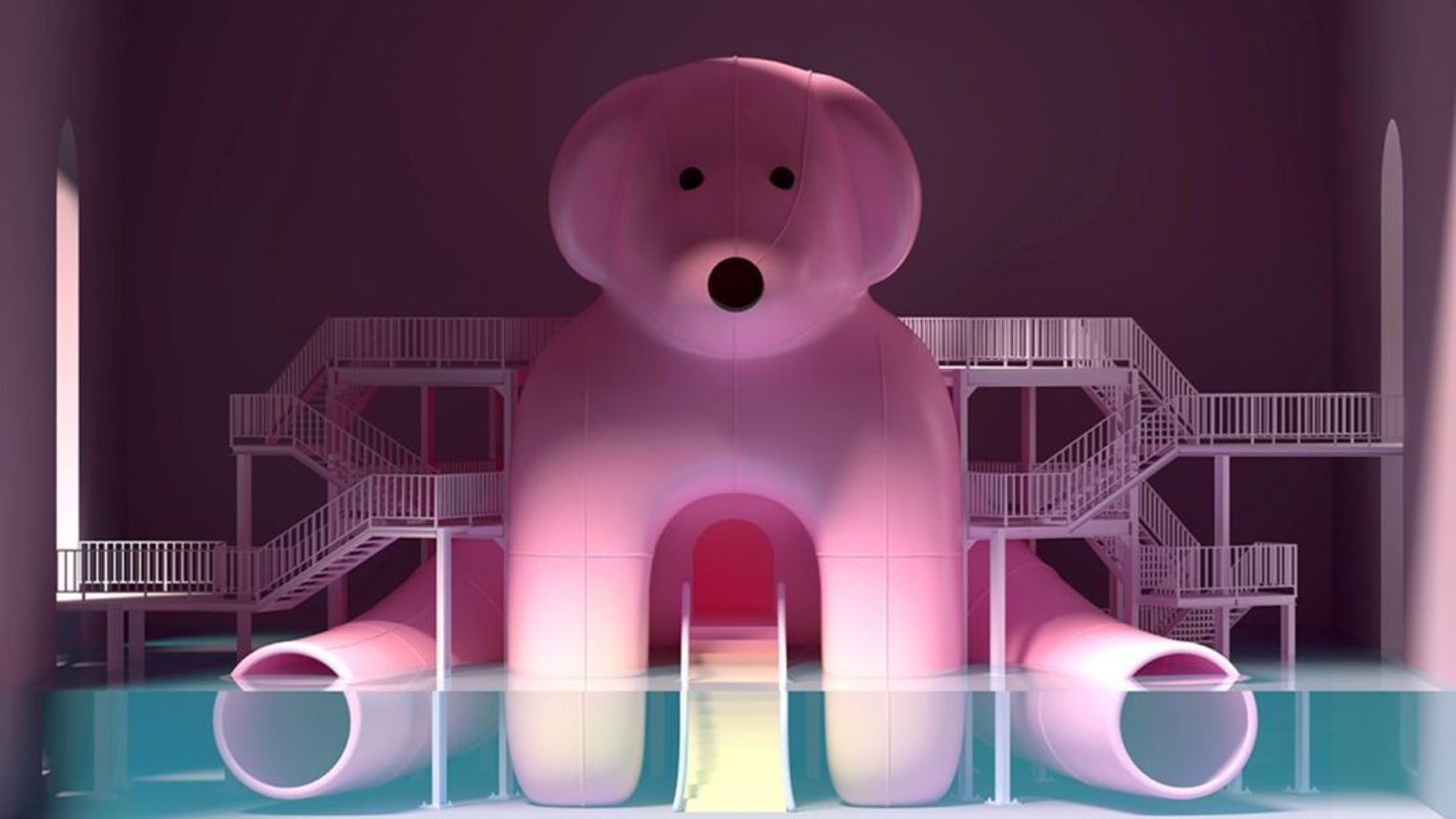
Paradise Opens Tomorrow places us squarely in the hotspot. Itcenters around new hybrids of Ghadyanloo’s signature playgroundswith plastic-fantastic animal avatars and his recent, forebodingelement of rising water. There is a slender, powder-pink rabbit-human,somehow evocative of the six-year-old beauty queen JonBenétRamsey, with a spiral slide protruding from its chest. Another rabbit’scartoonish fingers hold up a multicolored slide composed of cheapplastic units whose rainbow hues are reflected in the rabbit’s ears. Asubmarine-like green-grey bear rears up as his insides spill from historso, cascading earthward in an array of ladders and twirling slides.Finally, an oversize pink dog towers over a tiered playground; stairslead directly into its groin, from which one can slide down its hollowlimbs. In the last three works a few inches of water rise from theground, effectively rendering the playgrounds death traps.
In fact, the motif of animals and the flood harks back to one ofGhadyanloo’s earlier murals on a four-storey Tehran residentialbuilding. A giraffe’s lower half is submerged in water while its neckstretches toward a skylight; perched on its head are two men whoare just able to reach the aperture. The giraffe is the unwittingnon-human that will predictably perish in order for humans tosurvive. Now, in Ghadyanloo’s paintings, bona fide animals havegiven way to their defanged and sanitized likenesses in thephilosophical lineage of Mickey—the world’s most famous mousewhose face adorned a series of child-sized gas masks during theSecond World War, and who now presides over a global networkof theme parks that have destroyed large-scale wetlands andwildlife habitats. Aesthetically, Ghadyanloo’s animal avatars bearcloser resemblance to Kaws’ Companion or Squid Game’s giantanimatronic doll from the “Red Light, Green Light” elimination round.Their seamless plastic components and rivets are immaculatelyrendered; their faces are mostly mouthless and expressionless,allowing us the precious luxury of non-communication. They aredramatically illuminated by artificial light from multiple sources thatemphasize their pristine and monumental character, but also destabilizeour very modes of perception. Who are these gilded minotaurs—halfprophet, half beast—beckoning us to the funhouse, into the flood?Again, to summon Baudrillard: we see our life in them.
How did these universal symbols of innocence and play gofrom game elements to gamified Darwinism? The question isnot theoretical: somewhat ironically, the colorful playgroundsthat inspire Ghadyanloo’s paintings are often produced frompetrochemicals derived from oil and gas passing through theStrait of Hormuz, manufactured in Chinese factories, and endup in American parks and backyards. As western powers privatelygrumble about their declining geopolitical heft and shrinkingaccess to cheap goods, they have created playbooks of culturaland moral fictions to defend their perches in the global peckingorder. In this vein, post-9/11 Islamophobia has dehumanizedmillions of West Asians to the point where over 175 can be killed inMinab without material consequences, not to mention far larger numbers in Iraq, occupied Palestine, and elsewhere. Ghadyanloorecently completed these paintings in Iran during the war. Hisfamily initially feared that his father had been killed when his greenhouse was shattered by a nearby missile blast. After days ofbombardment, it became impossible to conceal the situation fromhis children, and they had to leave Tehran. With commercialaviation in and out of Iran severely curtailed, his works had to traveloverland to Istanbul and onward to his exhibitions. Although thesepaintings do not directly reference the war, it would be remiss,even vulgar, not to acknowledge the conditions under whichGhadyanloo was working.
Where do we go from here? The water is rising and the people aregone. The war is still “on.” But we have been in this jam before. Putdown your phone—in a few seconds we’ll turn the corner, wherethere’s a waiting ladder.
Chin-chin Yap
Courtesy Perrotin.
Mehdi Ghadyanloo combines minimalist themes and a surrealist aesthetic in his trompe-l’œil paintings, using acrylic, oil, or watercolour. He began his career as a muralist in Tehran in the early 2000s, when, following a call for proposals by the city, he produced almost one thousand gigantic wall paintings, including dreamlike landscapes and science-fiction scenes.


A respected voice in contemporary art discourse.
Focusing on ambitious storytelling and insightful art-world commentary. Ocula Magazine publishes in-depth interviews, critical essays and timely analysis on the artists, exhibitions and ideas driving the global art world.
Learn more about Ocula Magazine
Showcasing the best of the art world.
Ocula partners with galleries from around the world to highlight their artists, artworks and exhibitions. Gallery membership is by application and invitation, with each member vetted by an independent panel.
Learn more about Ocula Membership

Specialises in the sale of major artworks.
Led by a team with deep ties to the world’s leading auction houses, galleries and collectors. Ocula’s advisory team offers bespoke services to high-net-worth clients from around the world who are looking to acquire the best of contemporary and modern art.
Learn more about our team and services