Press Release

Bringing together works by Hans Hartung, Georges Mathieu, and Lee Bae, Archives of Traces: Gesture, Matter, and Time explores abstraction as a continuing negotiation of gesture, sign, matter, and time. The exhibition features three works by Hartung from 1963 to 1975, two paintings by Mathieu from 1969 and 1970, and a selection of works from Lee Bae’s Brushstroke series created in 2026.

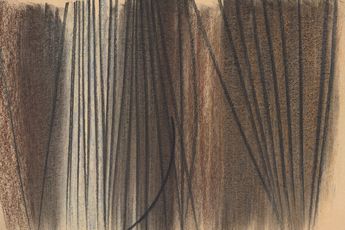
The three works by Hans Hartung presented in the exhibition, created between 1963 and 1975, reveal his varied approaches to gesture and the manipulation of paint. In T1963-H22 (1963), dense, scratch-like marks run through fields of blue and black, revealing subtle golden tones and creating a richly textured surface in which color and light appear to shift across the canvas. In the diptych T1974-E30 T1974-E31 (1974), sweeping black gestures overlap vibrant fields of turquoise, blue, red, and yellow. Curved and intersecting marks introduce a sense of movement, while the underlying color fields provide a contrasting sense of structure. Hartung was known for experimenting with unconventional painting tools, adapting implements such as customized scrapers, combs, lithographic rollers, and spray guns to expand the expressive possibilities of paint. In T1975-H21 (1975), he used a lithographic ink roller to create broad, textured bands of reddish-brown paint against a vivid yellow ground, punctuated by bold black lines. Together, these works demonstrate how Hartung developed distinct visual effects through different tools and techniques, continually exploring the relationship between spontaneous gesture and control.

In the mid-1960s, Georges Mathieu began to reconsider the relationship between spontaneous gesture and pictorial structure. While his earlier paintings emphasized the immediacy and expressive intensity of gesture, his subsequent work introduced more deliberate compositional frameworks, with geometric forms providing a foundation for his fluid, calligraphic marks. This shift did not signal an abandonment of spontaneity, but rather an expansion of his pictorial language. The two paintings on view, Excideuil (1969) and Montdory (1970), reflect this evolving approach. In Excideuil, a dense concentration of marks is intersected by straight and diagonal lines, while Montdory brings sweeping, curved brushstrokes into a more expansive composition. Together, they reveal Mathieu’s exploration of how expressive freedom could coexist with increasingly structured forms.

For Lee Bae, charcoal is more than a medium; it carries personal memories and cultural associations with fire, purification, and renewal. In his Brushstroke series, begun in 2019, the artist uses charcoal ink to explore the relationship between bodily movement, material, and time. Each gesture requires careful control, yet its final form also allows for the unpredictable behavior of ink and the subtle variations of the artist’s hand. The works on view are executed with charcoal ink on hanji, traditional Korean paper made from the inner bark of the paper mulberry tree. Historically, hanji was widely used for writing, painting, household objects, and architectural interiors. In these Brushstroke works, broad strokes twist, overlap, and fold into seemingly three-dimensional forms. Variations in the density and transparency of the ink record the movement of the artist’s body, bringing together the flatness of paper, the illusion of sculptural volume, and the passage of time.

Spanning more than six decades and distinct cultural contexts, the exhibition brings together different approaches to gesture, control, and material, revealing both shared concerns and individual artistic languages. Through Hartung’s technical experimentation, Mathieu’s evolving pictorial structures, and Lee’s engagement with the physical act of painting, the works transform movement into lasting visual traces. These echoes and differences create a cross-cultural dialogue that highlights the ongoing reinvention of abstraction, inviting viewers to consider it not as a fixed style but as a living language continually shaped by intention, material, and chance.

Courtesy Perrotin

Read More

Artists Exhibiting

Also Exhibiting at Perrotin

About the Gallery
Emmanuel Perrotin founded his first gallery in 1989 at the age of 21. He has opened since then over 17 different spaces, with the aim of continuing to offer increasingly vibrant and creative environments to experience artists work. He has worked closely with his roster of artists, some since more than 25 years, to help fulfil their ambitious dreams and projects. The gallery is now based in New York, Paris, Hong Kong, Seoul, Tokyo, and participates in all the significant worldwide art fairs each year (Art Basel (Hong Kong, Miami, Basel), Frieze (London, New York), FIAC (Paris), Dallas Art Fair, Art Cologne, Art Stage Jakarta, Expo Chicago, Art021 & West Bund Art & Design, Shanghai, Zona Maco Mexico, amongst others).
View Gallery Profile
Address
3/F, 27 Huqiu Road
Huangpu District
Shanghai
China
Opening Hours
Tuesday – Saturday
11am – 7pm
(1)
Shanghai 3/F, 27 Huqiu Road, Huangpu District
Perrotin
3/F, 27 Huqiu Road, Huangpu District, Shanghai, China
+86 216 321 1234
http://www.perrotin.com

Opening hours
Tuesday – Saturday
11am – 7pm
The art world in focus