



Press Release

Perrotin is pleased to present _Mounting Spirits, Resisting Empire,_the gallery’s first exhibition by Haitian-American artist Kathia St.Hilaire. In her new body of textile works, the artist will explore thehistory of the Banana Wars in Central America and the Caribbeanin the early 1900s. Employing an innovative reduction reliefprintmaking process, and incorporating nontraditional materials,she creates ornate tapestries that seek to preserve Haitian historyand Vodun religion.

There is a particular form of sensory consciousness present in Kathia St.Hilaire’s work that demands focused attention because she embeds itwith personal, historical, and sociopolitical experience. Her marvelouscontent offers an artistic language and world-making process that iscomplicated and richly imbued with visions that not only express a widerange of human emotions but are essentially and autonomously framedby her conceptual representations of the world of her ancestors, primarilythose deriving from Haiti. Her artistic evolution is marked by a distinctivefusion of cultural influences and a profound exploration of identity,humanism, and social justice.

One cannot appreciate St. Hilaire’s work solely for its beauty, as beautyconveys only a particular aesthetic. Aesthetic qualities don’t necessarilyunveil truths, and truth, in turn, exposes events that cannot remain hidden.

St. Hilaire’s art actively challenges historical concealment, exemplified inthe Caco series, which depict three prominent Haitian leaders of theCaco movement (Batraville, Péralte, Bobo) who led the peasant-basedresistance against the violent U.S. occupation of Haiti (1915-1934) andwere eventually killed by the United States Marines. To this day,Charlemagne Péralte remains synonymous to anti-U.S. imperialism.St. Hilaire’s practice echoes German philosopher Martin Heidegger’s(1889-1976) concept of art: barring aesthetics, the veritable essence ofart lies in its capacity to express and expose truths. Through multiplecanvases and panels, St. Hilaire not only reveals historical events butalso incorporates her aesthetic signature, providing us with theopportunity to explore her world-making processes in a fundamentallydifferent and insightful manner, through her use of color, materiality, andhistory.

St. Hilaire’s remarkable paintings are a testament to her skillful use ofcolour and texture. Her canvases feature vibrant colours, bank notes, skin-lightening creams, and intricate patterns that draw the viewer into aworld of sensory depth. Her colour palette seems carefully chosen toevoke emotion and arouse the senses toward an elevated consciousness.Bold, rich hues intermingle with soft, subtle tones, creating a visualexperience that is both dynamic and harmonious. There is no timidity norcoquetry in her work. This careful selection of colours not only enhances the aesthetic appeal of her art, but also conveys the depth and complexityof the ideas she explores. St. Hilaire’s mastery of texture is anotherdefining feature of her work. She employs various techniques, includingimpasto and layering to create depth and tactile qualities in her pieces.The interplay of texture and colour in St. Hilaire’s practice mirrors themultifaceted nature of volatile human experiences that she seeks tocapture and re-configure.

St. Hilaire’s visual elements are not just aesthetic choices; they carrydeep cultural significance, reflecting her Haitian roots and colonialremnants. Through her paintings, St. Hilaire explores the complexities ofidentity, the immigrant experience, the machination of imperialism, andher cultural hybridity as a Haitian-American or American-Haitian. She isboth an outsider and an insider with a strong grasp on artistic expression.Her work juxtaposes themes of conquest, cultural suppression, and laborexploitation with imagery that challenges stereotypes and preconceivednotions about race, gender, ethnicity, and power relations. As MartinHeidegger asserts, the “truth is inherent in the essence.” St. Hilaire’shyphenated cultural identity as a Haitian-American is characterised by ahistory of struggle, freedom, autonomy, and liberation from the harshchains of colonial slavery. It also involves the worship of non-Europeanancestral deities, such as Ogoun, the West African spirit-warrior. In oneof St. Hilaire’s works, Caco: Benoit Batraville, Ogoun is depicted as arevolutionary peasant with a red scarf tied to his left thigh, riding a horse,and spearing a uniformed adversary on a white horse. This powerfulrepresentation encapsulates the essence of her cultural being.

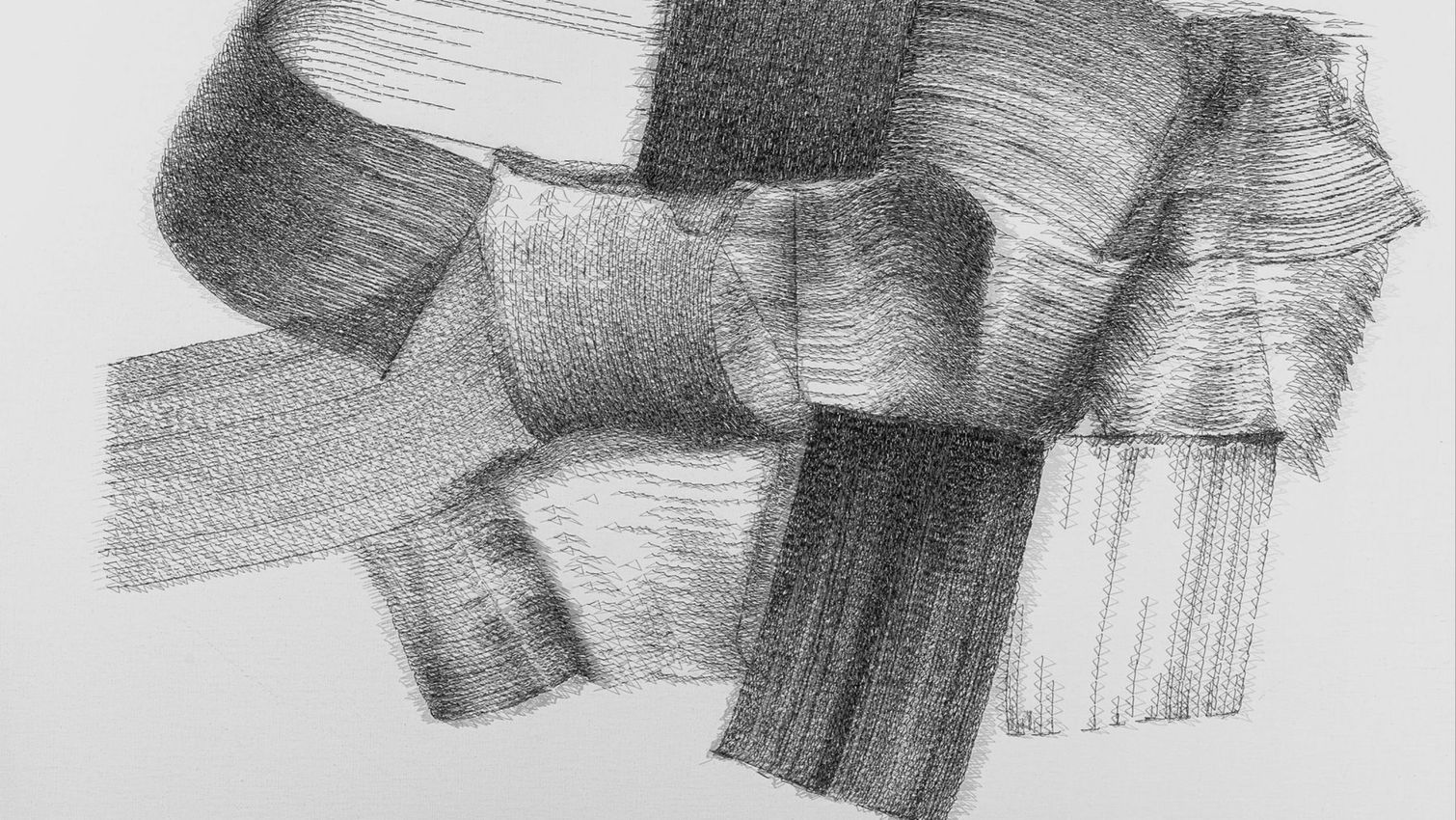
History creates the habitat within Kathia St. Hilaire’s mind. It is from herethat she articulates the past via aesthetically pleasing representations.Imitating, and yet going beyond the aesthetic of the traditional Vodunflags, St. Hilaire developed a technique called reduction relief printing—she starts with a large drawing before transferring it onto a sheet oflinoleum, which she then carves out in small sections and prints ontoeverything from beauty products to tires, until the whole linoleum iscarved away. Her materials are vast, including those that either echohistory (shredded tires, banknotes, coins, photographs, banana leaves, scrap metal, and aluminum) or portray the emotional toll of certainlegacies of colonialism (the use of skin-lighting cream). The pathbreakingand influential American philosopher, Susanne K. Langer (1898–1985),says, ‘Complete artistic success would be complete articulation of anidea...and the effect would be a perfect livingness of the work.’ Thelivingness of St. Hilaire’s work brings history alive through a quasi-magical realism intersected by a figurative materialism.

Through her art, St. Hilaire invites viewers to question their assumptionsand engage in meaningful conversation about the world we inhabit. St.Hilaire’s work is a testament to the transformative power of art and itspotential ability to inspire change and empathy in society. Susanne K.Langer poignantly indicates, ‘The life of art is a ‘life’ of forms, or even ofspace itself’. Kathia St. Hilaire’s framing of certain historical eventsthrough visual representation becomes a form of un-silencing—viarecognisable artistic forms—which reveals a new life form (See thepainting entitled Mamita Yunai, for instance).

St. Hilaire’s art is inherently anti-imperialist, as she challenges thedominant narratives that have long glorified empire while silencing thevoices of those who suffered under their rule. Her visual creations serveas a vivid and compelling counter-narrative, uncovering the concealedand untold histories of resistance and hardship that are often overlookedin the glossy, sanitised accounts of imperial rule. Her approach servesas a form of optical resistance against the sanitised, often mythologized,versions of history perpetuated by imperial power resonating with theglobal struggle for justice and decolonisation. Her art serves as acatalyst for empathy, a catalyst for reconsidering the past’s prevailingnarratives, and ultimately, a means to forge a more equitable andinclusive future. St. Hilaire’s exploration transcends artistic boundaries,sparking conversations that challenge, inspire, and enlighten.

Read More

Also Exhibiting

About the Gallery
Emmanuel Perrotin founded his first gallery in 1989 at the age of 21. He has opened since then over 17 different spaces, with the aim of continuing to offer increasingly vibrant and creative environments to experience artists work. He has worked closely with his roster of artists, some since more than 25 years, to help fulfill their ambitious dreams and projects. The gallery is now based in New York, Paris, Hong Kong, Seoul, Tokyo, and participates in all the significant worldwide art fairs each year (Art Basel (Hong Kong, Miami, Basel), Frieze (London, New York), FIAC (Paris), Dallas Art Fair, Art Cologne, Art Stage Jakarta, Expo Chicago, Art021 & West Bund Art & Design, Shanghai, Zona Maco Mexico, amongst others).
View Gallery Profile
Address
130 Orchard Street
New York
United States
Opening Hours
Tuesday – Saturday
10am – 6pm
(1)
New York 130 Orchard Street
Perrotin
130 Orchard Street, New York, United States
+1 212 812 2902
http://www.perrotin.com

Opening hours
Tuesday – Saturday
10am – 6pm
The art world in focus