Press Release

Perrotin Los Angeles is pleased to present My Fantasy’s Burdens, Kyungmi Shin’s debut exhibition with the gallery. Featuring both paintings and ceramics, the exhibition builds on Shin’s practice of interrogating Asian-American diasporic identity, drawing on a rich array of sources to foreground the cultural, economic, and scientific legacies of colonial trade.

Entangled Continents

by Danielle Shang | 尚端

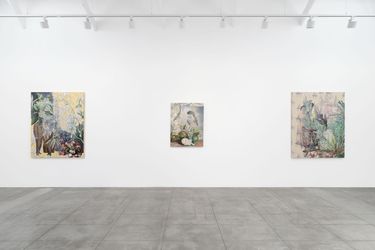
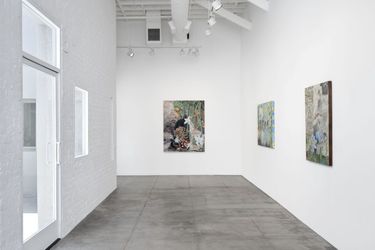
Kyungmi Shin’s paintings are not simply paintings. They are accumulations—of photography and collage, image transfer and found objects, pigments and metallic gilt lines—compiled, fragmented, and staggered into dense, textured surfaces whose layered depths reward sustained looking. Executed on wood panels or vintage wallpaper fabrics printed with Rococo-inspired motifs (in patterns characteristic of the style’s exotic ornamentation), each work folds centuriesof colonial global exchange—botanical, commercial, spiritual, bodily—into a single, vividly-colored picture plane that unfolds across multiple times and spaces at once.

At the heart of her solo exhibition My Fantasy’s Burdens (the title draws inspiration from poet Natalie Diaz’s “Postcolonial Love Poem”) is a significant shift in source material. Moving away from her family archive, Shin turns to USC’s Korean American Digital Archive, transitioning from personal history to collective memory. Black-and-white images of Korean Americans are photo-transferred directly onto clear-gessoed vintage chinoiserie textile wallpaper, producing a translucent, shadowy ground: ancestors rising through layers of orientalist ornament, invited into the picture as protagonists and storytellers.

Highly stylized leaves and flowers, along with Korean shaman talismans, are hand-painted over these layers, generating friction between photographic record and painterly imagination, compressed into a visual kaleidoscope of soft pinks, greens, yellows, and blues: the chromatic regime of chinoiserie—the ultimate “racial ornamentalism”—that became popular during the Rococo period, expressing both European taste for Chinese imports of silk, porcelain, and furniture, and the fashionable distorted imitation of Chinese designs. In her synthesis of photo-based media, collage, and painting, Shin enters into dialogue with artists such as Lorna Simpson, Njideka Akunyili Crosby, and Robert Rauschenberg, whose practices bring found and photographic images into continuous relation with painted surfaces—merging the indexical and the gestural to reconfigure memory and representation.

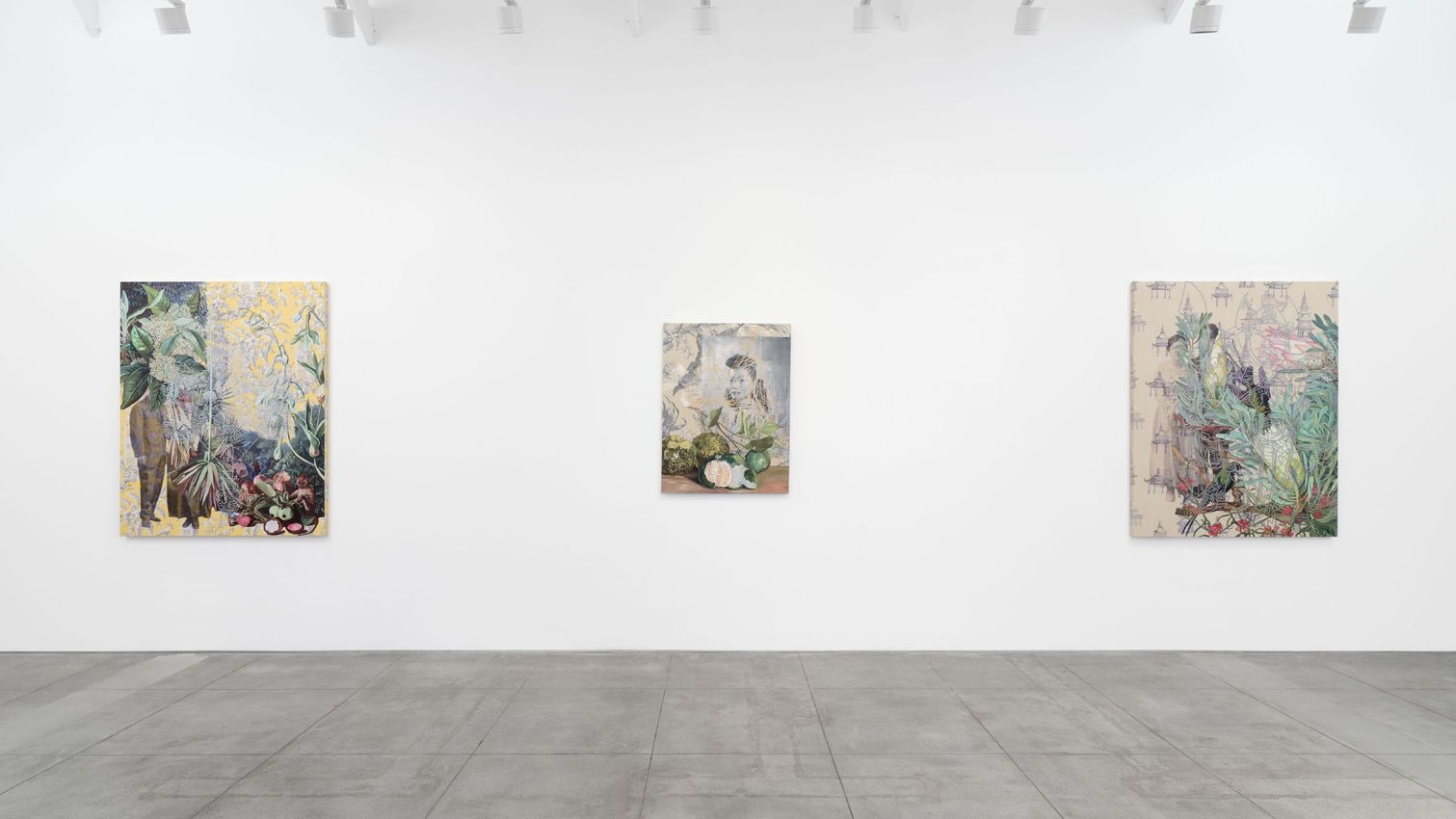
In the old world came knocking (2026), a group of anonymous Korean American children stands alongside a female chaperone, all looking directly into the camera. Their photo-transferred image, set across two wallpapers sewn together, is framed on either side by Shin’s over-painting of two botanical species: loquat, originating from southern China, and lignum vitae, the national flower of Jamaica. The botanical renderings draw from the plant paintings of Victorian biologist and botanical painter Marianne North (1830–1890). During colonial expansion, plants such as loquat and lignum vitae fed Europe’s fetish for the tropics, becoming status symbols whose rarity fueled a Victorian “plant fever.” Rounding out the imagery are other critical references. Above the children, a three-headed hawk presides—a Korean shaman talisman for warding off calamities. At the lower edge of the painting, two moon rabbits and a mythical creature from Korean folklore—keepers of the elixir of immortality—pound rice cakes, offering care and comfort. Across the surface, flowing and curvy pink metallic gilt lines trace the contours of blooming branches with a lustrous, alchemical sheen. These textured lines lend the painting a sculptural presence, oscillating between camouflage and declaration—catching the light to lift foreground from background in continuous visual tension, illuminating the world of ancestors with heavenly splendor.

In Orange Dreams (Dosan) (2025), the dignified figure of Ahn Chang-ho (1878–1938) is photo-transferred onto another wallpaper populated by grotesquely rendered “Asian” figures—caricatured bodies with exaggerated features and pigtails, lounging among pagodas and fantastical creatures in an idyllic garden. Ahn, known by his pen name Dosan, was a pivotal figure in Korean diasporic communities; his legacy is honored in Los Angeles at Dosan Ahn Chang Ho Memorial Interchange, where the 10 and 110 freeways meet. In the foreground, a playfully rendered Korean tiger joins botanical specimens of vanilla orchid and wild orange (again based on the botanical paintings of Marianne North). Native to Mesoamerica and Southeast Asia, these plants’ lush foliage both adorns and shields Dosan, even as it partially obscures the agonizing mise-en-scène behind him. Shin’s recurring appropriation of North’s botanical imagery serves as a pointed reminder: the celebrated Victorian expeditions that led to 19th-century plant taxonomies were made possible, in no small part, by Britain’s opium and coolie trades in Asia after its massive slave trade from Africa to the Americas ended in 1807. It is precisely this entanglement between aesthetic refinement and imperial violence that Shin insists we remember.

A companion installation in My Fantasy’s Burdens brings together ceramic tripod planters shaped into voluptuous female silhouettes with wings and avian feet—forms that invoke Rococo design only to turn it against itself, reclaiming the female body once rendered as object, ornament, and commodity. The planters hold peacock flowers, which also bear significance: while being prized by European gardeners for their exotic beauty, peacock flowers functioned, in colonial Suriname, as an abortifacient used by enslaved women to prevent children from being born into bondage. If chinoiserie’s decorative patterns eroticize and reduce the non-White body to a token of Orientalist fantasy, the peacock flowers foreground a dark truth: luxury was never innocent. The trade in “Oriental” objects, the brokering of coolies and opium across Asia, the trafficking of enslaved people across the Atlantic were not separate histories but interlocking systems upon which Western capitalism was built. As scholar Cedric Robinson argues, capitalism has always expanded through race—through the subjection and dispossession of colonized peoples.

Working across still life, portraiture, botanical illustration, genre painting, and ceramics, Shin constructs visual narratives that reveal what these European traditions have long obscured: the colonial mechanisms underlying the movement of flora, objects, and people across the globe. Past and present, document and mythology, beauty and violence are brought into uneasy proximity, situating her work at the intersection of encounter, exchange, extraction, and appropriation—histories linking the Americas, Asia, and Africa, whose labor and lands constituted the unacknowledged conditions of possibility for Western modernity. As scholar Lisa Lowe observes, modernity is “a complex, braided project, which links the [European] promises of emancipation, free labor, free trade, and government, with the heterogeneous pasts of conquest, capture, trade, and dominion on and across four continents.”

Shin holds this contradiction within every seemingly seductive surface of shimmer and glaze. In doing so, her work refutes the racialized logic in Hegelian philosophy of history that casts freedom as the exclusive telos of the West—justifying colonialism as a civilizing force and denying historical agency to non-European peoples. Against that erasure, My Fantasy’s Burdens insists on the presence and memory of Asians, Africans, and Indigenous peoples in the Americas, who have made and remade their worlds, even under conditions designed to foreclose that possibility.

On Saturday May 23 at Perrotin LA, Kyungmi will be in conversation with Aleesa Pitchamarn Alexander, Curator of Modern and Contemporary Art at the Cantor Arts Center and Co-Director of the Asian American Art Initiative at Stanford University.

Courtesy Perrotin.

Read More

Installation Views

Exhibition view: Kyungmi Shin, my fantasy's burdens, Perrotin (5/1/2026–30 May 2026). Courtesy Perrotin.
Exhibition view: Kyungmi Shin, my fantasy's burdens, Perrotin, Los Angeles (1–30 May 2026). Courtesy Perrotin.
Exhibition view: Kyungmi Shin, my fantasy's burdens, Perrotin (5/1/2026–30 May 2026). Courtesy Perrotin.

Also Exhibiting at Perrotin

Address
5036 W Pico Blvd
Los Angeles
United States
Opening Hours
Tuesday – Saturday
10am – 6pm
(1)
Los Angeles 5036 W Pico Blvd
Perrotin
5036 W Pico Blvd, Los Angeles, United States
+1 (323) 433-4063
http://www.perrotin.com

Opening hours
Tuesday – Saturday
10am – 6pm
The art world in focus