Press Release

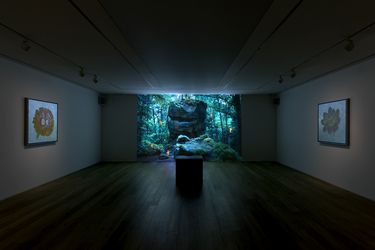
Perrotin Seoul is pleased to present ANIMA, Laurent Grasso’ssecond solo exhibition with the gallery in Korea. After PerrotinSeoul’s inaugural exhibition at Samcheong in 2016, the Frenchartist comes back with a large selection of paintings, sculptures,and neon works as well as Anima (2022), a new film which had itsworld premiere in Paris in the fall of last year.

In the exhibition, Laurent Grasso explores the visible and the invisible,creating bridges beyond the boundaries between human and non-human.Avoiding the pitfalls of representation and anthropomorphism,through his paintings, film, and sculptures, he aims to fulfill our worldwith new hypotheses.

Grasso’s work is inspired by scientific discoveries and human sciences,as well as by beliefs and mythologies attached to specific phenomenaor places. The artist conceived this exhibition ANIMA as a completenarrative with chapters like a film, a core medium in his artmaking,employing overhead camera shoots and various technologies andinstruments to reveal things invisible to the human eye. Central to thisexhibition, the film Anima (2022) is the fruit of a fertile exchange betweenart and scientific research begun several years ago in collaboration withGrégory Quenet, an environmental historian, and in the footsteps of thework of the philosopher Bruno Latour.

For this project, the artist is particularly interested in the spectacle behindthe Mont Sainte-Odile, a place with a mysterious and telluric force,dominating the Plain of Alsace in France. This pilgrimage site is linked tothe miracle of Saint Odile, and where perpetual adoration has beenpracticed since the end of the 19th century, is very close to a geoscientific survey point related to the study of the ‘Critical Zones’ as describedby Latour. But it is also a region traversed by powerful cosmo-telluriccurrents, which have attracted the interest of geobiologists, especiallythe stone fortifications better known as the ‘Pagan Wall,’ stretching outover nearly 11 kilometres in the forest that encircles the mountain andremains an archaeological enigma.

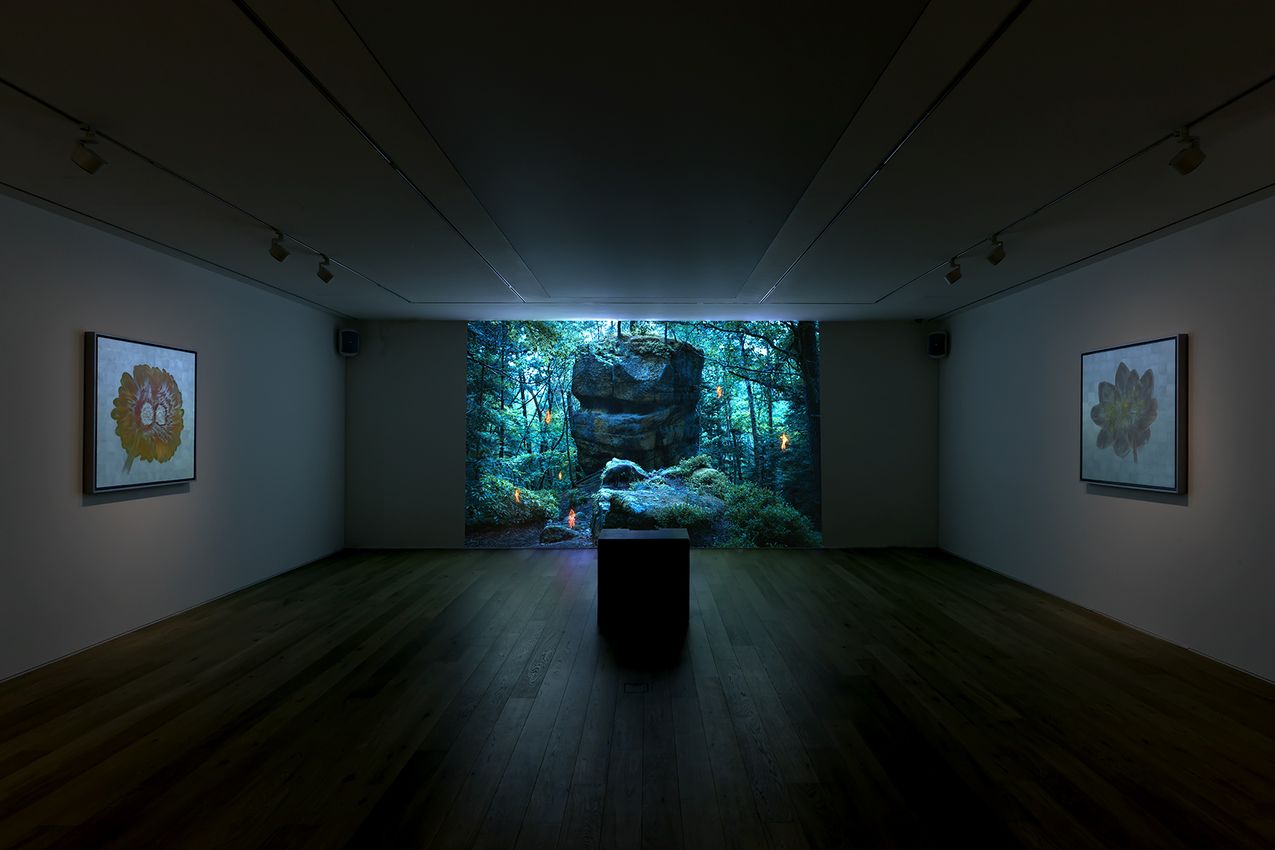
Intrigued by the confluence of geological, mythological, and spiritualforces, Grasso researched the history of the area in collaboration withQuenet. Shot in Mont Sainte-Odile, the film mixes the perspectivesand points of view of different protagonists — a man, a fox, rocks —populating a mysterious world that hovers in between reality anddreams with mystical elements such as suspended flames, ghostlyclouds, and even a ‘pyrophone’, a 19th-century musical instrumentthat produces notes with mini explosions taking place inside asequence of glass tubes. Choreographed camera movements, illusorytransparent images made with a LIDAR scanner, ethereal lighting, andan esoteric soundtrack by Warren Ellis plunge spectators into amysterious atmosphere where the invisible part of the world becomesvisible. The idea is to detach oneself from human vision to ultimatelycreate a new point of view. The artist revels in the idea that a tree, ananimal, or a rock could have, in the film, an interiority of their own, likean unknown form of intelligence.

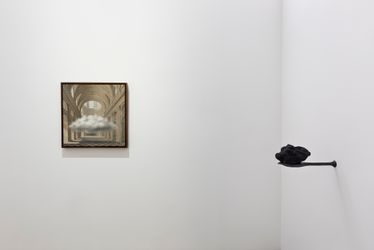
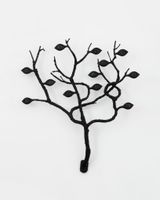
The multiplicity of perspectives adopted by the camera in the film findsa counterpart in the recurring motif of eyes that appear on bronze andneon Panoptes (2022) branches displayed in the entrance of theexhibition. They are reminiscent of the portrayals of Saint Odile who isoften depicted holding her eyes on an open book. Eyes are a subjectGrasso has already pursued for several projects. The symbol of theeye is found all over the monastery dedicated to Sainte Odile since itwas founded to celebrate the miraculous recovery of her sight.

Grasso gives the trees a form of sensitivity by putting eyes on theirbranches and suggests the notion of an intelligence belonging to theplant world. Exploring the thresholds between the material and theimmaterial, the artist transposes the materiality of the bronze of thePanoptes sculpture into a neon gas emitting light. Evoking the flow thatpasses through plants during photosynthesis, the neon _Panoptes_(2022) reflects a state of consciousness diffusing itself in the materialityof the world, presenting a conceptual juxtaposition.

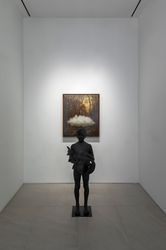
Next to the Panoptes (2022), another work echoes an imagery raisedby the film: the sculpture Anima (2023) depicts a young boy holding afox. Directly inspired by the appearance of the same animal in theeponymous film, this work is part of a series that explores the child’sconnection to the sacred. Like a messenger or an oracle, the young boygives the impression that he has access to something unique or holdsthe key to knowledge. The fox, which appears several times in the film,seems to have transfigured through the screen to be embodied as asculpture, provoking a sense of déjà vu and the back-and-forth shiftbetween the world generated by the film and the exhibition space.

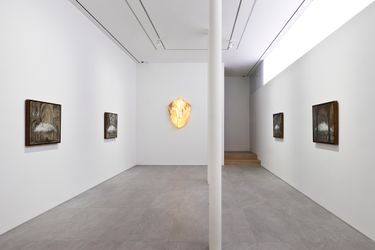
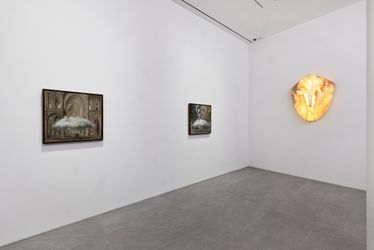
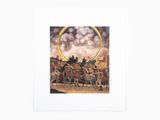
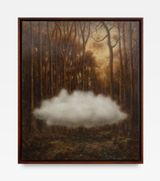
In the first-floor gallery, centered with The Helmet of Minerva (2023), amonumental onyx sculpture emanating a mysterious light, Grassointroduces a new series of paintings to complement his Studies into thePast that he began in 2009. This vast conceptual project incorporatingelements from his film in paintings executed in the manner of theRenaissance masters focuses on the strange phenomena frequentlyrendered in his work such as clouds and flames. They seem to havetransformed from the screen to fill the huge, vaulted architecture or theMont Sainte-Odile depicted in the paintings. These pieces are fabricatedin a quasi-scientific manner and the faithfully reproduced mythological,religious, and historic settings are interrupted by foreign objects andphenomena to upend our perception of the past. Grasso enjoysconsidering time as an artistic material, mixing temporalities, anddeveloping projects around the concept of time travel. In fact, Grassocollaborates with conservationists to create these historical paintingsto achieve what he calls a ‘false historical memory.’ This creates akind of archaeology of the future that disrupts the understanding ofwhere they came from and when they were made.

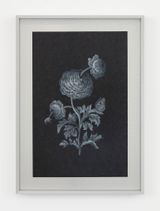
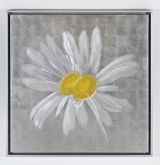
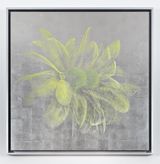
Finally, the Future Herbarium series presents species of flowers,such as daisies, anemones, and other Asteraceae showing signs ofmutation that could potentially occur in the near future. In thishypothetical world where the living would have taken new paths, theheart of the flowers has split, as though their DNA had undergoneunusual modifications. The translucent materiality of his works refersto the imagery of the LIDAR scanners, which has the particularity ofrevealing realities invisible to the naked eye which we find in the filmAnima (2022). The real is probed by means of scientific instrumentsto uncover potentialities that are only waiting to grow. In this respect, FutureHerbarium can be seen as an outgrowth of Anima (2022), an unfolding ofthe energies latent in the film. The reflective surface of the palladium sheetson which the flowers are painted, and on which is reflected in an alteredway in the video projection, accentuates the dialogue and discourseamong the film, the paintings, and potential worlds.

Consequently, through the film Anima (2022), the viewer is facedwith a territory that borders between reality and dream, and the edgesof an unidentified world. Surreal and ambiguous, yet not entirely outof the realm of possibility, Grasso’s installation intuitively blends thepast, present and future inevitably forcing visitors to question whatthey thought they knew.

Read More

Installation Views

About the Artist

At the crossroad of heterogeneous temporalities, geographies and realities, Laurent Grasso’s films, sculptures, paintings and photographs immerse the viewer in an uncanny world of uncertainty. The artist creates mysterious atmospheres in which the boundaries of what we perceive and know are challenged. Anachronism and hybridity play an active role in this strategy, diffracting reality in order to recompose it according to his own rules. Fascinated by the way in which various powers can affect human conscience, Laurent Grasso tries to grasp, reveal and materialise the invisible. Ranging from collective fears to politics, through electromagnetic or paranormal phenomenon, the artist reveals what lies behind the commonly perceived and offers us a new perspective on history and reality.

View Artist Profile

Also Exhibiting at Perrotin

Address
10, Dosan-daero 45-gil
Gangnam-Gu
Seoul
South Korea
Opening Hours
Monday – Saturday
10am – 6pm
(1)
Seoul 10, Dosan-daero 45-gil, Gangnam-Gu
Perrotin
10, Dosan-daero 45-gil, Gangnam-Gu, Seoul, South Korea

Opening hours
Monday – Saturday
10am – 6pm
The art world in focus