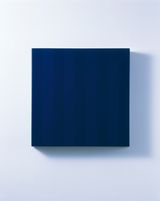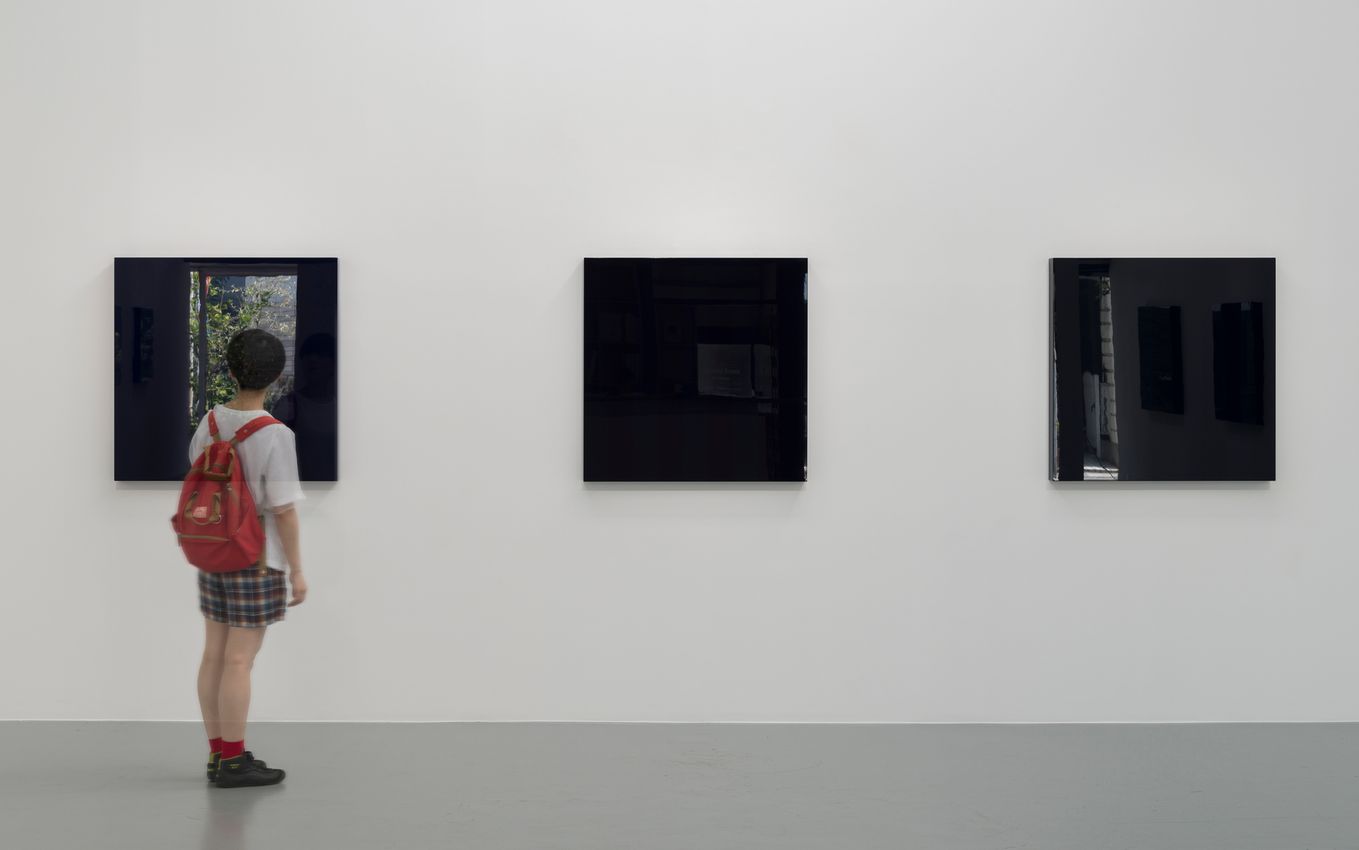
Saga eliminated shape and color from his canvases early in his career and reduced his practice to the utmost simplistic materials and methods. In so doing, he has referenced Japanese traditional art forms such as Noh, a musical drama in which performers express emotions through slow and minimal gesture. In “Perception”, Saga refers to Kodo, the Japanese art of appreciating incense – practiced as a game with a set of prescribed rules and manners. His new series “Inside” (2015-) are blue painted wood boards coated with Urethane, on which five vertical stripes subtly appear under the transparent layer. The five stripes are borrowed from the patterns used for the Genji-ko (Genji incense), in which participants are invited to appreciate five selections of aroma, and identify the same. This is described on the five-stripe diagram which Saga uses for his paintings. The artist suggests testing the scents, but subtlety describes it visually instead, following the grammar of Genji-ko, which dates from the Muromachi period (14th century).
Within Western art history, the stripes evoke the work of Daniel Buren, who formed an artist collective BMPT in the late 1960s, Paris. For Buren, the stripes are imitable and easily duplicated as aesthetic archetypes and critical tools for addressing questions of how we look, perceive, and appropriate. Saga imbues his painting with a vague stripe pattern through which the viewers negotiate their own reflections between seeing and gazing, perceiving and sensing. Within the realm of mirror-like reflection made through the gesture of Saga’s dedicated hand, the viewer is offered the intention of unrestricted field of vision.
---------
Atsushi Saga
Born in 1970, Saitama prefecture. He graduated at Department of Painting, the Tama Art University, before working in the sculpture media. In 2004, he started white “MUMI” series, challenging the viewer’s perception and ability to observe the work that have been produced from painting and polishing. His notable exhibition include: years “MUMI + cube on white (Criterium 61)”, Contemporary Art Center, Art Tower Mito, Ibaraki, 2004 - 05; “Another paradise”, 21st Century Museum of Contemporary Art, Kanazawa, Ishikawa , 2005 – 06; “Yokohama Triennale 2011”, Yokohama Museum of Art, Yokohama; and many others.
SCAI The Bathhouse is a contemporary art gallery located in Yanaka, with a town ambience reminiscent of Old Tokyo. In walking proximity to Ueno, an area dense with museums and art schools, the gallery was converted from a venerable 200-year-old public bathhouse. Take a step inside, and you will find a white cube with soft natural light descending from the high ceiling.

A respected voice in contemporary art discourse.
Focusing on ambitious storytelling and insightful art-world commentary. Ocula Magazine publishes in-depth interviews, critical essays and timely analysis on the artists, exhibitions and ideas driving the global art world.
Learn more about Ocula Magazine
Showcasing the best of the art world.
Ocula partners with galleries from around the world to highlight their artists, artworks and exhibitions. Gallery membership is by application and invitation, with each member vetted by an independent panel.
Learn more about Ocula Membership

Specialises in the sale of major artworks.
Led by a team with deep ties to the world’s leading auction houses, galleries and collectors. Ocula’s advisory team offers bespoke services to high-net-worth clients from around the world who are looking to acquire the best of contemporary and modern art.
Learn more about our team and services