Press Release

Reveries of a Solitary Wandering Giant

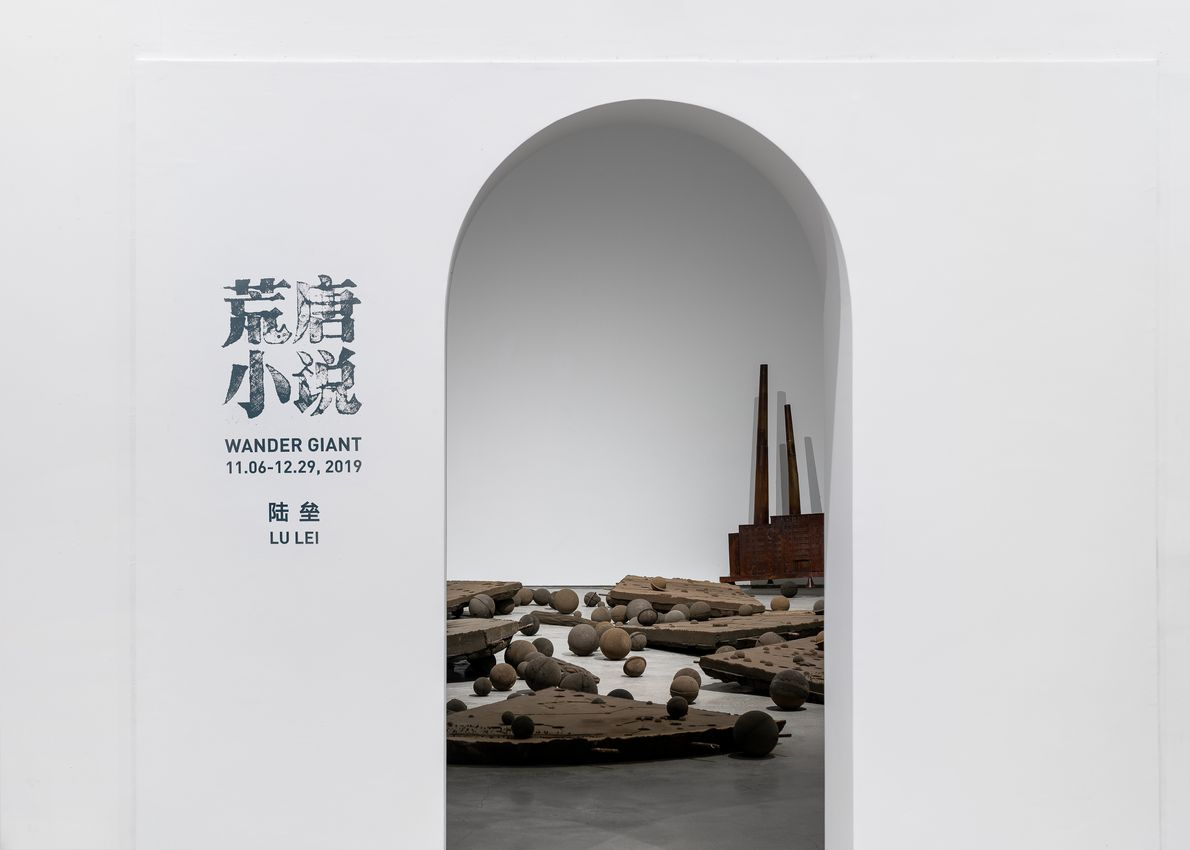
The charm of ‘fiction’ partly lies in the imagination and the ability to reorganize reality. In this sense, fiction does not have to be bound by the form of text. Anything based on imagination could be a fiction. The exhibition Wander Giant (Chinese title in English: ‘Absurd Fiction’) is the first solo exhibition of Lu Lei in Shanghai. Lu Lei has woven years of memories, perceptions and absurd thoughts into a visual fiction with installations and sculptures. For Lu Lei, absurdity does not mean self-mockery or irony, but it is the way that artistic creation process should be. From the perspective of Lu Lei, ‘Art should be absurd.’

In Wander Giant, Lu Lei depicts the ‘reveries of a wandering giant’. The giant incarnation of collectivism, wander in dreamland of memories, rendering his farcical daydreaming into cold, hard bodies. The scattered huge objects and scenes are like the fragments of dreams, familiar yet strange at the same time, attracting petty humans who have accidentally entered this place. Factories, chimneys, bats, loudspeakers... in addition to these recurring images in his works related to childhood memories, Lu Lei incorporates dimensions of the universe and space into them, further expanding and freeing the exhibition space and calling to mind Calvino’s Cosmicomics. When the solitary walker gains the body of a giant, his reveries expand exponentially, treating the stars and lightning as his toys, while the imaginative energy quietly overflows from the confined space surrounded by the white walls.

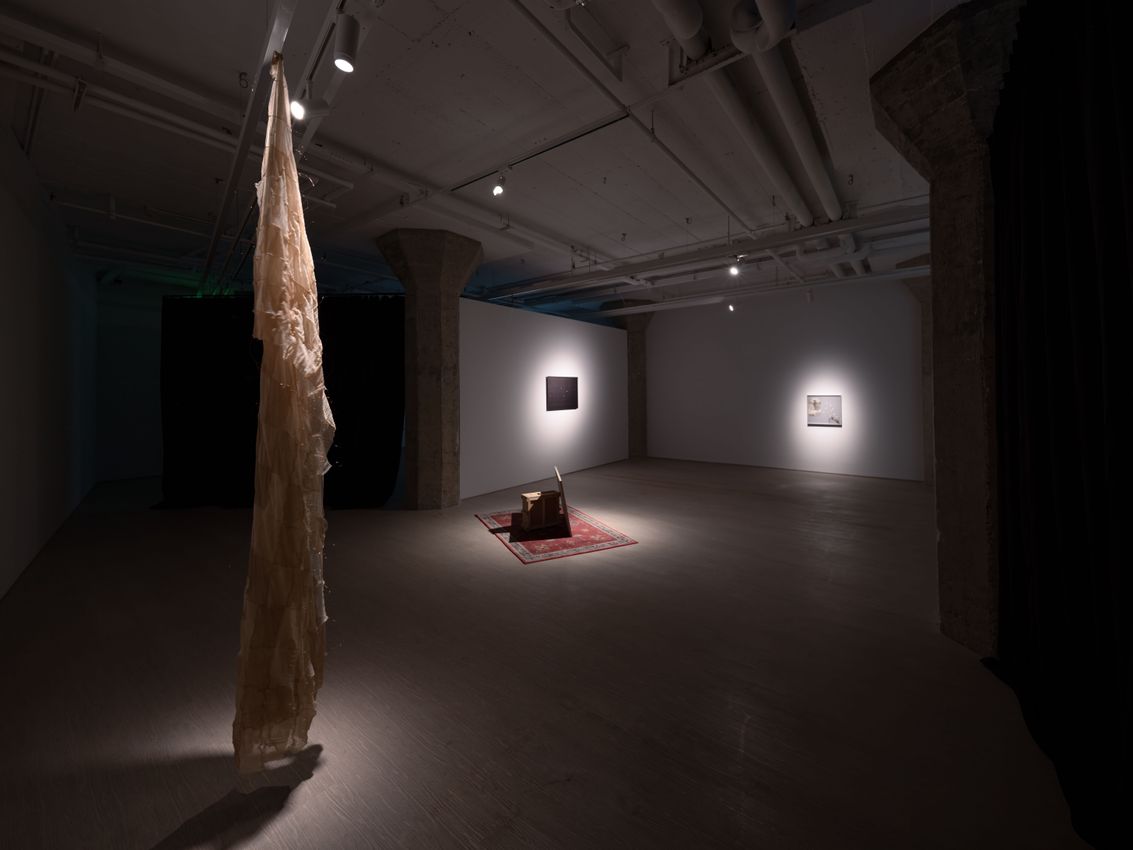
The three exhibition halls are presented as three chapters of the novel, with imaginary themes of ‘Game of the Giants’, ‘Reveries of the Giant’, and ‘The Giant Walking’. Although there is no specific image of the giant, by placing him as the subject in the narrative structure, Lu Lei embodies the influence and imprints of this behemoth everywhere. The audience walk through the halls, experiencing the varied games of imagery and open narrative scenes that enable them to produce their own stories.

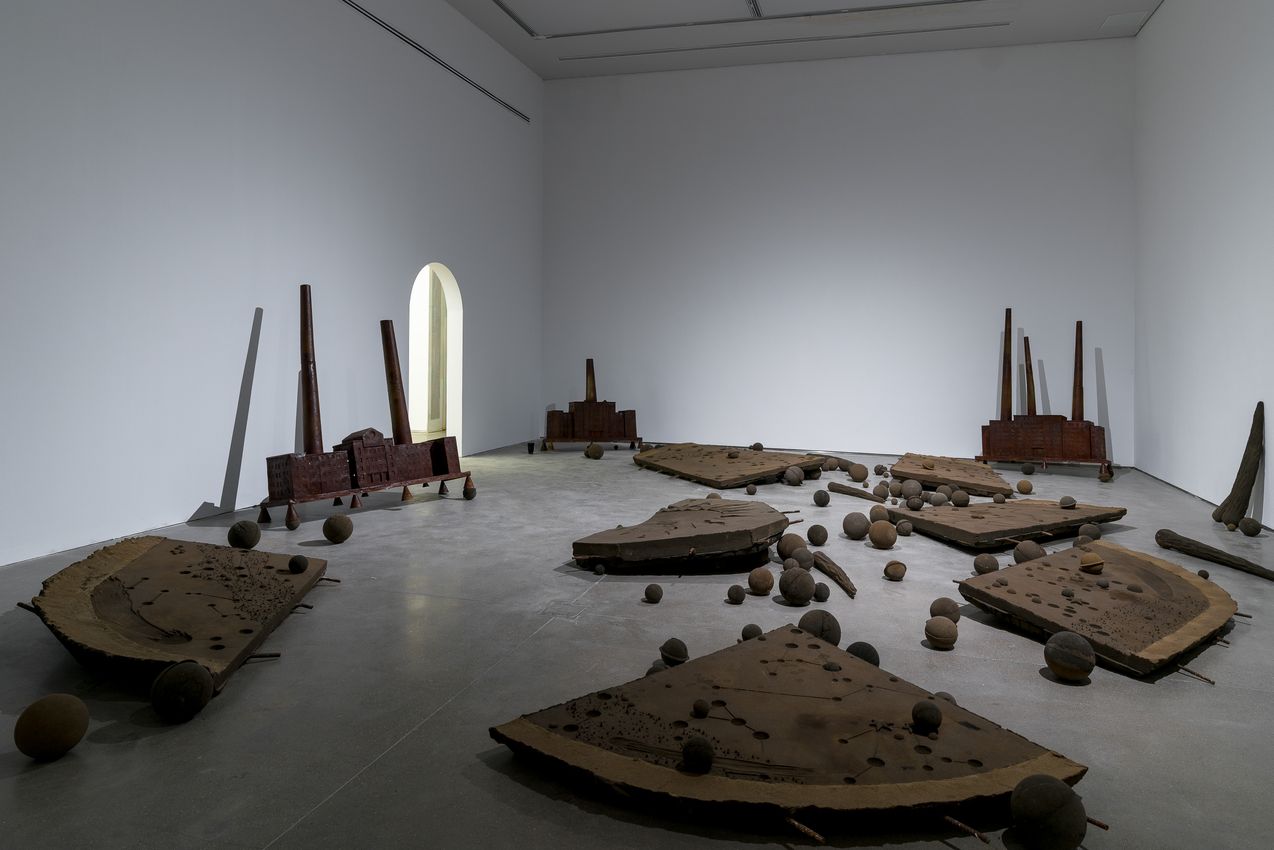
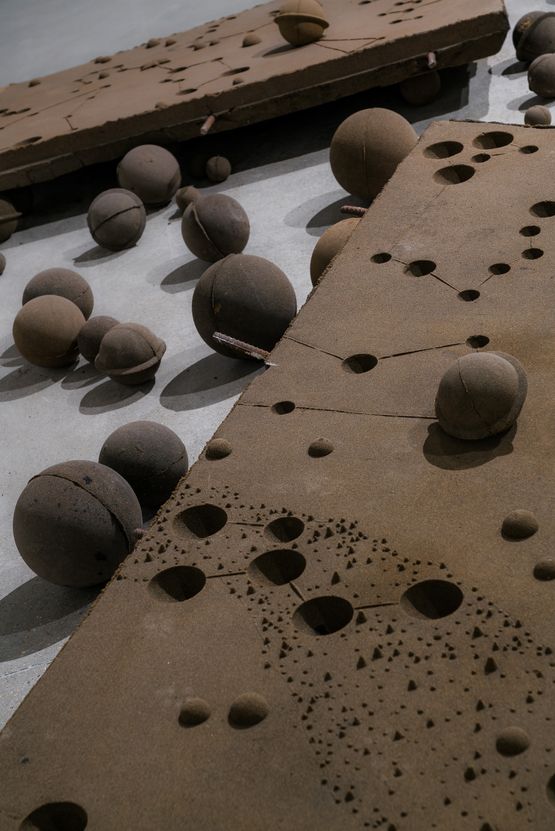
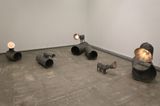
In In the cold winter, the giants gather at the center of the square, playing marbles game with sand, according to the direction of the stars, the title itself resembles a fragment from a novel, presenting a vividly telling picture to the audience. The large relief sculptures of sand molded with resin and engraved with atlases of constellations are scattered on the ground like the plates of continents. The sand balls scattered around are reminiscent of the glass marbles game that children play. However, its heavy presence and rough materials endow the work with a sense of primitive mythology, as if they were ancient relics.

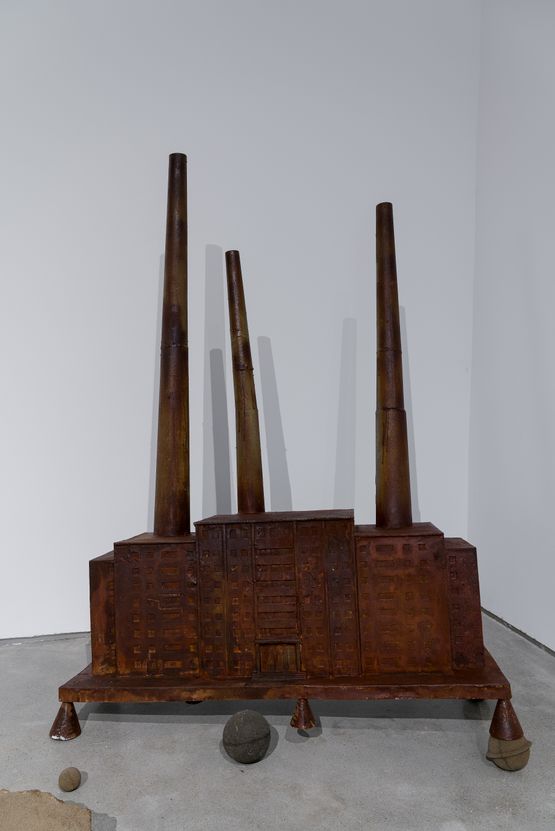
In the summer night, the giants use bat catchers to attract bats shows another game of the giants—the Soviet-style factories with chimneys are used by the giants as a toy to catch bats. The bat is one of Lu Lei’s frequently used elements, derived from memories of his childhood life in the chemical industry compound. The chimneys of the abandoned factories were full of dark bats, flying in and out through the towering cylinders like black smoke. For Lu Lei, the factories themselves were deprived of their original functions and turned into bizarre devices that captured bats instead.

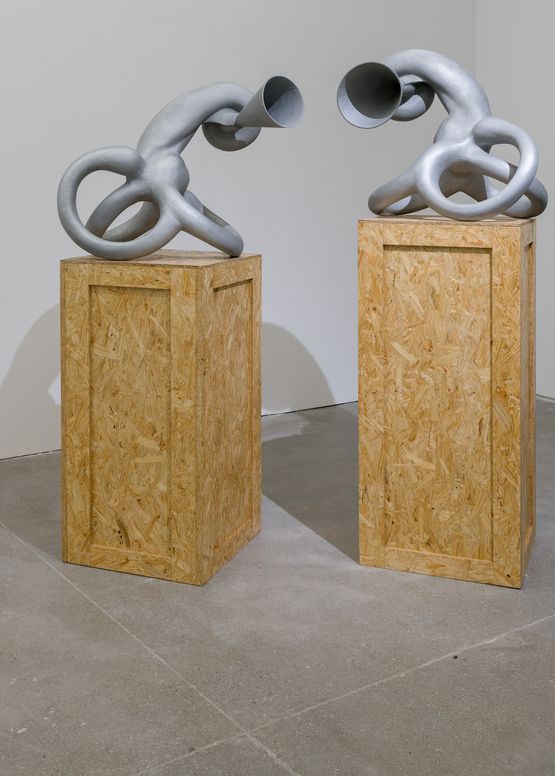
Long live the Roar!’ and ‘W&H Were Hit by Lightning show the wild reveries of the giant. The roar and the thunder that do not actually happen on site are summoned here in a form of fantasy, exerting a powerful sensory stimulation on the audience on a spiritual level. Long live the Roar! is reminiscent of one of Lu’s masterpieces ‘Pretending Egomania’. The work consists of two sculptures placed opposite to each other. The open ‘speakers’ extend from the entangled cochleae like living creatures with thoughts. The two sculptures face each other, either as enemies of confrontation or as comrades of a group. What will the audience hear from them? A dialogue, a quarrel, or a declaration against the void?

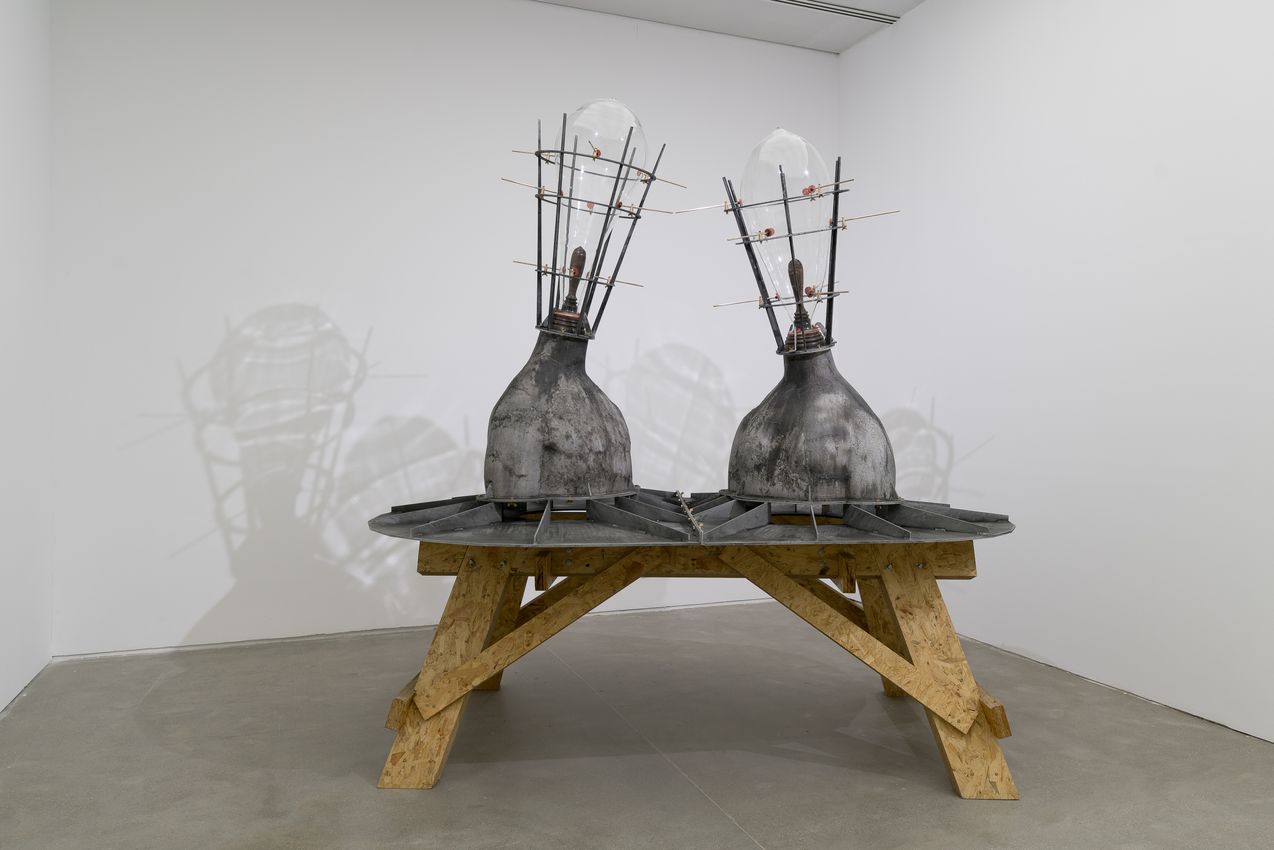
W&H Were Hit by Lightning uses a variety of materials such as cast aluminum, copper, beech and glass, also presented in pairs. Two huge busts stand on the round table; the metal spikes that extend from the ‘heads’ make them natural lightning conductors, as if lightning from the sky was the only way to light them up. The W and H in the title of the work come from the Chinese initials of ‘King (Wang)’ and ‘Queen (Hou)’ and at the same time accidentally match those of ‘Husband & Wife’ in English. It gives the audience the chance to further wonder about the relationship between the two ‘protagonists’ in this work.

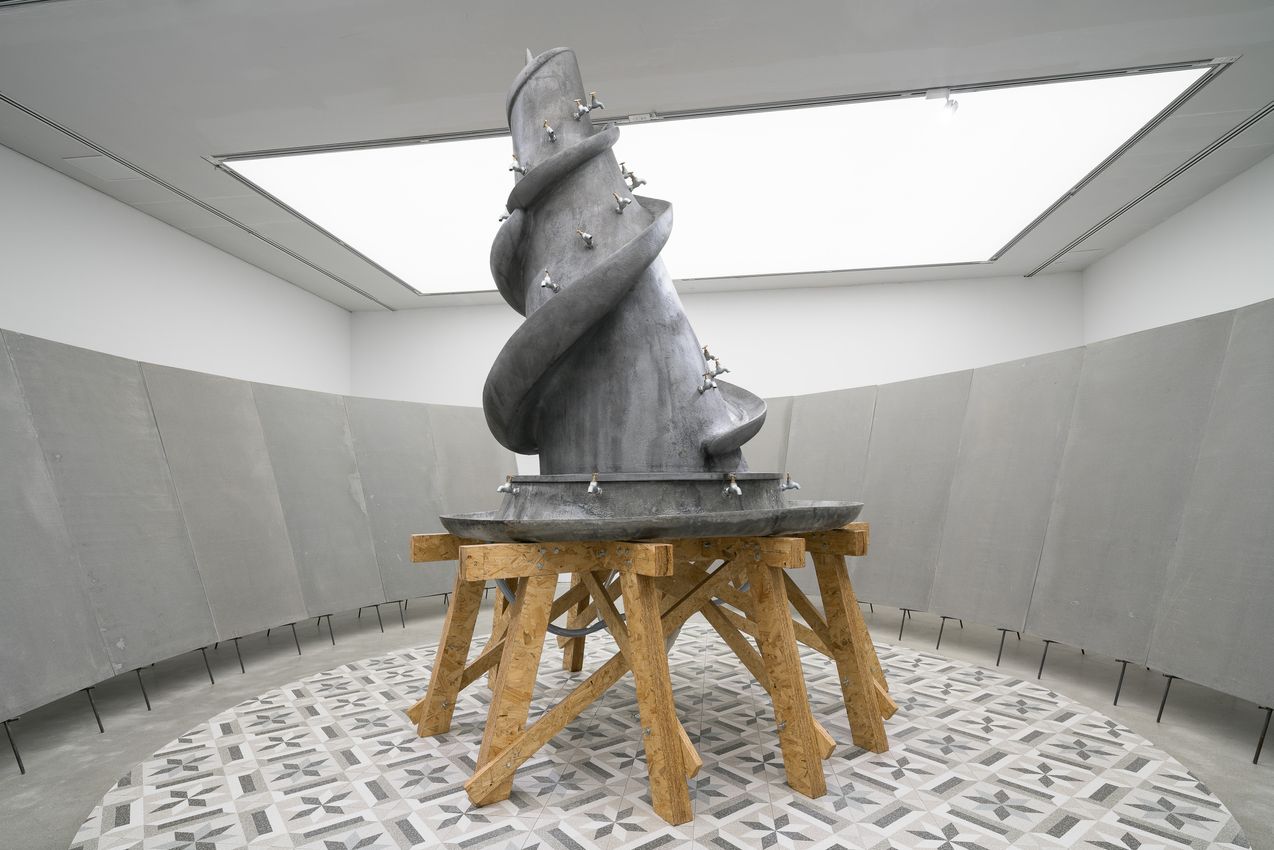
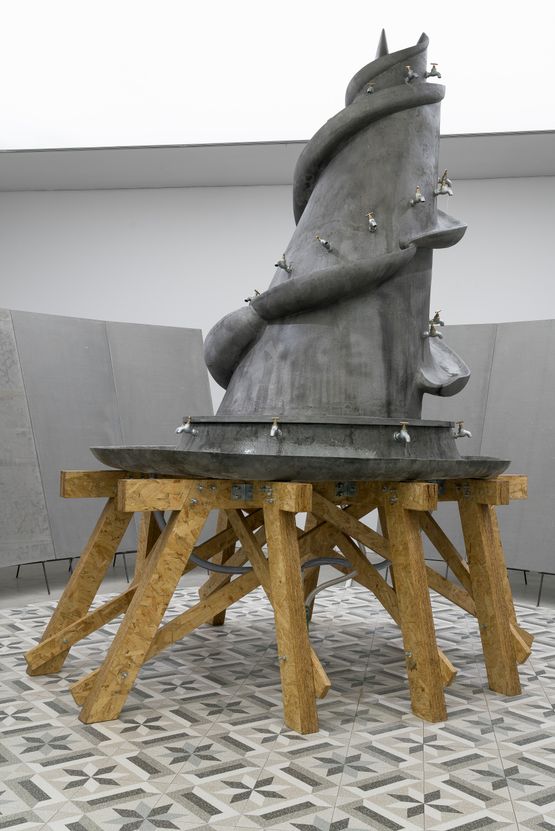
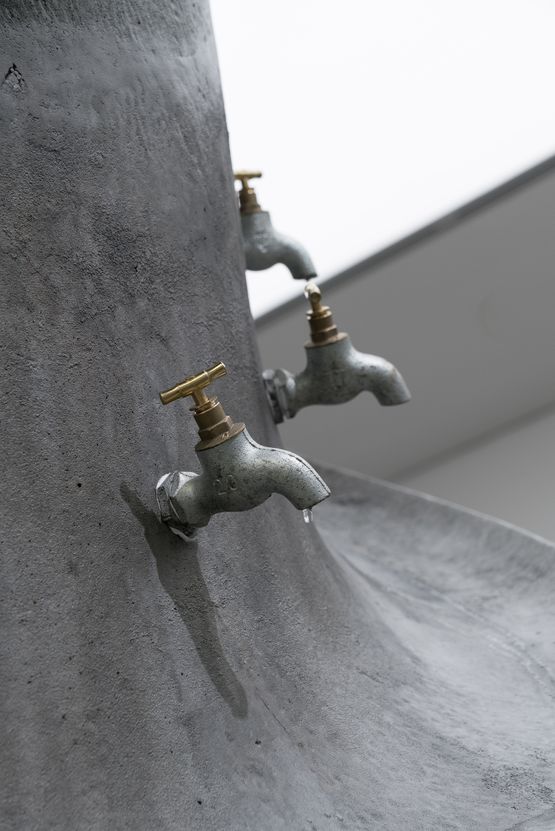
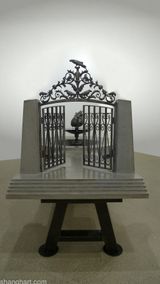
‘The Parentheses Corridor and Hand Washing Basins’ comes from Lu Lei’s childhood memory of tiled corridors and public basins. He altered the shapes of long and straight corridor and basins, transforming the corridor into a circular square surrounded with cement boards that form brackets. The hand washing basins are erected over a circular counter, forming a spiral tower reminiscent of Vladimir Tatlin’s Monument to the Third International. Water flows through the faucets down the spiral-shaped basins. The overall structure of this work is like a parody of the classic garden landscape of ‘the fountain in the garden’, or an elegy to the ‘square-monument’ collectivist historical symbol. At the same time, the artist also retains the functional purposes of the corridor and the basins as much as possible. The audience can walk freely on the corridor, tracing the giant’s footprints, or wash their hands at the basins, feeling the mysterious scenes that exist only in fantasy directly with their body.

Wander Giant continues to show the consistent personal style of Lu Lei. The audience can easily identify the artist’s unique creation at first sight, from its cold and restrained color expression, the sensitivity and control of industrial materials, and the mysterious imagery of personal memory and social symbols. Human beings are always deeply influenced by the experience and environment during their own growth. This influence is imperceptible and irresistible. Through repeated citation and deformation of collectivist relics, and the emphasis on their structure, order and texture, Lu Lei tries to break away from the old-fashioned political criticism and reflection and show his understanding and capturing of the industrial age in a ‘non-attitude’ way.

According to Lu Lei’s plan, the exhibition at ShanghART Shanghai is just one part of Wander Giant, which will continue to be written in the form of exhibition or works in the future. For Lu Lei, although the works will produce various interpretations when they appear in front of the public, in the process of creation, the most important principle he holds is ‘to create for no one but myself’. This reminds us of what novelist J. D. Salinger once said, ‘I write for myself, for my own pleasure.’ Salute to ‘for myself’!
Read More

Installation Views

About the Artist

Lu Lei is a Beijing based artist. His works often incorperate materials and references from a bygone era: monumental towers and triumphal halls; Morse code lamps, maps of military barracks and sculptures of Mao Zedong. These are fragments of a recent history, yet in Lu’s hands they become illusory artefacts of an alternative reality. His meticulously laid plans bear comparison to the utopian projects of mid-century China. Watercolour paintings provide a draft for the realization of his penultimate installations, yet the artist himself- born in the early 70s- possesses no first-hand experience of Maoist China. In this sense the artist does not attempting to restore a socio-political truth but forges symbols and narratives of an idealised past.

View Artist Profile

Also Exhibiting at ShanghART

About the Gallery
ShanghART gallery was initiated in 1996 in Shanghai. It has since grown to become one of China’s most influential art institutions and a vital resource to the development of contemporary art in China with two spaces in 50 Moganshan Road (Main Space and H-Space), a public warehouse space in West of Shanghai (ShanghART Taopu), and a gallery space in Beijing and representing over 40 artists.

Being recognized for its importance ShanghART became the initial gallery from China participating in major international art fairs like Art Basel and Fiac, Paris. ShanghART gallery also enjoys the great respect of being among the 75 most influential galleries selected in Thames & Hudson’s publication ‘International Art Galleries: Post-war to Post-millennium.’
View Gallery Profile
Address
Bldg.10, 2555 Longteng Avenue
Xuhui District
Shanghai
China
Opening Hours
Tue - Sun, 11am - 6pm
(1)
Shanghai Bldg.10, 2555 Longteng Avenue, Xuhui District
ShanghART
Bldg.10, 2555 Longteng Avenue, Xuhui District, Shanghai, China
+86 216 359 3923 / +86 215 424 9033
http://www.shanghartgallery.com

Opening hours
Tue - Sun, 11am - 6pm
The art world in focus