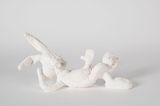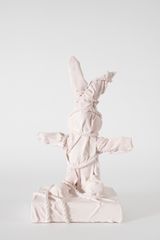
Perrotin is pleased to present Time Fold, an exhibition of new and historical works by Daniel Arsham. Spanning sculpture, painting, and works on paper drawn from nearly two decades of the artist’s practice, the exhibition traces Arsham’s sustained engagement with geology, archaeology, and the cultural residue of the recent past.
Time Fold brings together several of Arsham’s major bodies of work in dialogue with a group of five drawings from the artist’s archives, created between 2007 and 2010, that are exhibited publicly for the first time.
Arsham has long described himself as working within a ‘fictional archaeology’: an imagined future in which the material culture of the recent past has been returned to the earth and recovered, transformed by the same mineralogical processes that shape geological time. In Time Fold, this archaeology is turned back on itself, becoming a site of excavation not only of objects but of the artist’s own history.
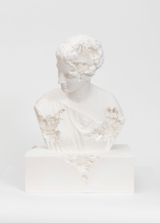
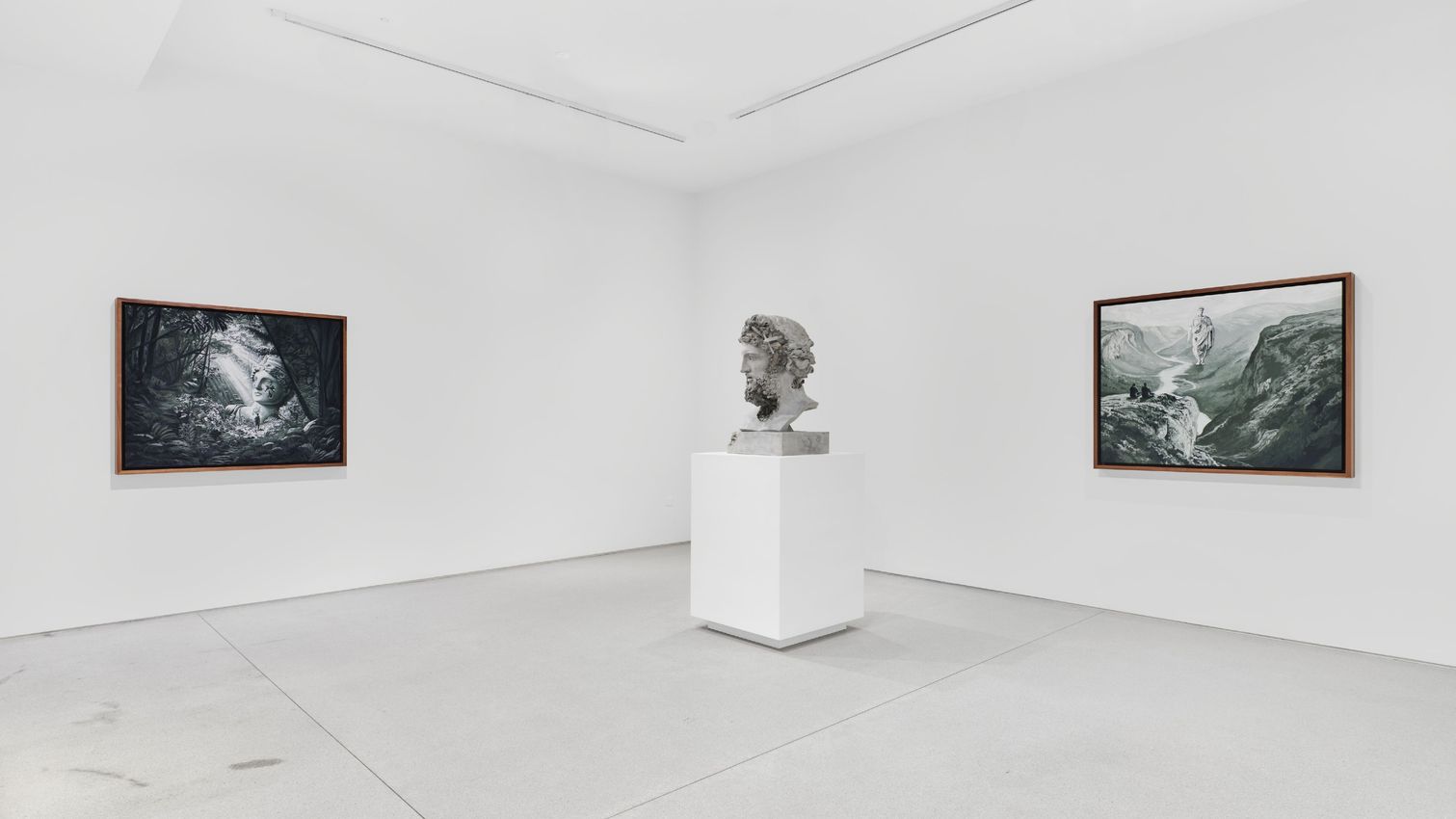
The exhibition opens with Arsham’s eroded busts and classical figures, works that fuse the iconography of ancient sculpture with the mineral vocabulary of the natural world. In Grey Selenite Eroded Bust of Zeus, the commanding features of one of antiquity’s most powerful deities are overtaken by crystalline growth. The nearly two-metre-tall Bronze Eroded Bust of Pericles, cast in bronze and polished stainless steel and on view in the Claridge’s lobby, carries this into monumental scale. These are not objects that mourn the past but rather propose an entirely different relationship with it, one in which deep history and the present moment are understood as co-existing states.
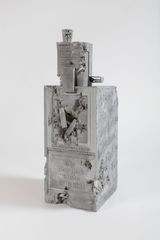
The same logic governs Arsham’s treatment of objects from popular and consumer culture, in which the detritus of twentieth-century life undergoes the same petrifying transformation. Works including Ash and Pyrite Eroded Pentax 6x7 75mm Camera and Grey Selenite Eroded Space Odyssey Movie Poster collapse the distance between the ancient world and the late twentieth century, proposing that a camera from the 1970s and a Greek hero from antiquity occupy the same speculative archaeological moment. The result is a peculiarly moving reassessment of what we consider worthy of preservation, and what we allow to be lost.
A new body of sculptures composed of sand introduces a further destabilisation of form. Where earlier works simulate erosion through the accumulation of mineral deposits, these new sculptures operate through structural fragility, foregrounding the conditions under which objects might fail to endure at all.
Central to the exhibition is a group of five works on paper drawn from Arsham’s archives and shown publicly for the first time. Three gouache works on mylar, Apollo Belvedere; Geometry in Collapse, Portrait Bust of Duke Nemours and Floating Geometry, and Statue of a Wounded Amazon and Geometry, show classical figures overlaid with flat, architectural geometric forms, a compositional logic that directly anticipates the mineral intrusions of Arsham’s later three-dimensional work. Alongside these are two gouache drawings, Camera Study in Gouache and Rolleiflex Camera Study in Gouache, in which the analogue camera appears as a subject of the same careful, elegiac attention it would later receive in sculpture.
Seen together, these early works confirm that Arsham’s central preoccupations were fully formed at the outset of his practice. Time Fold is not an exercise in chronology. It is an argument that past and future are not oppositional categories but coexisting states, and that every object, in Arsham’s hands, is always in the process of becoming something else.
Courtesy Perrotin.


Daniel Arsham’s uchronic aesthetics revolve around his concept of fictional archaeology. Working in sculpture, architecture, drawing and film, he creates and crystallises ambiguous in-between spaces or situations, and further stages what he refers to as future relics of the present. They are eroded casts of modern artifacts and contemporary human figures, which he expertly makes out of some geological material such as sand, selenite or volcanic ash for them to appear as if they had just been unearthed after being buried for ages. Always iconic, most of the objects that he turns into stone refer to the late 20th century or millennial era, when technological obsolescence unprecedentedly accelerated along with the digital dematerialisation of our world. While the present, the future and the past poetically collide in his haunted yet playful visions between romanticism and pop art, Daniel Arsham also experiments with the timelessness of certain symbols and gestures across cultures.


A respected voice in contemporary art discourse.
Focusing on ambitious storytelling and insightful art-world commentary. Ocula Magazine publishes in-depth interviews, critical essays and timely analysis on the artists, exhibitions and ideas driving the global art world.
Learn more about Ocula Magazine
Showcasing the best of the art world.
Ocula partners with galleries from around the world to highlight their artists, artworks and exhibitions. Gallery membership is by application and invitation, with each member vetted by an independent panel.
Learn more about Ocula Membership

Specialises in the sale of major artworks.
Led by a team with deep ties to the world’s leading auction houses, galleries and collectors. Ocula’s advisory team offers bespoke services to high-net-worth clients from around the world who are looking to acquire the best of contemporary and modern art.
Learn more about our team and services