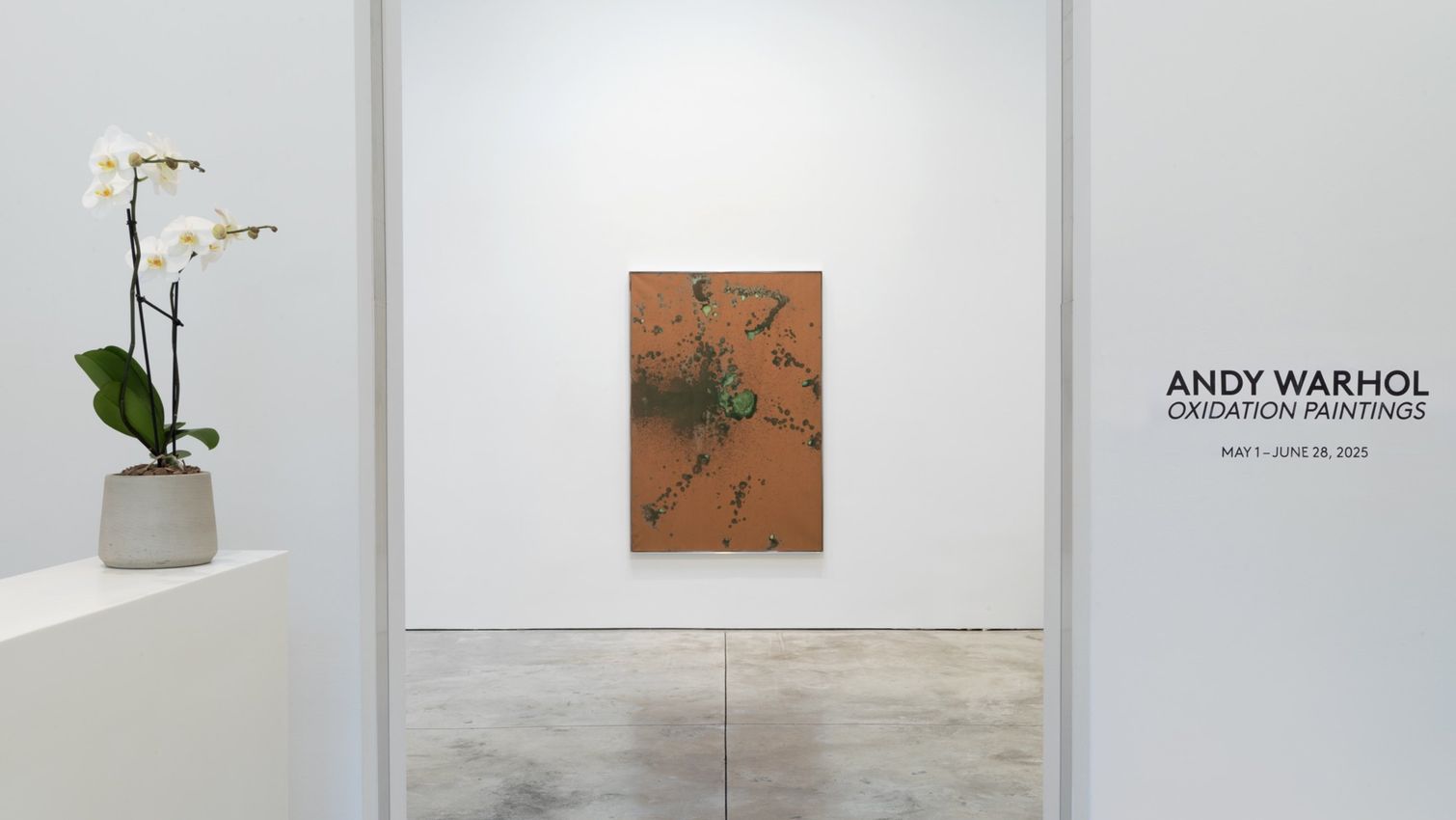
Skarstedt is pleased to announce Andy Warhol: Oxidation Paintings, an exhibition that revisits one of the most audacious and conceptually complex series of Warhol’s career. The presentation marks the gallery’s first dedicated showing of the series since Warhol/Klein: Fire & Oxidation in 2014. The present show invites a renewed encounter with works that stand at the intersection of abstraction, alchemy, performance, and the bodily.
Rarely exhibited as a standalone series, viewing Warhol’s Oxidation Paintings underscores their enduring ability to disrupt—and expand—our understanding of painting’s potential. Departing from the photographic source material that had dominated his practice since the 1960s, Warhol here turned to the raw potential of abstraction. In place of celebrity faces and mechanized silkscreens are gold or copper metallic fields, chemically altered by vitamin-enhanced urine—a process that yielded surfaces of unpredictable iridescence, where blooms of acidic green and oxidized black sweep across the corroded grounds.
Formally, the works gesture to the gestural. At once playful and precise, they present a clear dialogue with Jackson Pollock’s all-over canvases, seen as the embodiment of the heroic masculinity and genius of postwar American painting. In contrast, Warhol’s Oxidation Paintings perform a distinctly irreverent inversion. The urine—sometimes splattered directly onto the support, sometimes poured from vessels, occasionally brushed—mimics the bravura of Pollock’s drip while stripping it of its mythos. The Oxidation Paintings are action painting by other means, rerouted through a logic of waste, erotic play, and chemical transformation.
Created on the heels of other series, such as the Torsos, Sex Parts, Piss, and Cum Paintings, the Oxidation Paintings had a timely emergence alongside the atmosphere of the gay and punk subcultures of 1970s New York. Still ever the outsider, the means of their making reflects the intimacy of the activities within these subcultures, essentially abstracting sex. In doing so, Warhol gets up close to the aura of the times while maintaining an aesthetic distance from it all. At the same time, urine as material—filled as it is with DNA—makes these paintings involuntary portraits: of Warhol, of his assistants, of friends and anonymous strangers. They hover between bodily presence and artistic detachment.
Yet, beyond their transgressive wit, the Oxidation Paintings are also works of unexpected beauty and resonance. Their glimmering surfaces recall the iconography Warhol would have seen in the devotional panels of his Catholic upbringing: gold leaf and metallic surfaces that called forth ideas of the sacred—influences that would affect his entire career, from the shimmering background of his Gold Marilyn to the gold leaf of his earliest shoe drawings.
The paintings are, in many ways, performative. They are relics of acts carried out in a specific time and place, and yet they resist closure. Like the Rorschach Paintings that would follow in the early 1980s, the Oxidation Paintings ask viewers to project, intuit, and interpret. At once sensuous and cynical, playful and charged, they remain difficult to categorize, and all the more powerful as result.
Andy Warhol: Oxidation Paintings invites viewers to consider Warhol not only as a chronicler of fame and commodity, but as a shrewd manipulator of materials, gestures, and myths. It offers a glimpse into a moment when Warhol, often perceived as emotionally remote or mechanically detached, engaged with the most intimate forms of mark-making. And it reminds us that beneath the surface, there is always a question of presence, of process, and of transformation.
Andy Warhol was a leading figure in the American Pop Art movement, renowned for exploring consumer culture, mass media, and celebrity. Working across painting, printmaking, photography, film, and sculpture, he reflected the commonplace imagery of mid-century American popular culture and advertising in numerous iconic artworks.


A respected voice in contemporary art discourse.
Focusing on ambitious storytelling and insightful art-world commentary. Ocula Magazine publishes in-depth interviews, critical essays and timely analysis on the artists, exhibitions and ideas driving the global art world.
Learn more about Ocula Magazine
Showcasing the best of the art world.
Ocula partners with galleries from around the world to highlight their artists, artworks and exhibitions. Gallery membership is by application and invitation, with each member vetted by an independent panel.
Learn more about Ocula Membership

Specialises in the sale of major artworks.
Led by a team with deep ties to the world’s leading auction houses, galleries and collectors. Ocula’s advisory team offers bespoke services to high-net-worth clients from around the world who are looking to acquire the best of contemporary and modern art.
Learn more about our team and services