



Press Release

When a collector once asked Jean-Michel Basquiat for his C.V., the artist offered to draw around the outline of his hand. I imagine Alma Allen’s hands, too, as a record of his experience: whorled and rubbed, smoothed and shattered — ‘plump with struggle’, as one critic described Allen’s life story. Though his sculptures take their final form in the hard stuff of stone, wood and, more recently, metal, each one still begins, as they have since he began carving with a pocketknife as a teenager in Utah, in the immediacy of the hand: the artist working string, clay or wax through his fingers, pushing their limits, finding the point where they have poise and weight. It’s a meditative practice that approaches a kind of automatism: the aim is not to attain mastery over these simple materials nor to realise some predetermined intention with them, but to release some potential form that is already somehow already there – to ‘have my hands teach me something’, Allen says.

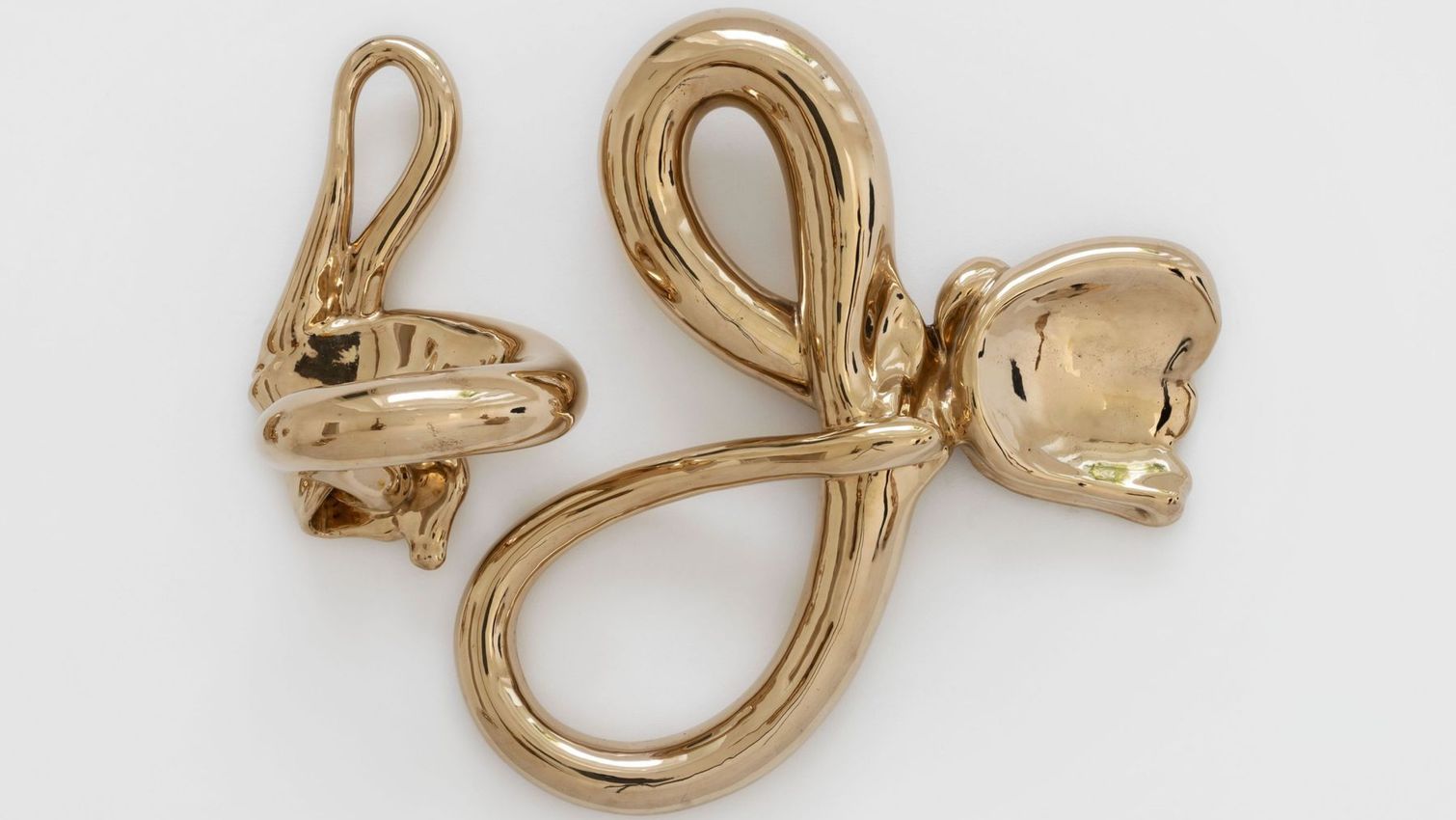
Scanned from these hand-sized works, scaled up and finally cast in bronze at Allen’s home foundry, the sculptures in this exhibition still bear Allen’s intimate relationship to the tactile. You don’t need to be a seafarer – or to know that the artist loves to sail and is planning a voyage by boat from Mexico to Europe soon – to recognise the haptic grammar of nautical knots in these sculptures’ twists and coils, or to feel in their snaking, spilling masses echoes of lengths of rope hitched up, looped around and extruded out from a tie. Allen worked on many of these pieces after spending time in Venice this year; he tells me, carrying with him the experience ‘of being surrounded by water’; several of them he worked on aboard his boat, carrying his hand-sized models in a small suitcase. Looking at these tensile, fluid forms, you can almost imagine forces pulling on them across a voyage: rough winds, deep tides, towing and straining. Yet for all they stretch and wind, these braids and tangles do not give. If they evoke strain or stress, they also impart an ultimate sense of holding fast – holding on. Standing for a kind of endurance, they also remind us of what art is and always has been for Allen: the means of survival.

Also included in the exhibition are a series of new works that embrace a flatter plane: wall-mounted and distinguished by ridges or pleats, sometimes contrasting with areas of smoothness, like the inside and outside of an animal hide, folded over itself. When we talk, I liken these to pieces of origami, or paper aeroplanes, and Allen says something about pages of writing, folded up so no-one can read them: so that they keep their secrets. Allen has long been a champion of the held-back and the unsaid – hence the regimented inconclusiveness of his titles (here as ever, each work goes by ‘Not Yet Titled’.) It makes sense when he tells me that the first and possibly most impactful artworks he ever encountered were Native American petroglyphs, carved into a cave wall or rock face anywhere from hundreds to thousands of years ago by ‘someone I never knew, or saw’. Which means that for Allen, mystery was always baked into the experience of art: it’s a meeting with a part of the world that can’t be fully known.

The lines or seams in these new works also, to me, recall the ribs or ‘flutes’ which run down the length of a saguaro, that sacred cactus whose columnar form is recalled by some upright works in this exhibition. The other thing they remind me of are the folds in a piece of Renaissance drapery, like the ones in, say, the Madonna del Parto (c.1457) that Piero della Francesca was said to have painted by hand in seven days, just after his mother’s death. Evoking both the divine and the botanical, these works shed further light on the towering piece that Allen placed at the centre of his Venice exhibition: a great gleaming form that evoked both the saguaro and the shape of the Virgin of Guadalupe, the patroness of Mexico, who left her miraculous mark in the folds of a tilma, an indigenous cloak. ‘I do, in a sense, make apparitions,’ Allen concedes when we speak. We are talking about mysteries: unexplained experiences, the doctrine of analytical idealism and life in a town where the appearance of a spirit is an everyday occurrence, like the weather, but also how a life streaked with isolation and destitution has led, through twists and turns, to the living miracle of a loving family and a busy studio. In their constant encounter with the unexpected, Allen’s sculptures are tributes to these mysteries and witness to the essential and unpretentious curiosity with which the artist meets them: his simple desire to ‘look around the corner of what reality is and use my own life as an experiment to understand it.’

Which brings me back to the works being ‘Not Yet Titled’, and this reminder always holds back space for understanding or information to be revealed. Hindsight, I read somewhere, is only ever 50/50, after all: the other half of the story is still out there, still to come.

— Matthew Joseph McLean

Courtesy Perrotin.

Read More
About the Artist

Alma Allen, a Utah-born, Mexico-based sculptor, selected to represent the United States at the 2026 Venice Biennale, is known for work characterised by fluid, biomorphic forms. Carved from natural materials such as wood, stone, and bronze, he merges traditional hand-carving techniques with advanced robotic technology to create works that feel both ancient and modern. Allen’s sculptures evoke a mysterious life force, blending tactile softness with monumental scale, exploring the intersection of material, form, and the intangible presence of objects.

View Artist Profile

Also Exhibiting at Perrotin

About the Gallery

Emmanuel Perrotin founded his first gallery in 1989 at the age of 21. He has opened since then over 17 different spaces, with the aim of continuing to offer increasingly vibrant and creative environments to experience artists work. He has worked closely with his roster of artists, some since more than 25 years, to help fulfil their ambitious dreams and projects.

View Gallery Profile
Address
76 rue de Turenne
Paris
France
Opening Hours
Tuesday – Saturday
10am – 6pm
(1)
Paris 76 rue de Turenne
Perrotin
76 rue de Turenne, Paris, France
+33 1 42 16 79 79
http://www.perrotin.com

Opening hours
Tuesday – Saturday
10am – 6pm
The art world in focus
