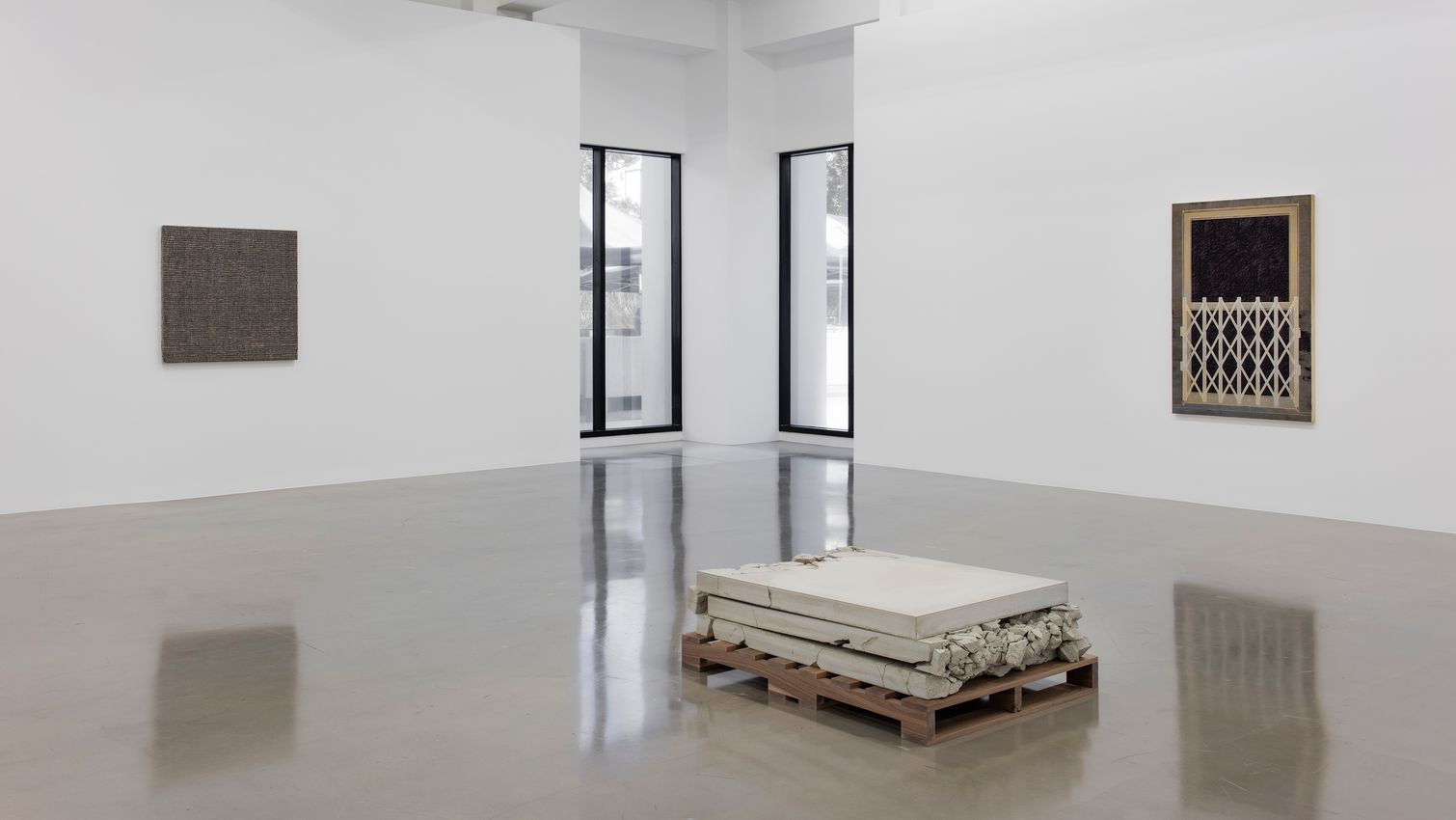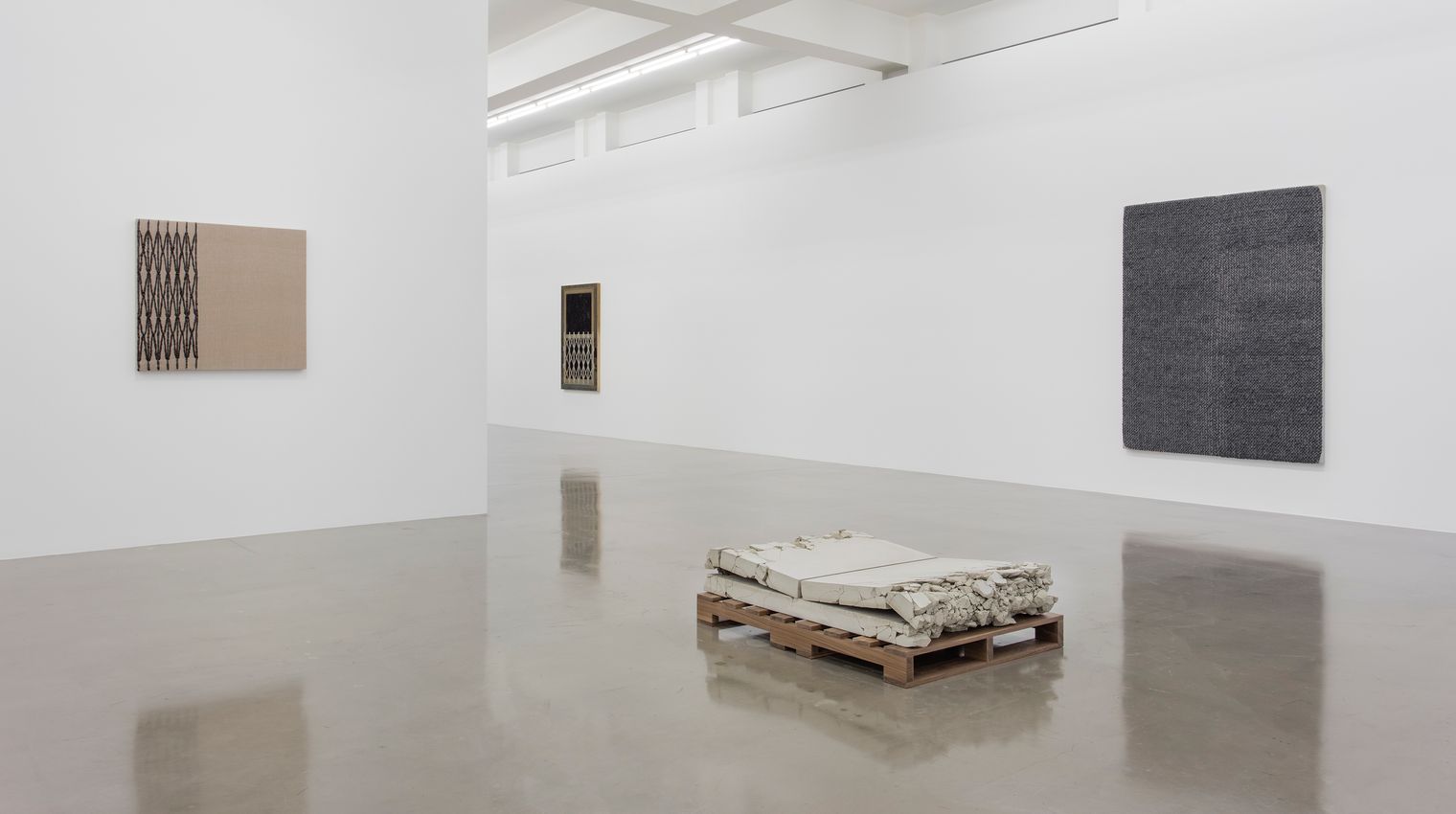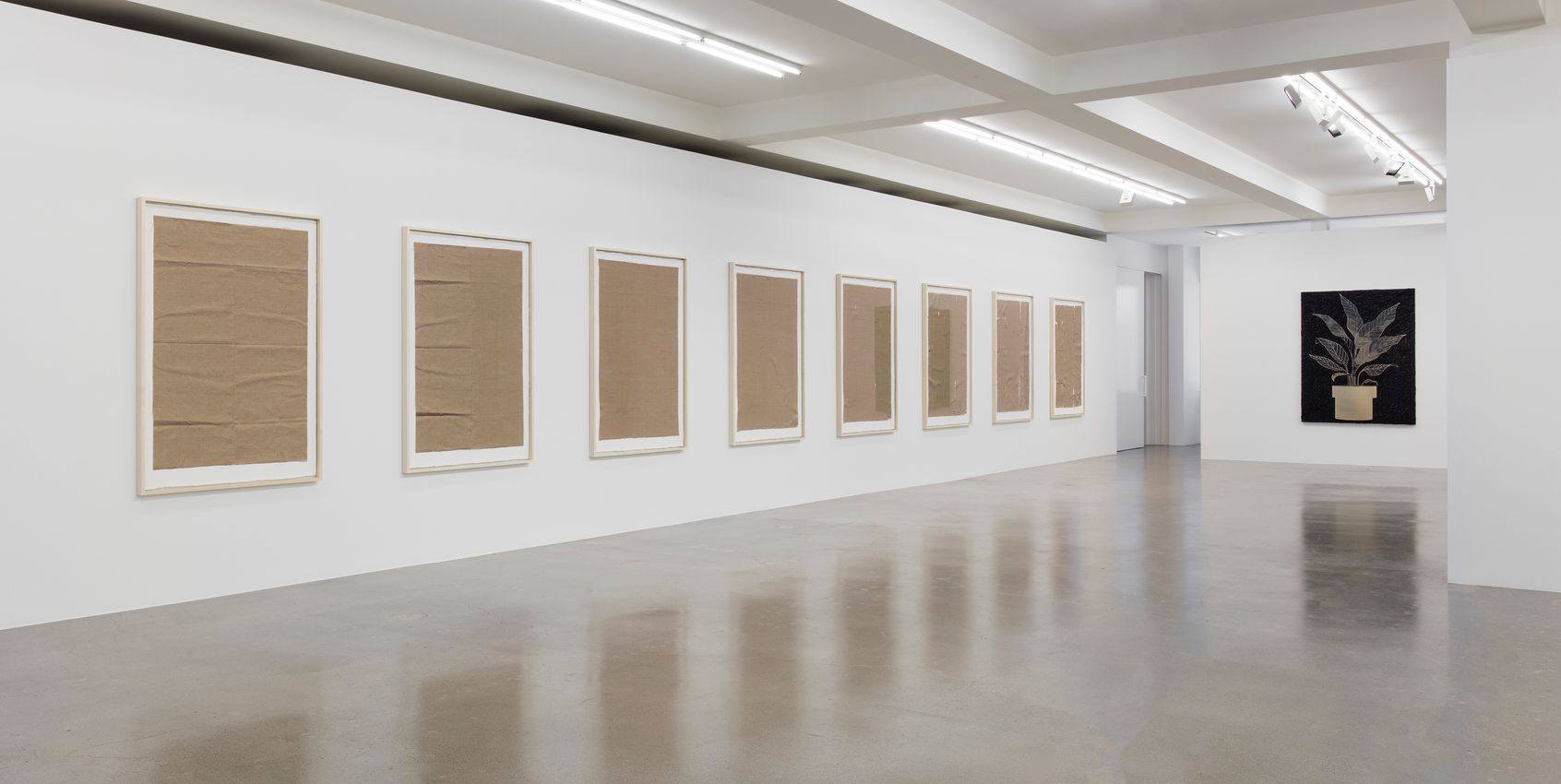
Sprüth Magers, Los Angeles, is pleased to present Folds and Faults, an exhibition of new work by Analia Saban that extends the artist’s experimental, witty, and profound exploration into the ways in which artworks both enter into being and enter into dialogue with the world they inhabit. Across four recent series, the artist weaves together—literally, at times—medium and content, folding art and architectural references in with everyday concerns that range from light- hearted investigations to meditations on mortality. As in past works, Saban’s new series are deeply engaged with the basic tools of art-making: while she uses traditional materials such as paint, linen, wood, ink and paper, she turns onto its head our concept of what a painting, sculpture or drawing entails.
In the exhibition’s title, Saban borrows the idea of the fold, in part, from philosopher Gilles Deleuze, whose writings describe the cosmos as an ‘origami universe’ that is forever expanding and unfolding; this process also mirrors our own continual folding of the external world into our interior, subjective experience and self-image. This is a deeply connected and elastic view of reality; yet one riven, too, with faults that have the potential to crack and swallow us whole. As an artist based in Los Angeles, one of the earth’s earthquake capitals, Saban’s perpetual awareness of impending fracture, destruction, and demise carries over into her work, albeit in an oblique and even sometimes playful manner.
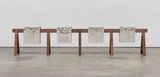
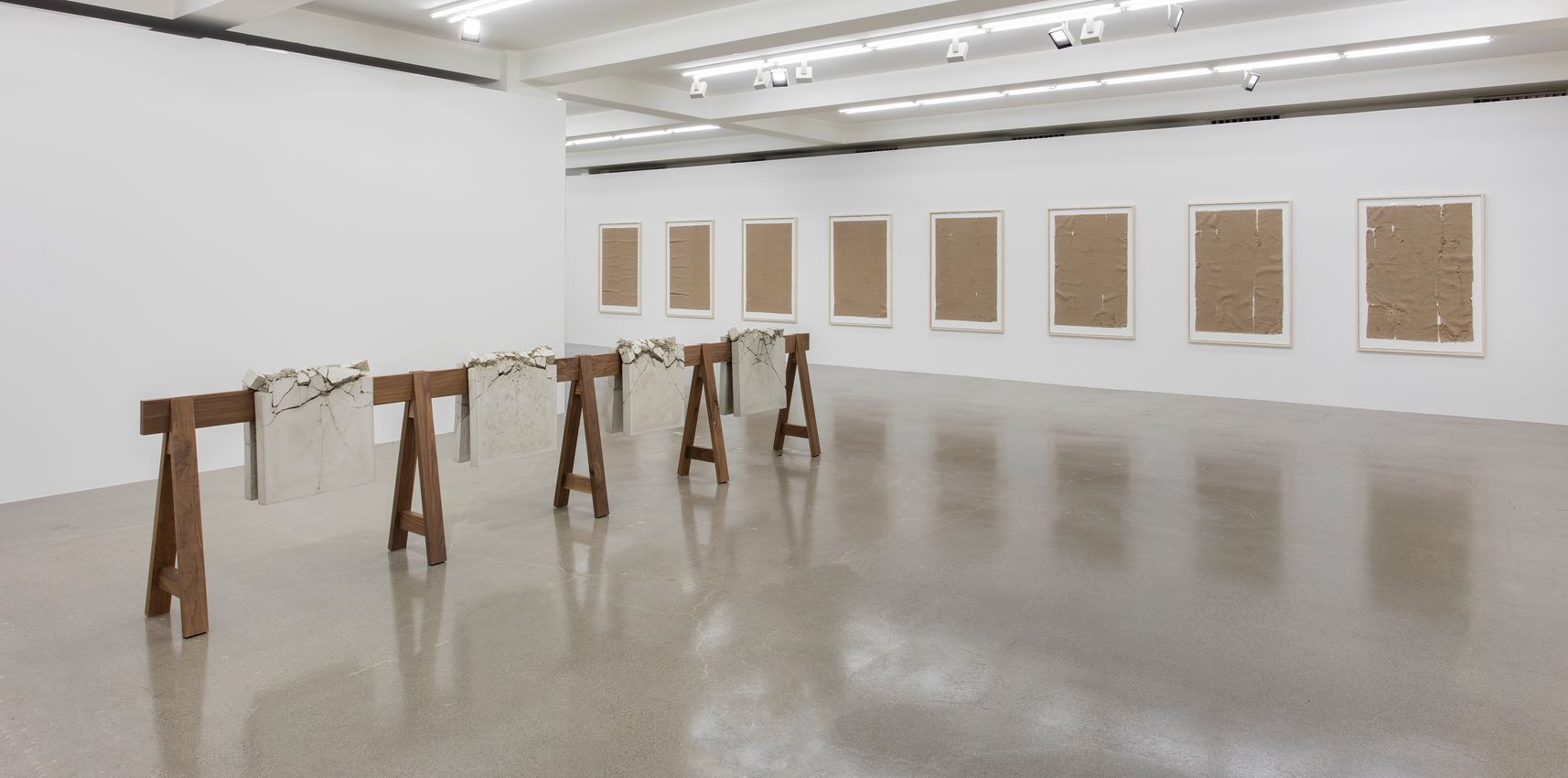
The artist’s recent concrete sculptures, for example, involve actual folds and faults reminiscent of aging, crumbling structures. To create them, Saban worked closely with engineers to develop a method of folding slabs of concrete, going entirely and wryly against what the substance was intended to do as a standard construction material. Her resulting works are creased in patterns that mimic printers’ paper-folding techniques (gate fold, accordion fold, etc.), and they sit and drape improbably atop hand-crafted walnut sawhorses and shipping pallets. The beauty of the wood contrasts with the deteriorating concrete, making the work at once attractive and absurd.
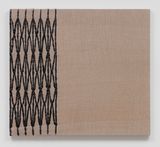
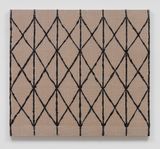
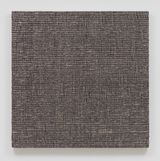
Saban’s undoing and reconfiguring of mediums continues in her series of weavings. Each painting has been woven by hand on a traditional loom; as the linen canvas materializes, networks of dried acrylic brushstrokes are entwined throughout its warp and weft. On the one hand, the monochromatic lines and shapes that populate these works share the minimalist impulses of painters such as Sol Lewitt and Agnes Martin. On the other, they subvert the established notion of painting as paint-on-canvas by inventing what is essentially paint-within-canvas, and creating objects that hover between painting and sculpture. The works’ geometric patterns also coalesce gradually into recognizable forms, such as window frames, doorways, and the protective accordion-style gates seen across Los Angeles and other cities. What begins as an ingenious artistic flip evolves into an exploration of the porous boundaries between artworks, objects, architecture, and daily life.
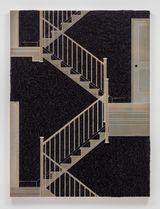
Saban’s group of large paper-on-ink panels, depicting the interiors of a home, enact a similar media reversal. She produces them by layering thin, laser-sculpted pieces of paper onto fields of pitch-black ink. As the paper hits the still-wet ink, its translucence builds, sometimes to the point of splitting and disintegration. And as the ink dries— sequestered into pockets that form staircases, venetian blinds, and plant pots—it gains a rough wrinkled skin that conflicts with Saban’s careful, diagrammatic architectural compositions. The domestic scenes in these works are entirely familiar, but their unusual process creates a strong sense of tactility and intrigue. Moreover, it is a telling coincidence that in Deleuze’s writings, he used the metaphor of a two-story house to illustrate his theory of the fold and subjectivity.
Finally, a new suite of photographic inkjet prints once again confounds ideas about how art mediums are supposed to function. Across the walls of the gallery’s second floor, we witness the slow coming apart of a linen canvas, its threads gradually unwoven by an unseen hand. The photographs look uncannily real, tempting viewers to reach out to pull the loose strands themselves. They are printed onto meticulously prepared ‘sheets’ of acrylic paint, which are created by drying thin layers of white paint, building them up gradually until they are thick enough to support the printing process. These and Saban’s works throughout the exhibition move the viewer in and out of states of contemplation, incredulity, and pleasure that are indicative not just of Los Angeles’s shifting grounds, but those of today’s anxiety-ridden planet. While art can offer respite from the external world, Saban’s materially rich and alluring objects keep turning us back, folding us outside the gallery and into reality.
Analia Saban (*1980 in Buenos Aires, Argentina) lives and works in Los Angeles, CA. She has exhibited widely in both solo and group shows in American and European museums such as Blaffer Art Museum, Houston (2016), Rubell Family Collection Contemporary Art Foundation, Miami (2015-2016), LACMA, Los Angeles (2012, 2014-2016), The National Museum, Oslo (2014-2015), Kiosk, Ghent (2015), Armory Center for the Arts, Pasadena (2014), Palais de Tokyo, Paris (2013), MARCO Museum of Contemporary Art, Vigo (2012), and Centre d’art Contemporain de Fribourg, Switzerland (2012/2013).
A concurrent exhibition of Saban’s work, Pigmente, will also be on view at Sprüth Magers, Berlin, July 7 – September 2, 2017.
Analia Saban was born in Buenos Aires, Argentina, in 1980 and lives in Los Angeles and New York City. She has exhibited widely in both solo and group shows. Recent group exhibitions include Variations: Conversations in and Around Abstract Painting, LACMA, CA, Vibrant Matter, Kiosk, Ghent, Belgium, both 2015, An Appetite for Painting, National Museum of Norway, Oslo, 2014, Expanding on an expansive subject, Part 2: Analia Saban, Is this a painting?, Armory Center for the Arts, Pasadena, CA, 2014, Le Club des Sous L’Eau / Nouvelles Vagues / Young Curator Season, Palais de Tokyo, Paris, 2013, the Hammer Museum’s first Los Angeles biennial exhibition, MADE IN LA 2012 and LA>La Ballena Negra, MARCO Museum of Contemporary Art, Vigo, Spain, 2012, Lost Line: Selections from the Permanent Collection, Los Angeles County Museum of Art, Los Angeles, 2012, and Pour une grammaire du hazard, FRI-ART, Centre d’art Contemporain de Fribourg, Switzerland, 2012/2013. She is the recipient of the Norton Museum’s Rudin Prize For Emerging Photographers Award, West Palm Beach, 2012, the Santa Monica Artist Fellowship, 2010, as well as grants from the Durfee Foundation, 2009 and the Fundacion Antorchas Fellowship, Buenos Aires, 2003 – 2005.
Sprüth Magers has expanded from its roots in Cologne (Germany) to become an international gallery dedicated to exhibiting the very best in groundbreaking modern and contemporary art. With galleries located in Berlin Mitte, London’s Mayfair and the Miracle Mile in Los Angeles–as well as an office in Cologne and an outpost in Hong Kong–Sprüth Magers retains close ties with the studios and communities of the German and American artists who form the core of its roster.

A respected voice in contemporary art discourse.
Focusing on ambitious storytelling and insightful art-world commentary. Ocula Magazine publishes in-depth interviews, critical essays and timely analysis on the artists, exhibitions and ideas driving the global art world.
Learn more about Ocula Magazine
Showcasing the best of the art world.
Ocula partners with galleries from around the world to highlight their artists, artworks and exhibitions. Gallery membership is by application and invitation, with each member vetted by an independent panel.
Learn more about Ocula Membership

Specialises in the sale of major artworks.
Led by a team with deep ties to the world’s leading auction houses, galleries and collectors. Ocula’s advisory team offers bespoke services to high-net-worth clients from around the world who are looking to acquire the best of contemporary and modern art.
Learn more about our team and services