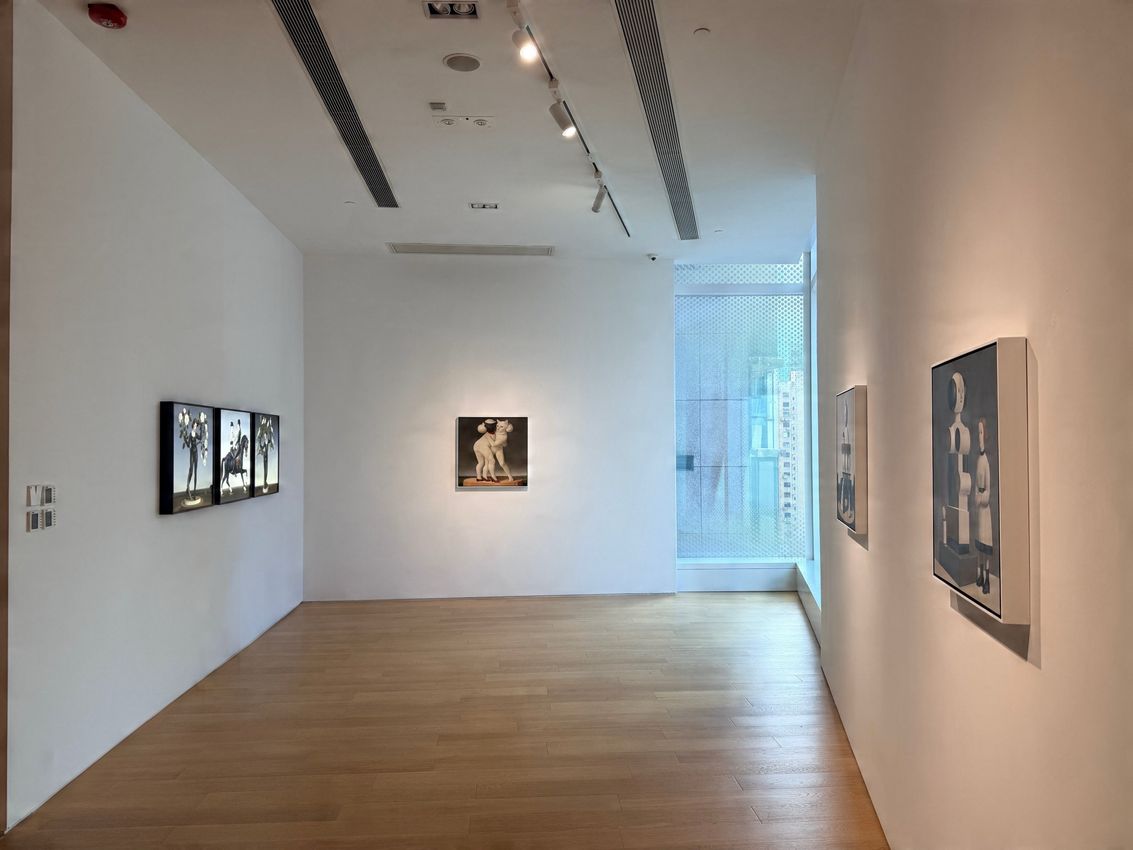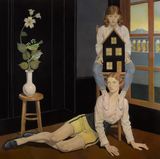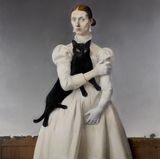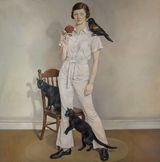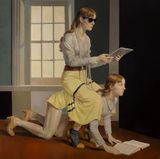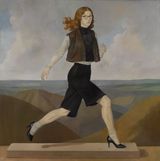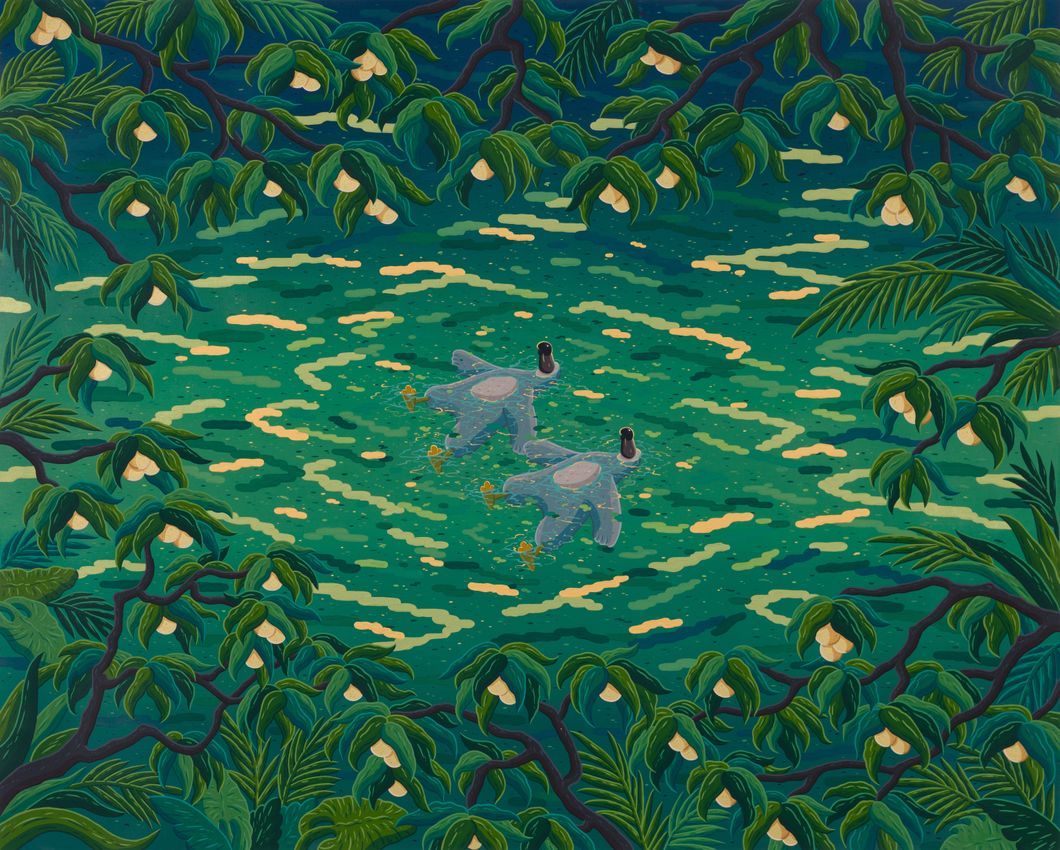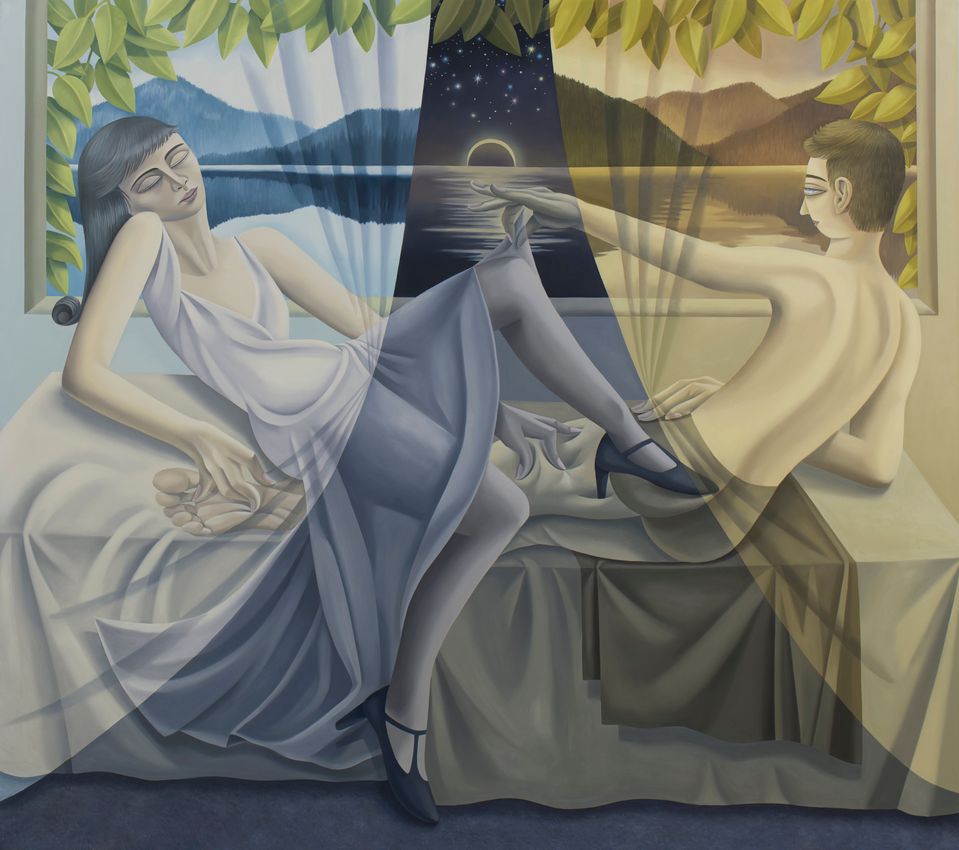

The figures in Von Wolfe’s paintings do not explain themselves. They offer no easy entry, no familiar gesture of welcome. They are present,
composed, entire unto themselves - and in that self-containment lies their quiet authority.
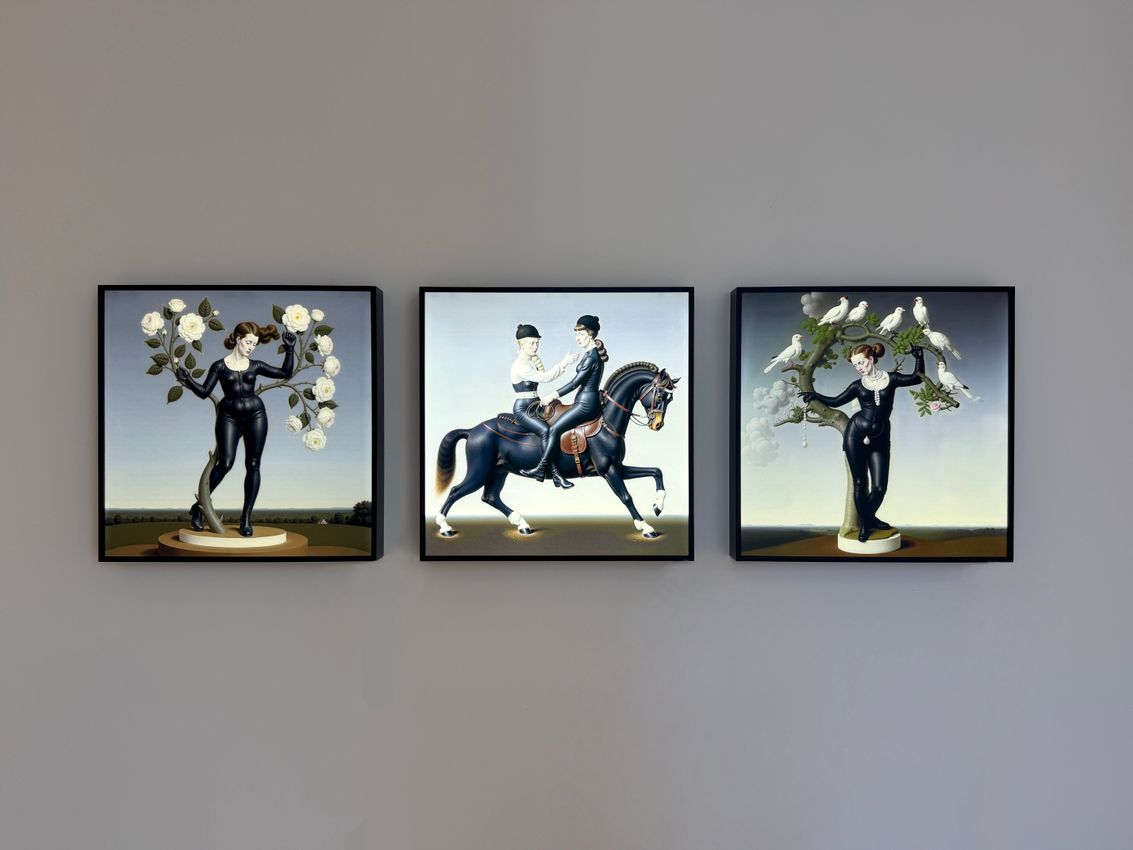
Simone Weil wrote that attention is the rarest and purest form of generosity: not the strained concentration of the will, but a kind of suspension, awaiting in which the soul empties itself in order to receive. The figures gathered across these fourteen works inhabit precisely that state - a complete stillness that reads not as passivity but as concentrated attention, an emotional restraint that signifies strength rather than absence. Women hold roses, command animals, stand beside artificial constructions of their own making, ride through impossible gardens. Whatever the action or setting, the underlying posture is constant: a figure who contains rather than expresses, who holds rather than releases, whose silence is full.
We live in an age that has forgotten how to wait. Screens deliver images faster than the eye can settle on any one of them; algorithms generate and discard at velocities that make selection feel like surrender. Social media presents a speeded-up world in which attention itself has become a commodity - harvested, fragmented, sold back to us in forms we no longer recognise as our own. Against this current, Von Wolfe’s practice proposes a deliberate slowness. Each painting originates in digital space, where algorithmic systems generate images in their hundreds, where speed is the native condition. Most are discarded. A few - the outliers - resist dismissal, carrying an intensity that the artist recognises through intuition rather than logic. And then something crucial occurs: the chosen image is withdrawn from the current, translated into oil paint, layer upon layer, until the immaterial acquires material weight and the ephemeral achieves permanence. The algorithm is not rejected. It is slowed. Made to wait. Made to endure the long patience of pigment drying, of hand following hand, of time itself becoming part of the image. The digital origin is not disavowed. It is the ground upon which the painting’s ambiguity stands.
These figures inhabit painted worlds that share their quality of ordered intensity. Landscapes and interiors rendered with a precision that exceeds the photographic- perspectives too exact, symmetries too perfect, light too clear and consistent. The effect is of a reality somehow improved upon, or perhaps exposed in its underlying structure. These are not distorted visions. They are hyper-lucid ones.
The results can be monumental. Pearls of the Desert measures two hundred and seventy centimetres on each side - nearly nine square metres of painted surface upon which a rider in white sits astride a white camel, pearls cascading from harness and bridle like a waterfall, a celestial orrery floating above. The pearl appears throughout this exhibition as more than ornament. It drapes the neck of a cat who has claimed royalty. It encircles the throat of a figure who commands birds from the branches of a tree. It dangles from the hand of another holding roses against her body. And in Eternal Flames, the artist inscribes his own name upon a classical urn - a vessel which is itself a kind of pearl, formed layer by imperceptible layer until what was formless becomes precious. The pearl describes the practice itself: selection from abundance, accretion over time, the slow transformation of the unrewarding many into the irreplaceable one.
Animals circulate through these works as psychological counterparts. Cats appear as familiars, their direct gaze reversing the conventional relation between viewer and subject. Dogs embody a calm that throws human anxiety into sharp relief. Horses become vehicles for the transmission of knowledge between riders, suggesting that understanding may flow along non-verbal channels. The boundary between human and animal is never stable; each seems to borrow something essential from the other.
The exhibition marks a technical expansion. Several works combine UV-printed acrylic with LED illumination housed in powder-coated frames, producing images that glow from within. Here the painting’s surface becomes a source of light, and the viewer is immersed in a luminous field where the distinction between image and illumination collapses. The technological medium is not hidden. It is the subject.
Von Wolfe is a British artist descended from Baron von Schlossberg, court painter to King Ludwig II of Bavaria. He studied philosophy at York University. He works between London and the vast interior of digital generation, selecting from thousands of images the few that demand to become paintings.
His work has been the subject of a major museum retrospective at the Kaohsiung Museum of Fine Arts, Taiwan, where his exhibition Garden Fortress presented a comprehensive survey of his painting across multiple gallery spaces.
This is his second solo exhibition in Asia with Tang Contemporary Art, following his presentation at the gallery’s Seoul space.
The fourteen paintings gathered here constitute a coherent universe, a system of echoes, repetitions, and variations that rewards sustained attention. Enter it as you would enter a garden whose paths circle back upon themselves, where each turn reveals not something new but something previously glimpsed, now seen more clearly.
The pearl forms in silence. The double watches. And we, standing before these images, are ourselves seen in return.

Wolfe von Lenkiewicz (Von Wolfe) is a British artist based in London whose work primarily examines themes of identity, intimacy, psychological depth and power dynamics, offering nuanced reflections on universal experience. The artworks often highlight the tension between control and autonomy, illuminating how unseen societal, technological, and psychological forces influence and shape individual agency.


Tang Contemporary Art was established in 1997 in Bangkok, later establishing galleries in Beijing and most recently Hong Kong. Tang Contemporary Art is fully committed to producing critical projects and exhibitions to promote Contemporary Chinese art regionally and worldwide and encourage a dynamic exchange between Chinese artists and those abroad.

A respected voice in contemporary art discourse.
Focusing on ambitious storytelling and insightful art-world commentary. Ocula Magazine publishes in-depth interviews, critical essays and timely analysis on the artists, exhibitions and ideas driving the global art world.
Learn more about Ocula Magazine
Showcasing the best of the art world.
Ocula partners with galleries from around the world to highlight their artists, artworks and exhibitions. Gallery membership is by application and invitation, with each member vetted by an independent panel.
Learn more about Ocula Membership

Specialises in the sale of major artworks.
Led by a team with deep ties to the world’s leading auction houses, galleries and collectors. Ocula’s advisory team offers bespoke services to high-net-worth clients from around the world who are looking to acquire the best of contemporary and modern art.
Learn more about our team and services