



Thomas Erben is pleased to present a group exhibition of both emerging and established Chinese artists exploring the dimensional shifts in personal space, both conceptually and physically, across the sociological landscape of China today. Through the transformation from a highly populated egalitarian society, where the concept hardly existed, to an environment of increasingly demarcated zones, the realm of personal space in China is still much contested and continually changing.
The metamorphosis of the physical terrain through China’s campaign of urbanisation has seen over 200 cities sprout from farmlands and existing ones transform beyond recognition all within the span of 20 years. At the same time newfound wealth, technology, international travel and communicative outlets, most formidably the internet, have condensed the world, making personal space potentially infinite. Identities are reshaped and intimacy redefined as virtual communities of individuals are forged over the world-wide-web. Middle class materialism and a quickly growing consumer society have seen comfort levels peak, at the same time that social pressures and a sense of alienation mount.
The artists included in the exhibition have responded to these changes based on their own experiences and observations. Through video, photography and painting; from the private domains of intimacy to the domain of the public sphere, this exhibition endeavors to understand thecomplexity of personal space in China today.
MA DAHA’s Get The Fuck Out! stems from a story in which the artist’s family was told to leave before their house was demolished in order to make room for an expanding roadway–as part of Beijing’s frantic preparation for the 2008 Olympics. Wallflower, collected from popular video blogs, shows lonely exhibitionists dancing and singing within the privacy of their own bedrooms. A surreal interplay of exhibitionism and voyeurism, these blogs have given rise tomany self-made celebrities.
WANG WEI’s Transitional Space is a performance in which several mingong (farmers turned construction workers) use recycled red bricks (the mainstaple of construction in China) to build and demolish a wall which hugs the inner dimensions of a gallery space. This piece poignantly describes the re-emergence of a stratified class system, economic disenfranchisement, and urban expansion.
ZHUANG HUI’s ‘bathhouse series’ (1998) depicts a fading relic of communal life. Using a cheap point and shoot camera the artist and an assistant randomly snapped a full roll of film while moving through the shower ritual. Here the once non-existent concept of personal space in China is poignantly articulated.
KAN XUAN’s short video pieces portray the mundane as absurd within the context of a post-Socialist society where weight watching, sexual revolution and heightened self-consciousness are nurtured. Kan Xuan’s intimately scaled works humorously decode the conundrum of modernisation.
WANG PENG’s Disappearance, in which digital portraits are lined up from right to left in receding perspective, plays with the relationship between pictoral and physical space. The notion of identity, ego and the figure in a digital age are also apparent in Scans which depict life size vertical details of both the male and female figure.
SHU HAO is an example of a younger generation whose identity as a painter is intertwined with his experiences of the internet. Gaming characters, which he invents as alter egos, web pornography and other images from the digital world are depicted through Hao’s expressive, adept and sometimes erratic hand work.
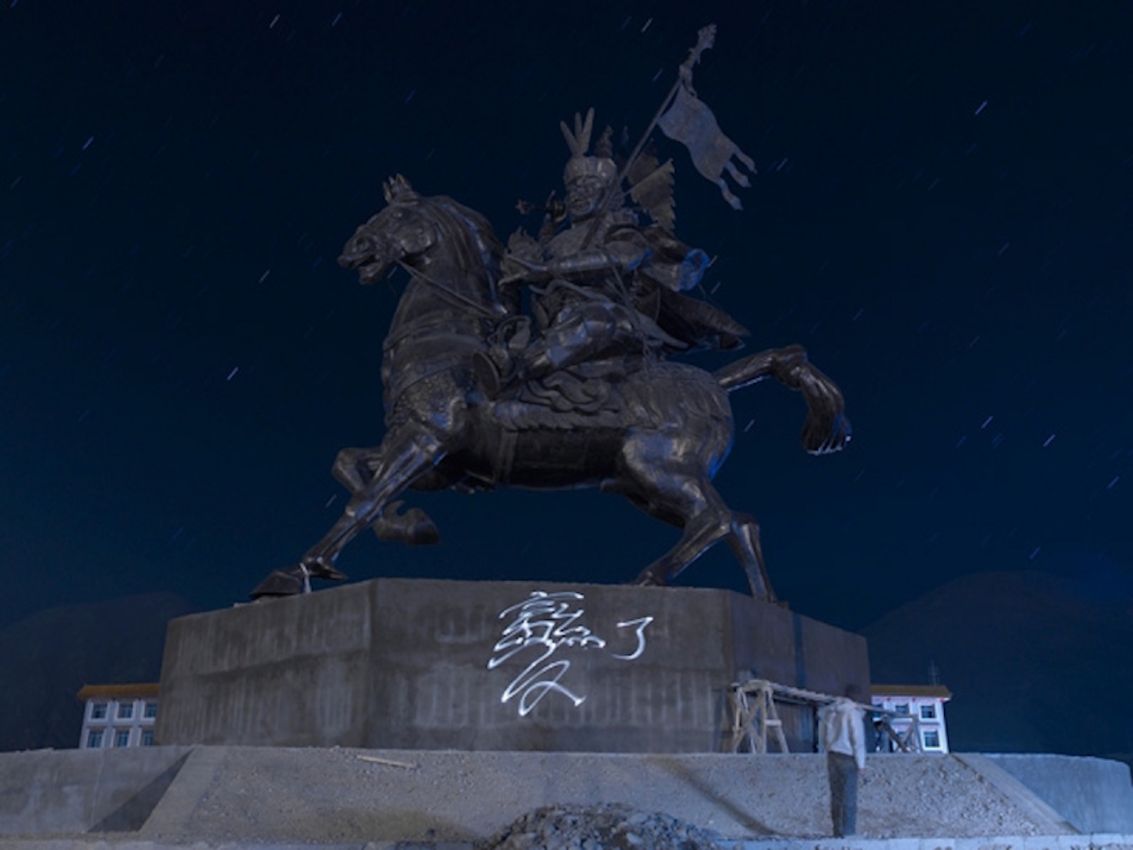
QIU ZHIJIE: Experimenting with long exposure photography Qiu Zhijie, enacted blasphemous performances in a graveyard of unknown revolutionary soldiers by the Great Wall. As the legacy of the Communist Revolution runs thinner in China these martyrs, already suffering from their anonymity, turn in their graves as a game of hide and seek is staged andcaptured.
YIXIANGJU Art Group: Zhang Hui, Wang Mao, Wang Chen, Wang Renke. This artist collective, many of the members coming from a theatrical background process recordings of their own daily lives through improvisational banter, resulting in a piece which depicts a world between reality and illusion. The group reflects the dialectic relationship of onstage and backstage, between those things in life thatwe manipulate, and those that silently manipulate us.
ZHANG YU’s drawings are inspired by everything from her own life to fashion magazines to television ads. These works explore an imaginary space in which the world of popular images and personal psyche collide.
Established in 1996, Thomas Erben Gallery focuses on rediscovering and introducing artworks that expand or deviate from the media usually associated with an artist.

A respected voice in contemporary art discourse.
Focusing on ambitious storytelling and insightful art-world commentary. Ocula Magazine publishes in-depth interviews, critical essays and timely analysis on the artists, exhibitions and ideas driving the global art world.
Learn more about Ocula Magazine
Showcasing the best of the art world.
Ocula partners with galleries from around the world to highlight their artists, artworks and exhibitions. Gallery membership is by application and invitation, with each member vetted by an independent panel.
Learn more about Ocula Membership

Specialises in the sale of major artworks.
Led by a team with deep ties to the world’s leading auction houses, galleries and collectors. Ocula’s advisory team offers bespoke services to high-net-worth clients from around the world who are looking to acquire the best of contemporary and modern art.
Learn more about our team and services