To the Customer
Thank you for using the idiot’s manual. This artwork of modern design is reasonably structured with stablefunctions.
It is designed to meet different customer needs for high quality with easy operation and perfect capability. Webelieve you’ll be satisfied with its forms and excellent symbolic disavowal.conducive to the survival of species within the box during long-distance shipping, but simultaneously interruptsthe history of a transplanted ecosystem, initiating another timeline that parallels that of the native habitat.
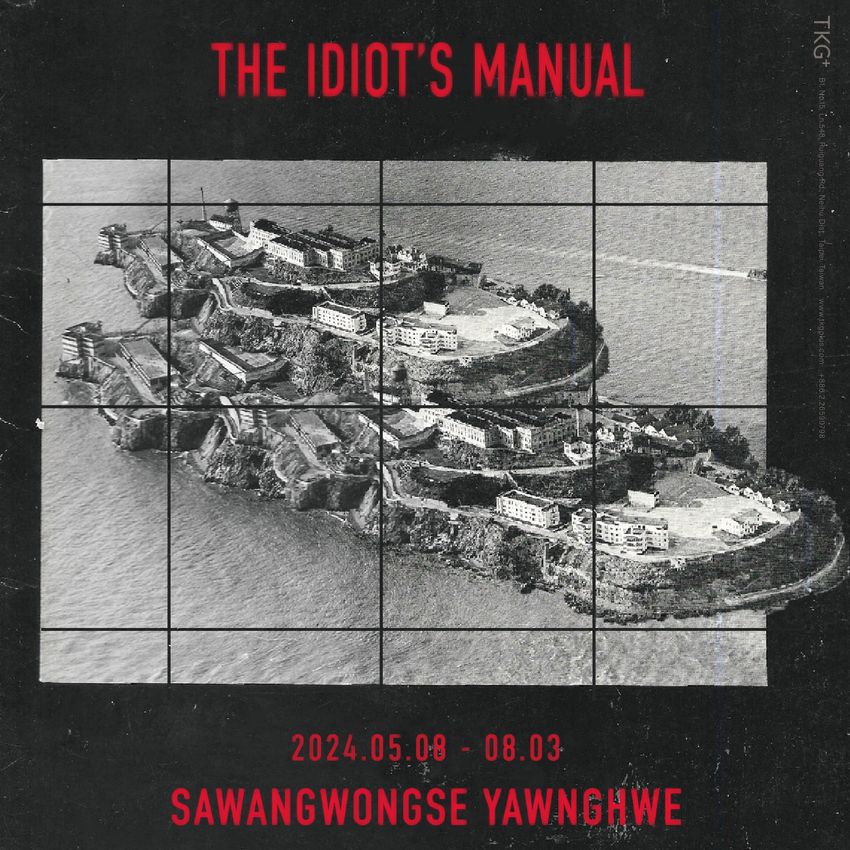
The Idiot’s Manual is Sawangwongse Yawnghwe’s third solo exhibition in Taiwan after a four-year hiatus.Unlike his previous exhibitions, Yawnghwe Office in Exile / State Museum / Absoluter Gegenstoss / Absolute__Recoil (2019) and Burmese History X (2020) — the former being a fictional museum exploring the narratives ofthe exiled Shan people of Myanmar, and the latter embodying a dialectic that interrogates historiographythrough the chronicles of the exiled Yawnghwe family and Myanmar, The Idiot’s Manual encapsulates theartist’s pivot from addressing the political relationship between the state and family toward a broader, morecomplex global perspective. This solo exhibition is centred on the four major dilemmas that confronthumanity: global warming, the pandemic, social tensions, and the total digital control of human thinking.
The artist considers these four predicaments as the apocalypse. Originally derived from the Bible, the term ‘apocalypse’ encompasses notions of end-time catastrophes or divine revelations, used by ancient Jewish andChristian prophets to describe visions of the end of the world: signs from heaven, a world awash in naturaldisasters and human calamities, as if nearing its end. But isn’t our world dangerously close to such impendingcataclysms? Constant climate anomalies, rampant pandemic viruses unhindered by borders, escalatinginternational tensions, and various forms of warfare breaking out across the globe — everything inextricablylinked to the global market economy. Not to mention the capital market dominated by big data algorithms —despite our ongoing criticism and self-reflection — it has outgrown the confines of the market, ensnaring ourthoughts and consciousness.
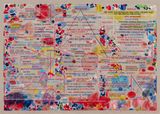
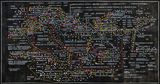
In the artist’s new work Post-Apocalypse Parallax (2024), he draws on philosopher Slavoj Žižek’s notion ofideological fantasy. Žižek suggests that reality presents itself as an illusion, in an attempt to mask thegrotesque abyss behind the truth. That, too, is how the capitalist world operates; we must not take reality atface value, but delve into the illusion to find the underlying ideologies without being blindsided. ‘We must thinknow. We must act now.’ The artist paints a massive canvas in his unique cartographic style, navigatingbetween his thoughts and physical labor, shedding light on this age of revelations.
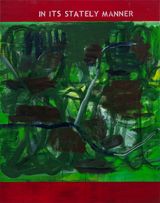
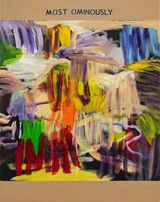
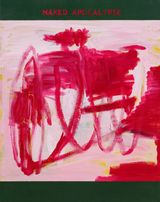
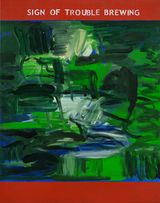
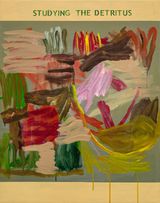
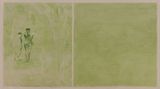
In addition to the artist’s distinctive cartographic paintings, this solo exhibition comprises a series of abstractworks that combine intuitive brushwork with text, specifically phrases excerpted from his late father’snotebooks. As a descendant of the exiled Shan royalty, the artist’s life remains deeply entwined with hisfamily’s tumultuous past. Some phrases are inscribed in the colour strips that dominate the top and bottom ofeach work, while others are written across the paintings. In some works, text is completely absent.
The juxtaposition of text and imagery hints at the inherent discrepancy between text and image/landscape,much like an ideological gap that emerges between facts as we see them and facts as they are described. It is through constant reflexive and dialectical thinking that we can forge a new path in seeing, an endeavour towardomniscience, yet acutely aware of our limitations.
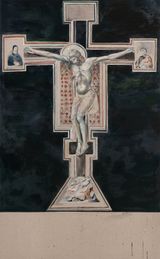
_Camille Claudel (_2023) references the protagonist from the ancient Greek tragedy Antigone. Fearless in herdetermination to bury her brother against the authorities, Antigone defies the city’s order, and facesinsurmountable odds for what she believes is right. Another piece, The Crucifix (2023), reimagines Giotto’sCrucifixion, revealing the moment when truth comes to light. Steeped in religious symbolism and iconography,these two works serve as spiritual signifiers through their reinterpretation of classical motifs.
The Idiot’s Manual not only manifests as Sawangwongse Yawnghwe’s profound reflection on global crises, butunderscores an urgent call for dialectical contemplation on humanity’s existence. In a world where capitalismreigns, the artist grapples with the constant need for self-reproduction, while sounding a clarion call to action. Itis imperative, in the age of information explosion and unending calamities, that we navigate with caution thelabyrinth of collective ideology, and identify fallacies that lurk within, guided by our thoughts and ideas.
Sawangwongse Yawnghwe’s painting and installation practice engages politics with reference to his family history as well as current and historical events in his country. Family photographs also provide the basis for a pictorial language through which he explores events in the country, suggesting that existing and available archives cannot reveal a nation’s entire truth. In addition, Yawnghwe’s work of maps charts the conflicts between drugs such as heroin and amphetamines, revolutionary armies, minority ethnicities, mining and gas pipelines, the armament of generals, as well as state genocide against its minorities. He intends to bring discernible order to a complex political situation.
A forerunner of Taiwanese modern art, the Tina Keng Gallery hinges upon the philosophy that art is a reflection of the times. The Tina Keng Gallery has its roots in the Lin & Keng Gallery (1992–2009) based in Taipei, Taiwan and Beijing, China. Delving into Western painting and Chinese art history, Lin & Keng tirelessly promoted the work of Asian classical masters, cultivating a critical thought on Greater Chinese modern art. The Tina Keng Gallery has continued this tradition by centering its focus on Asia, further excavating art history and rediscovering modern aesthetics. Upon this foundation, the Tina Keng Gallery is steadfast in nurturing Taiwanese modern and contemporary art, with hopes to capture the changing states of art through writings of history, in so doing highlighting the cultural underpinnings of its worldview. Art arises from culture, and culture mirrors the times. The Tina Keng Gallery endeavors not only to support Greater Chinese modern and contemporary art, but to shape a perspective that is elementally Asian.

A respected voice in contemporary art discourse.
Focusing on ambitious storytelling and insightful art-world commentary. Ocula Magazine publishes in-depth interviews, critical essays and timely analysis on the artists, exhibitions and ideas driving the global art world.
Learn more about Ocula Magazine
Showcasing the best of the art world.
Ocula partners with galleries from around the world to highlight their artists, artworks and exhibitions. Gallery membership is by application and invitation, with each member vetted by an independent panel.
Learn more about Ocula Membership

Specialises in the sale of major artworks.
Led by a team with deep ties to the world’s leading auction houses, galleries and collectors. Ocula’s advisory team offers bespoke services to high-net-worth clients from around the world who are looking to acquire the best of contemporary and modern art.
Learn more about our team and services