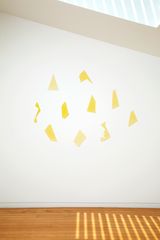
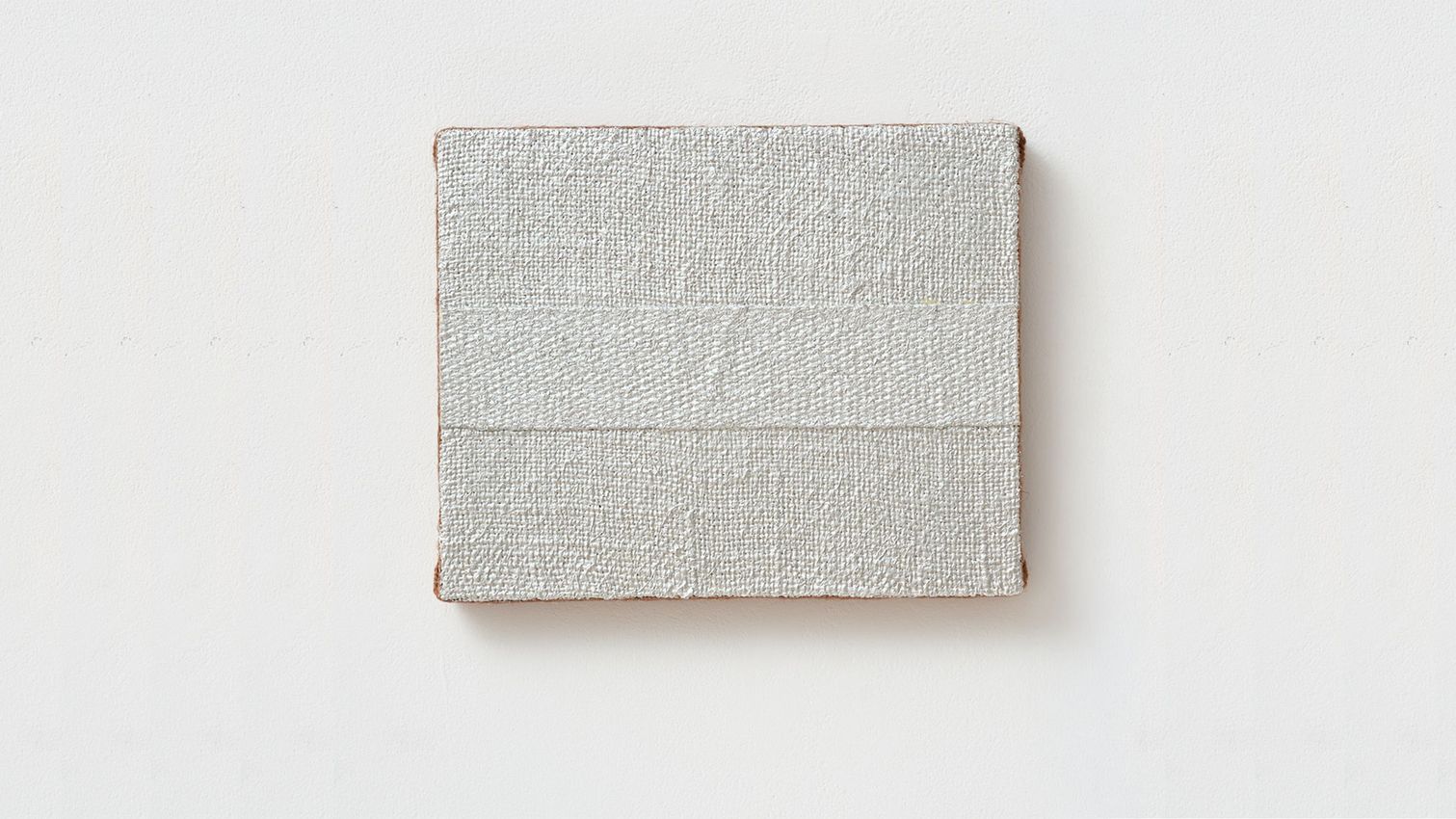
Time Slice Theory proposes that each of our conscious moments are made of fractions, shining and dispersed. A fine silt of wakefulness flickering in the moving light of the minds river. From this theoretical viewpoint, cognition is formed of a series of discreet frames rather than as a single, smooth duration, in rapid pulses of apprehension that pass in waves across the wet aperture of the eye. Sensation, awareness, becomes a dance of micro instants. A cinema of self-world perception shining on the surface of a great, magnetic darkness. In the exhibition, Time slice, Jeena Shin shifts her focus from her subtle, painterly reworking of two-dimensional space, to a spatially distributed reflection on contemporary theories of time-perception and consciousness. Noting the first images captured of a black hole by the Event Horizon Telescope, Shin looks to the ways in which Deleuze’s theories of cinema and the ‘time-image’ might be refracted through more recent theories of space, time and consciousness.
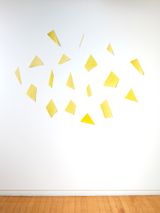
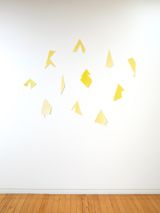
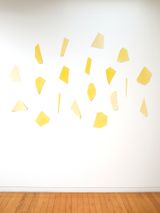
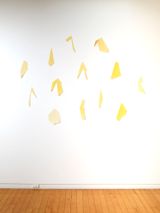
The conception of the whole, held and constant moment of the image is thus called into question in Time slice. Shin’s recent paintings tend instead towards vibration, giving way to the dappled light of a supple present in which the shimmering potential of a crystalline moment is suspended. The exhibition is composed of two phases; Time slice I-III, a triptych on canvas in which Shin’s recognisable lexicon of positive and negative forms tease the shadowy movements of the after-image into play; and S1-1 & 2, S2-1, 2 & 4, a series of wall works that continue the twenty-year evolution of a single, geometric form. In each of these distinct modes, contained versus dispersed, Shin works to coax the assumed stillness of the two-dimensional image toward a more pliable realm of movement and instability.
By thinking painting through the theoretical architectures of time perception and cinema, Shin approaches what film theorist Patricia Pisters has coined the ‘neuro-image’. Applied to cinema, the neuro-image emphasizes a tendency in contemporary film-making to focus on forms of consciousness rather than character, thereby inviting its audience into the audio-visual textures of mood, perception and cognitive reasoning rather than the procedural event-structure of traditional narrative-driven storytelling. Revisiting Deleuze’s famous time-image by way of the insights of modern neuroscience Pisters writes;
The neuro-image speaks “from the future” and as such it is speculative and a highly plastic conception of time that recuts, reassembles the present and the past with different speeds and intensities, all from a speculative future of its explosive end.
Explosive, when used in this sense, is a scene of regeneration rather than a fiery dead-end. It denotes an expansive, cyclical, perspective of events that includes the conditions for the creation of the new. From this perspective, time explodes and our perception of time gains complex dimensions. Applied to the paintings in Time slice, Pisters concept of the neuro-image invites considered meditation on the questions at the heart of Shin’s recent work, suggesting that seeing is to be found in flux with the fabric of what is seen.
Jeena Shin (b. Seoul, South Korea) is a contemporary artist based in Auckland, Aotearoa New Zealand. She is an MFA graduate of the Royal Melbourne Institute of Technology (2000) and holds a BFA from Elam School of Fine Arts(1997). Known for her distinctive, fine-tuned sensibility, Shin works with subtle shifts in light, form and tone to draw a vibrant gentleness from otherwise unyielding two-dimensional surfaces. Drawing on theories of perception, time and consciousness, Shin’s works on canvas and large-scale wall works are developed from subtle variations and repetitions of her evolving cast of forms. In 2011, Shin was part of the ARTSPACE Residency at Changdong National Arts Studio, Seoul, hosted by the National Museum of Contemporary Art, Korea. She has completed a number of major projects, including site-specific works at Adam Art Gallery, Wellington City Gallery, Dunedin Public Art Gallery (2011) and Artspace Aotearoa NZ (2009). Most recently, the installation Movement Image Time, was commissioned by Te Papa Tongarewa Museum of New Zealand, (2018) Recent exhibitions include Surface Effect: Amanda Gruenwald, Jeena Shin, Michael Zavros, Govett Brewster Art Gallery, New Plymouth (2017), Movement: Andrew Barber and Jeena Shin, Dowse Art Museum, Wellington (2016) and Necessary Distraction: A Painting Show, Auckland Art Gallery Toi o Tāmaki, curated by Natasha Conland (2015). Her work is held in major collections throughout Aotearoa New Zealand.

Jeena Shin’s paintings critically examine the spatial properties that inhere in a reticulated network of fold lines. They also probe the visual and spatial resonances produced by varying the intensities of a single colour. Her works acknowledge that colour is deceptive, relative, and duplicitous. The artist is keenly aware of what Josef Albers has already noted, ‘with colour we do not see what we see. Because colour, as the most relative medium in art has innumerable faces or appearances’.


Two Rooms is a contemporary art exhibition venue located in a converted warehouse in Central Auckland, New Zealand. Opened in August 2006, Two Rooms presents a program of residencies and projects by leading International and New Zealand contemporary artists. The building houses two exhibition spaces, the Project Room and the Long Room.

A respected voice in contemporary art discourse.
Focusing on ambitious storytelling and insightful art-world commentary. Ocula Magazine publishes in-depth interviews, critical essays and timely analysis on the artists, exhibitions and ideas driving the global art world.
Learn more about Ocula Magazine
Showcasing the best of the art world.
Ocula partners with galleries from around the world to highlight their artists, artworks and exhibitions. Gallery membership is by application and invitation, with each member vetted by an independent panel.
Learn more about Ocula Membership

Specialises in the sale of major artworks.
Led by a team with deep ties to the world’s leading auction houses, galleries and collectors. Ocula’s advisory team offers bespoke services to high-net-worth clients from around the world who are looking to acquire the best of contemporary and modern art.
Learn more about our team and services