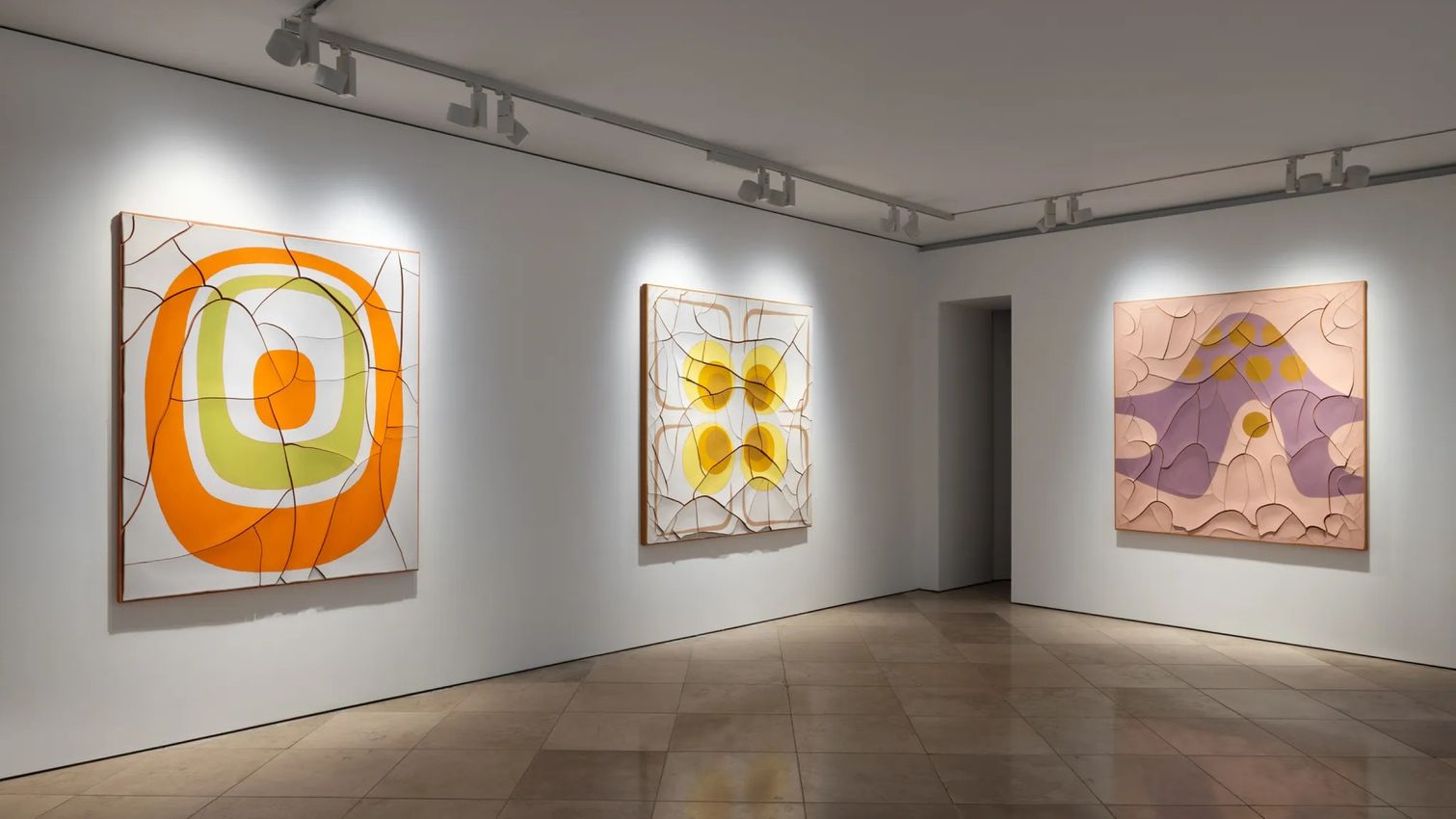
Victoria Miro is delighted to present an exhibition of new painting and sculpture by John Kørner. Commenced during a residency with the gallery in Venice, this new body of work is rich with association, taking the city as a metaphorical springboard into atmospheric realms of speculation and imagination. The exhibition is accompanied by a new essay by Max Andrews.
In erudite, questioning works John Kørner tackles subject matter with various degrees of abstraction and metaphor. These new paintings, initiated during a residency at the gallery’s Venice studio, reveal a fluidity of paint and thought as the artist considers aspects of place, his experience of and connection to a city saturated with images and its emotional and psychological undertow.
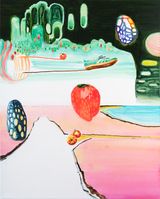
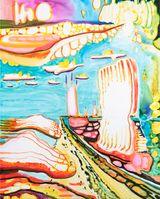
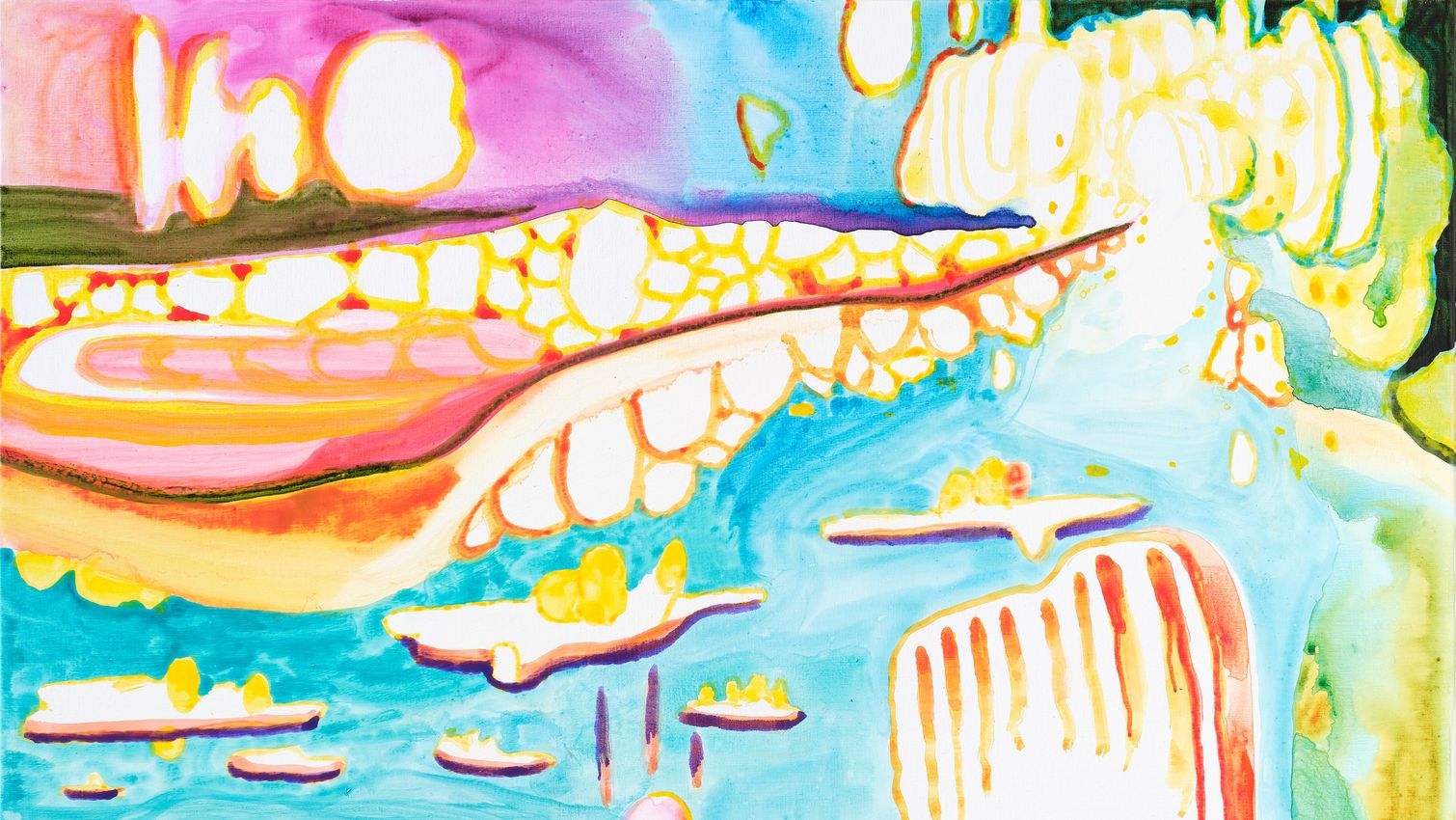
The paintings are rich with association – environmental, atmospheric, chromatic, gastronomic. Elements of Venice’s topography are discernible, its watery aspect evident throughout. Yet, driving forces of fluctuation, mutability and unpredictability serve to unsettle just as reference points are established and understood. Horizons stretch and warp, the ground shifts, rises and falls, defying logic or nature. Meanwhile, heightened, at times pointedly saccharine colours – hues of gelato or spritz – denote a sun-drenched, near-hallucinatory world.
These fugitive spaces are populated by a shifting cast of protagonists. Figures (beachgoers; a diver), fruit (apples; chromatically transient strawberries), footwear (a single adidas Spezial trainer) appear but are themselves caught as if in moments of transformation, rendered with dreamlike distortions of scale or colour, or recast, changing shape, direction or velocity from painting to painting.
While Kørner is celebrated as a colourist, white plays an especially active role, as in Diving Into the Unknown Venezia, in which a figure launches into the starkness of the unpainted world, or in Lido Lagoon, where areas of whitenessstraddle water and air, wrongfooting the viewer, or in Beach Matter, where a void reads as the body and legs of a beachgoer whose putative head bleeds into the colours of a setting sun. Throughout, Kørner alludes to optical or meteorological effects – from solar flare to Instagram filter – further inviting us to question the veracity of his mirage-like imagery.
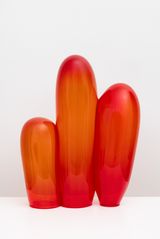
In this context, the artist’s storied Problems assume multiple roles. A staple of his practice, Kørner’s Problems – oval or egg-like forms that appear in his paintings and as sculptures – allude not to specific problems per se but to the nature of questions and conundrums as they emerge and are comprehended in the world. They act as metaphors for the human condition and trigger questions about representation, knowledge, or belief – fundamental existential issues or those that allude to specific world events.
In these new paintings, the Problems exist singly – standing like candied megaliths or floating in space – or gather as spume, cloud or chorus. It is hard not to think of these thought bubbles as reflecting a certain anxiety, ecological or otherwise, specific to place. As Max Andrews comments in his accompanying essay, ‘A painter of problems that take shape in reality finds himself painting in a city literally sinking under the weight of intractable troubles.’
Problems also appear as sculptures, created in collaboration with the master glassmakers of Murano. Three problems in total is an especially characterful trio of Campari-coloured forms that seem to lean woozily on each other for support, while the amber forms of Three problems as one are nested like Matryoshka Dolls, one contained by another: ringing with beauty, cut through with unease.
With lightness of touch and painterly dexterity, John Kørner explores his medium’s fundamental duality - its physical presence and its descriptive powers - and the potential for communication or miscommunication that ensues. Kørner has referred to his apparently cheerful paintings as Problems. The viewer is often presented with non-figurative forms including multicoloured ovals and dancing arabesques that symbolise a kind of pre-thought, and simple figurative elements that remind us of the ways in which paint can be used to evoke universally recognisable things: a bicycle, a crocodile, a ship, a person. When displayed simultaneously, often on grounds of intense colour in the works for which Kørner first became known, these abstract signs and nameable things cause the eye to dance between levels of recognition.


Since Victoria Miro founded her eponymous gallery in Cork Street, Mayfair, in 1985, the gallery has grown to represent over 40 artists and estates. With a reputation for presenting ground-breaking artworks from around the world, Victoria Miro has exhibition spaces in Mayfair and Wharf Road in London, and a further gallery space in Venice.

A respected voice in contemporary art discourse.
Focusing on ambitious storytelling and insightful art-world commentary. Ocula Magazine publishes in-depth interviews, critical essays and timely analysis on the artists, exhibitions and ideas driving the global art world.
Learn more about Ocula Magazine
Showcasing the best of the art world.
Ocula partners with galleries from around the world to highlight their artists, artworks and exhibitions. Gallery membership is by application and invitation, with each member vetted by an independent panel.
Learn more about Ocula Membership

Specialises in the sale of major artworks.
Led by a team with deep ties to the world’s leading auction houses, galleries and collectors. Ocula’s advisory team offers bespoke services to high-net-worth clients from around the world who are looking to acquire the best of contemporary and modern art.
Learn more about our team and services