Whitestone Gallery Singapore is pleased to present Counterweight: The Systems of Two, a significant dual exhibition curated by Tamares Goh, marking the relaunch of Whitestone Gallery’s new exhibition space. The exhibition will open on 15 August 2026.
Featuring two prominent Singapore artist couples: Stefen Chow and Huiyi Lin (Chow and Lin) alongside Dr. Wang Ruobing and Chen Sai Hua Kuan (Ruobing & Sai), this exhibition presents physics as the primary metaphor for a shared existence. It highlights the unique dynamics of these artist couples, showcasing how their shared lives and collaborative or parallel practices offer fresh interpretations of contemporary global and local realities.
Here, unity is not merely a romantic ideal; it is a functional necessity. Their work functions like a lever: the partnership becomes the central point of balance, creating the strength needed to confront the weight of global issues. Through these dualities, the domestic space bleeds into the professional sphere, transforming the private unit into a tool for navigating the world.
Chow and Lin|Decentralized Value Systems 2026 0009, Ready-made Table Lamp and Ceramic Capsules, 2026, size varied, Edition: 1 of 3 + 1 AP
Grounded in economics, policy, and media studies, Chow and Lin exemplify a rigorous, research-driven methodology. Their work operates as a calibrated lens through which to explore global, often abstract issues, transforming raw data, domestic and everyday objects into precise visual forms. Apart from their seminal project The Poverty Line, which uses food as a universal language to translate the abstract concept of poverty into something visible and tangible, the artists will present 42 works of their practice for this exhibition as research-based observers, shaped by their inner worlds and family. For the first time, they will introduce new materialities to their practices, expanding their field of association into more embodied, sensory experiences—through ceramics in Decentralized Value Systems (2026) and textiles in Blink (2026), offering a renewed and expanded direction within their evolving artistic language.
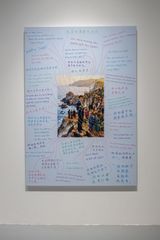
In the series Blink (2025), Chow and Lin explore the growing tension between technological advancement and human evolution. Developed at a time when generative AI has entered everyday use, the project reflects on a historical turning point in image-making—where authorship, authenticity, and even reality itself become increasingly unstable. The installation features fabricated posters printed with AI-generated images of food, overlaid with sewn texts that question what is seen, created with the artists’ two children, members of Generation Alpha who grow up within this algorithmic condition. Familiar yet artificial, Blink questions whether we will soon lose the ability—or even the desire—to distinguish between lived reality and algorithmic simulation.
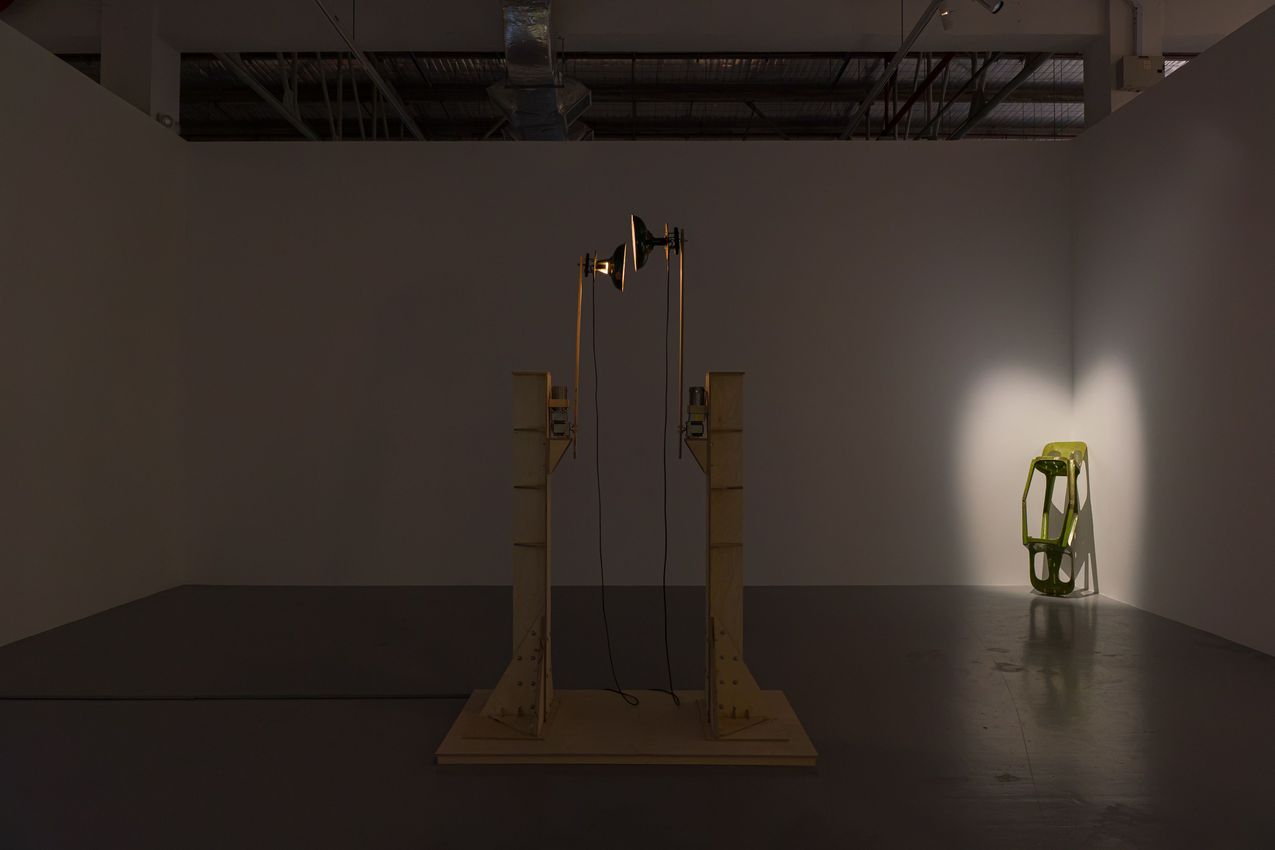
Ruobing & Sai|Eight Legged on Back (Green for Something series), Used coffeeshop plastic chairs, 2014, 160 × 40 × 50 cm
Conversely, Counterweight brings to light the collaborative tension inherent in the work of artist duo Ruobing & Sai, capturing the delicate “tug and pull” of two identities merging into a singular entity. In the spirit of a lifelong partnership—a continuous conversation requiring both a fierce holding on and a constant letting go—their work demands a rigorous, tactile engagement with the everyday. Through the Something For Green project, their inquiry becomes less of a serious lecture and more of a playful wonder about how things co-exist—and whether they find meaning together, or simply enjoy the chaos of trying. Ultimately, they uncover a beautiful, whimsical riddle: that our most intimate, private lives are quietly choreographed by our messy, direct, and delightful collisions with the wider world.
Their new work, from Tide... sound check (2026-ongoing), is a research-based sound artwork made from the sea, for the sea. Sound recordings captured from the sea are engraved onto vinyl records fabricated entirely from plastic marine debris collected along its shorelines. By transforming discarded waste into a sound-bearing medium, the work enables the sea to “speak” through the very material that pollutes it. The artwork collapses the distinction between medium and message: plastic debris becomes both evidence of environmental degradation and a vessel for the ocean’s sonic memory, inviting audiences to reflect on the interconnected relationships between human activity, marine ecosystems, and the global circulation of pollution.
Through sheer encountering and the vulnerability of trial and error, Ruobing & Sai forge intuitive, sensory relationships with emerging forms. Within this exertion, the found object serves as a vital device. Each found object arrives with its own density and historical weight—a pre-existing mass that the artists must balance, combine, and reconfigure. This is evidenced in their gathering of residues from their daily environment, the lands, and the seas, transforming discarded fragments into a shared physical language.
Together, the repertoires of these two duos suggest that art itself is the ultimate language of counterbalance. It is the medium through which the friction of partnership is translated into a legible force. Beyond the domestic or the practical, their work serves as a stabilising rhythm, an aesthetic equilibrium that addresses the turbulence of the modern era. In this context, the artist duo is a microcosm of a much larger, shifting system. By mastering the internal tugging and pulling of their collaboration, they offer a visual and conceptual framework for navigating a world in which we are all small, yet interconnected, parts.
Tamares Goh is an arts administrator, educator, and artist. She holds a BA in Fine Art from LASALLE-SIA College of the Arts (1996) and an MFA from the Glasgow School of Art (2001).
From 1996 to 2024, Goh taught part-time at several Singapore’s art institutions, including LASALLE College of the Arts, the Nanyang Academy of Fine Arts, and Nanyang Technological University’s School of Art, Design and Media. As a practicing artist, she has participated in various residencies, including Studio 106 in Singapore and MariaKapel in Hoorn.
In 2003, she joined Esplanade – Theatres on the Bay as an arts programmer, going on to develop and lead its visual arts programming and curate numerous festivals. Notably, she co-curated the Singapore Biennale in 2013 and produced Zai Kuning’s Dapunta Hyang: Transmission of Knowledge for the 57th Venice Biennale in 2017. Between 2018 and 2024, she led the Curatorial Programmes and Audience Engagement teams at both the National Gallery Singapore and the Singapore Art .Museum, and was Festival Director for Gallery Children’s Biennale and Light To Night festival across a couple of editions. In 2025, she curated Tropical Lab 19 at LASALLE College of the Arts and returned to Esplanade as Head of Visual Arts.
Stefen Chow (b. 1980) and Huiyi Lin (b. 1980) Chow and Lin are an artist duo consisting of Stefen Chow and Huiyi Lin. Their practice questions the state of being in a world defined by transition. They explore how identity, values and memory are embedded in everyday objects and systems, emphasizing the physicality of time. With a collaboration that started from life and traversed into art, they seek human scale and agency in the vastness of global societal narratives.
Chow and Lin have exhibited at The Museum of Modern Art (MoMA), Art Basel Hong Kong, Lahore Biennale, Arles Les Rencontres De La Photographie, National University of Singapore Museum. Their works are in the permanent collections of MoMA, China Central Academy of Fine Arts Museum, Art Vontobel. They are authors of The Poverty Line (published by Actes Sud and Lars Müller Publishers) which is in the collections of the Centre Pompidou Bibliothèque publique d’information, V&A Museum and National Gallery Singapore. They have been awarded by LUMA Rencontres, Berlin Falling Walls, Art Outreach, TED.
They also engage closely with international policy, research and innovation platforms to further interdisciplinary discourse. They have spoken at the World Economic Forum and United Nations. They have delivered lectures at The London School of Economics, Sciences Po, Lee Kuan Yew School of Public Policy and Parsons School of Design.
Chow and Lin are based in Beijing and Singapore. They are represented by Whitestone Gallery.
Wang Ruobing (b. 1975) & Chen Sai Hua Kuan (b. 1976) Ruobing & Sai is an artist duo comprising Singapore-based artists Wang Ruobing and Chen Sai Hua Kuan. Since 1997, they have collaborated whenever their ideas converge, developing a shared practice grounded in dialogue, experimentation, and sustained engagement. Together, they founded Comma Space, an independent art space and research hub dedicated to supporting the local arts community.
Wang Ruobing is an artist, educator, and independent curator whose practice and research critically examine the evolving relationship between humans and the environment, with a particular focus on the intersections of ecology, materiality, and knowledge production. She holds a Doctor of Philosophy (DPhil) from the University of Oxford, United Kingdom. Formerly a curator at the National Gallery Singapore, she is currently an Associate Professor at the University of the Arts Singapore.
Chen Sai Hua Kuan is a multidisciplinary artist whose practice transforms everyday materials and experiences into engaging, thought-provoking works. Working across sculpture, installation, sound, film, drawing, and performance, he often incorporates playfulness and humour to challenge conventional ways of seeing. His work has been presented in major international and local exhibitions, including the Museum of Contemporary Art Busan (2021), the Busan International Short Film Festival (2015), the Singapore Biennale (2013), and the 14th Media Art Biennale WRO, Poland (2011). Notable works include Hearing Padang (2023), a monumental interactive sound installation commissioned by the National Gallery Singapore, and Space Drawing No. 5 (2009), commissioned by the National Centre for Contemporary Art, Kaliningrad, Russia.
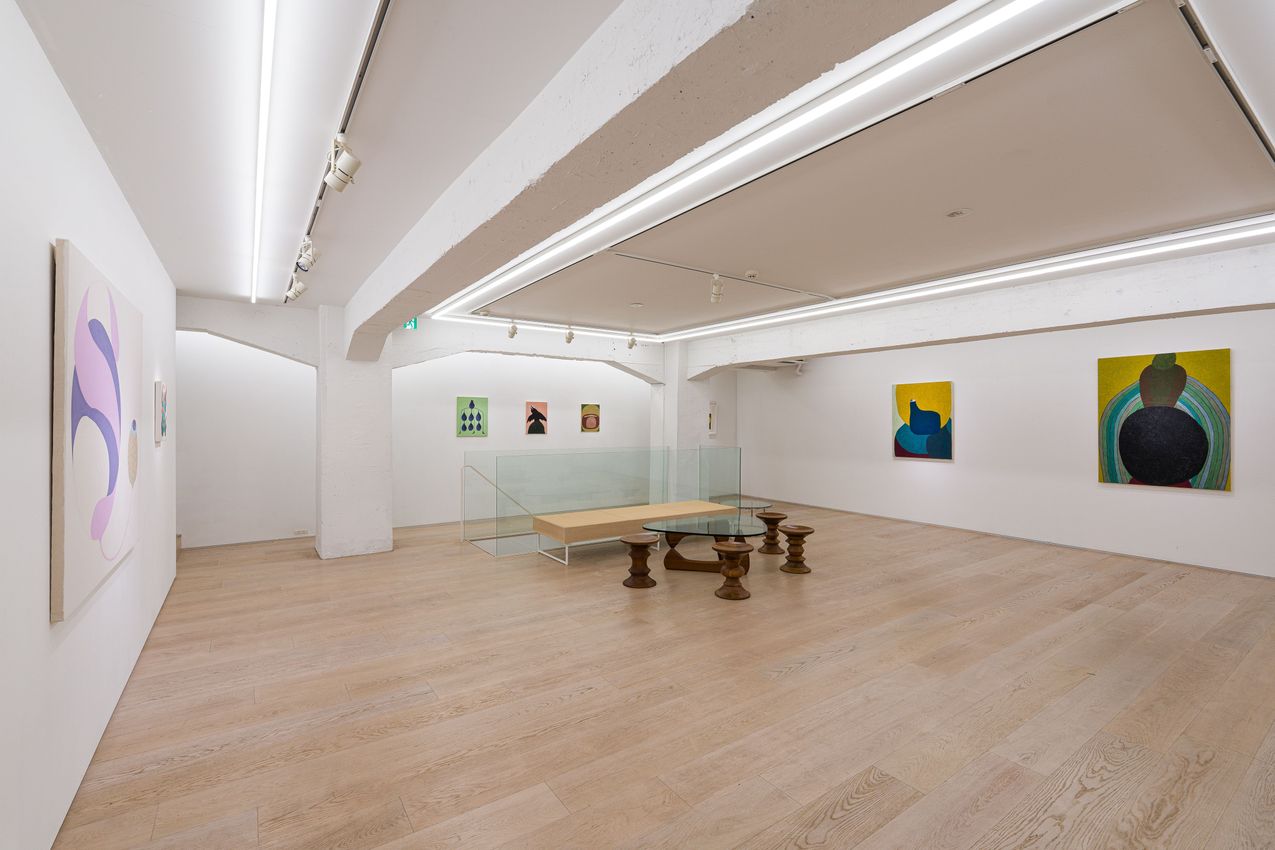
Exhibition view: Group Exhibition, Counterweight: The Systems of Two | A Two Duos Exhibition Curated by Tamares Goh, Whitestone Gallery (16 August–17 October 2026). Courtesy Whitestone Gallery.
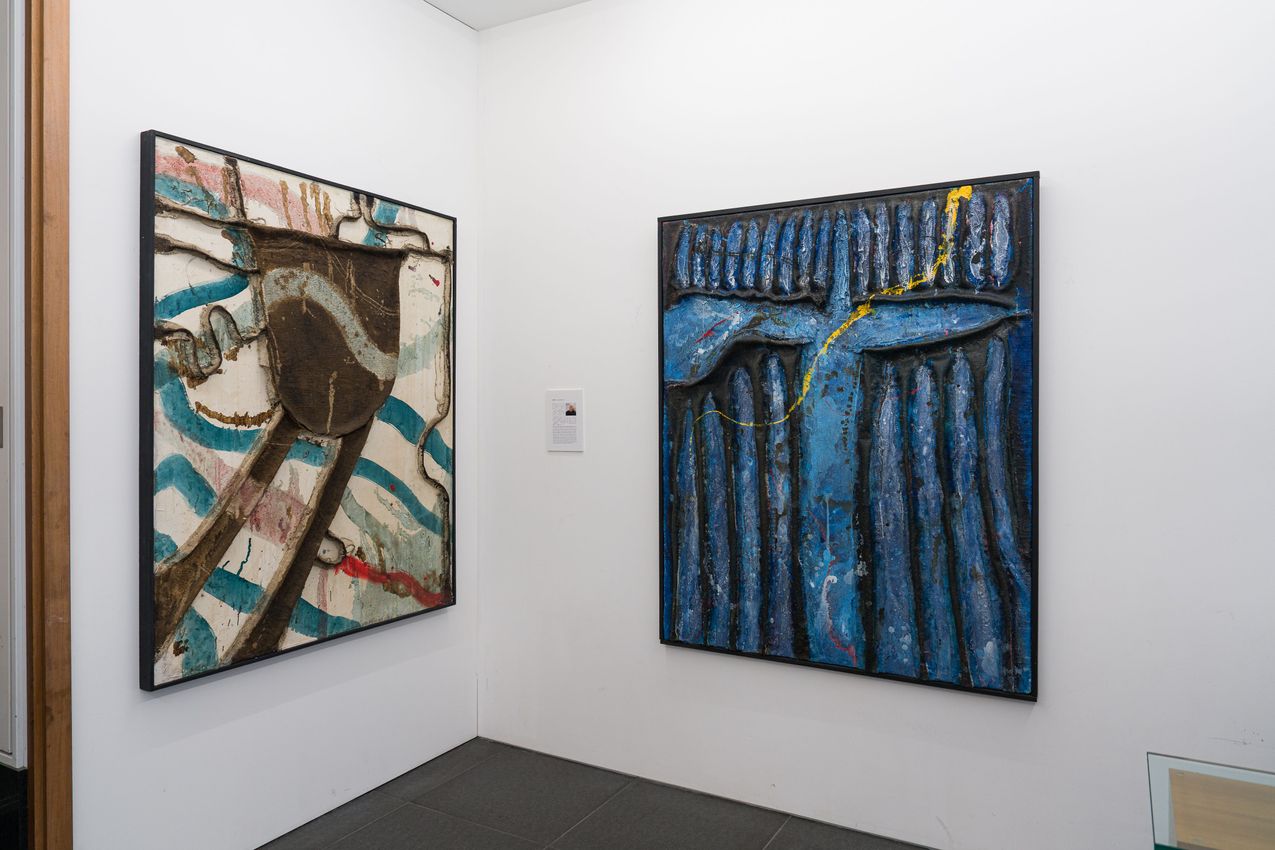
Exhibition view: Group Exhibition, Counterweight: The Systems of Two | A Two Duos Exhibition Curated by Tamares Goh, Whitestone Gallery (16 August–17 October 2026). Courtesy Whitestone Gallery.
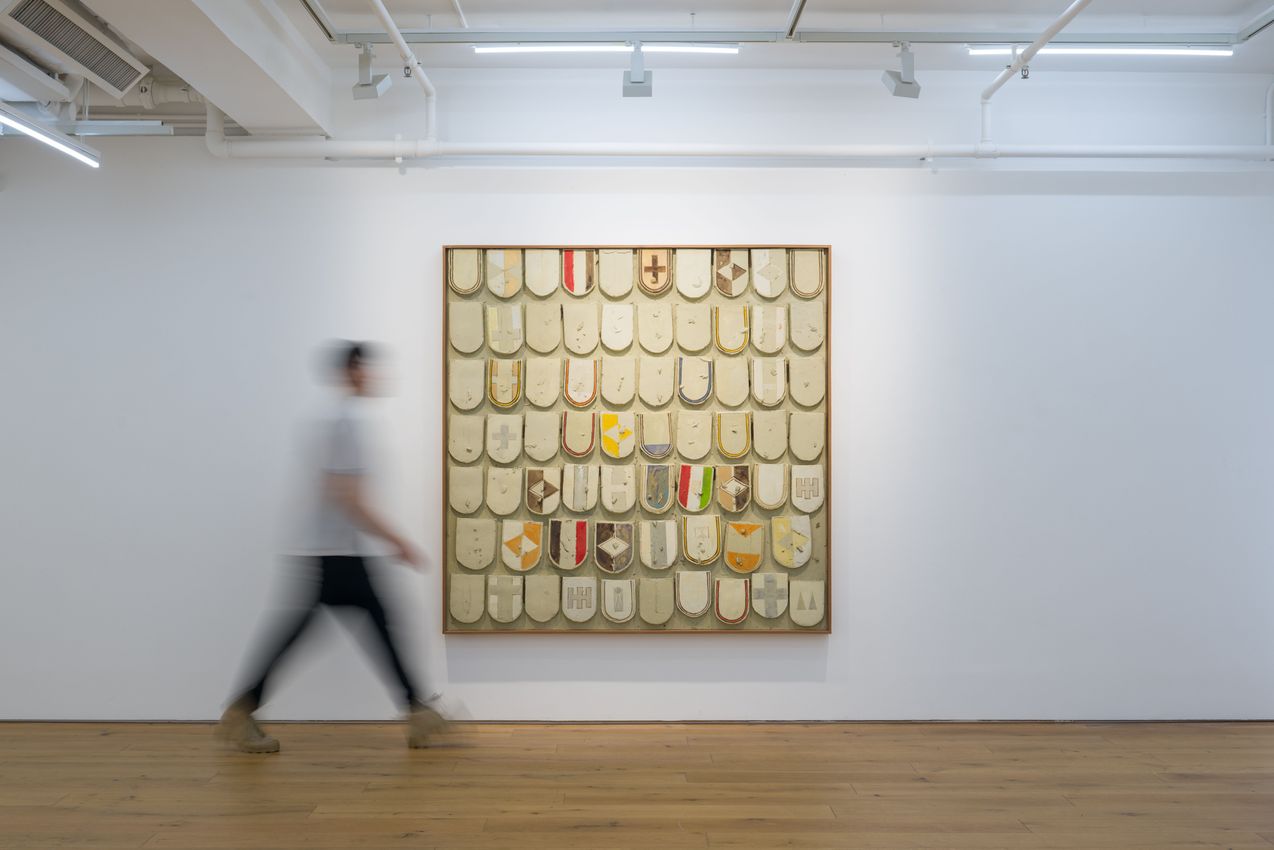
Exhibition view: Group Exhibition, Counterweight: The Systems of Two | A Two Duos Exhibition Curated by Tamares Goh, Whitestone Gallery, Singapore (16 August–17 October 2026). Courtesy Whitestone Gallery.
Exhibition view: Group Exhibition, Counterweight: The Systems of Two | A Two Duos Exhibition Curated by Tamares Goh, Whitestone Gallery (16 August–17 October 2026). Courtesy Whitestone Gallery.
Exhibition view: Group Exhibition, Counterweight: The Systems of Two | A Two Duos Exhibition Curated by Tamares Goh, Whitestone Gallery, Singapore (16 August–17 October 2026). Courtesy Whitestone Gallery.
Exhibition view: Group Exhibition, Counterweight: The Systems of Two | A Two Duos Exhibition Curated by Tamares Goh, Whitestone Gallery (16 August–17 October 2026). Courtesy Whitestone Gallery.
Exhibition view: Group Exhibition, Counterweight: The Systems of Two | A Two Duos Exhibition Curated by Tamares Goh, Whitestone Gallery, Singapore (16 August–17 October 2026). Courtesy Whitestone Gallery.
Exhibition view: Group Exhibition, Counterweight: The Systems of Two | A Two Duos Exhibition Curated by Tamares Goh, Whitestone Gallery, Singapore (16 August–17 October 2026). Courtesy Whitestone Gallery.
Exhibition view: Group Exhibition, Counterweight: The Systems of Two | A Two Duos Exhibition Curated by Tamares Goh, Whitestone Gallery (16 August–17 October 2026). Courtesy Whitestone Gallery.
Exhibition view: Group Exhibition, Counterweight: The Systems of Two | A Two Duos Exhibition Curated by Tamares Goh, Whitestone Gallery, Singapore (16 August–17 October 2026). Courtesy Whitestone Gallery.
Exhibition view: Group Exhibition, Counterweight: The Systems of Two | A Two Duos Exhibition Curated by Tamares Goh, Whitestone Gallery (16 August–17 October 2026). Courtesy Whitestone Gallery.
Exhibition view: Group Exhibition, Counterweight: The Systems of Two | A Two Duos Exhibition Curated by Tamares Goh, Whitestone Gallery (16 August–17 October 2026). Courtesy Whitestone Gallery.
Exhibition view: Group Exhibition, Counterweight: The Systems of Two | A Two Duos Exhibition Curated by Tamares Goh, Whitestone Gallery, Singapore (16 August–17 October 2026). Courtesy Whitestone Gallery.
Exhibition view: Group Exhibition, Counterweight: The Systems of Two | A Two Duos Exhibition Curated by Tamares Goh, Whitestone Gallery, Singapore (16 August–17 October 2026). Courtesy Whitestone Gallery.
Exhibition view: Group Exhibition, Counterweight: The Systems of Two | A Two Duos Exhibition Curated by Tamares Goh, Whitestone Gallery (16 August–17 October 2026). Courtesy Whitestone Gallery.
Exhibition view: Group Exhibition, Counterweight: The Systems of Two | A Two Duos Exhibition Curated by Tamares Goh, Whitestone Gallery, Singapore (16 August–17 October 2026). Courtesy Whitestone Gallery.
Exhibition view: Group Exhibition, Counterweight: The Systems of Two | A Two Duos Exhibition Curated by Tamares Goh, Whitestone Gallery (16 August–17 October 2026). Courtesy Whitestone Gallery.
Exhibition view: Group Exhibition, Counterweight: The Systems of Two | A Two Duos Exhibition Curated by Tamares Goh, Whitestone Gallery, Singapore (16 August–17 October 2026). Courtesy Whitestone Gallery.
Exhibition view: Group Exhibition, Counterweight: The Systems of Two | A Two Duos Exhibition Curated by Tamares Goh, Whitestone Gallery (16 August–17 October 2026). Courtesy Whitestone Gallery.
Exhibition view: Group Exhibition, Counterweight: The Systems of Two | A Two Duos Exhibition Curated by Tamares Goh, Whitestone Gallery (16 August–17 October 2026). Courtesy Whitestone Gallery.
Exhibition view: Group Exhibition, Counterweight: The Systems of Two | A Two Duos Exhibition Curated by Tamares Goh, Whitestone Gallery, Singapore (16 August–17 October 2026). Courtesy Whitestone Gallery.
Exhibition view: Group Exhibition, Counterweight: The Systems of Two | A Two Duos Exhibition Curated by Tamares Goh, Whitestone Gallery, Singapore (16 August–17 October 2026). Courtesy Whitestone Gallery.
Exhibition view: Group Exhibition, Counterweight: The Systems of Two | A Two Duos Exhibition Curated by Tamares Goh, Whitestone Gallery (16 August–17 October 2026). Courtesy Whitestone Gallery.
Exhibition view: Group Exhibition, Counterweight: The Systems of Two | A Two Duos Exhibition Curated by Tamares Goh, Whitestone Gallery (16 August–17 October 2026). Courtesy Whitestone Gallery.
Exhibition view: Group Exhibition, Counterweight: The Systems of Two | A Two Duos Exhibition Curated by Tamares Goh, Whitestone Gallery, Singapore (16 August–17 October 2026). Courtesy Whitestone Gallery.
Exhibition view: Group Exhibition, Counterweight: The Systems of Two | A Two Duos Exhibition Curated by Tamares Goh, Whitestone Gallery (16 August–17 October 2026). Courtesy Whitestone Gallery.
Exhibition view: Group Exhibition, Counterweight: The Systems of Two | A Two Duos Exhibition Curated by Tamares Goh, Whitestone Gallery (16 August–17 October 2026). Courtesy Whitestone Gallery.
Exhibition view: Group Exhibition, Counterweight: The Systems of Two | A Two Duos Exhibition Curated by Tamares Goh, Whitestone Gallery (16 August–17 October 2026). Courtesy Whitestone Gallery.
Exhibition view: Group Exhibition, Counterweight: The Systems of Two | A Two Duos Exhibition Curated by Tamares Goh, Whitestone Gallery (16 August–17 October 2026). Courtesy Whitestone Gallery.