Press Release

The gallery’s fifth exhibition devoted to American painter Alice Neel (1900–1984) focuses on the New York locations she frequented and interior views of her apartment, where she also worked in lieu of having a studio. Although celebrated for her paintings of people, her practice was much broader. Still Lifes and Street Scenes, which spans the period 1928 to 1981, is akin to a visual journal or chronicle. The works not only capture the places where Neel lived but also, at times, reflect her inner emotional world.

Alice Neel painted _Harlem Rive_r (1928) at the age of twenty-eight. It reflects her early style, characterised by a sombre colour scheme that stands out against the later, more vibrant paintings. The juxtaposed elements of the river, sky and architecture create a visual journey through the composition and jostle for the viewer’s attention. Neel was interested in German Expressionism at the time, as evidenced by the angularity, distortions and stylisation. Landscape painting can serve as an outlet for self-expression, and Harlem River depicts a dynamic, unsettled scene. For Neel, these were troubling times: her first child, daughter Santillana, had died of diphtheria in 1927, shortly before her first birthday.

While Harlem River could easily be mistaken for a plein air painting, it is important to note that Neel rarely painted outside. She only occasionally did so at her small cottage in Spring Lake, New Jersey, which she purchased with the help of her parents and her lifelong friend, John Rothschild. His portrait, John with Bowl of Fruit (1949), is included in the exhibition. Here, the sitter’s eyes are closed, which is unusual in Neel’s work. The bowl of fruit occupies the forefront of the composition, sharing equal importance with the sitter. John’s averted eyes contrast with the orange fruit. The blue tonality of the painting conjures an air of solemnity. Rothschild is one of only a handful of sitters whom Neel painted on multiple occasions, capturing his changing appearance and character over time. They met in 1932 and remained friends all their lives.

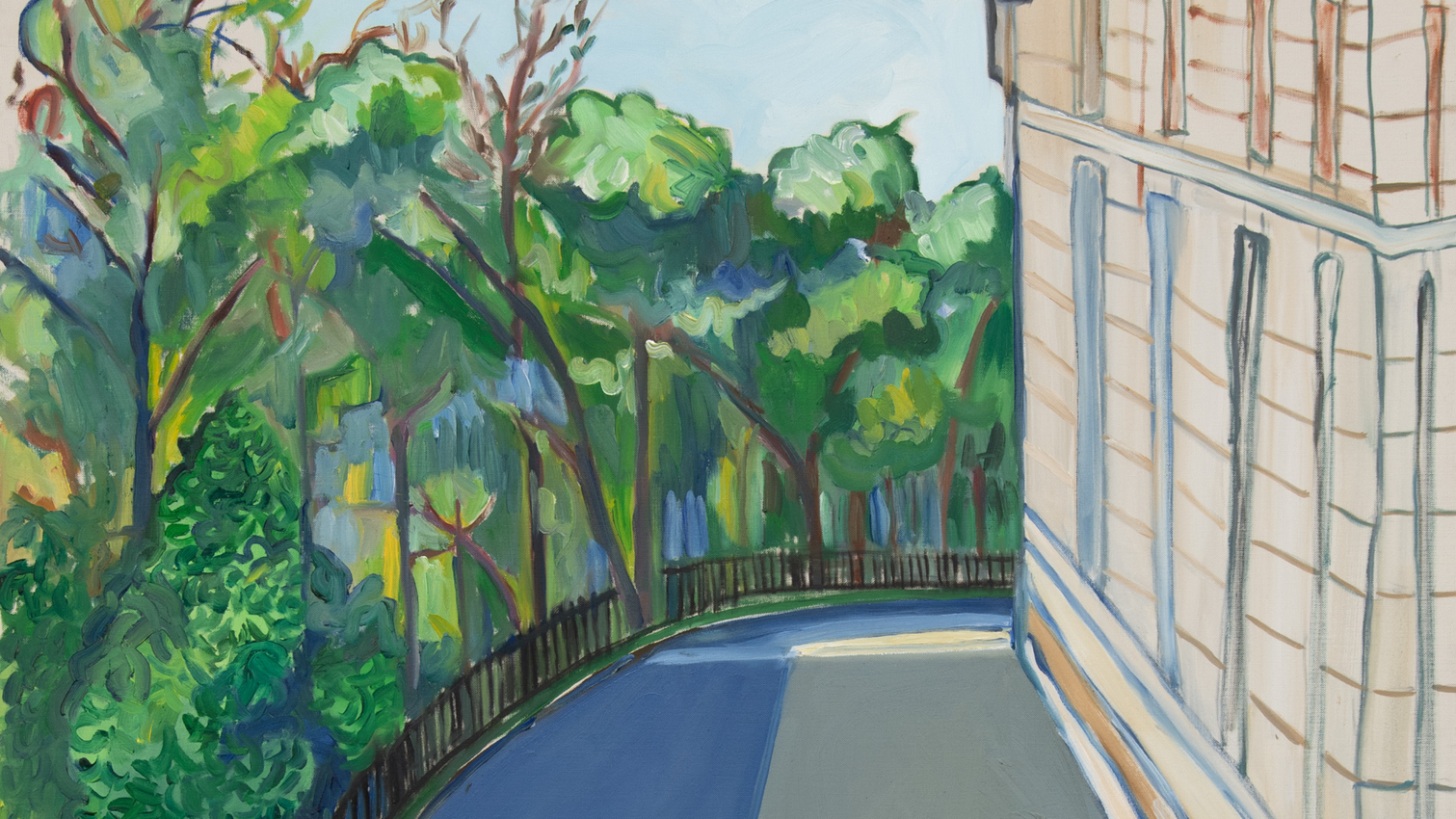
When Neel was in New York, where she spent most of her time, she was just as captivated by the urban landscape as she was by the people. She absorbed the architecture and atmosphere of the streets, and when she returned to her apartment, painted her impressions from memory. Neel did not seek out the awe-inspiring, iconic architecture of New York—the wonder of the age—for her cityscapes. She instead focused on everyday buildings, familiar streets and gathering places, such as parks—all the locations where everyday life unfolds. See, for example, Classic Fronts (1930), Fire Escape #2 (1946), First Communion (1955), which is set in Central Park, and Broadway in the Rain (1965). Just as she often portrayed the marginalised in her portraits, Alice Neel also captured the overlooked corners of New York. At times, she observed the world from her window, commenting, “I really live out my front room windows... It’s like having a street in your living room... Since I’ve always been claustrophobic, it is a great escape for me not to feel shut up in a room.” The most recent work in the exhibition, The Living and the Dead (1981), is a poignant reminder of those words. The skull on the table and the bustling street below serve as a contemporary memento mori, reminding us of the transience of life. Alice Neel finished this piece three years before her death in 1984, having recently had heart surgery to implant a pacemaker.

Similar scenes to the painted cityscapes can be found among Neel’s drawings. Her sketches are direct, fluid and full of life: they show people in the park, on their doorsteps, or trudging through the snow. Most of these are standalone works: the spontaneous records of scenes that captured her attention or her imagination, such as the semi-abstract Eclipse (1965). Notable among these drawings are Landscape with Steps (1959) and Park with Children (1955), which are rare sketches that could serve as preliminary studies for subsequent paintings. The latter is a study for First Communion (1955), included in the exhibition, thereby allowing a rare glimpse at the transformation from sketch to finished work.

In contrast, the still life paintings in the exhibition provide intimate glimpses into Alice Neel’s private world. Over the years, she lived in various neighbourhoods in New York.1 From 1938 to 1962, while her two sons were growing up, she lived in Spanish Harlem. In 1962, they moved to the apartment on the Upper West Side where she lived until her death. As direct and expressionistic as her portraits and cityscapes, her still lifes frequently reflect the emotional undercurrents of her environment. Through ordinary objects, the artist evokes a sense of closeness and psychological presence. For example, Still Life with Bowl of Fruit (1940) was executed when her young son was unwell. Neel explained: “Richard was ill with an eye infection and this bowl of fruit assumed immense proportions. I think one of Rimbaud’s poems says: In certain states of the spirit which are almost supernatural, the profundity of life is revealed in the spectacle, however ordinary it may be, that we may have in front of our eyes. It becomes the symbol of life. I think this occurred in my painting of the wooden bowl with the fruit.” Neel had a deep understanding of the art historical canon. Fish Still Life (1950) evokes a long-standing tradition of fish still life paintings, one that stretches from the Dutch Golden Age to the modern era. The fish’s severed head is extremely expressive; the alarmed eyes and mouth, open with pain, convey a human expression of suffering.

Alice Neel (b. 1900, Merion Square, PA, USA; d. 1984, New York, NY, USA) has recently been honoured with a major retrospective titled Alice Neel: People Come First at the Metropolitan Museum of Art, New York (2021); Guggenheim Museum, Bilbao (2021); and the De Young Museum, San Francisco (2022). During her lifetime, the Whitney Museum of American Art celebrated Neel with her first retrospective in 1974 and a centennial, posthumous exhibition in 2000, which was initiated by the Philadelphia Museum of Art, where it was shown in 2001. A travelling exhibition highlighting the artist’s political and social engagement was co-organised by the Centre Pompidou, Paris; Barbican Centre, London and Munch Museum, Oslo (2022-2023). Other recent solo exhibitions include the Orange County Museum of Art, Costa Mesa (2023); and a travelling exhibition co-organised by Ateneum Art Museum, Helsinki; Gemeentemusum, The Hague; the Fondation Vincent Van Gogh Arles; and the Deichtorhallen Hamburg (2016-2018); and Nordiska Akvarelmuseet, Skärhamn, Sweden (2016), among many others.

Read More
About the Artist

Alice Neel (1900-1984) is widely recognised as one of the great American painters of the twentieth century. Her success, however, has largely been posthumous. In the past decade, interest in her work has grown exponentially, with a series of landmark exhibitions and art historical studies firmly cementing her position on the international stage.

View Artist Profile

Also Exhibiting at Xavier Hufkens

About the Gallery
Xavier Hufkens is one of Europe’s leading galleries for contemporary art. Located in Brussels, the gallery maintains a diverse exhibition programme with solo exhibitions of the gallery artists as well as group exhibitions and special projects. The gallery deals in a distinctive combination of painting, drawing, sculpture, photography, video and installation-based work.

The origins of the gallery date back to 1987, when Xavier Hufkens opened a gallery space in an un-refurbished warehouse in the neighbourhood of the South Station (Midi) in Brussels. During the early years, the focus of the gallery was upon mid-career and emerging artists and the gallery is known for having introduced some of the most influential contemporary artists to Brussels at a time when they were still relatively unknown. British sculptor Antony Gormley, who is still affiliated with the gallery, Felix Gonzalez-Torres and Rosemarie Trockel all showed in Belgium for the first time with Xavier Hufkens (Gormley in 1987; Gonzalez-Torres in 1991 and Trockel in 1993).

In 1992, the gallery moved to a 19th-century townhouse at 6 rue Saint-Georges, close to the Avenue Louise. Completely renovated by Belgian architects Paul Robbrecht, Hilde Daem and Marie-José Van Hee, the house quickly gained a reputation for being not just one of the most beautiful contemporary art spaces in the Belgian capital, but also one of the most interesting. The expanded exhibition programme coincided with the additional representation of a number of established artists from Belgium and abroad, including Richard Artschwager, Thierry De Cordier and Jan Vercruysse. In 1997, Hufkens expanded the gallery further by annexing the adjacent building and a number of new artists joined the gallery, including Louise Bourgeois, Roni Horn and Thomas Houseago.

A second space in the same street, at 107 rue Saint-Georges, opened in spring 2013. Located in the Galerie Rivoli, a mixed-use commercial development from the 1970s, the new gallery space was designed by Swiss architect Harry Gugger, who was previously in partnership with Herzog and De Meuron. Slegten & Toegemann, Brussels, managed the project.

An eclectic but very clear vision underpins all of the gallery’s activities: ‘The definition of the gallery was established from the start. The common thread, then and now, is quality over and above everything else, which I find more intellectually challenging than a forced definition. From the early days I juxtaposed established artists such as Michelangelo Pistoletto with someone like Felix Gonzalez-Torres when he was totally unknown. Today I still mix my work: I have no problem showing Malcolm Morley … alongside Robert Ryman, or Willem de Kooning.’ [Xavier Hufkens in The Art Newspaper, Issue 220, January 2011, published online: 20 January 2011]

Xavier Hufkens represents some thirty artists from different generations. He was part of the six-member selection committee for Art Basel during seven years and also participates in up to five international Arts Fairs annually. The gallery has partnerships with the estates of Louise Bourgeois, Willem de Kooning, Robert Mapplethorpe and Alice Neel.
View Gallery Profile
Address
44 rue Van Eyck
Van Eyckstraat
Brussels
Belgium
Opening Hours
Tuesday – Saturday
11am – 6pm
(1)
Brussels 44 rue Van Eyck, Van Eyckstraat
Xavier Hufkens
44 rue Van Eyck, Van Eyckstraat, Brussels, Belgium

Opening hours
Tuesday – Saturday
11am – 6pm
The art world in focus