





Press Release

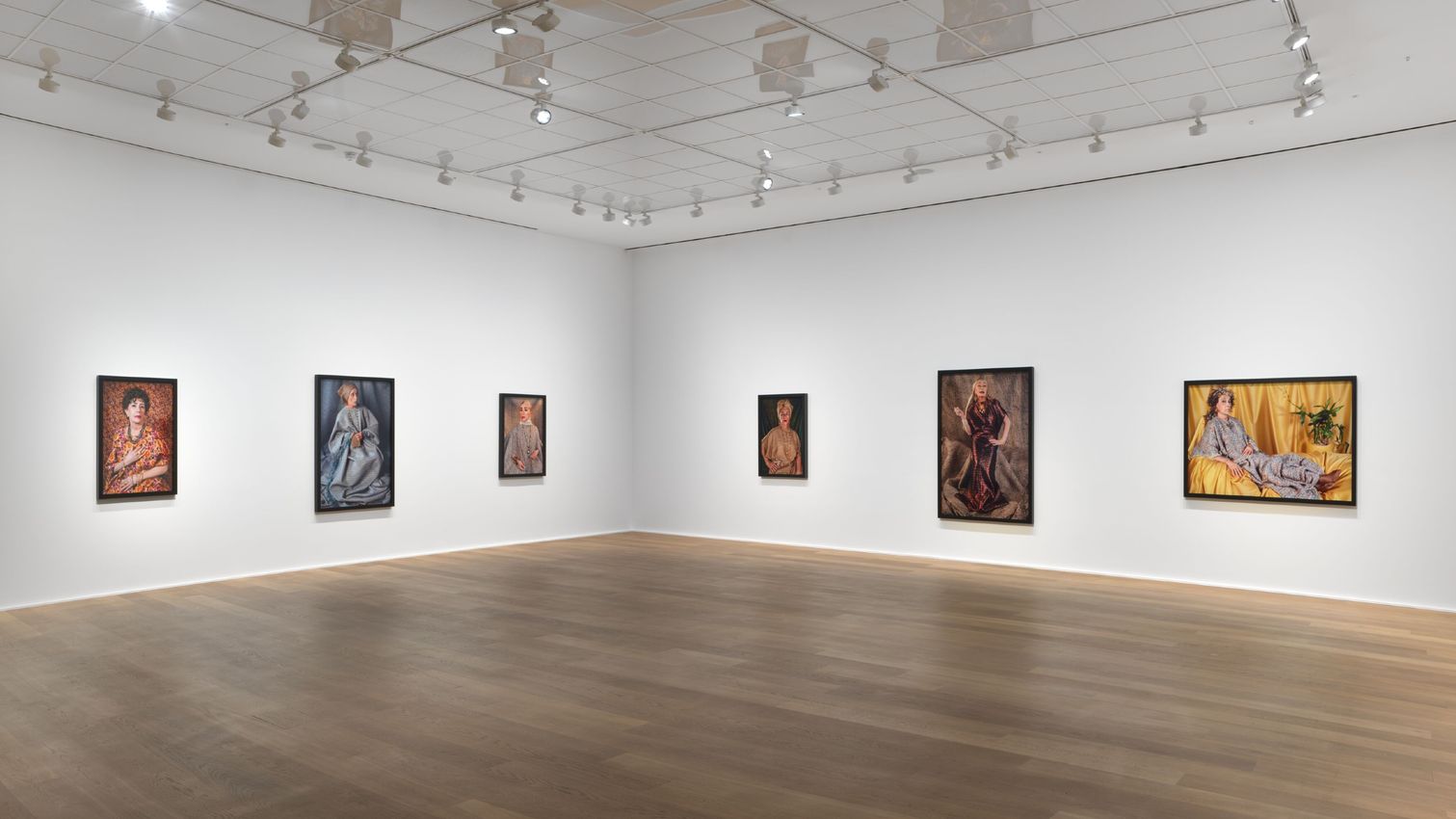
This autumn, Cindy Sherman debuts photographic works from her new Fabric Matrons series, which exploresidentity as a continual process of construction over a lifetime. Shaped by a visual vocabulary of elaboratelydraped fabrics, the protagonists in Sherman’s images appear to dissolve into their surroundings, heighteningthe tension between concealment and display to examine how women negotiate visibility across differentphases of life. Sherman’s staged scenes, several of which incorporate elements drawn from Chanel’s archives,foreground the performance—and perception—of femininity and beauty, probing the societal expectationsand enduring pressure to fashion and maintain a public image over time.

About the exhibitionCindy Sherman found a starting point for this new series within the pages of a giveaway magazine from a highend store in the Hamptons, filled with smooth, airbrushed images of a well-known model of Sherman’s owngeneration, dripping in jewelry. Marking a sophisticated evolution in her engagement with fashion imagery,the artist began working with lengths of fabric as both styling and backdrop at once, establishing the series’unmistakable visual language. At Chanel’s invitation, Sherman incorporated fabric and jewelry by the fashionhouse into some of the works, including remarkable tweeds woven with materials like strips of leather, goldthread and sequins. Sherman’s dialogue with Chanel dates back to her Ominous Landscapes series (2010 –2012), in which her characters wore archival garments and accessories. The Fabric Matrons series, on view inLondon, brings an intensified sense of theatrical styling, drawing on the visual codes of editorial photographyto disrupt the glamour of fashion with deliberate artifice and fabrication.

Working without a script, Sherman builds each protagonist intuitively, experimenting first with fabric andwigs until a personality emerges, then applying makeup to complete their character. Among the groupof fabricated individuals is a muse wrapped in fabric that forms a floor-length red dress and a matron intweed and pantyhose set against yellow drapery. One figure clutches a pearl-embellished bag, displaying anincongruous mix of peasant-style dress and a high-end accessory that reflects the layered, and sometimescontradictory, nature of identity.

A master of transformation, Sherman has served as her own model for over five decades, producing andperforming an array of invented roles that explore and subvert familiar tropes of female identity. Though thepersonas are fictional, the confrontation at the center of Fabric Matrons is, in part, with Sherman herself,stating: ‘It’s gone beyond beauty. I think it’s showing these characters’ neuroses—probably my own, andsimilar to many women my age.’ Working close to the camera, she found the process of aging startling towitness and links this to a double standard in which women are disproportionately measured against ideals ofbeauty and youth compared to men.

The tension between resisting and embracing the passage of time surfaces throughout the series in detailsof styling and mise-en-scène, offering differing takes on beauty, aging and femininity. Props, rarely used inthe series, make a notable appearance in a photograph of a reclining figure, illustrating these competingattitudes. Beside her, a glossy magazine represents longstanding ideals of youth and beauty, while a book onphysiognomy, or face reading, treats facial lines and wrinkles as natural, inherent features worthy of attentionand study. Sherman further articulates this duality through make-up to create near-airbrushed appearances insome works while emulating signs of aging in others.

Sherman’s choices before the camera also point to the complex relationship between identity and visibility. Inseveral photographs, the protagonists wear gloves that render their skin artificially flawless to hint at a tendencyto hide one’s true self. Other characters are clothed in fabrics that blend into the backdrop, raising questionsabout who is afforded social recognition. Conceived as a group of distinct individuals rather than a narrativesequence, Sherman’s works invite viewers to recognise elements of themselves in her characters and, in doingso, to confront their own anxieties, choices and desires surrounding identity.

Courtesy Hauser & Wirth

Read More

Installation Views

About the Artist

Born in 1954 in Glen Ridge, New Jersey, Cindy Sherman lives and works in New York NY. Her ground-breaking photographs have interrogated themes around representation and identity in contemporary media for over four decades. Coming to prominence in the late 1970s with the Pictures Generation group alongside artists such as Sherrie Levine, Richard Prince and Louise Lawler, Sherman studied art at Buffalo State College in 1972 where she turned her attention to photography. In 1977, shortly after moving to New York, Sherman began her critically acclaimed ‘Untitled Film Stills’. A suite of 69 black and white portraits, ‘Untitled Film Stills’ sees Sherman impersonate a myriad of stereotypical female characters and caricatures inspired by Hollywood pictures, film noir, and B movies. Using a range of costumes, props and backdrops to manipulate her own appearance and to create photographs resembling promotional film images, the series explores the tension between artifice and identity in consumer culture which has preoccupied the artist’s practice ever since.

View Artist Profile

Also Exhibiting at Hauser & Wirth

About the Gallery

Hauser & Wirth was founded in 1992 in Zurich by Iwan Wirth, Manuela Wirth and Ursula Hauser, who were joined in 2000 by Partner and Vice President Marc Payot. A family business with a global outlook, Hauser & Wirth has expanded over the past 26 years to include outposts in Hong Kong, London, New York, Los Angeles, Somerset and Gstaad. The gallery represents over 70 artists and estates who have been instrumental in shaping its identity over the past quarter century, and who are the inspiration for Hauser & Wirth’s diverse range of activities that engage with art, education, conservation and sustainability.

View Gallery Profile
Address
23 Savile Row
London
United Kingdom
Opening Hours
Tuesday – Saturday
10am – 6pm
(1)
London 23 Savile Row
Hauser & Wirth
23 Savile Row, London, United Kingdom
+44 207 287 2300
http://www.hauserwirth.com

Opening hours
Tuesday – Saturday
10am – 6pm
The art world in focus
