Press Release

Evan Holloway‘s new exhibition Scry if you want to presents three approaches to visionary practice and, even with the pun in the title, invites non-ironic engagement with the artworks as potential portals to the extraordinary. A musical/video addendum features several songs written by Holloway that explain the theory and ideas behind the works. These are so diverse in terms of style and technique that one could easily mistake them, at first glance, as being by three different artists. Yet the varied forms share a conceptual intent. Each investigates the art object as a latent vehicle for transcendent experience.

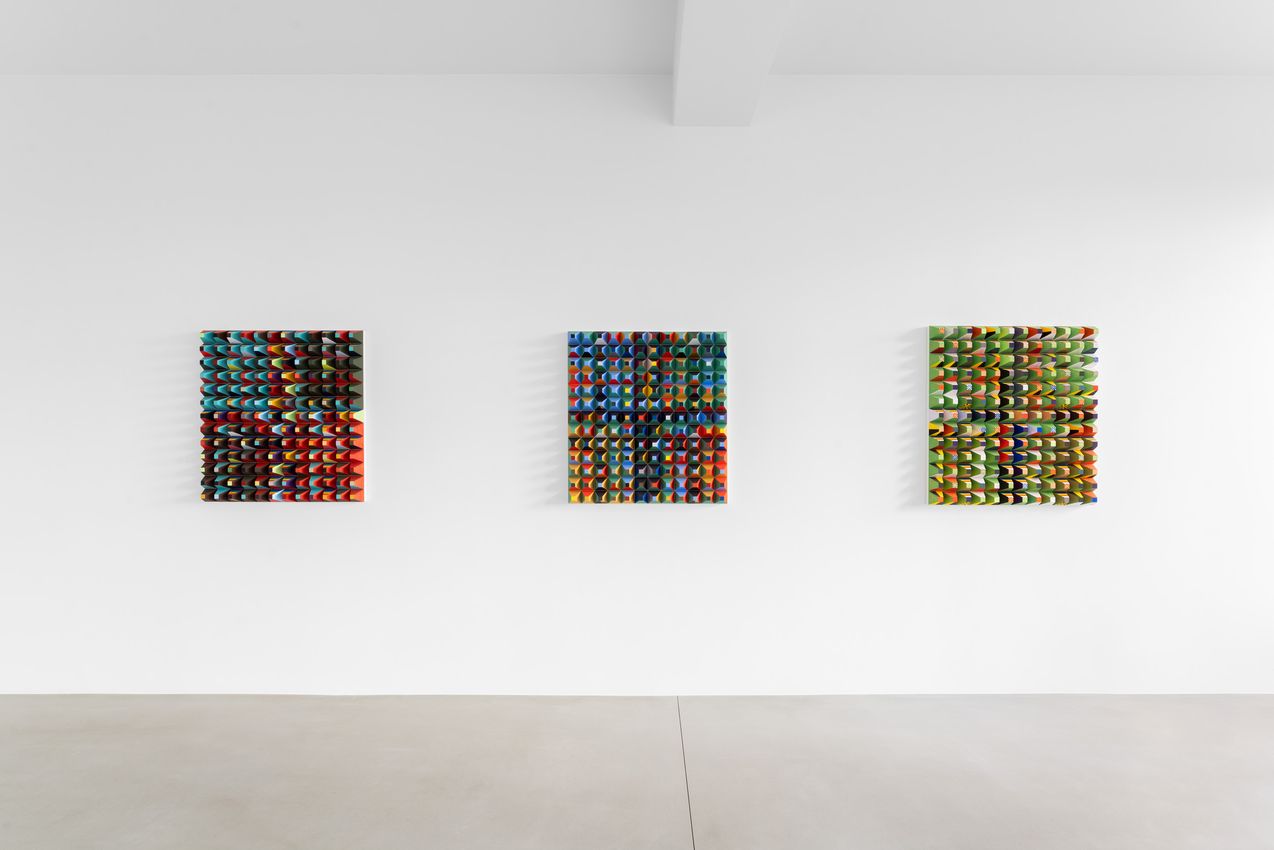
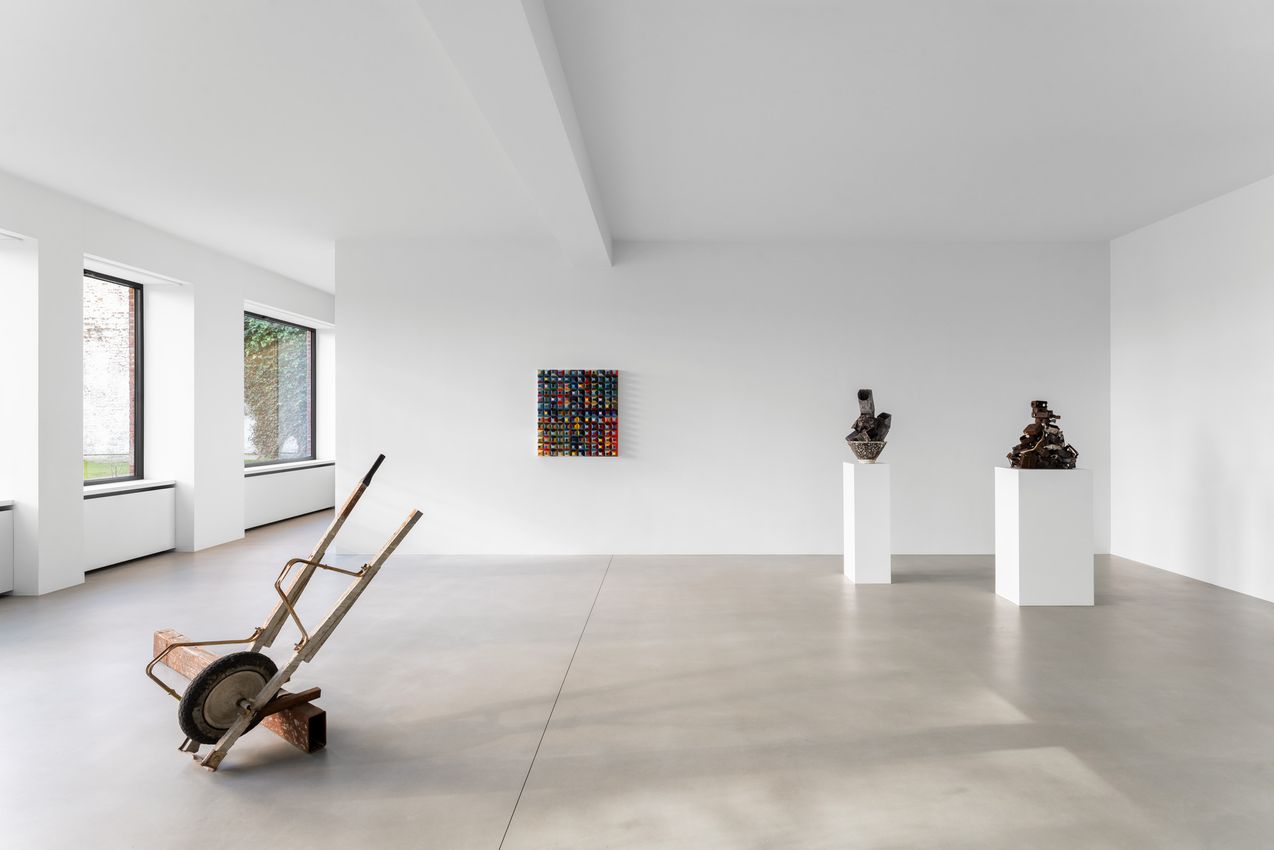
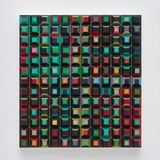
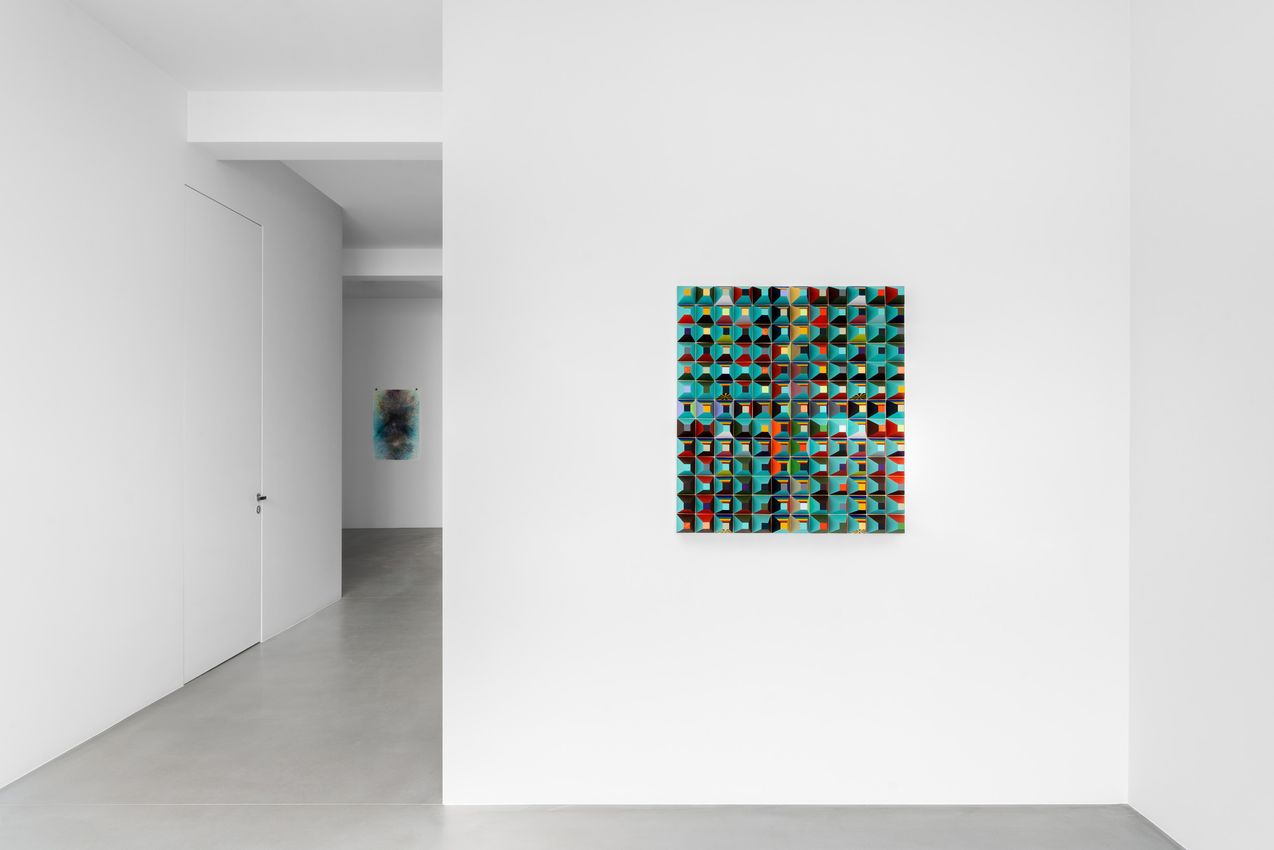
Holloway’s colourful wall-mounted bas-relief sculptures, called Enochian Tablets, initially seem to relate to the tradition of system-based abstraction, as exemplified by the paintings of Piet Mondrian or Alfred Jensen. This is because the appearance of each tablet is governed by a set of pre-determined principles. Yet Holloway does not follow rules of his own invention. He subscribes, instead, to a set of instructions that originated in late sixteenth-century England. They were received (today we might say ‘channelled’) by Elizabeth I’s astrologer, the notable mathematician, astronomer and spy John Dee (1527–1608/9), and his associate, the alchemist and scryer Edward Kelley (1555–1597). Through their many communications with spirits, seen in a crystal ball or on a flat obsidian ‘shew-stone’, they were instructed to make a grid of 12 × 13 squares and told to place letters (later replaced by a unique alphabet) within these spaces in a particular order. This formed an interlocking array of spirit names.

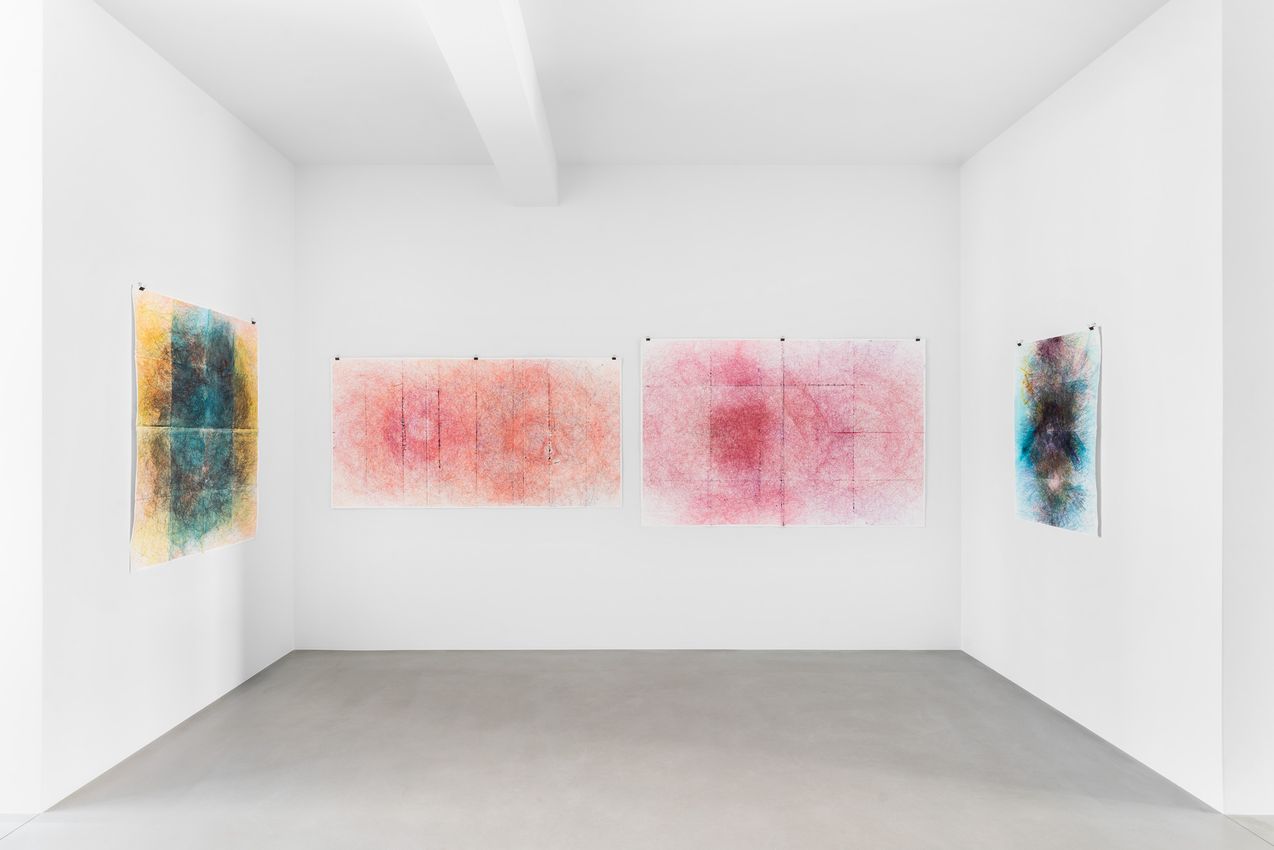
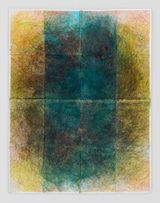
The Automatic Drawings, on the other hand, represent an attempt to bypass the artist’s consciousness, which links them to modernist works such as the cadavre exquis experiments of the Surrealists or even Jackson Pollock’s so-called ‘drip-paintings’. Holloway works and reworks his drawings over countless hours, using various methods to deter and prevent him from looking at the paper. This also limits his conscious control over the final outcome. As part of the process, large sheets of paper are folded and placed on a turntable. This mechanical device not only ensures a randomness in the mark-making but also allows the artist to work across a larger surface area. The folding and vigorous pen-work results in visceral rips in the paper which are repaired, and the drawings are worked again. This intensive process creates swirling compositions of densely-layered fine lines. Upon closer inspection, tiny, mesmerising fields and complicated intersections can be discovered amidst the array of intricate marks. For the artist, these open a new arena for scrying and intuitive gazing.

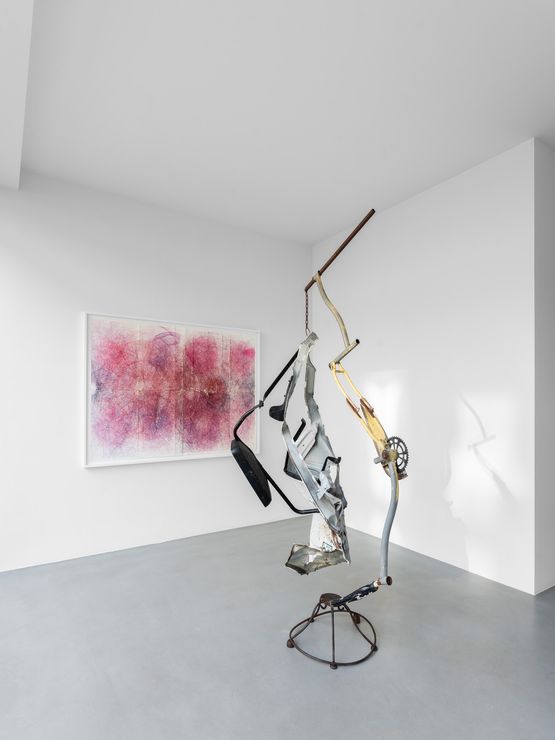
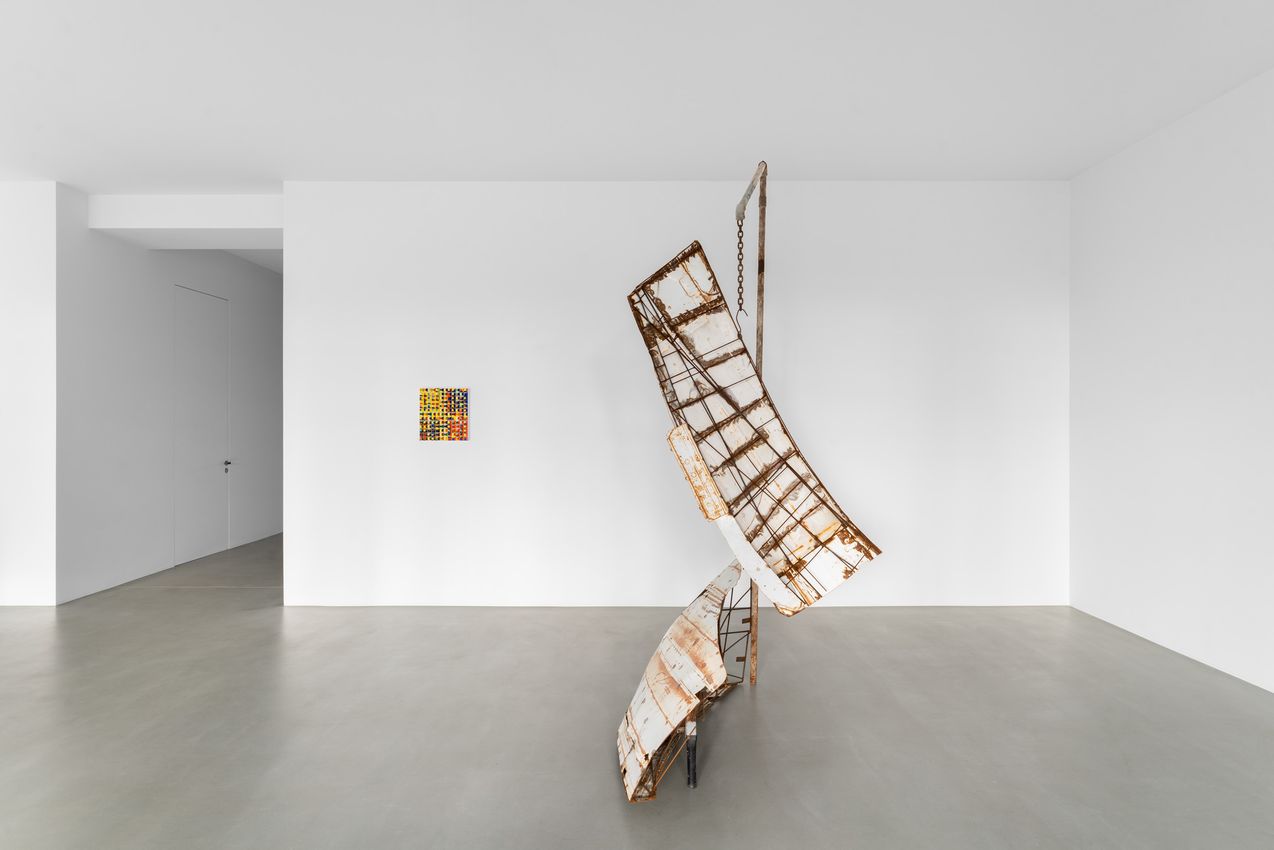
Holloway is primarily known as a sculptor. In this exhibition, he presents a series of what he calls ‘direct metal sculptures’. These are improvised, welded works that highlight his continuing interest in formalist sculpture as a site for real-life engagement with objects-in-space. As Holloway states in one of the exhibition’s explanatory songs: ‘You can feel with your body, you can sense with your mass’. As with nearly all his sculptural work, Holloway insists that the visceral experience of sculpture in relation to the viewer’s body is the most fundamental aspect of the medium. The artist works intuitively with space while making these sculptures but is also being led (and limited) by the potential of the objects he has found. Historically, the direct metal assemblages can be seen in the context of ‘junk sculpture’, a term coined by Lawrence Alloway in 1961 to describe work made exclusively from obsolete materials. The art critic traced its evolution back to Futurism, Dada, Surrealism, and even the Bauhaus.

Evan Holloway is particularly interested in how, despite the huge technological advances of our age, certain fundamental aspects of life continue unabated. Car parts and wheelbarrow frames, as seen in the exhibition, are manufactured in much the same way today as they were a century ago, for example. The experience Holloway seeks to create is an intensely analogue one that revolves around our perception of the physical-material world and the new, often poetic relationships that arise between the disparate parts. While the work pays homage to previous iterations of ‘junk sculpture’, they remain resolutely contemporary. As with the other works in the show, these sculptures play with time, history, and the potential for an individual viewer to engage in sensory exploration.

Read More

Installation Views

About the Artist

The sculptural work of Evan Holloway is based on his belief in the simple and fundamental transactions between people and objects. This also means that his sculptures are not just abstractions or decorations, but are to be understood as a commentary on contemporary society and its values. Evan Holloway uses the vocabulary of modern sculpture for rigorous formal experimentation and he constantly plays on allusions and materials. His questioning of perception and representation is also explored through his love of craftsmanship, and through his comments on ‘style’ or ‘taste’. His work is characterised by the playful use of colour and the introduction of human figures, mostly in the form of heads, masks or little creatures, and the mathematical, alphabetical and geometric systems that he uses to disrupt and re-order the associations typically attached to them.

View Artist Profile

Also Exhibiting at Xavier Hufkens

About the Gallery
Xavier Hufkens is one of Europe’s leading galleries for contemporary art. Located in Brussels, the gallery maintains a diverse exhibition programme with solo exhibitions of the gallery artists as well as group exhibitions and special projects. The gallery deals in a distinctive combination of painting, drawing, sculpture, photography, video and installation-based work.

The origins of the gallery date back to 1987, when Xavier Hufkens opened a gallery space in an un-refurbished warehouse in the neighbourhood of the South Station (Midi) in Brussels. During the early years, the focus of the gallery was upon mid-career and emerging artists and the gallery is known for having introduced some of the most influential contemporary artists to Brussels at a time when they were still relatively unknown. British sculptor Antony Gormley, who is still affiliated with the gallery, Felix Gonzalez-Torres and Rosemarie Trockel all showed in Belgium for the first time with Xavier Hufkens (Gormley in 1987; Gonzalez-Torres in 1991 and Trockel in 1993).

In 1992, the gallery moved to a 19th-century townhouse at 6 rue Saint-Georges, close to the Avenue Louise. Completely renovated by Belgian architects Paul Robbrecht, Hilde Daem and Marie-José Van Hee, the house quickly gained a reputation for being not just one of the most beautiful contemporary art spaces in the Belgian capital, but also one of the most interesting. The expanded exhibition programme coincided with the additional representation of a number of established artists from Belgium and abroad, including Richard Artschwager, Thierry De Cordier and Jan Vercruysse. In 1997, Hufkens expanded the gallery further by annexing the adjacent building and a number of new artists joined the gallery, including Louise Bourgeois, Roni Horn and Thomas Houseago.

A second space in the same street, at 107 rue Saint-Georges, opened in spring 2013. Located in the Galerie Rivoli, a mixed-use commercial development from the 1970s, the new gallery space was designed by Swiss architect Harry Gugger, who was previously in partnership with Herzog and De Meuron. Slegten & Toegemann, Brussels, managed the project.

An eclectic but very clear vision underpins all of the gallery’s activities: ‘The definition of the gallery was established from the start. The common thread, then and now, is quality over and above everything else, which I find more intellectually challenging than a forced definition. From the early days I juxtaposed established artists such as Michelangelo Pistoletto with someone like Felix Gonzalez-Torres when he was totally unknown. Today I still mix my work: I have no problem showing Malcolm Morley … alongside Robert Ryman, or Willem de Kooning.’ [Xavier Hufkens in The Art Newspaper, Issue 220, January 2011, published online: 20 January 2011]

Xavier Hufkens represents some thirty artists from different generations. He was part of the six-member selection committee for Art Basel during seven years and also participates in up to five international Arts Fairs annually. The gallery has partnerships with the estates of Louise Bourgeois, Willem de Kooning, Robert Mapplethorpe and Alice Neel.
View Gallery Profile
Address
44 rue Van Eyck
Van Eyckstraat
Brussels
Belgium
Opening Hours
Tuesday – Saturday
11am – 6pm
(1)
Brussels 44 rue Van Eyck, Van Eyckstraat
Xavier Hufkens
44 rue Van Eyck, Van Eyckstraat, Brussels, Belgium

Opening hours
Tuesday – Saturday
11am – 6pm
The art world in focus