Xavier Hufkens is pleased to announce its second gallery exhibition with Giorgio Griffa (b. 1936, Turin) curated by Yann Chateigné Tytelman. Titled Empatia, this new presentation with the artist connects two groups of works created over 50 years apart, demonstrating the italian painter’s great coherence, relentless creativity, and ongoing ability for renewal.
Between 1967 and 1968, Giorgio Griffa, who until then had been practicing landscape painting in the spirit of De Chirico’s Magic Realism, underwent a revolution in his way of working. He abandoned figuration and established a production protocol that he has adhered to until today. The unprimed canvas is laid flat on the floor. Without any preparatory drawing, Griffa paints directly onto the raw canvas, standing upright, creating simple forms that gradually occupy the surface.
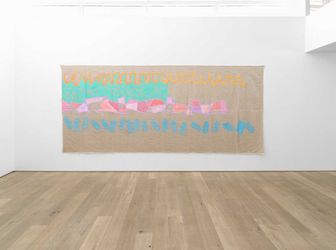
The marks — horizontal lines, oblique strokes, spirals, numbers, letters, or words — organise, combine, and compose themselves. New patterns appear in waves, while others fade and reappear, forming cycles of paintings (13 to date) that interact and “contaminate” each other, imbuing the work with a dynamic, evolving, and almost musical essence.
The composition, always initiated in the upper left corner of the painting, gradually unfolds across the support and then stops at a moment the artist deems appropriate, leaving the work suspended, deliberately “unfinished.” This deliberate pause, an act of great restraint, exposes the material process of painting in all its vulnerability; and invites the viewer to participate in its completion. It embodies a search for equilibrium, a point of dynamic instability that underscores Griffa’s intention for each work to serve as a fragment of a larger, ongoing endeavour — a galaxy-like oeuvre in perpetual reconfiguration and renewal.
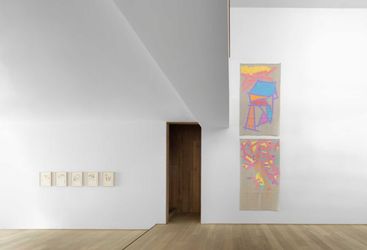
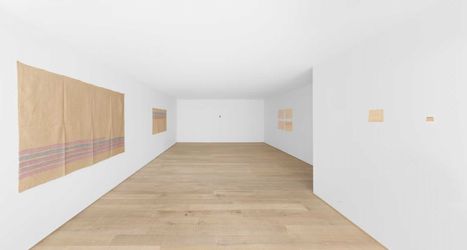
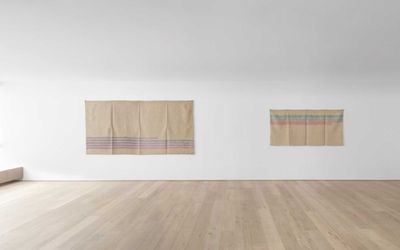
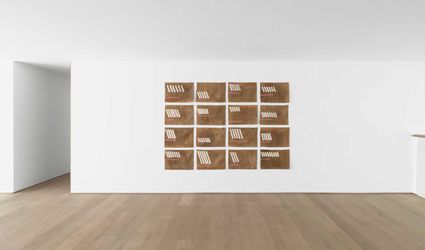
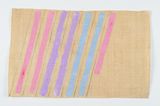
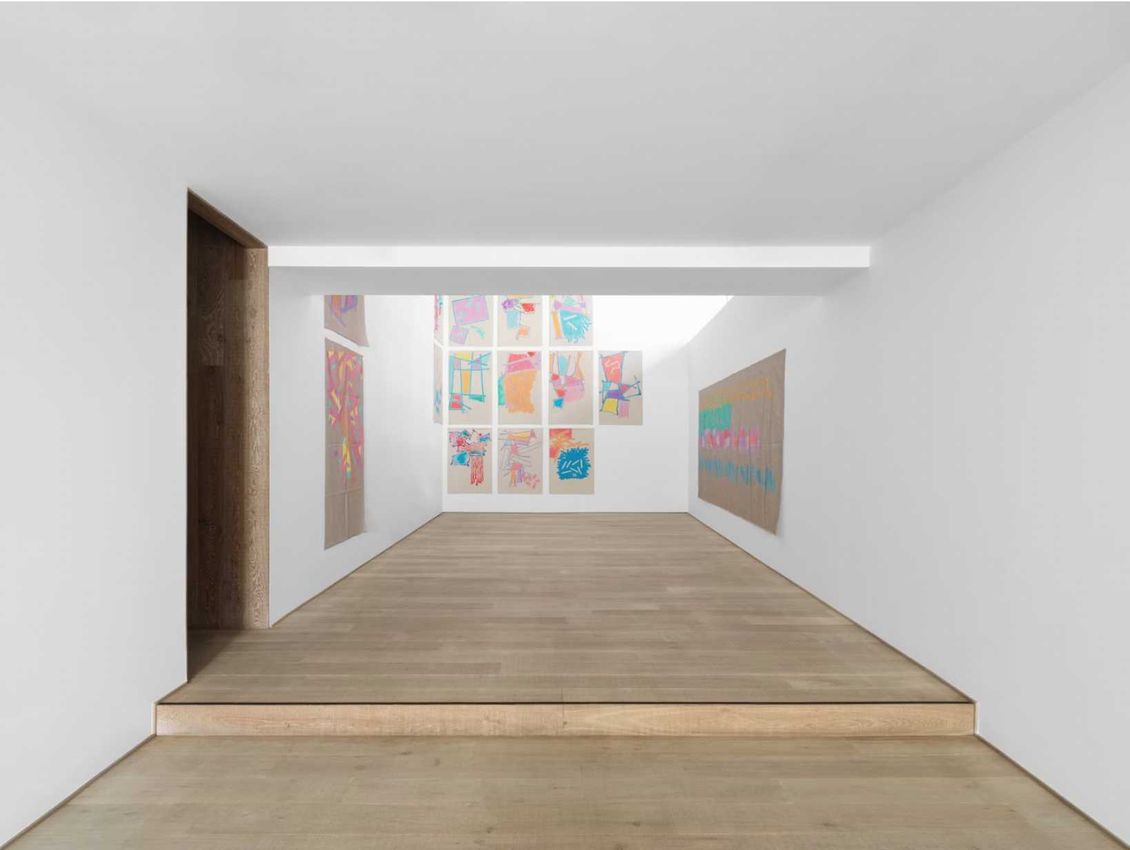
The work is then numbered and inventoried. Each painting is folded and meticulously stored, waiting to be shown. As a result, the canvases bear visible creases, a characteristic hallmark of their economy. The reduction of means that underpins Griffa’s production is also evident in how the artist displays his works. The canvases, without stretchers or frames, are freely nailed to the wall, discreetly secured at the top edge with a few nails. This radical simplicity allows observers to see how the fluidity of material permeates the raw linen in a tactile manner. The luminous colours, ranging from soft and pastel to bright and acidic tones, contrast with the subdued neutrality of the beige and brown hues of the canvas.
Griffa’s pictorial language, seemingly rational, materialistic, and deconstructive, has occasionally led critics to associate his work with various conceptual and critical movements of the 1970s—such as “cold painting,” “planned” or “analytic” painting, Arte Povera, Minimalism, and Supports/Surfaces. Later, in the 2000s, emphasis was placed on a poetics of emptiness, an aesthetics of withdrawal. While these aspects are present within his oeuvre, the exhibition also aims to reveal the extent to which the artist’s world, rooted in observation of nature, relies on a ritual of patience, nearly scientific precision, and a vital movement inherent within the work. This connection possibly traces back to the origins of his practice: the representation of nature, the movements of air and light, and the lines and marks inscribed in the landscape.
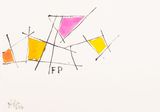
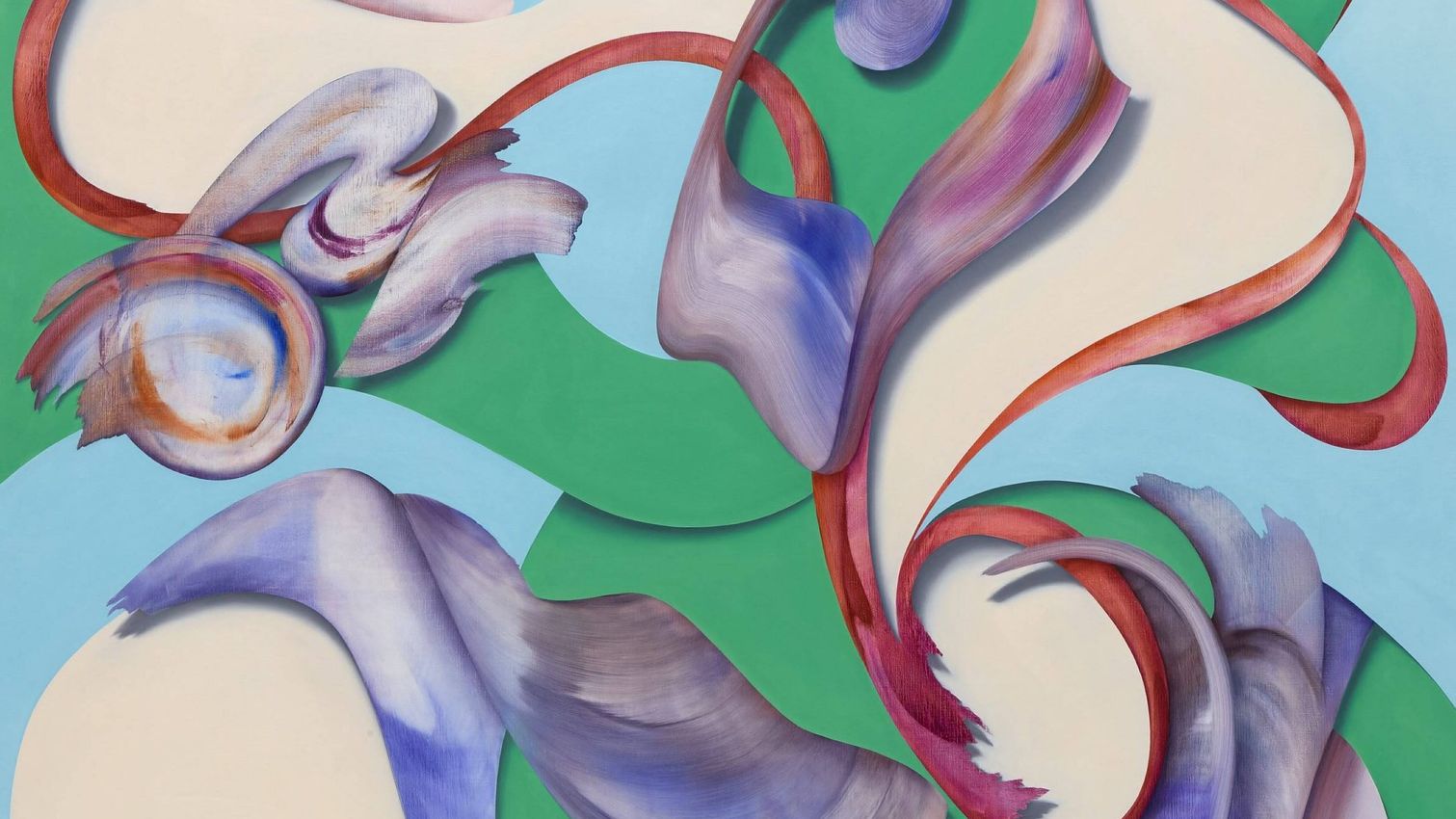
In 2022, the first collaboration between Xavier Hufkens and Giorgio Griffa resulted in the exhibition Luce buio, which traced the artist’s work from the 1970s to the present day. Two years later, this new exhibition connects two pivotal moments in the artist’s career. It focuses on the present, opening with a series of paintings and works on paper from a new cycle, Disordine [disorder], never before shown to the public. These works feature complex, organic, crystalline geometries, inspired by Griffa’s interest in the exact sciences, ranging from physics to the study of the cosmos. They invite a profound exploration into forms and colours representing possible and infinite depictions of chaos and the unknown, essential for the organisation of life.
In contrast to these recent works, the exhibition presents a constellation of Segni primari [primary marks], rare and fundamental works from the 1960s and 70s. These artworks serve as foundational elements in Griffa’s unclassifiable practice. Despite their minimalist presentation of traces and inventories of simple marks — which might initially seem at odds with the disorder of Griffa’s recent series — they actually reveal a shared openness. Griffa’s painting practice embodies an absorption within, refusing separation from the flows and energies of the world, while rejecting any imposition of dominance over the subject matter: painting as empathy.
“We say chaos, total disorder, when we are faced with an order we don’t know. In reality, disorder is something else, a slip, a gap in the existing order, which the intelligence of nature uses to constitute a new order, in an endless dynamic. It also applies to thought and to the thinking of Einstein, Picasso or Giotto. The measure of disorder is called entropy and is correlated with the measure of new order.” — Giorgio Griffa, Disorder, between chaos and entropy (2024).
Text by Yann Chateigné Tytelma.


Giorgio Griffa (b. 1936, Turin; lives and works in Turin) initially completed a law degree in 1958 and became a practising lawyer. From 1960 to 1963, he learned how to paint by assisting the Italian painter Filippo Scroppo (1910–1993). Despite early associations with movements such as Arte Povera, pittura analitica [fundamental painting] and Minimalism, his work has always stood outside the mainstream currents in contemporary art. Giorgio Griffa participated in important international exhibitions such as Prospekt, Düsseldorf (1969 and 1974) and the Venice Biennale (1978, 1980 and in 2017) as well as Processes of Visualised Thought: Young Italian Avant-garde, Kunstmuseum Luzern (1970) and A Painting Exhibition of Painters who Place Painting in Question, curated by Michel Claura, Stadtische Museum, Monchengladbach (1973). Recent solo presentations of Giorgio Griffa’s works include Uno and Due, Galleria Civica d’Art Moderna e Contemporanea, Turin (2002), Neuer Kunstverein, Aschaffenburg (2005), MACRO, Museo d’Arte Contemporanea, Rome (2011), Golden Ratio, Mies van der Rohe Haus, Berlin (2013); A Continuous Becoming, Camden Art Centre, London (2018); Tutti i pensieri di tutti, Palazzo Collicola, Spoleto (2020-21); Marvels of the Unknown, LaM - Lille Métropole Musée d’art moderne, Villeneuve-d’Ascq (2021); La Recherche, Centre Pompidou (2022).


A respected voice in contemporary art discourse.
Focusing on ambitious storytelling and insightful art-world commentary. Ocula Magazine publishes in-depth interviews, critical essays and timely analysis on the artists, exhibitions and ideas driving the global art world.
Learn more about Ocula Magazine
Showcasing the best of the art world.
Ocula partners with galleries from around the world to highlight their artists, artworks and exhibitions. Gallery membership is by application and invitation, with each member vetted by an independent panel.
Learn more about Ocula Membership

Specialises in the sale of major artworks.
Led by a team with deep ties to the world’s leading auction houses, galleries and collectors. Ocula’s advisory team offers bespoke services to high-net-worth clients from around the world who are looking to acquire the best of contemporary and modern art.
Learn more about our team and services