Press Release

Thirty years since his first solo exhibition with Xavier Hufkens, Antony Gormley asks: ‘if a mind occupies the body and the body occupies a building, how does it feel if we substitute building for body? To what degree are we sheltered and contained by our structures and to what extent are we controlled by them?’

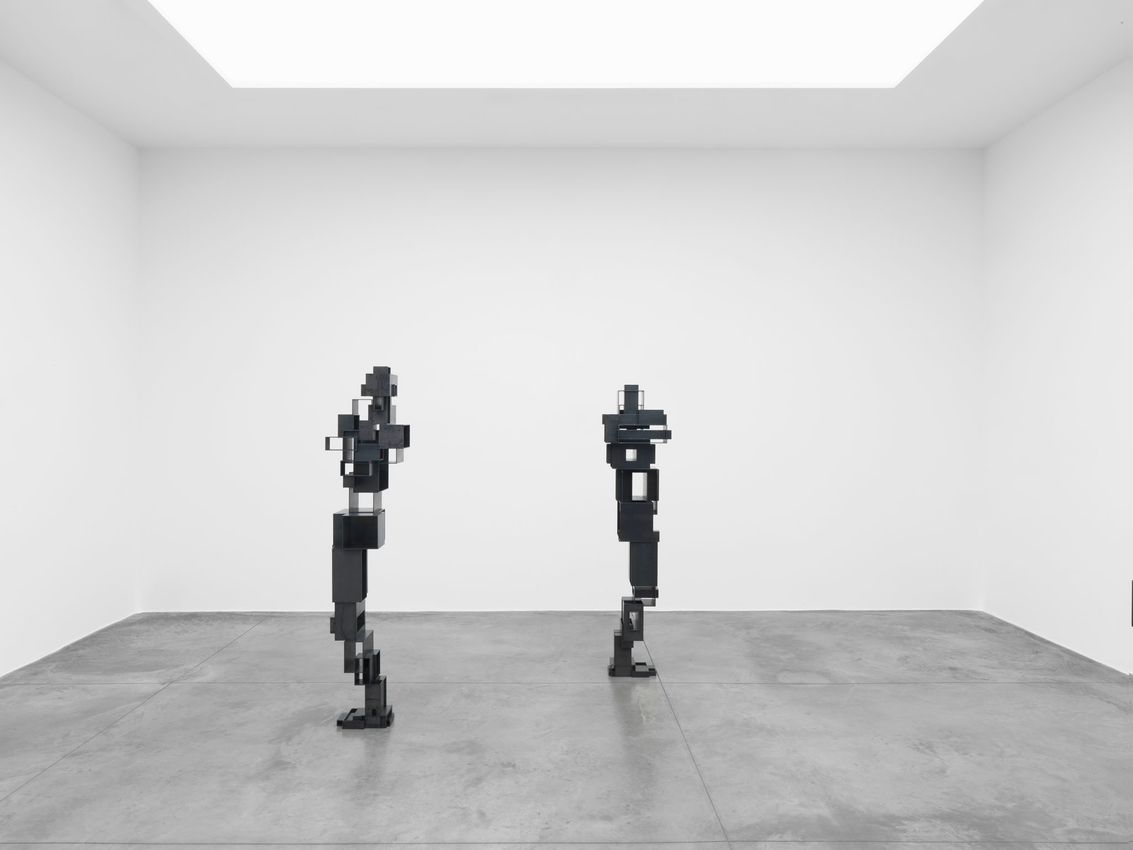
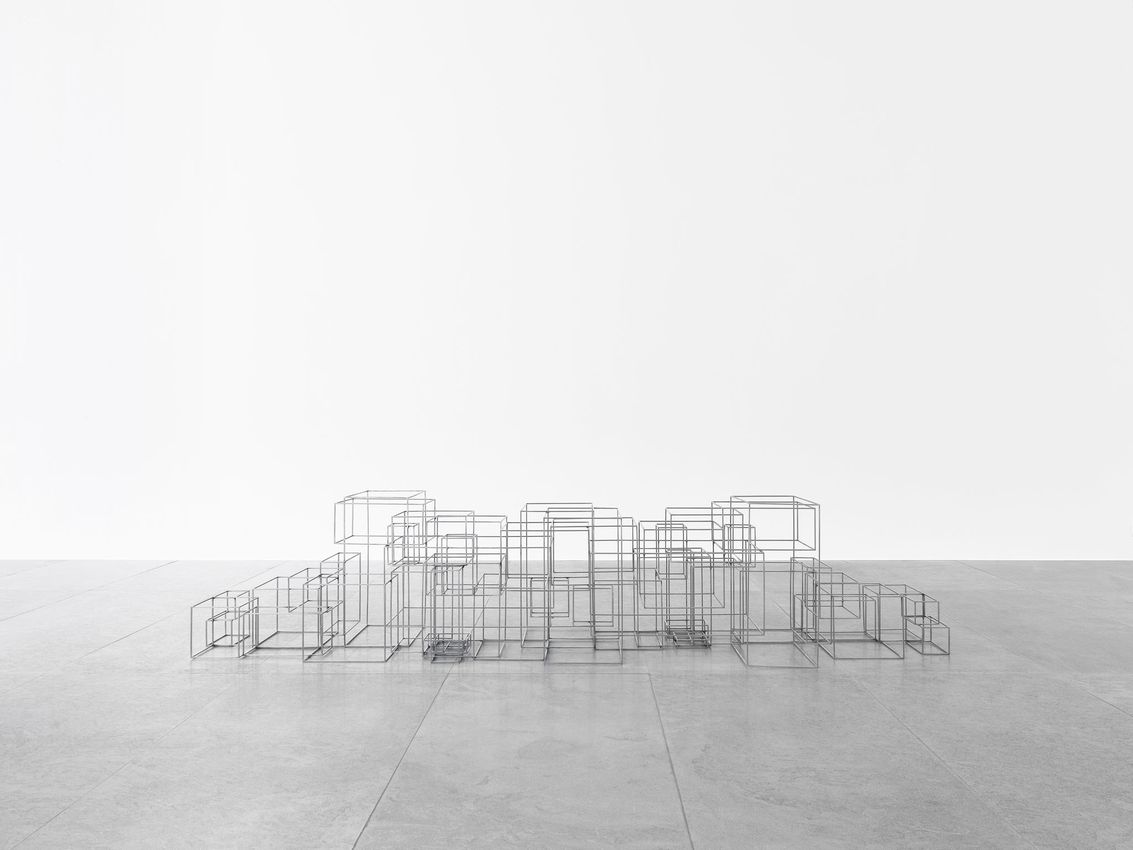
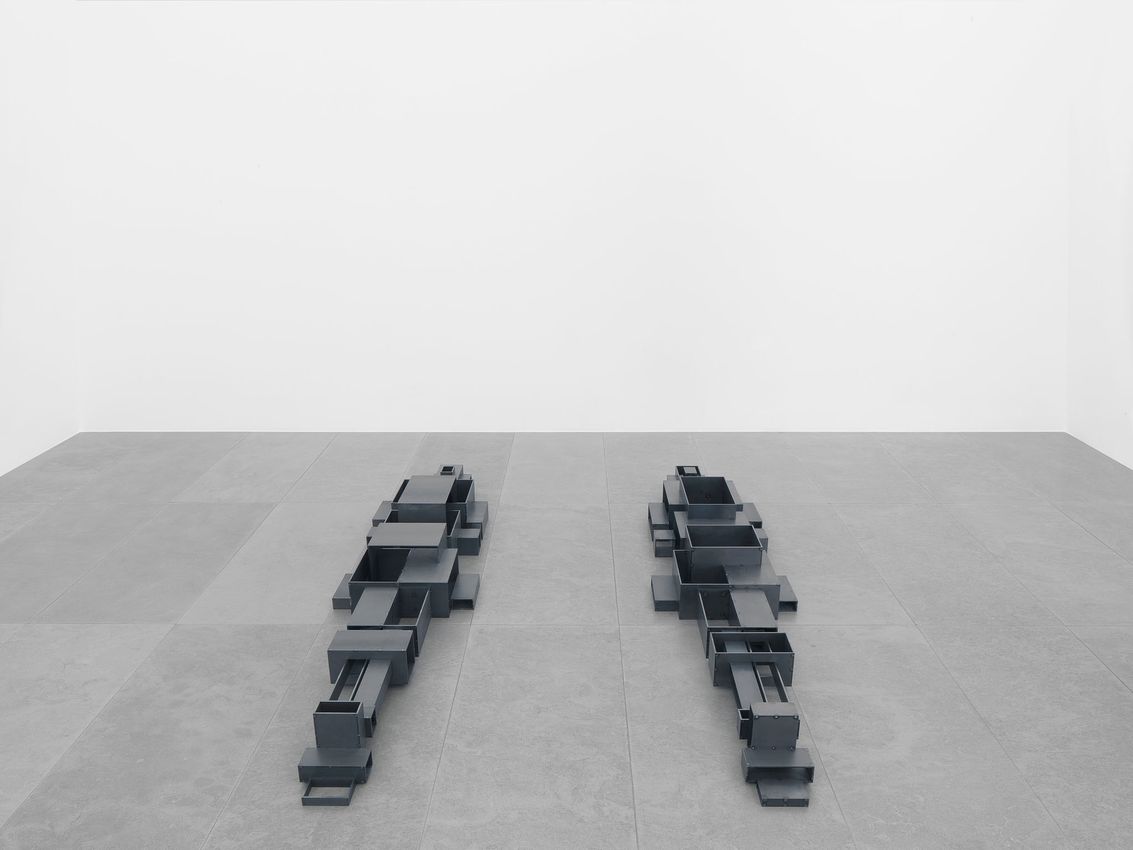
The exhibition borrows its title from LIVING ROOM, the new two-part sculpture around which the exhibition is centred. As is typical of Gormley’s oeuvre, this installation departs from a concrete and tangible given: the artist’s own body. Working from three-dimensional scans, the resulting figures have been reduced to a series of interpenetrating cell-like structures, some of which are solid, others of which are open. The formation of LIVING ROOM calls to mind, in both plan and elevation, any number of utopian buildings. Whereas the work resembles a three-dimensional architectural model when viewed from the side, an altogether different view can be gained from the upper

floor of the double-height gallery space. From here, the work is not dissimilar from an aerial view, or ground plan, of a modernist housing ensemble. This lofty vantage point is also the ideal position from which to study the perfect symmetry of the two forms and the subtle but corresponding differences

in negative and positive space. This key work alludes, both literally and figuratively, to the notion of the ‘house’, which is here articulated as a man- made construction and shelter, without which we would ultimately perish, but also as the bodily ‘shell’ that protects something infinitely more remote and enigmatic: the cerebral inner ‘space’ where thought and emotion reside. In his exploration of the points of contact between these two spheres, the work bears witness to Gormley’s on-going investigation of geometry, abstraction and our metaphysical relationship to the built environment. Through materials, gesture and spatial relationships, the artist strives to give form to that which is least visible and most profound: the sensation of occupying a body that, in turn, inhabits the world.

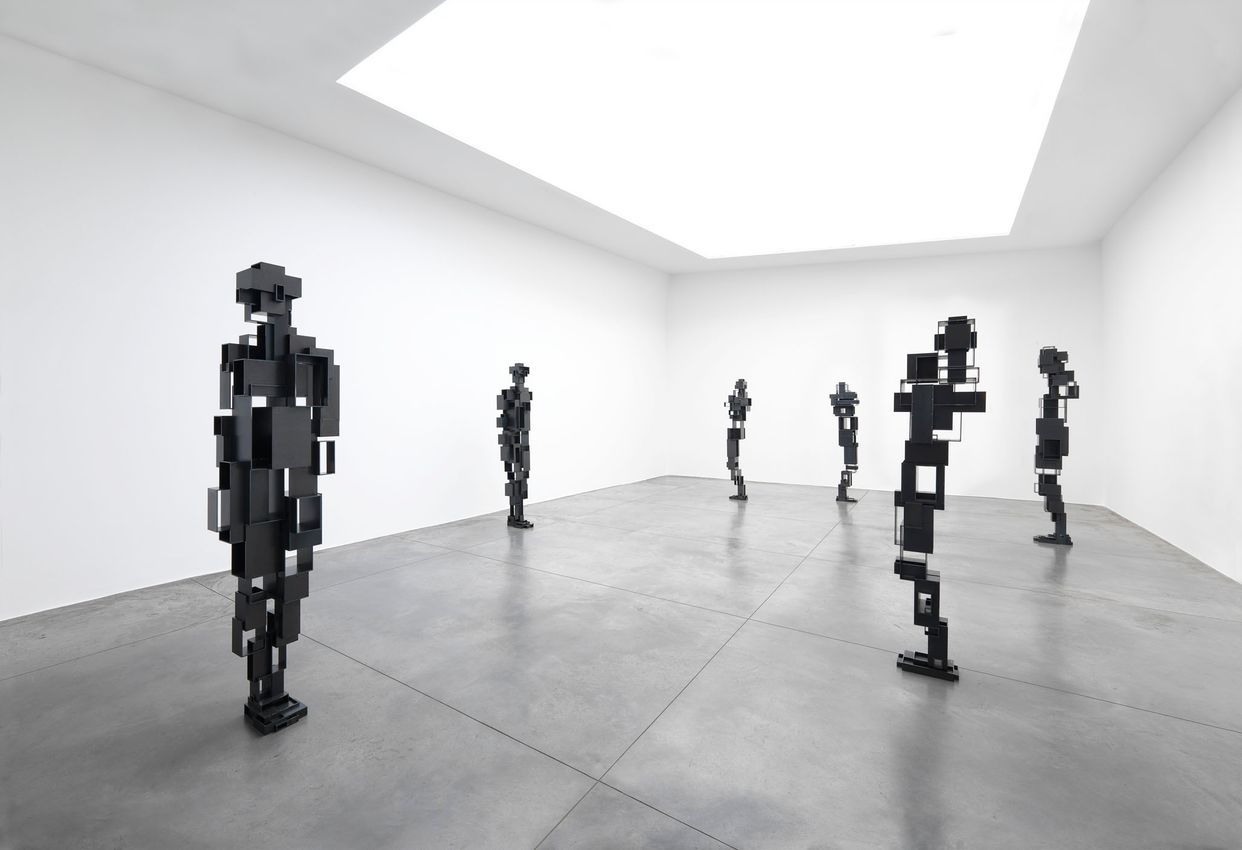
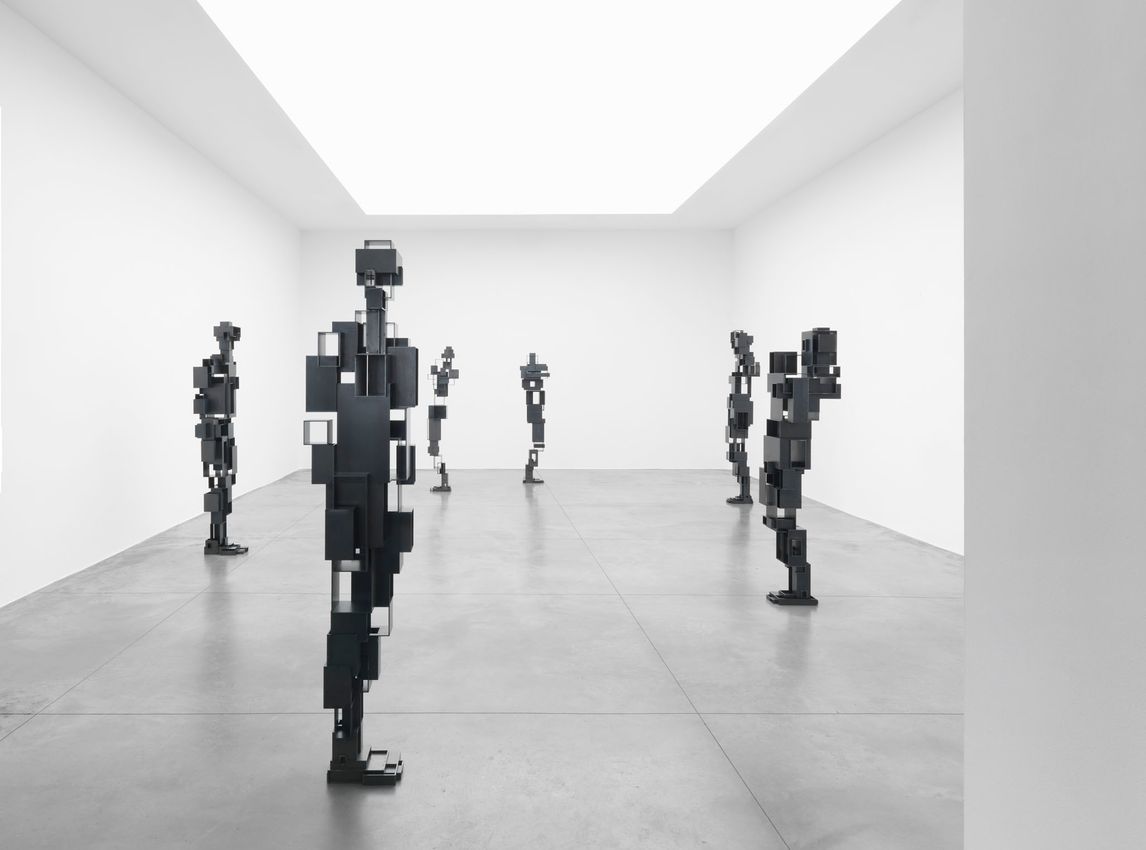
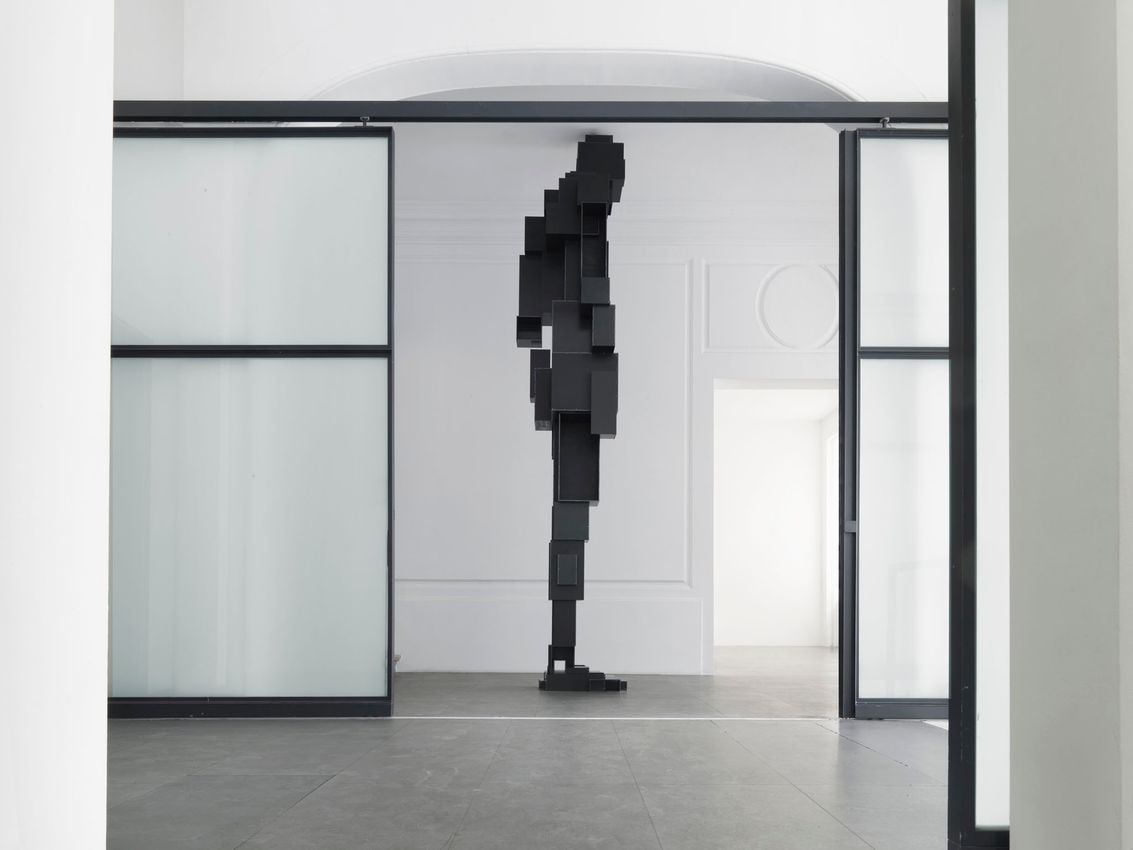
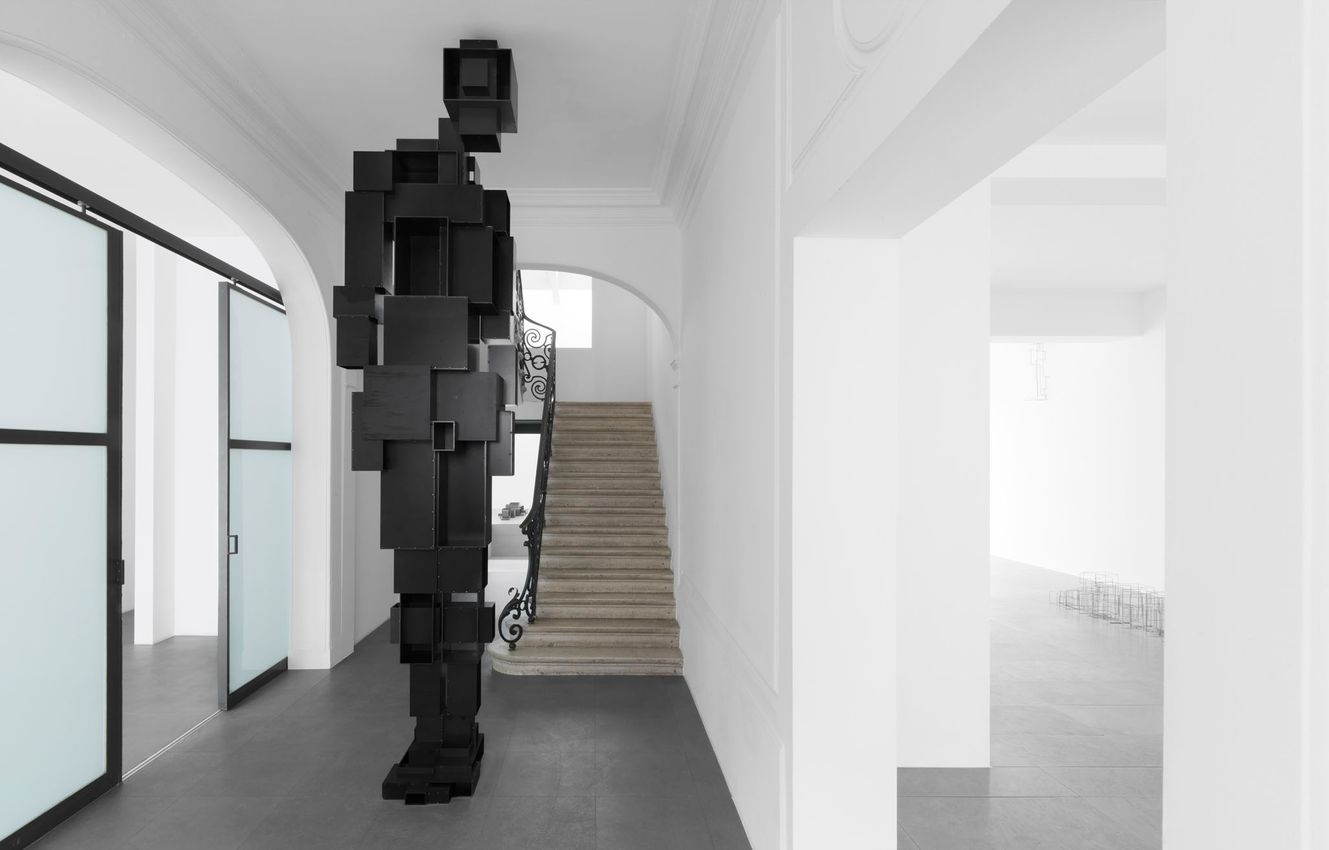
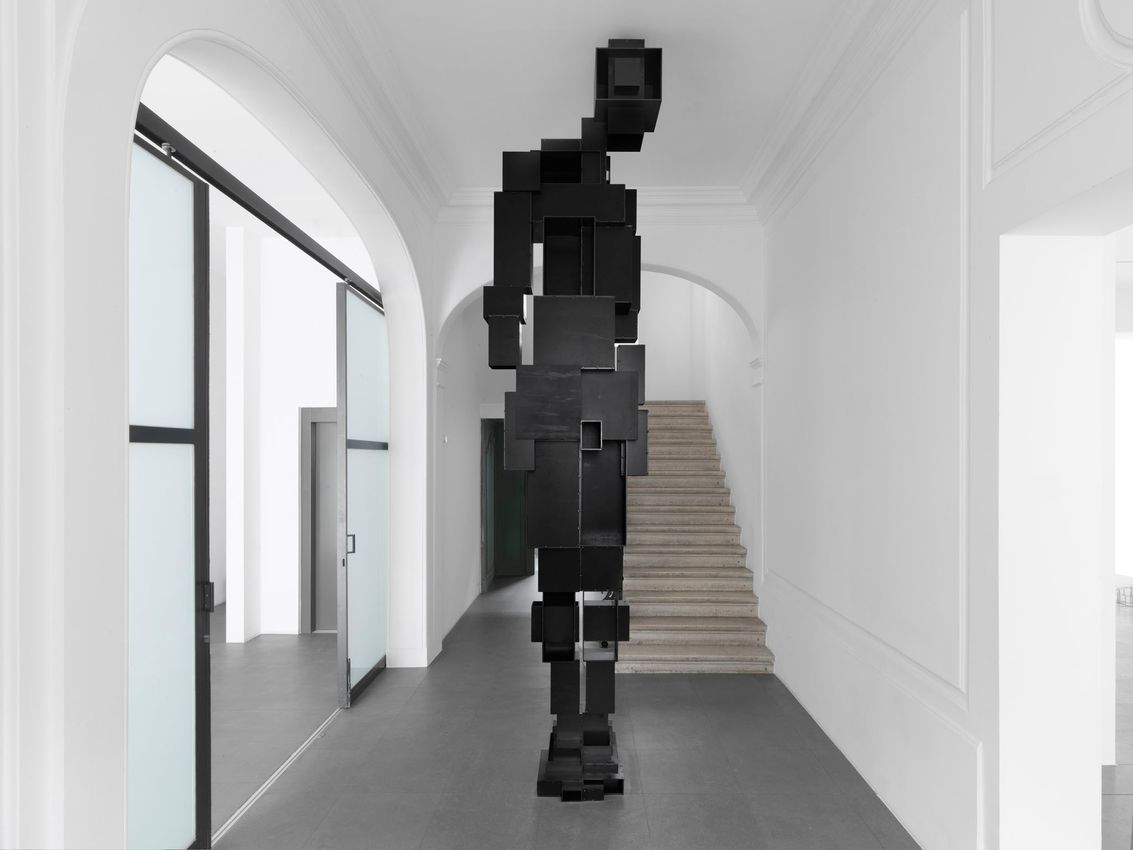
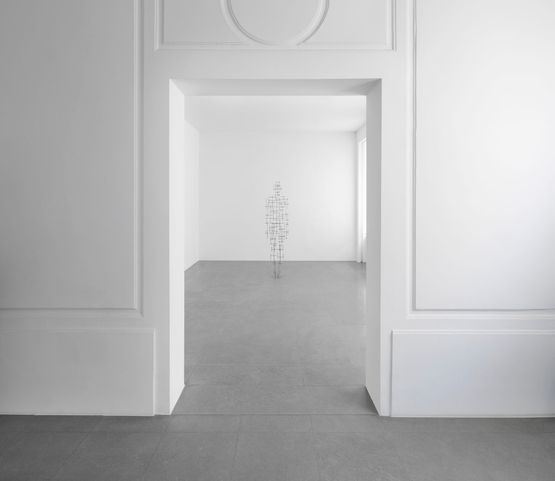
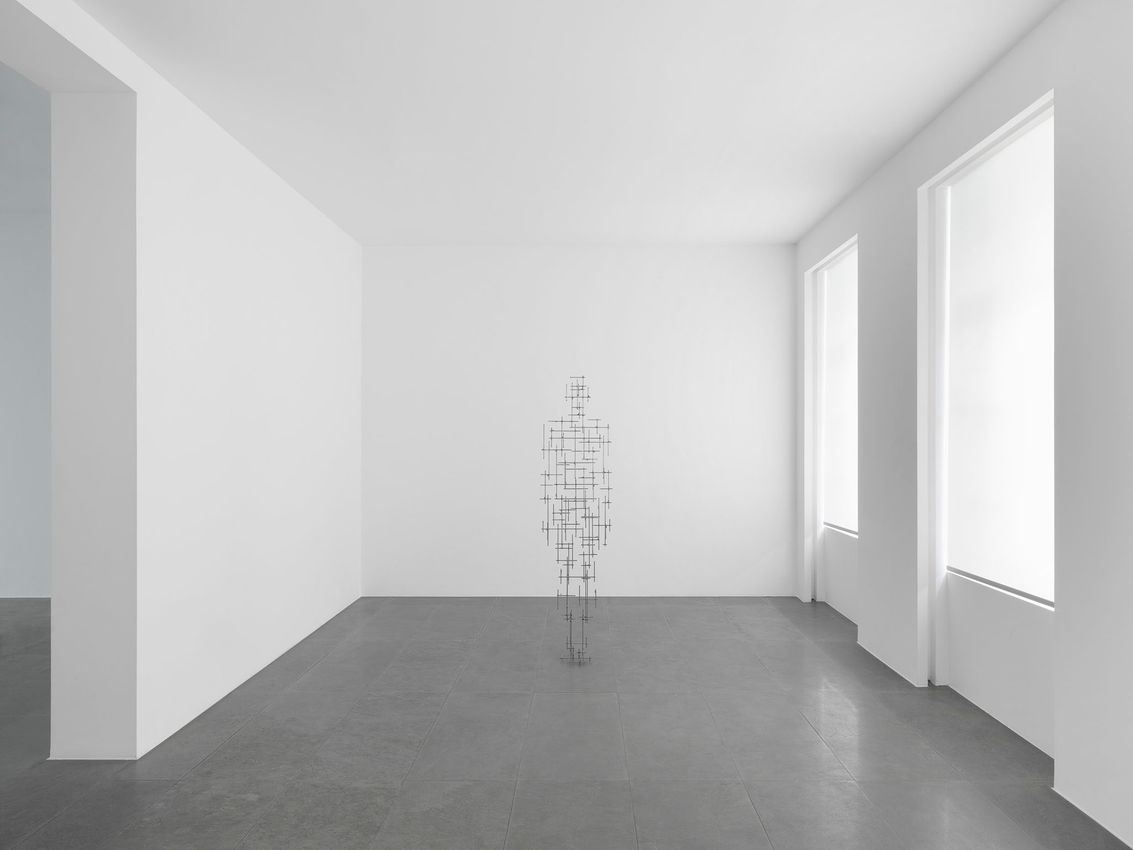
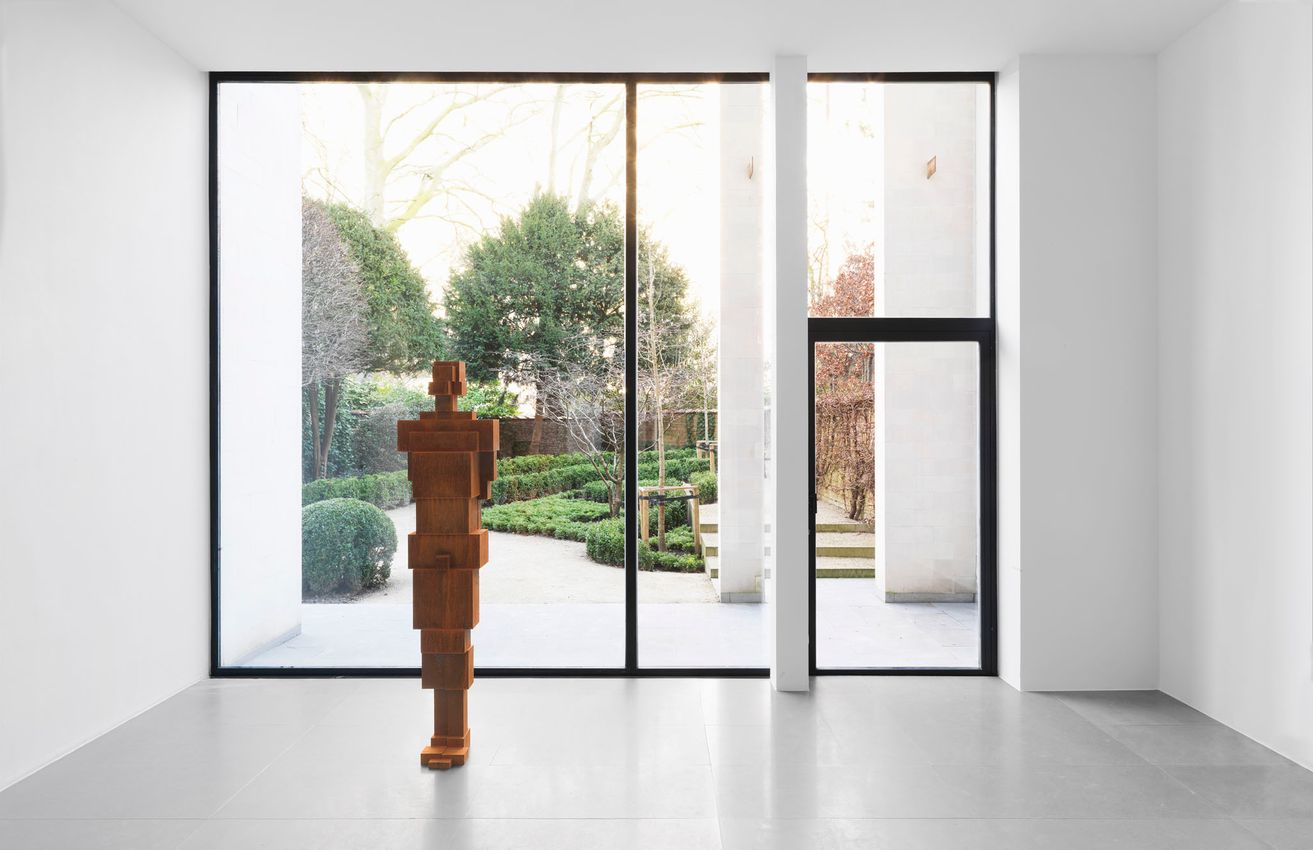
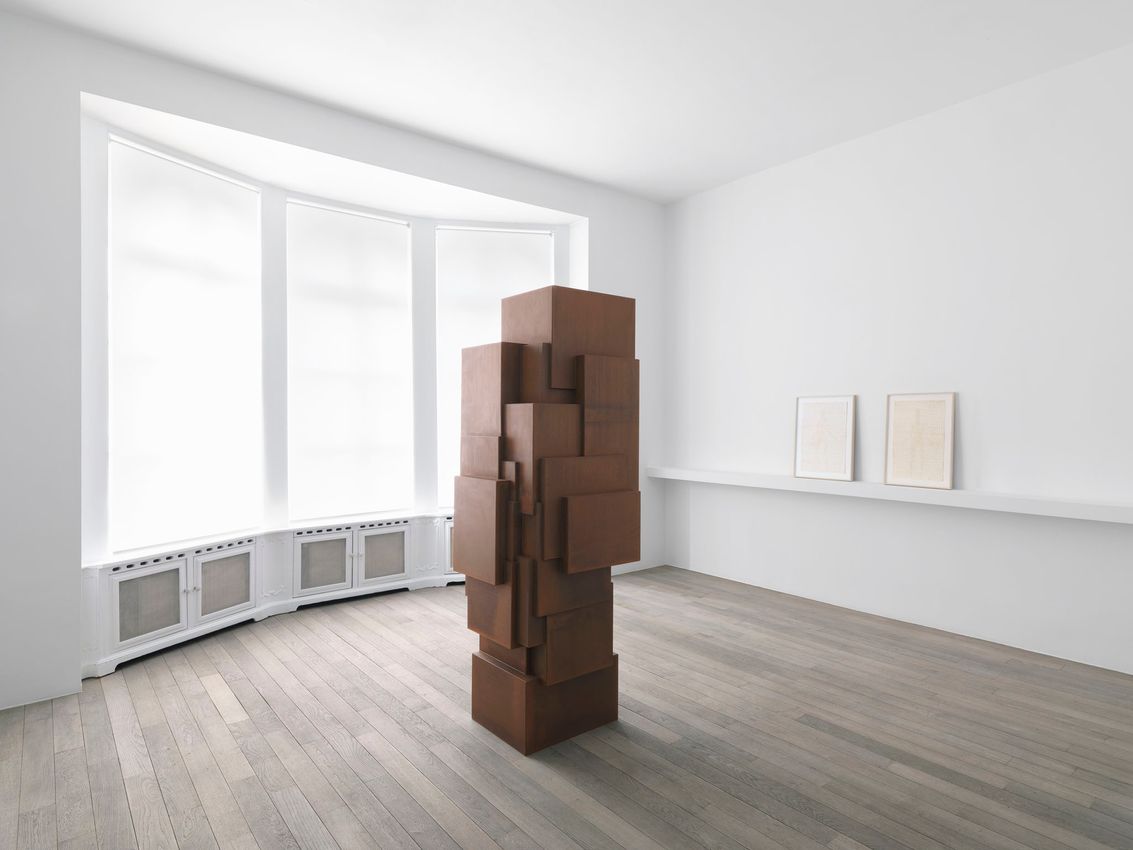
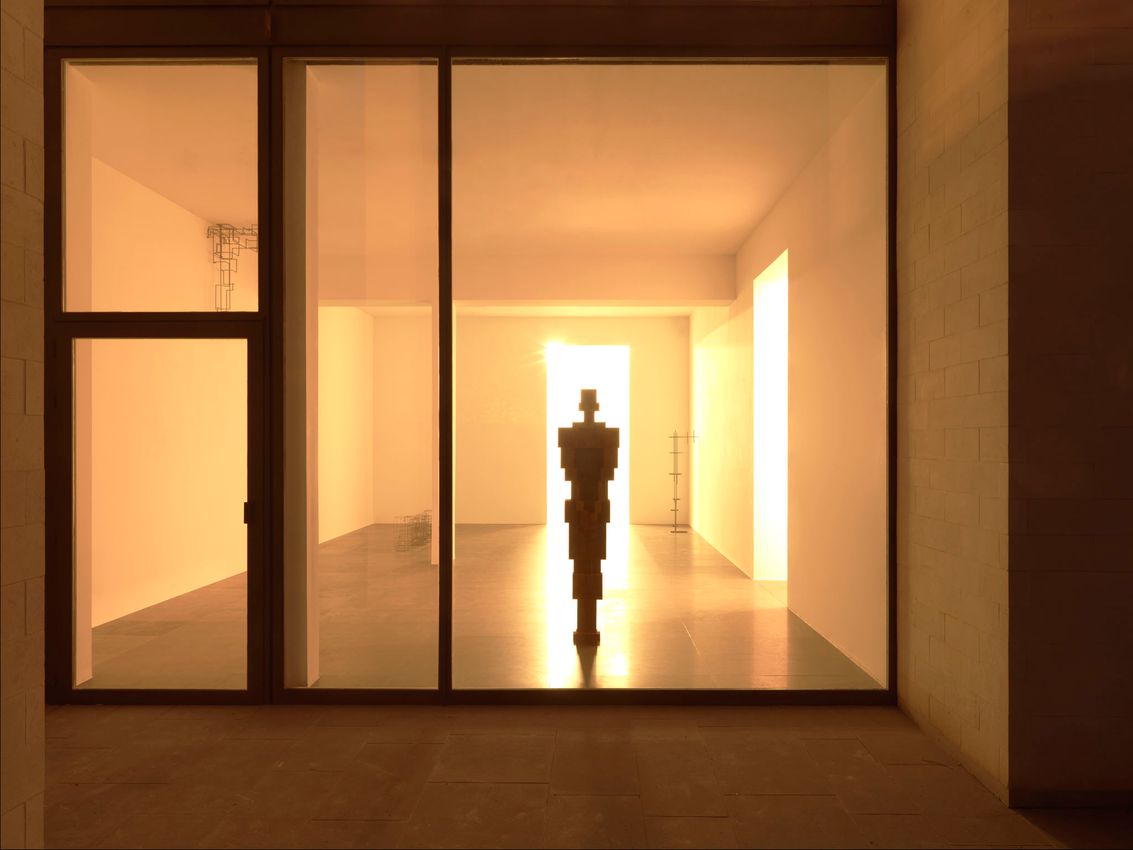
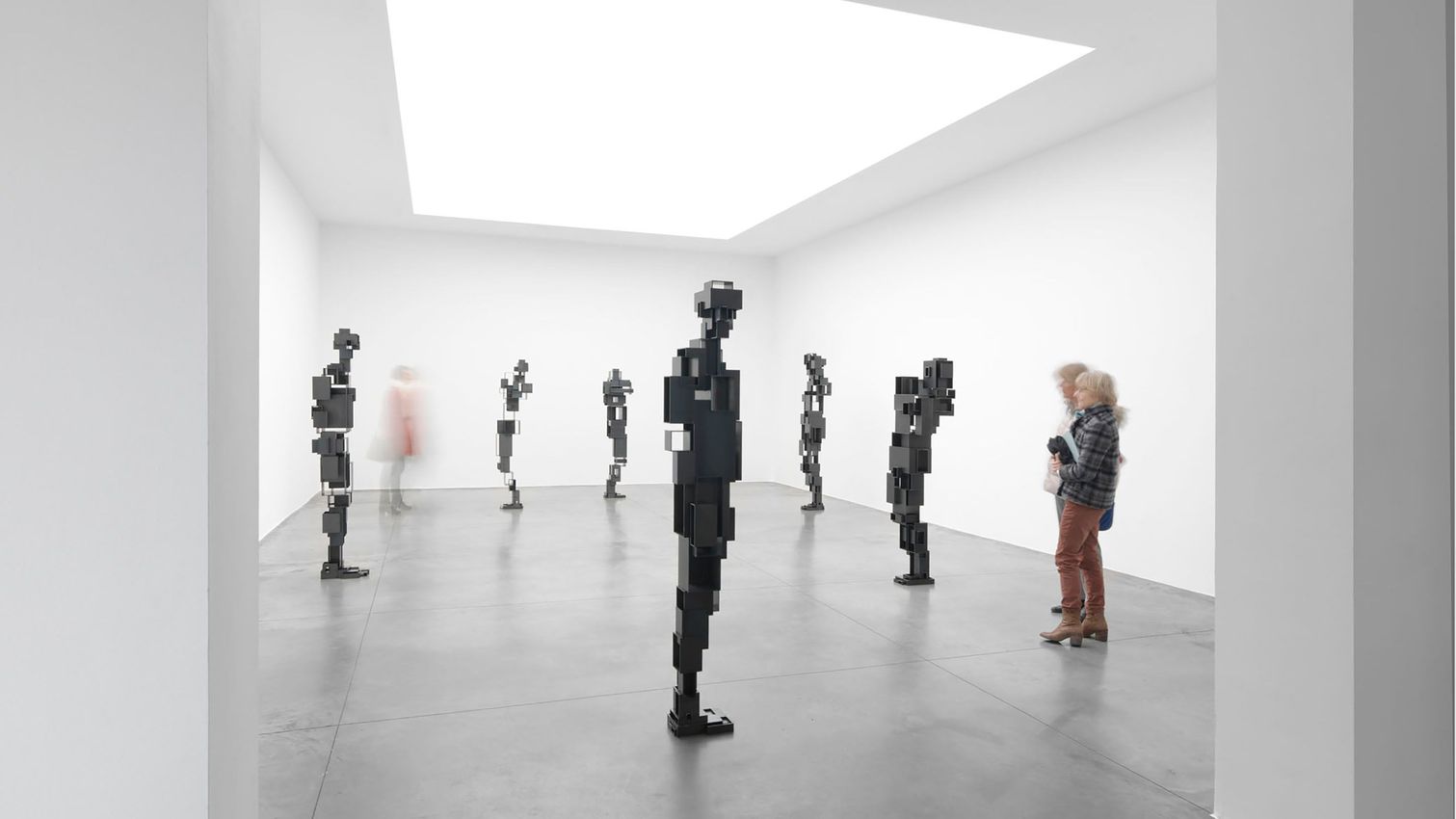
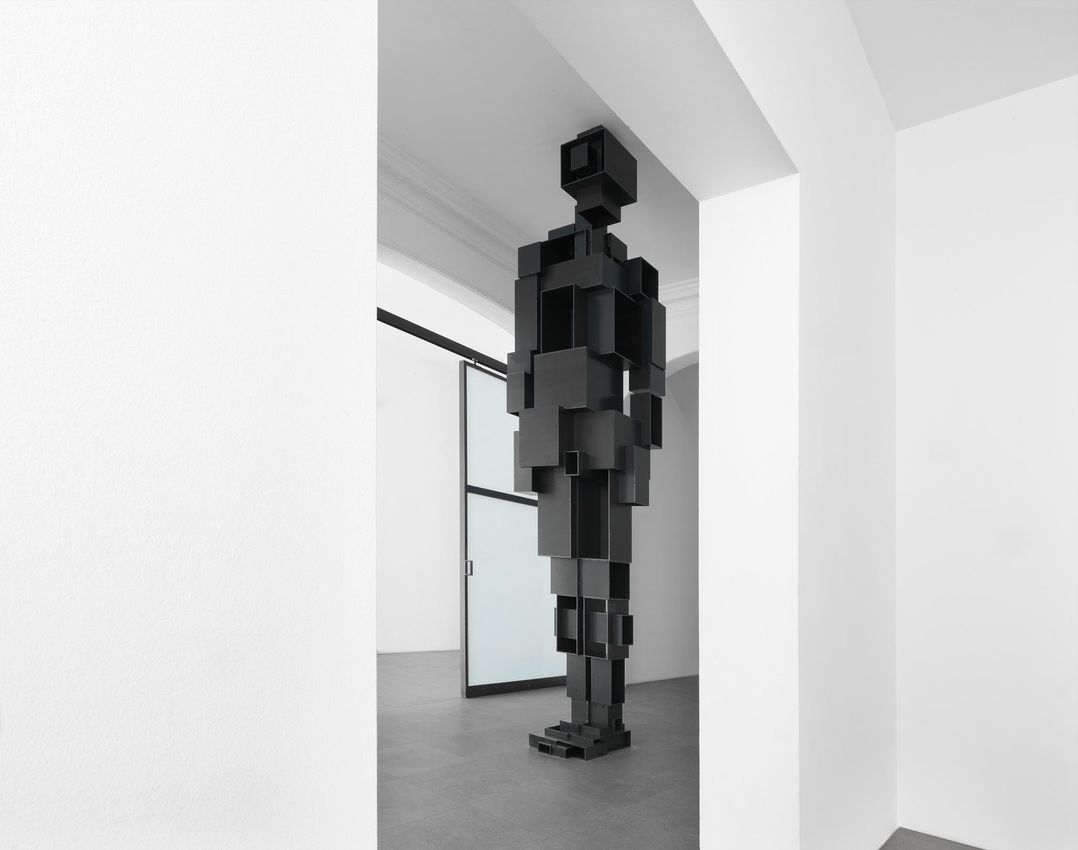
The visual language of LIVING ROOM is also evident in the seven free- standing ‘open blockwork’ sculptures on view. Described by Gormley as ‘conflating the body that occupies space with the vessels that contain it’, these works are a further iteration on the theme of interiority and exteriority, and the notion of a vessel (body) within a vessel (building) – and vice versa. But just as our physical and emotional states alter, so too do the figures, with the open and closed surfaces supplying different degrees of transparency or opacity. In this exhibition, the abstracted human figures can be heavy and solid, as in the cast- iron pieces, or tenuous and insubstantial to the point of appearing to disappear into the surrounding space. As we circulate these nuanced beings, they invite us to enjoy the interplay of mass to void, dark to light, and open to closed.

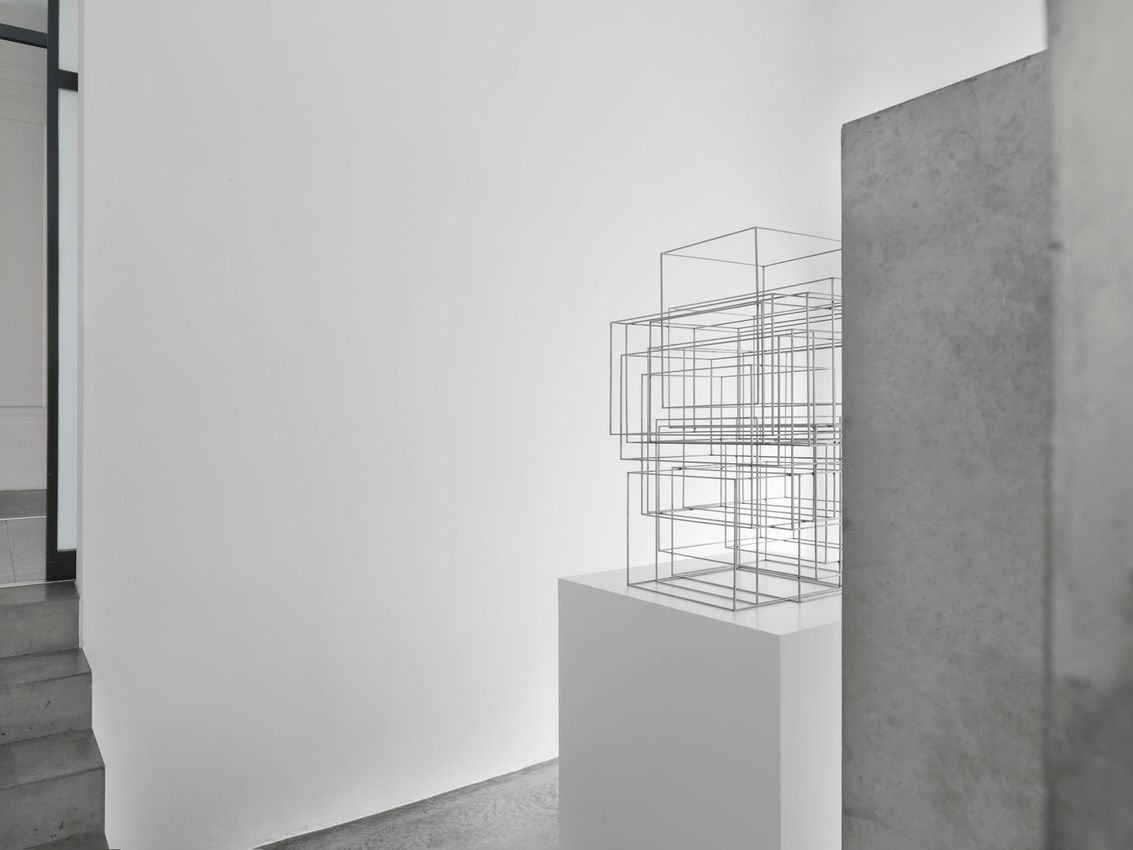
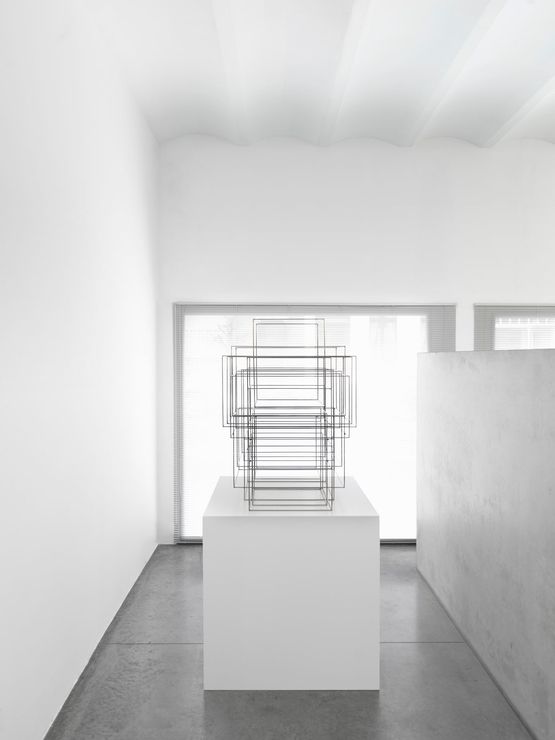
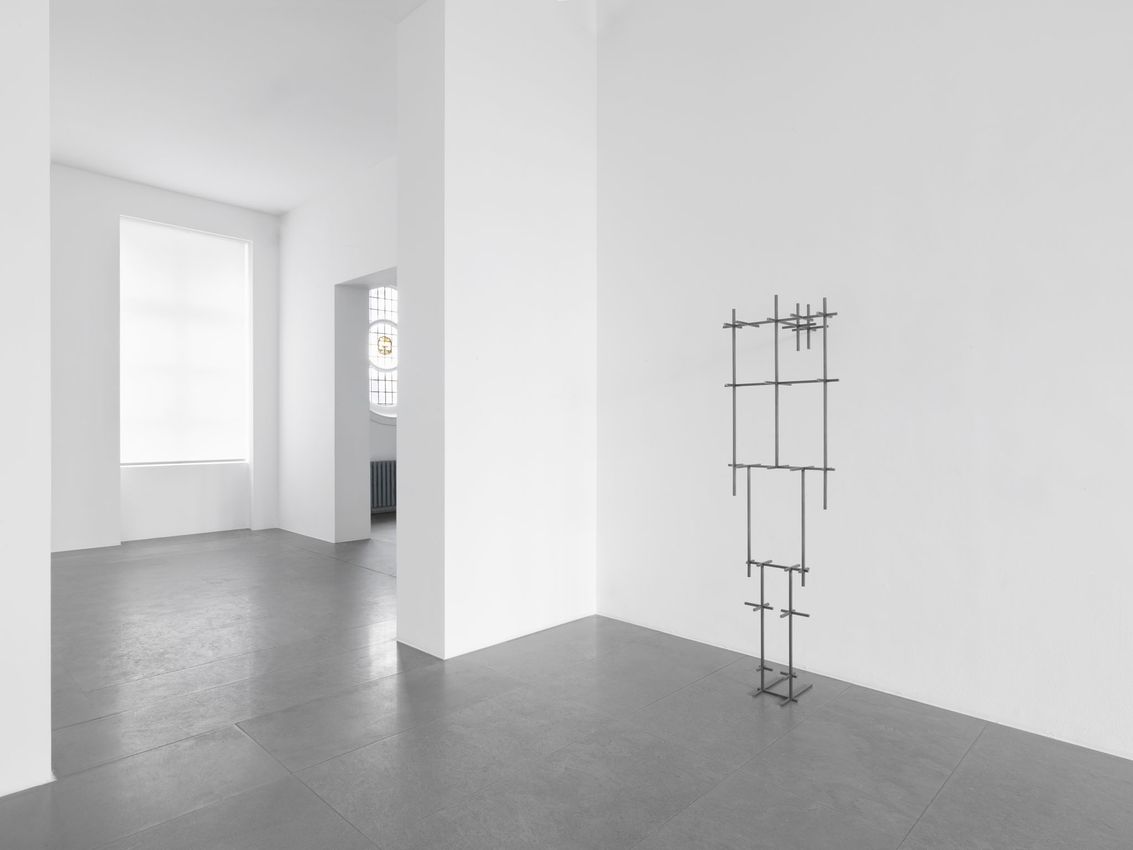
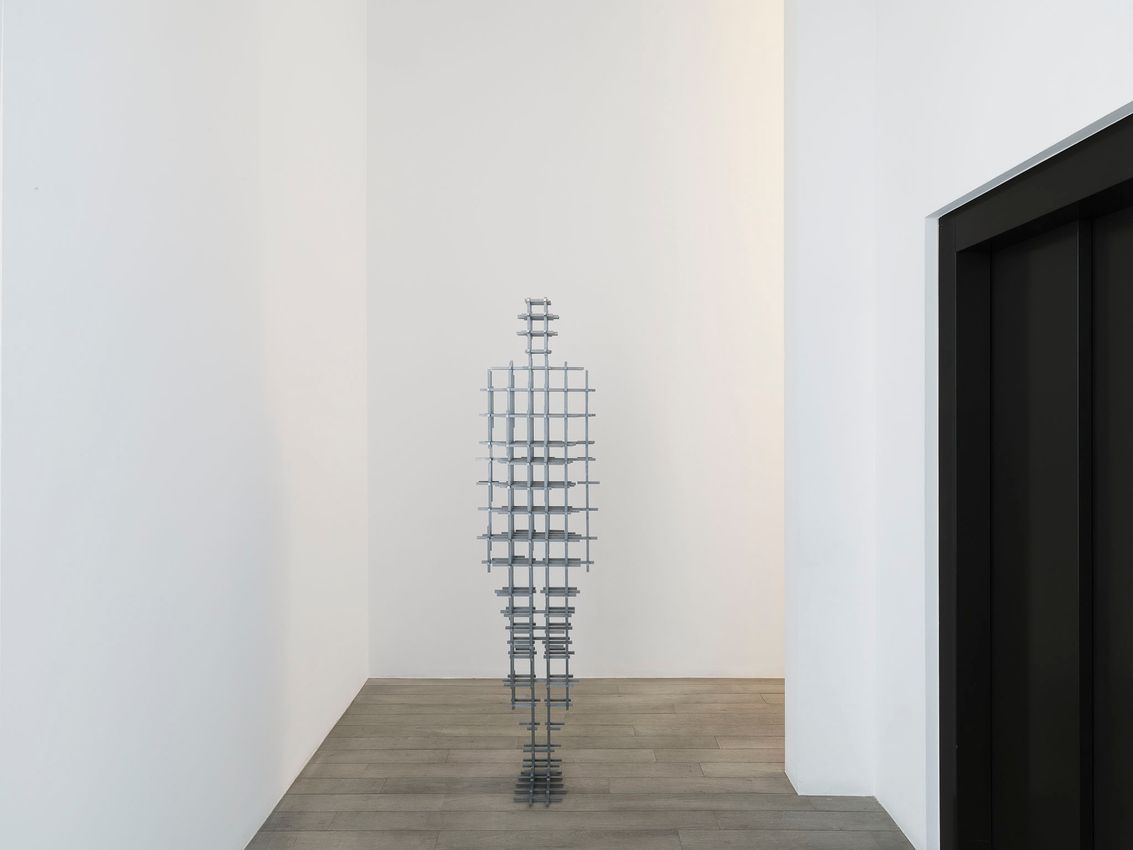
The blockwork figures are complemented by recent linear sculptures in square-section stainless-steel bar. Collectively known as ‘framers’ and ‘liners’, the artist describes these works as the ‘objective mappings of subjective space’. Either free-standing or suspended, they structure and energise the intimate and domestic spaces of the gallery. Upstairs, a new work SET is shown alongside CONSOLE III, an open framework evocation of the ‘tanker’ entitled FALL V. A series of related drawings completes the display.

Permeating the exhibition is the language of modernity, most notably De Stijl and American minimalism, which is here harnessed to evoke pathos. Gormley’s work can thus be viewed as a continuation of this abstract tradition in the sense that his geometric constructions and sculptural voids eschew illustration and mimesis while allowing an open ground for projection and reflection.

Antony Gormley (b.1950, London) was awarded the Turner Prize in 1994,
the South Bank Prize for Visual Art in 1999, the Bernhard Heiliger Award for Sculpture in 2007, the Obayashi Prize in 2012 and the Praemium Imperiale
in 2013. His work has been exhibited all over the world, most recently in
Object, National Portrait Gallery, London (2016-2017); Event Horizon, Hong Kong (2015-2016); Land, various Landmark Trust properties in the UK (2015-2016); Human, Forte Di Belvedere, Florence, Italy (2015); Another Time, Mardalsfossen, Norway (2015); Sculpture 21st: Antony Gormley, Lehmbruck Museum, Duisburg, Germany (2014-2015); Expansion Field, Zentrum Paul Klee, Bern, Switzerland (2014); Firmament And Other Forms, Middelheim Museum, Antwerp, Belgium (2013). Antony Gormley lives and works in London.

Read More

Installation Views

About the Artist

Antony Gormley is widely acclaimed for his sculptures, installations and public artworks that investigate the relationship of the human body to space. His work has developed the potential opened up by sculpture since the 1960s through a critical engagement with both his own body and those of others in a way that confronts fundamental questions of where human being stands in relation to nature and the cosmos. Gormley continually tries to identify the space of art as a place of becoming in which new behaviours, thoughts and feelings can arise.

View Artist Profile

Also Exhibiting at Xavier Hufkens

About the Gallery
Xavier Hufkens is one of Europe’s leading galleries for contemporary art. Located in Brussels, the gallery maintains a diverse exhibition programme with solo exhibitions of the gallery artists as well as group exhibitions and special projects. The gallery deals in a distinctive combination of painting, drawing, sculpture, photography, video and installation-based work.

The origins of the gallery date back to 1987, when Xavier Hufkens opened a gallery space in an un-refurbished warehouse in the neighbourhood of the South Station (Midi) in Brussels. During the early years, the focus of the gallery was upon mid-career and emerging artists and the gallery is known for having introduced some of the most influential contemporary artists to Brussels at a time when they were still relatively unknown. British sculptor Antony Gormley, who is still affiliated with the gallery, Felix Gonzalez-Torres and Rosemarie Trockel all showed in Belgium for the first time with Xavier Hufkens (Gormley in 1987; Gonzalez-Torres in 1991 and Trockel in 1993).

In 1992, the gallery moved to a 19th-century townhouse at 6 rue Saint-Georges, close to the Avenue Louise. Completely renovated by Belgian architects Paul Robbrecht, Hilde Daem and Marie-José Van Hee, the house quickly gained a reputation for being not just one of the most beautiful contemporary art spaces in the Belgian capital, but also one of the most interesting. The expanded exhibition programme coincided with the additional representation of a number of established artists from Belgium and abroad, including Richard Artschwager, Thierry De Cordier and Jan Vercruysse. In 1997, Hufkens expanded the gallery further by annexing the adjacent building and a number of new artists joined the gallery, including Louise Bourgeois, Roni Horn and Thomas Houseago.

A second space in the same street, at 107 rue Saint-Georges, opened in spring 2013. Located in the Galerie Rivoli, a mixed-use commercial development from the 1970s, the new gallery space was designed by Swiss architect Harry Gugger, who was previously in partnership with Herzog and De Meuron. Slegten & Toegemann, Brussels, managed the project. A third space opened in spring 2020, located at 44 Rue Van Eyck, designed by architect Bernard Dubois.

An eclectic but very clear vision underpins all of the gallery’s activities: ‘The definition of the gallery was established from the start. The common thread, then and now, is quality over and above everything else, which I find more intellectually challenging than a forced definition. From the early days I juxtaposed established artists such as Michelangelo Pistoletto with someone like Felix Gonzalez-Torres when he was totally unknown. Today I still mix my work: I have no problem showing Malcolm Morley … alongside Robert Ryman, or Willem de Kooning.’ [Xavier Hufkens in The Art Newspaper, Issue 220, January 2011, published online: 20 January 2011]

Xavier Hufkens represents some thirty artists from different generations. He was part of the six-member selection committee for Art Basel during seven years and also participates in up to five international Arts Fairs annually. The gallery has partnerships with the estates of Louise Bourgeois, Willem de Kooning, Robert Mapplethorpe and Alice Neel.
View Gallery Profile
Address
6 rue St-Georges
St-Jorisstraat
Brussels
Belgium
Opening Hours
Tuesday – Saturday
11am – 6pm
(1)
Brussels 6 rue St-Georges
Xavier Hufkens
6 rue St-Georges, St-Jorisstraat, Brussels, Belgium

Opening hours
Tuesday – Saturday
11am – 6pm
The art world in focus