Press Release

Xavier Hufkens is pleased to present a major exhibition of new work by Tatiana Trouvé, her first solo exhibition in Brussels. Occupying three levels of the gallery, The Auxiliaries unfolds through an ever-expanding practice encompassing sculpture, drawing, and installation. Trouvé’s works inhabit an intermediate zone where multiple realities coexist, each interlinked within a practice that is both generative and regenerative. ‘All the elements that make up worlds connected to each other through affinities, echoes, reminiscences, and how these liaisons map out a shared wandering, without origin or end, in a completely open ecosystem’, Tatiana Trouvé notes.

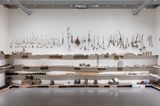
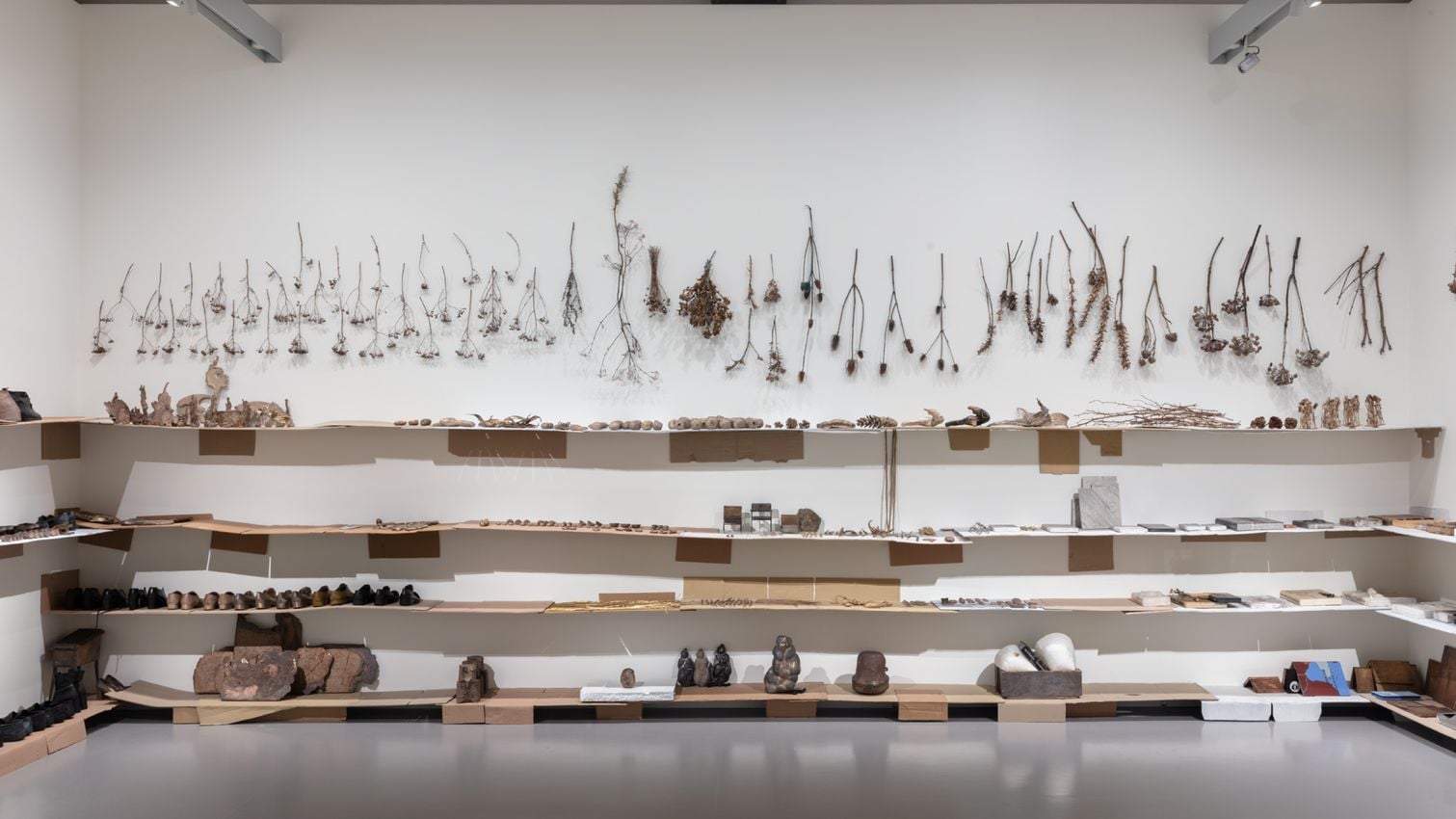
The exhibition opens with L’Inventario [The Inventory] (2026), a provisional-looking shelving structure resembling cardboard cast in aluminium. Combining still-life compositions with empty shelves, the installation alludes to the artist’s storage and the studio as a place of transformation, where objects and their relationships exist in a state of perpetual becoming. Rather than suggesting accumulation, the work evokes absence and depletion. As Trouvé observes: ‘The idea is to get into a space where a few elements still survive, but where the essentials are already gone.’

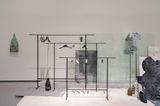
Les Colliers des villes [City Necklaces] are composed of objects collected by the artist during her travels. Cast in bronze, brass, steel or aluminium before being painted, these fragments become condensed itineraries carrying traces of encounters and lived experience, recalling the interconnected journeys of Italo Calvino’s Invisible Cities (1972). Travel and temporality likewise shape the latest iteration of I cento titoli [A Hundred Titles], a work whose title changes every year over one hundred years (1968—2068). Cast in bronze, the ‘dis-adjusted’ suitcase floats between a temporal and a conceptual journey.

Travelling, movement, mapping and circularity also underpin On the Eve of Never Leaving (2026), a work based on sound pollution measurements taken around the Boulevard Périphérique that encircles Paris. Here, sounds become lines, movements become structures, and an invisible phenomenon acquires material presence. Composed of truncated loops and segments, the sculpture echoes the continuous circuit of the ring road, while the adjoining plaster panel, a fragment of Trouvé studio’s wall, recalls the acoustic barriers lining the motorway, linking the artist’s studio life to the murmuring of the world.

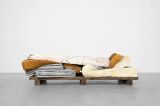
In the basement, Sitting Sculptures (2026), from the series Les Ouvrières invisibles [The Invisible Workers], foregrounds the auxiliary materials that enable sculptures to exist: mattresses, blankets, pillows and foams used to drag heavy and fragile objects around the studio, transport pallets, lifting straps, silicone taken from casting moulds, fragments, casts, residues, and discarded materials all reappear in new forms. Retaining traces of their histories even as they assume new identities, these elements reveal the movement and the hidden labour embedded within sculptural practice.

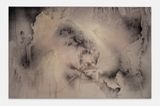
Upstairs, the porous relationship between drawing and sculpture comes to the fore through a selection from the Les Dessouvenus [The Unremembered] series, begun in 2013, alongside a new series of drawings, Les Auxiliaires [The Auxiliaries]. Across both series, Trouvé’s practice oscillates between chance operation and construction, orientation and disorientation: worlds emerge through chemically altered surfaces, while drawings originate in the chance event of a hair falling across a canvas, preserved beneath tracing paper, its meandering path evoking routes, cables and trajectories.

As the boundaries between studio and exhibition, drawing and sculpture, process and finished work dissolve, Tatiana Trouvé’s works emerge not as fixed entities but as temporary constellations within an exhibition as an open network of transformations. Across shifting relations between objects, materials, gestures and places, works continually change status as they move from one form to another, generating new affinities, echoes and trajectories. Rather than resolving into stable meanings, they remain suspended within an ecosystem without origin or end, where different worlds coexist and continually give rise to one another.

Read More
About the Artist

Tatiana Trouvé has developed a vast and ambitious body of work in which drawing, sculpture, and installation are intricately interwoven. Her practice moves seamlessly between the imagined and the constructed, forming a poetic visual language that explores time as suspended, memory through its ruptures, and spatial disorientation. Trouvé first garnered critical attention with Bureau d’Activités Implicites (1997–2007), a formative project she described as a “laboratory of time.” Combining fictional documents, personal archives, and architectural modules, it introduced many of the thematic and formal concerns that continue to shape her work: the construction of psychological and physical space, the layering of memory, and the tension between presence and absence.

View Artist Profile

Also Exhibiting at Xavier Hufkens

About the Gallery
Xavier Hufkens is one of Europe’s leading galleries for contemporary art. Located in Brussels, the gallery maintains a diverse exhibition programme with solo exhibitions of the gallery artists as well as group exhibitions and special projects. The gallery deals in a distinctive combination of painting, drawing, sculpture, photography, video and installation-based work.

The origins of the gallery date back to 1987, when Xavier Hufkens opened a gallery space in an un-refurbished warehouse in the neighbourhood of the South Station (Midi) in Brussels. During the early years, the focus of the gallery was upon mid-career and emerging artists and the gallery is known for having introduced some of the most influential contemporary artists to Brussels at a time when they were still relatively unknown. British sculptor Antony Gormley, who is still affiliated with the gallery, Felix Gonzalez-Torres and Rosemarie Trockel all showed in Belgium for the first time with Xavier Hufkens (Gormley in 1987; Gonzalez-Torres in 1991 and Trockel in 1993).

In 1992, the gallery moved to a 19th-century townhouse at 6 rue Saint-Georges, close to the Avenue Louise. Completely renovated by Belgian architects Paul Robbrecht, Hilde Daem and Marie-José Van Hee, the house quickly gained a reputation for being not just one of the most beautiful contemporary art spaces in the Belgian capital, but also one of the most interesting. The expanded exhibition programme coincided with the additional representation of a number of established artists from Belgium and abroad, including Richard Artschwager, Thierry De Cordier and Jan Vercruysse. In 1997, Hufkens expanded the gallery further by annexing the adjacent building and a number of new artists joined the gallery, including Louise Bourgeois, Roni Horn and Thomas Houseago.

A second space in the same street, at 107 rue Saint-Georges, opened in spring 2013. Located in the Galerie Rivoli, a mixed-use commercial development from the 1970s, the new gallery space was designed by Swiss architect Harry Gugger, who was previously in partnership with Herzog and De Meuron. Slegten & Toegemann, Brussels, managed the project. A third space opened in spring 2020, located at 44 Rue Van Eyck, designed by architect Bernard Dubois.

An eclectic but very clear vision underpins all of the gallery’s activities: ‘The definition of the gallery was established from the start. The common thread, then and now, is quality over and above everything else, which I find more intellectually challenging than a forced definition. From the early days I juxtaposed established artists such as Michelangelo Pistoletto with someone like Felix Gonzalez-Torres when he was totally unknown. Today I still mix my work: I have no problem showing Malcolm Morley … alongside Robert Ryman, or Willem de Kooning.’ [Xavier Hufkens in The Art Newspaper, Issue 220, January 2011, published online: 20 January 2011]

Xavier Hufkens represents some thirty artists from different generations. He was part of the six-member selection committee for Art Basel during seven years and also participates in up to five international Arts Fairs annually. The gallery has partnerships with the estates of Louise Bourgeois, Willem de Kooning, Robert Mapplethorpe and Alice Neel.
View Gallery Profile
Address
6 rue St-Georges
St-Jorisstraat
Brussels
Belgium
Opening Hours
Tuesday – Saturday
11am – 6pm
(1)
Brussels 6 rue St-Georges
Xavier Hufkens
6 rue St-Georges, St-Jorisstraat, Brussels, Belgium

Opening hours
Tuesday – Saturday
11am – 6pm
The art world in focus