




Press Release
Xavier Hufkens is pleased to announce a new exhibition by American artist Wyatt Kahn.

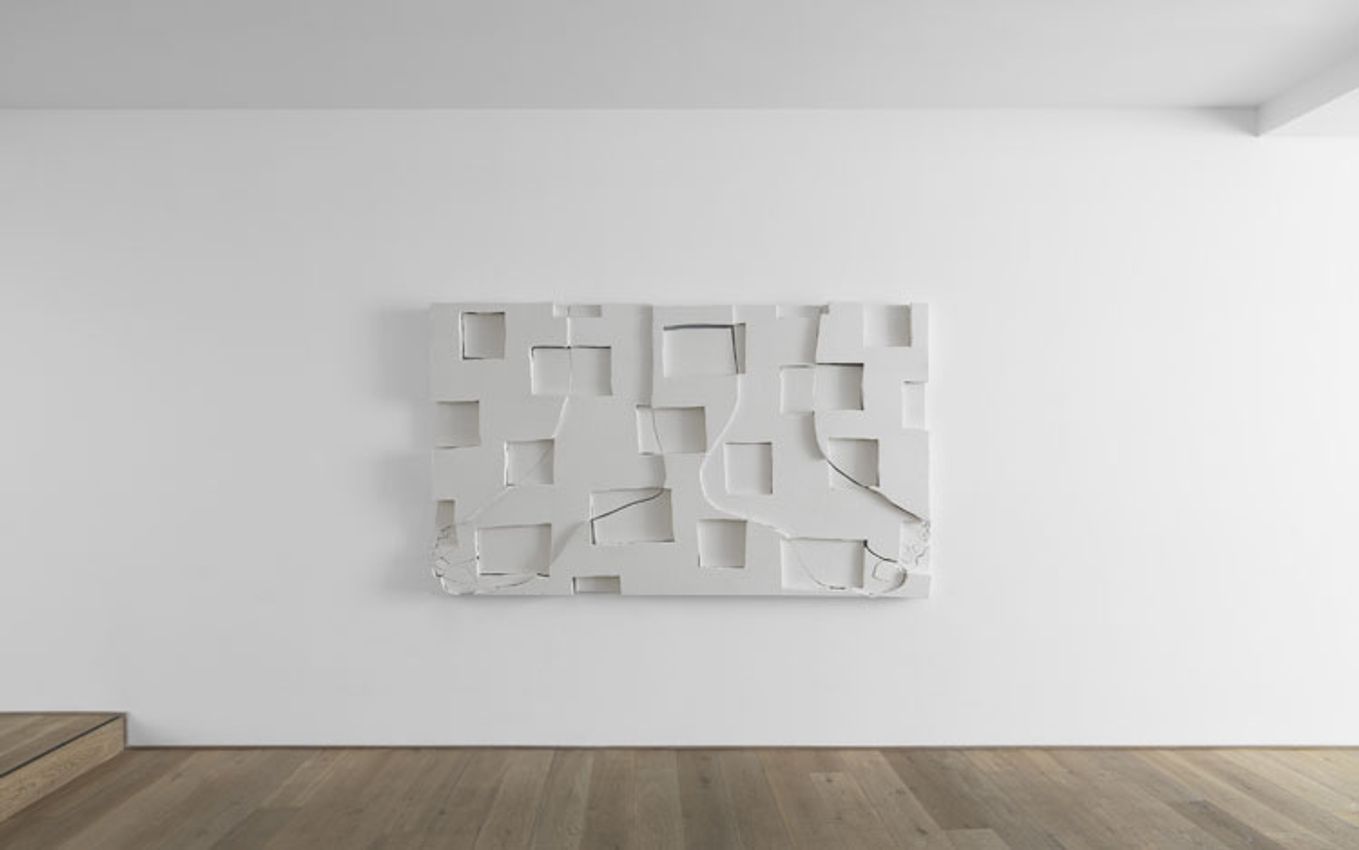
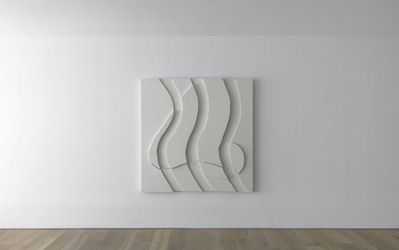
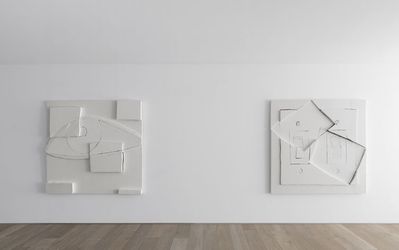
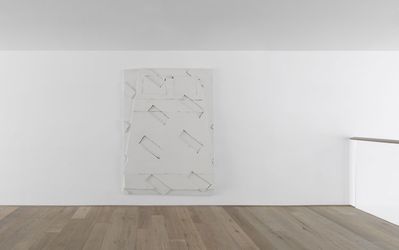
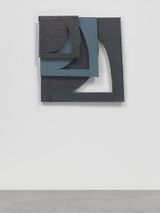
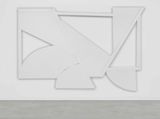
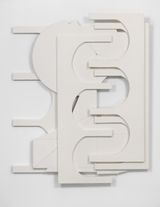
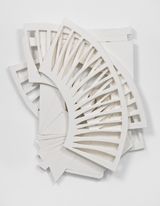
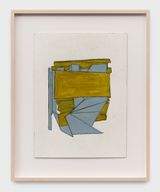
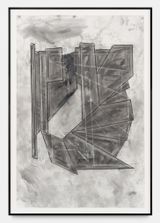
Wyatt Kahn is known for a striking body of work that investigates the boundaries between painting, sculpture and drawing. Comprised of unprimed layers of linen stretched across wooden frames, Kahn assembles complex wall-mounted works in which the gaps between the individual panels form abstract or pictorial compositions. An initial way of approaching his oeuvre is to consider the way in which it is created: each new series typically begins with sketches in pencil and pen, which are slowly refined into definitive drawings. These are transferred onto wood and cut apart. Kahn then stretches two layers of linen or canvas over the panels, typically the same heavyweight material that would be used for stretching paintings.

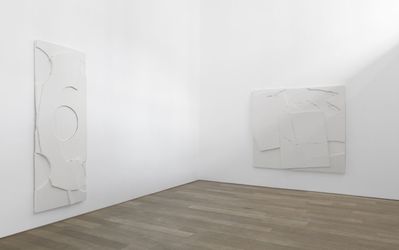
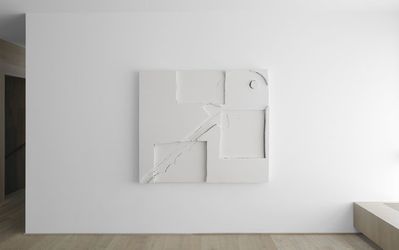
While Kahn’s constructions might resemble paintings, and are made of similar materials, they are completely devoid of paint. Rather, they are three-dimensional, semi-sculptural objects in which negative space (the gaps between the panels) not only establishes structure and depth, but also line. In this sense, the works are akin to spatial drawings or, in other words, they are the three-dimensional iterations of two-dimensional, linear compositions. Dispensing with the arbitrary constraint of the rectangle, Kahn allows the formations to extend across the wall-space, sometimes leaving voids that capture the architectural support within the piece. Speaking of this facet of his work, Kahn has said: ‘I see them as drawings, where the wall is the paper. The whole object is the drawing on the wall.’

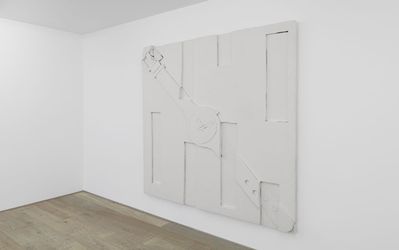
The artist’s oeuvre, which deals with both abstraction and representation, is based upon the history of the two central pillars of 20th-century American art: one being abstract and minimal painting and sculpture, the other being the use of imagery to express language, communication and humour. While previous series have explored one or other of these avenues individually, the artist’s most recent reliefs are an attempt to explore both simultaneously. At the same time, they can also be read as the materialization of far-reaching conceptual concerns – most notably the interdisciplinary tension that exists between sculpture, painting and drawing, as well as the dialogue between the ideas and ideologies surrounding the three traditional modes of artistic expression. Kahn is also interested in the idea of an undefined abstract space: an idea that he feels has emerged through the tension of architectural and pictorial space, and the emergence of a new form of space created in the advent of digital technology. Kahn has responded to this by creating reliefs that are possessed of a specific physicality, one that addresses the more recognisable space of the object, but also the new space of the abstraction. The objects depicted in this series are representative of the artist’s on-going exploration of certain subjects, such as figuration, and are recognisable from previous bodies of work. By consistently honing in on these concerns, the artist is developing a language that runs throughout, and connects, his entire oeuvre.

Kahn’s compositions are also on a human scale, both as a way of augmenting the viewer’s physical relationship to the object, and also of the artist to his work: nothing exceeds the limits of what can be created by the human hand. Thus the idea of craftsmanship, and the flaws inherent within hand-production, comes to the fore. Of this Kahn has said: ‘making a perfect work is not interesting to me, but human error is. You look for those moments, and when you find one it makes it all worth it. It adds another layer.’ It is this sense of ‘natural failure’ – the impossibility of achieving perfection within the handcrafted – which sets Kahn’s contemporary interpretation of minimalism apart from that of the 1960s and 1970s, which was predicated upon perfectionism. Kahn’s enigmatic and multilayered constructions repay careful contemplation – the more one looks, the more one sees. In the end, the conceptual and formal ambiguities inherent within the pieces, and their subtle surface imperfections, give way to a thought-provoking sense of unity.

Wyatt Kahn (b. 1983) lives and works in New York. Recent solo exhibitions include: Work, Performa 15 Biennial, Swedish Cottage Marionette Theatre, New York (2015); Wyatt Kahn: Object Paintings, Contemporary Art Museum, St. Louis, USA (2015) and Wyatt Kahn, LA><ART, Los Angeles (2014). Group shows include: Space Between, Curated by Louis Grachos and Stephanie Roach, FLAG Art Foundation, New York (2015); Abstract America Today, Saatchi Gallery, London (2014) and Never Enough: Recent Acquisitions of Contemporary Art, Dallas Museum of Art (2014).

Installation Views

About the Artist

Wyatt Kahn is primarily known for his investigations into the visual and spatial relationship between painting and sculpture. Using unprimed canvases stretched over wooden frames, Kahn assembles complex wall-mounted works in which the gaps between the individual canvases give rise to abstractor pictorial compositions. Rather than tracing the lines and shapes directly onto the canvas itself, he turns them into physical components of the artwork. Referencing the tradition of minimalist abstraction, Wyatt Kahn’s monochrome multi-panel ‘paintings’ are informed by a desire to explore non-illusory forms of representation. In essence, their subject becomes the interplay between two and three dimensions, as experienced via shifts in surface, structure and depth. In Kahn’s work, the wall upon which the work is hung becomes an integral part of the composition. Interested in a painting’s potential to function as the very embodiment of the object it depicts, Kahn has also developed works in which the shaped stretchers combine to create the form of an actual object, while a synthesis of hand-drawn motifs and words epitomize its essential qualities.

View Artist Profile

Also Exhibiting at Xavier Hufkens

About the Gallery
Xavier Hufkens is one of Europe’s leading galleries for contemporary art. Located in Brussels, the gallery maintains a diverse exhibition programme with solo exhibitions of the gallery artists as well as group exhibitions and special projects. The gallery deals in a distinctive combination of painting, drawing, sculpture, photography, video and installation-based work.

The origins of the gallery date back to 1987, when Xavier Hufkens opened a gallery space in an un-refurbished warehouse in the neighbourhood of the South Station (Midi) in Brussels. During the early years, the focus of the gallery was upon mid-career and emerging artists and the gallery is known for having introduced some of the most influential contemporary artists to Brussels at a time when they were still relatively unknown. British sculptor Antony Gormley, who is still affiliated with the gallery, Felix Gonzalez-Torres and Rosemarie Trockel all showed in Belgium for the first time with Xavier Hufkens (Gormley in 1987; Gonzalez-Torres in 1991 and Trockel in 1993).

In 1992, the gallery moved to a 19th-century townhouse at 6 rue Saint-Georges, close to the Avenue Louise. Completely renovated by Belgian architects Paul Robbrecht, Hilde Daem and Marie-José Van Hee, the house quickly gained a reputation for being not just one of the most beautiful contemporary art spaces in the Belgian capital, but also one of the most interesting. The expanded exhibition programme coincided with the additional representation of a number of established artists from Belgium and abroad, including Richard Artschwager, Thierry De Cordier and Jan Vercruysse. In 1997, Hufkens expanded the gallery further by annexing the adjacent building and a number of new artists joined the gallery, including Louise Bourgeois, Roni Horn and Thomas Houseago.

A second space in the same street, at 107 rue Saint-Georges, opened in spring 2013. Located in the Galerie Rivoli, a mixed-use commercial development from the 1970s, the new gallery space was designed by Swiss architect Harry Gugger, who was previously in partnership with Herzog and De Meuron. Slegten & Toegemann, Brussels, managed the project.

An eclectic but very clear vision underpins all of the gallery’s activities: ‘The definition of the gallery was established from the start. The common thread, then and now, is quality over and above everything else, which I find more intellectually challenging than a forced definition. From the early days I juxtaposed established artists such as Michelangelo Pistoletto with someone like Felix Gonzalez-Torres when he was totally unknown. Today I still mix my work: I have no problem showing Malcolm Morley … alongside Robert Ryman, or Willem de Kooning.’ [Xavier Hufkens in The Art Newspaper, Issue 220, January 2011, published online: 20 January 2011]

Xavier Hufkens represents some thirty artists from different generations. He was part of the six-member selection committee for Art Basel during seven years and also participates in up to five international Arts Fairs annually. The gallery has partnerships with the estates of Louise Bourgeois, Willem de Kooning, Robert Mapplethorpe and Alice Neel.
View Gallery Profile
Address
107 rue St-Georges
St-Jorisstraat
Brussels
Belgium
Opening Hours
Tuesday – Saturday
11am – 6pm
(1)
Brussels 107 rue St-Georges
Xavier Hufkens
107 rue St-Georges, St-Jorisstraat, Brussels, Belgium

Opening hours
Tuesday – Saturday
11am – 6pm
The art world in focus
