




ALICE ADAMS
b. 1930, United StatesAlice Adams is a pioneering American artist whose practice has redefined the possibilities of sculpture, fibre art, and public art over seven decades. Renowned for her innovative use of materials and architectural forms, Adams was a key figure in the American fibre art movement and a trailblazer in site-specific land art with major public art commissions across the United States.
Adam work, celebrated in landmark institutional exhibitions, like Abstract Erotic at The Courtauld Gallery in London in 2025, stands out for its ability to transform familiar materials into spaces that invite new ways of seeing and experiencing the built environment.
Early Years
Born in New York City in 1930 and raised in Jamaica, Queens, Alice Adams graduated with a BFA in painting from Columbia University in 1953. She then studied tapestry weaving and design at the École nationale d’art décoratif d’Aubusson in France, supported by a Fulbright grant. After returning to New York, Adams began to move beyond traditional tapestry, experimenting with the reverse side of weavings and incorporating rope, sisal, and found objects. She was part of a generation of artists—including Lenore Tawney and Sheila Hicks—who brought weaving into three-dimensional space and helped define American fibre art.
Alice Adams Artworks
Alice Adams’s contemporary art practice is defined by her continual exploration of the relationship between sculpture, architecture, and environment. Her early woven forms evolved into large-scale sculptures and site-specific installations, often using industrial and construction materials.
Fibre Art and Tapestry Innovations (1950s–1960s)
Adams’s early tapestries broke with tradition by using the reverse side as the primary surface and adding unconventional materials. Her work was included in the influential exhibition Woven Forms at the Museum of Contemporary Crafts in 1963. By the mid-1960s, Adams was creating three-dimensional ‘structures’ that combined weaving with industrial materials, and her use of tarred rope, chain link, and steel cable anticipated later developments in sculpture. In 1966, Lucy Lippard included Adams in the seminal exhibition Eccentric Abstraction at Fischbach Gallery, alongside Louise Bourgeois and Eva Hesse.
Architectural Sculpture and Urban Space (late 1960s–1970s)
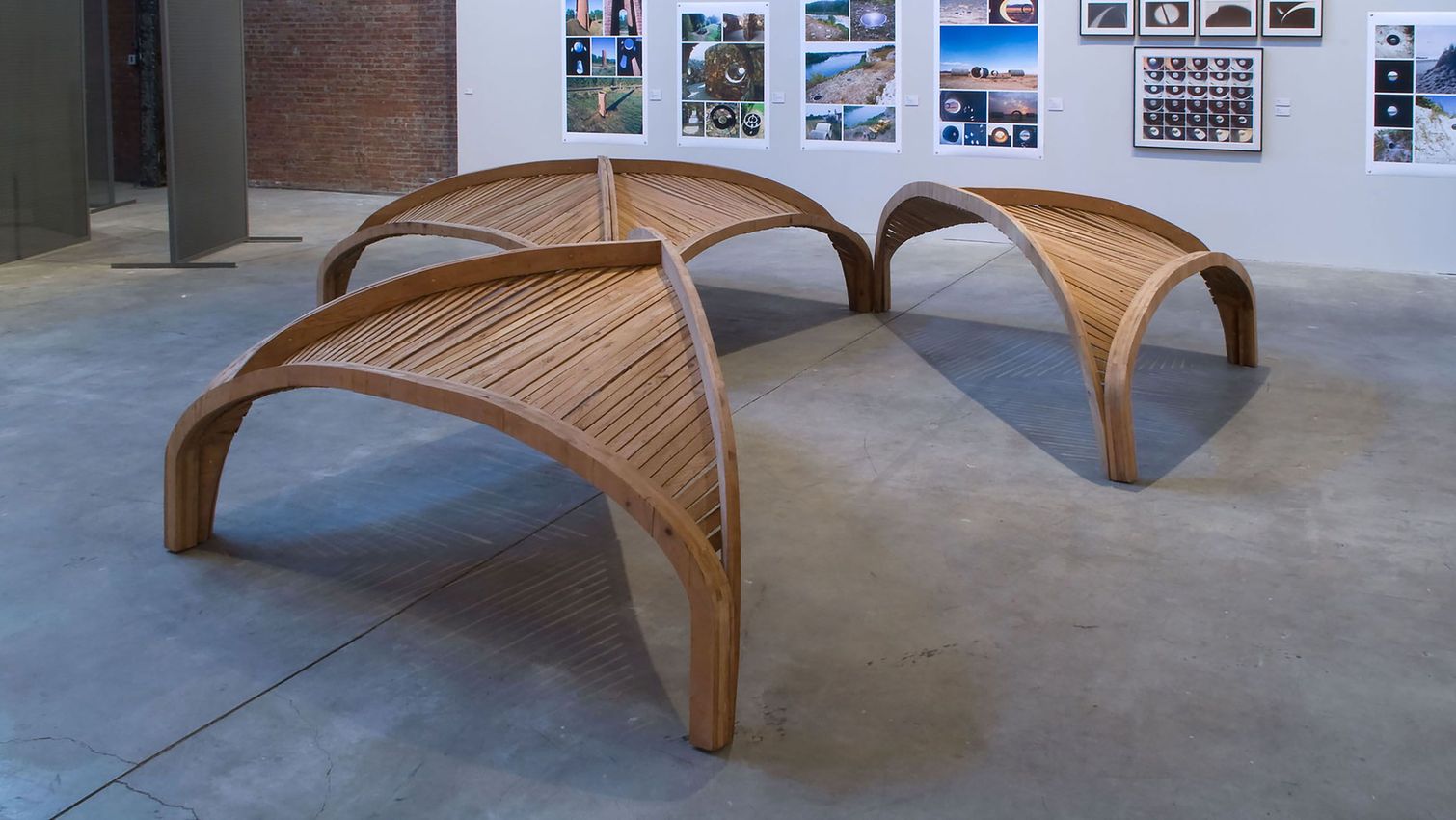
From the late 1960s, Adams’s sculptures explored architectural elements—walls, corners, columns, vaults—using materials like latex, wood lath, and plaster. Works such as Wall and Floor (1967) and Large Vault (1975) examine the boundaries between art, architecture, and environment, often referencing the cycles of construction and demolition in New York City. Her site-specific earthworks, including Shorings (1978, Artpark) and Mound for Viewing Slope and Sky (1981, Princeton University), used heavy equipment and earth to create sculptural interventions in the landscape.
Public Art and Major Commissions (1980s–present)
Since the 1980s, Adams has focused on permanent public art projects for transit systems, airports, campuses, and urban spaces across the United States. Notable works include Small Park with Arches (Toledo Botanical Garden, 1984), The Roundabout (Philadelphia), Scroll Circle (University of Delaware), Beaded Circle Crossing (Denver International Airport), and Stone and Glass Gardens (Fort Lauderdale/Hollywood International Airport). These projects often incorporate wood, stone, metal, water, and plantings, transforming public spaces into sites for gathering and contemplation.
Select Public Commissions
- Small Park with Arches, Toledo Botanical Garden (1984)
- The Roundabout, Center City Philadelphia
- Scroll Circle, University of Delaware
- Beaded Circle Crossing, Denver International Airport
- Stone and Glass Gardens, Fort Lauderdale/Hollywood International Airport
Select Awards and Accolades
- Guggenheim Fellowship
- National Academy of Arts and Letters Award in Sculpture
- Fulbright Grant for study in France
Exhibitions
Alice Adams has been the subject of both solo and group exhibitions at important galleries and institutions. Below is a selection of important exhibitions.
Solo Exhibitions
- Large Vault, Zürcher Gallery, New York (2024)
- White Coat, National Academy of Design, New York (2024)
Group Exhibitions
- Abstract Erotic: Louise Bourgeois, Eva Hesse, Alice Adams, The Courtauld Gallery, London (2025)
- Making Knowing: Craft in Art, 1950–2019, Whitney Museum of American Art, New York (2019–2021)
- Materializing Six Years: Lucy Lippard and the Emergence of Conceptual Art, Brooklyn Museum, New York (2012)
- Decoys, Complexes and Triggers: Feminism and Land Art in the 1970s, Sculpture Center, New York (2008)
Alice Adams FAQs
Where can I see Alice Adams’s art?
Alice Adams’s public artworks can be seen at the Toledo Botanical Garden, Denver International Airport, Fort Lauderdale/Hollywood International Airport, University of Delaware, and Center City Philadelphia. Her sculptures have also been exhibited at major institutions such as the Whitney Museum of American Art and The Courtauld Gallery.
What is Alice Adams best known for?
Alice Adams is best known for her innovative fibre art, architectural sculptures, and large-scale public art commissions that transform urban and public spaces throughout the United States.
What materials does Alice Adams use in her artworks?
Her work spans traditional tapestry, rope, sisal, chain link, latex, wood, stone, metal, water, and plantings, often combining industrial and natural elements to create immersive environments.
What awards has Alice Adams received?
Alice Adams has received a Guggenheim Fellowship, the National Academy of Arts and Letters Award in Sculpture, and a Fulbright Grant for study in France.
Are there any interesting facts about Alice Adams?
Adams was among the first artists to move weaving into three dimensions and to use industrial materials in sculpture. She was one of only three women included in Lucy Lippard’s influential Eccentric Abstraction exhibition in 1966.
Ocula | 2025

Explore and Follow Artists Shaping Contemporary Art
A respected voice in contemporary art discourse.
Focusing on ambitious storytelling and insightful art-world commentary. Ocula Magazine publishes in-depth interviews, critical essays and timely analysis on the artists, exhibitions and ideas driving the global art world.
Learn more about Ocula Magazine
Showcasing the best of the art world.
Ocula partners with galleries from around the world to highlight their artists, artworks and exhibitions. Gallery membership is by application and invitation, with each member vetted by an independent panel.
Learn more about Ocula Membership
Specialises in the sale of major artworks.
Led by a team with deep ties to the world’s leading auction houses, galleries and collectors. Ocula’s advisory team offers bespoke services to high-net-worth clients from around the world who are looking to acquire the best of contemporary and modern art.
Learn more about our team and services