





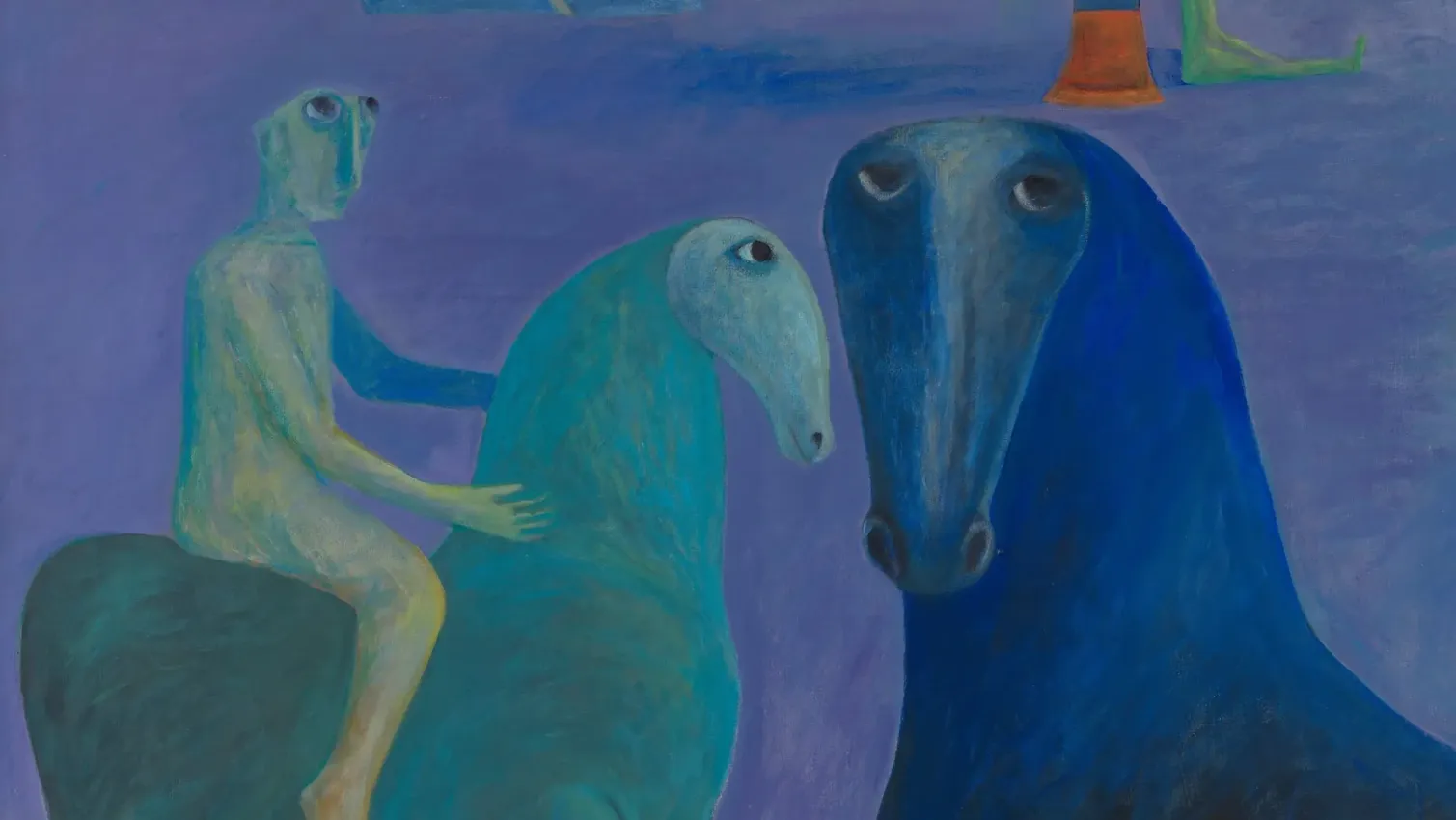
AHMED MORSI
b. 1930, EgyptAhmed Morsi is an Egyptian artist, poet, and critic whose Surrealist paintings weave together dreamlike imagery and Arabic poetry—his work Deux Pêcheurs (Two Fishermen) was featured at Sotheby’s Origins II auction in Diriyah in January 2026, part of a landmark sale that saw Saudi artist Safeya Binzagr set a new auction record of $2.06 million.
Early Years
Morsi was born in Alexandria, Egypt, on 9 March 1930 to Saida Darwish and Mahmoud Morsi ‘Abdel ‘As, a contractor. He grew up channelling the lively arts scene of his coastal home city into his visual and literary practice.
Morsi briefly attended the Italian-run Bicchi Studio for studies of the human form but was largely self-taught. He published his first collection of poems, Songs of the Temples/Steps in Darkness, in 1949 at the age of 19. He graduated from the University of Alexandria’s Faculty of Arts with a degree in English Literature in 1954.
From 1955 to 1957, Morsi lived in Baghdad, where he forged friendships with Iraqi writers and painters including Abdel Wahab Al-Bayati and Fuad Al-Takarli, and began writing art criticism. Returning to Egypt, he became the first Egyptian to design stage sets and costumes for The National Theater and Cairo Opera House, collaborating with playwrights Alfred Farag and Abdel Rahman Al-Sharkawi. In 1974, Morsi relocated to New York City, where he continues to paint, write, and pursue printmaking and photography.
Ahmed Morsi Artworks
Ahmed Morsi creates Surrealist paintings filled with talismanic symbols, folkloric figures, and dreamlike imagery that explore themes of existence, isolation, memory, and the subconscious, bridging visual art and symbolic poetry in what scholars describe as contemporary Egyptian Surrealism.
Early Works (1950s)
Morsi’s canvases from the 1950s evoke religious mysticism found in the popular neighbourhoods of Egypt’s cities. Bold outlines reflect his close collaboration with ‘Abdel Hadi al-Gazzar, a pioneer of the ‘Folk Realist’ style in 1940s Egypt. His 1952 Self-Portrait with Cello demonstrates his early engagement with modernist influences from Picasso, Brancusi, de Chirico, and Giacometti.
Glyptic Heads (1960s)
During the 1960s, Morsi developed distinctive glyptic heads that skirt the edges of anthropomorphic representation. Works such as Untitled (Bull) (1968) bear witness to his life-long engagement with symbolism and Surrealist practice.
New York Period (1974–Present)
After relocating to New York, Morsi’s paintings became populated by recurring figures: fish out of water, androgynous subjects, mythological horses, human-size clocks, and images within images. His universal maritime scenes represent multiple seas and feelings of placelessness, reflecting the loss of an Alexandria that once was.
‘Waiting for Godot’ (2012)
This painting exemplifies themes of exile and alienation that art historian Hala Halim identifies in Morsi’s work. The canvas demonstrates his continued experimentation with Surrealist imagery including headless bodies, seashores, naked breasts, and horses.
Deux Pêcheurs (Two Fishermen)
This work was featured at Sotheby’s Origins II auction in Diriyah, Saudi Arabia, in January 2026.
Literary Works
Morsi authored the first Arabic monograph on Picasso in 1969 and translated the Surrealist writings of Paul Éluard and Louis Aragon into Arabic. His poetry has been described by critics as al-she’ar al-ramzy (symbolic poetry), hovering between the edges of perception and reality.
Select Awards and Accolades
- Member of Jury Committee, 6th International Biennale of Cairo (1996)
- Featured in major institutional exhibitions including ICA Miami, Salon 94 New York, and the Metropolitan Museum of Art
Ahmed Morsi’s 2026 Auction Record
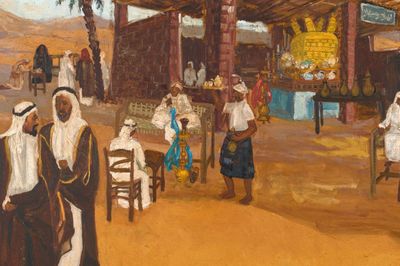
Ahmed Morsi achieved a new auction record on 31 January 2026 when his 1954 oil painting Deux Pêcheurs (Two Fishermen) sold for $190,500 at Sotheby’s Origins II auction in Diriyah, Saudi Arabia—more than one and a half times its low estimate of $120,000. The sale represented a 250% increase over his previous auction record of $53,600, set by Self-Portrait with Cello (1952) at Bonhams London in April 2018. The work, which had been in a private collection in Dubai since 2005, reflects Morsi’s early engagement with symbolism, the human figure, and the sea—subjects that have remained central to his practice for over seven decades. The record-setting result came as part of an auction that also saw Saudi artist Safeya Binzagr’s Coffee Shop in Madina Road achieve $2.06 million, establishing a new record for a Saudi artist. Other artists whose works achieved notable results included Ali Banisader and Mohammed Al Saleem.
Ahmed Morsi Exhibitions
Ahmed Morsi has been the subject of both solo exhibitions and group exhibitions at important institutions and galleries. Below is a selection of important exhibitions.
To be kept up to date with upcoming exhibitions featuring Ahmed Morsi, follow him on Ocula.
Select Solo Exhibitions
- Detail From a Mural, Salon 94, New York (2021)
- Ahmed Morsi in New York: Elegy of the Sea, ICA Miami (2024)
- Metaphysics, Gallery Misr, Cairo (2012)
- Akhnatoun Gallery, Center of Fine Arts, Cairo (2003, 2005)
- Alexandria Museum of Fine Arts, Alexandria (1958, 1960, 1961)
- Cairo Atelier, Cairo (1959, 1966, 1969, 1970)
Select Group Exhibitions
- Origins II, Sotheby’s, Diriyah, Saudi Arabia (2026)
- Foreigners Everywhere : Stranieri Ovunque curated by Adriano Pedrosa , 60th Biennale Di Venezia - Venice, Italy (2024)
- Surrealism Beyond Borders, Metropolitan Museum of Art, New York / Tate Modern, London
- 6th International Biennale of Cairo (1996)
- El Wasti International Exhibition, Baghdad (1971)
- First Egyptian Salon, Amir Taz Palace, Cairo (2007)
Website
Ahmed Morsi’s website can be found at ahmedmorsi.com.
Ahmed Morsi FAQs
Who is Ahmed Morsi?
Ahmed Morsi is an Egyptian artist, poet, and critic born in Alexandria in 1930, widely regarded as a leading figure of contemporary Egyptian Surrealism. His paintings combine dreamlike imagery with symbolic poetry, while his literary work includes translations of French Surrealist writings and the first Arabic monograph on Picasso.
Where can I see work by Ahmed Morsi?
Ahmed Morsi’s artworks can be viewed at institutions including the Museum of Modern Art (MoMA) in New York and the Barjeel Art Foundation in Sharjah. His works have been exhibited at ICA Miami, Salon 94 in New York, and the Metropolitan Museum of Art.
Where does Ahmed Morsi live?
Ahmed Morsi has lived in New York City since 1974, where he continues to paint, write, and pursue printmaking and photography. He previously lived in Alexandria and Cairo, Egypt, and spent two years in Baghdad, Iraq.
How is Ahmed Morsi’s name pronounced?
Ahmed Morsi’s name is pronounced ‘AH-med MOR-see’, with emphasis on the first syllable of ‘Ahmed’ and the first syllable of ‘Morsi’.
Where can I buy Ahmed Morsi work?
Ahmed Morsi is represented by Salon 94 in New York. His works appear at international auction houses including Sotheby’s, Christie’s, and Bonhams. You can explore sites like Ocula to find galleries that represent the artist and enquire directly about buying art by Ahmed Morsi.
What is Ahmed Morsi’s artistic style?
Ahmed Morsi’s style is described as contemporary Egyptian Surrealism, combining painting and Arabic poetry to address universal themes of existence, isolation, dreams, and the subconscious. His canvases feature talismanic symbols, folkloric figures, maritime scenes, and dreamlike objects influenced by modernist masters including Picasso, de Chirico, and Giacometti.
What is Ahmed Morsi known for besides painting?
Ahmed Morsi is also celebrated as a poet and art critic. He published his first poetry collection at age 19, authored the first Arabic monograph on Picasso, translated French Surrealist writings into Arabic, and designed stage sets for The National Theater and Cairo Opera House.
Ocula | 2026



Explore and Follow Artists Shaping Contemporary Art
A respected voice in contemporary art discourse.
Focusing on ambitious storytelling and insightful art-world commentary. Ocula Magazine publishes in-depth interviews, critical essays and timely analysis on the artists, exhibitions and ideas driving the global art world.
Learn more about Ocula Magazine
Showcasing the best of the art world.
Ocula partners with galleries from around the world to highlight their artists, artworks and exhibitions. Gallery membership is by application and invitation, with each member vetted by an independent panel.
Learn more about Ocula Membership
Specialises in the sale of major artworks.
Led by a team with deep ties to the world’s leading auction houses, galleries and collectors. Ocula’s advisory team offers bespoke services to high-net-worth clients from around the world who are looking to acquire the best of contemporary and modern art.
Learn more about our team and services