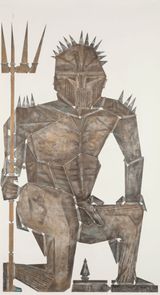
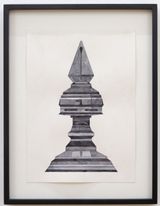
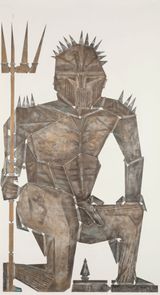
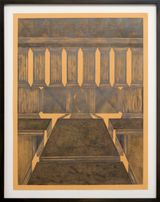
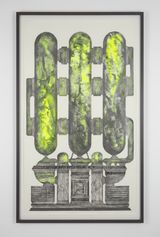
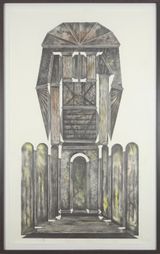
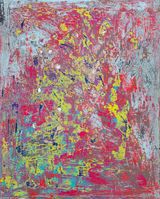
Once describing himself as a ‘Romantic of the new millennium,’ Andreas Werner’s practice is heavily rooted in an emphasis on emotion and utopian landscapes that both refer to and float above the real world.
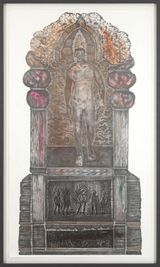
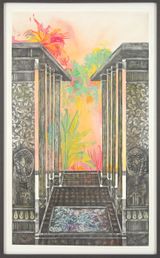
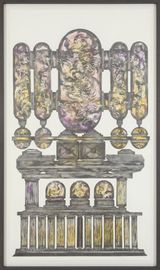
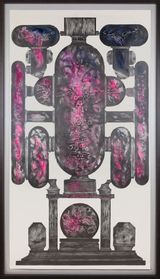
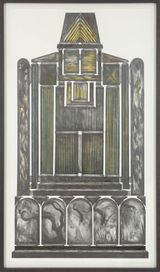
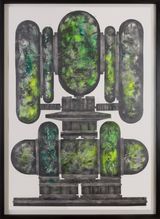
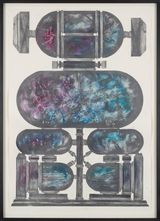
Veering between abstraction and realism, his landscapes and obelisks incorporate the visual style of Fritz Lang’s film Metropolis (1927) with graphically rendered geographical strata and ancient temples from worlds untouched by humankind.
‘Iceberg, Landscape and Vastness’
Directly after encountering Friedrich’s The Sea of Ice, Werner reinterpreted the painting in the form of a series of small-scale graphic works called ‘Iceberg, Landscape and Vastness’ (2011—2012). This became the title for his diploma exhibition at the Academy of Fine Arts Vienna in 2012, where the works were displayed on the wall in sporadic configurations, forming ‘narrative strands of association.’
Some works depict the iceberg purely as a silhouette that descends far below water level, others as precisely hatched line drawings. Yin Yang (2011) shows two icebergs—white above the surface and black below—the emphasis on the long stretch of ocean provided by dotted paper allowing the eye to sink down into ‘contemplation.’
Geology and Abstraction
Moving away from the purely representational, Werner created the series ‘some roads to somewhere’ for Galerie Hilger Brotkunsthalle Wien in 2013.
These small-scale collages and drawings visualise the geological dimension of nature, which is another key fascination for the artist. In works like geology II (2013), Werner hand-replicated layers of seismographic trace lines in an almost mechanical manner, evenly spaced and sloping upwards, so that the combined effect creates what could be striations in a rocky outcrop.
‘WE DREAMED OF A PAST FUTURE’
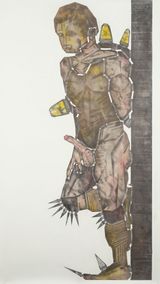
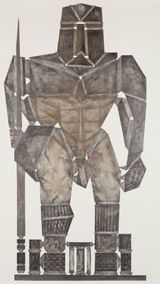
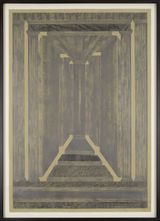
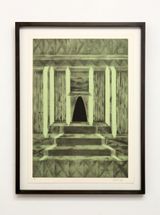
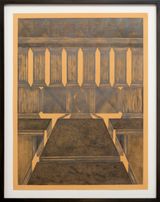
In 2019, Werner created the series ‘WE DREAMED OF A PAST FUTURE’, which turned away from earthly landscape to fictional worlds inspired by the work of Polish writer Stanisław Lem.
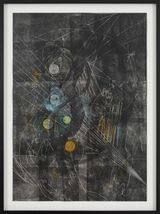
During his residency at the Nida Art Colony in Lithuania, Werner was inspired by Lem’s The Star Diaries (1957) and the protagonist’s journey to other worlds. The monochromatic pencil drawings he produced were heavily inspired by Constructivist architecture, far less graphic and more heavy and expressionistic than his earlier works.