





DADAMAINO
1930-2004, ItalyEduarda Emilia Maino was born on October 2, 1935 in Milan. A self-taught painter Dada (diminutive for Eduarda) took up art after completing a medical degree. In 1957 she met Piero Manzoni who became a life-long friend. The following year she adhered to the Milanese avant-garde and created her first substantial body of work, the Volumi, punctured canvases which bear a strong resemblance to Fontana’s Buchi. This same year Dada had her first solo show at the Galleria dei Bossi in Milan.
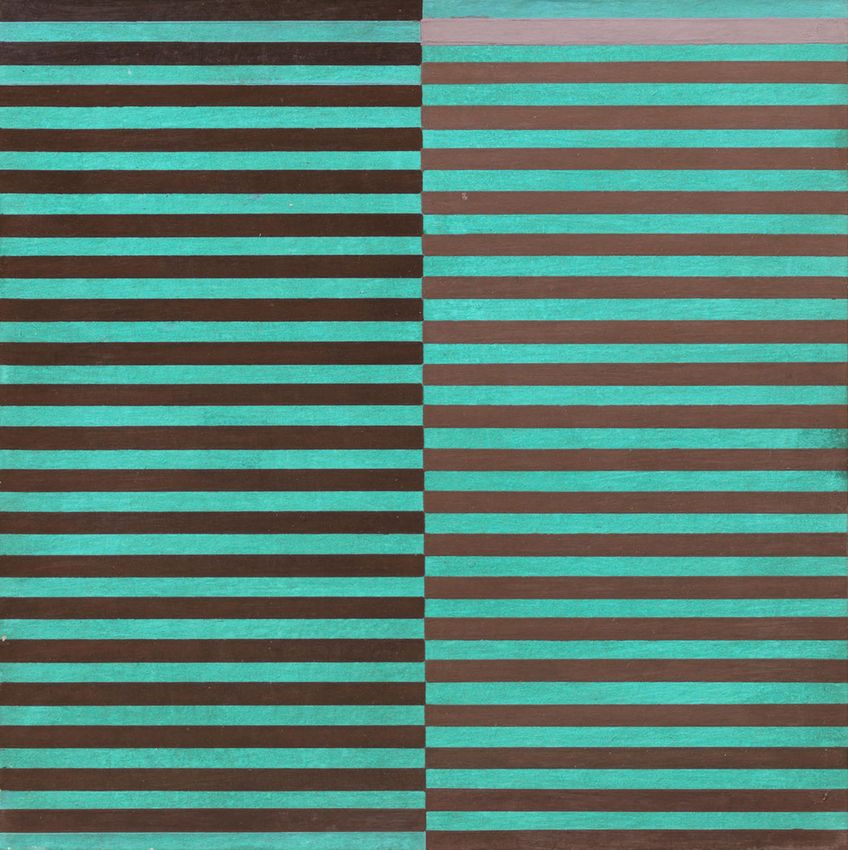
In 1959 she joined the Milan-based experimental group Azimuth (founded by Bonalumi, Castellani and Manzoni) which had connections with Group Zero in Germany, Group Nul in the Netherlands, and Group Motus in France. In 1961 the artist took part in a show in the Netherlands, where her name was mistakenly spelt as one word, Dadamaino. From 1963-64 onwards she would adopt this name. In 1962 her work was featured in the major Nul group exhibition at the Stedelijk Museum in Amsterdam. This same year she joined the newly founded Nouvelle Tendence movement whose members included Getulio Alviani, Bruno Munari, Raphael Soto and Enzo Mari. In the first half of the decade, particularly fascinated with the idea of movement she created a series of optical-dynamic objects, these were followed by the Ricerca del colore (1966-68) in which she undertook a scrupulous analysis of the solar spectrum’s chromatic combinations.
In the 1970s Dadamaino’s work took on a different direction as she developed a set of invented signs. Notable among these is L’Alfabeto della mente, a series of seven alphabet-like signs. Dadamaino filled her compositions which resembled written letters by selecting one sign at the time and repeating it endlessly. She resorted to the same set of signs in her following cycle, I fatti della vita, which she showed in a solo room at the Venice Biennale in 1980.Three years later a large retrospective of her work was organized by the Padiglione d’Arte Contemporanea (PAC) in Milan, and in 1990 she participated again in the Venice Biennale. A full retrospective of her work was mounted in 2000 by the Bochum museum in Bochum. Dadamaino died on April 13, 2000 in Milan.
Source: www.guggenheim-venice.it





Explore and Follow Artists Shaping Contemporary Art
A respected voice in contemporary art discourse.
Focusing on ambitious storytelling and insightful art-world commentary. Ocula Magazine publishes in-depth interviews, critical essays and timely analysis on the artists, exhibitions and ideas driving the global art world.
Learn more about Ocula Magazine
Showcasing the best of the art world.
Ocula partners with galleries from around the world to highlight their artists, artworks and exhibitions. Gallery membership is by application and invitation, with each member vetted by an independent panel.
Learn more about Ocula Membership
Specialises in the sale of major artworks.
Led by a team with deep ties to the world’s leading auction houses, galleries and collectors. Ocula’s advisory team offers bespoke services to high-net-worth clients from around the world who are looking to acquire the best of contemporary and modern art.
Learn more about our team and services