The art world in focus
Subscribe to our newsletter for news and insights on artists, galleries and exhibitions.

Hong Kong Museum of Art was one of 15 government-run museums that together reported a drop in income and a rise in expenditure. Photo: ruelleruelle.
Hong Kong’s 15 government-run museums have reported a deficit of more than $500 million HKD (£47.44 million) in the year 2025–2026, according to figures released recently by the Leisure and Cultural Services Department (LCSD), renewing debate over how the city’s public museums should be funded and operated.
Institutions including the Hong Kong Heritage Museum, Hong Kong Museum of Art and Hong Kong Science Museum generated a total of $30 million HKD (£2.85 million) in income against recurrent expenditure of $542.8 million HKD (£51.5 million), creating a shortfall of $512.8 million HKD (£48.66 million) for the year.
Chan Pui-leung, a member of Hong Kong’s Legislative Council who has been vocal on issues relating to museum funding, told Ocula: “The widening gap between income and expenditure of museums under the LCSD is related to the long-term non-adjustment of ticket prices, uneven development of audiences and lack of market thinking.”
This gap widened during the past 12 months, with income falling by just over 12 percent and expenditure rising by just over 10 percent compared with the previous year. In the same period, attendance also declined across the 15 institutions, falling from 6.69 million to 5.9 million.
Permanent exhibitions at most LCSD museums have been free since 2016, an arrangement the department said follows the general practice of public museums in mainland China, and which was introduced following a trial that received considerable public support. Only the Hong Kong Science Museum and Hong Kong Space Museum retain modest permanent-exhibition charges to meet operational needs.
Lawmakers, however, have criticised this approach. Chan explained: “In my opinion, the government should review and adjust the fees and charges [for tickets] in a timely manner, but the adjustments should be made in a gradual and orderly manner to take into account the affordability of the public.”
Chan has also questioned whether museums could draw more extensively on commercial and private support to combat rising costs and address falling self-generated income. In a recent question to Hong Kong’s Legislative Council, he addressed the country’s secretary for culture, sports and tourism Rosanna Law, and emphasised that museums should “proactively expand diversified revenue channels”.
He told Ocula: “Museums at home and abroad are constantly innovating and developing fee-based items such as theme guided tours, [brand collaborations], immersive experiences and venue rental to increase museum revenue. However, museums under the LCSD lack market thinking, which makes it impossible to turn popularity into wealth.”
LCSD did not respond to Ocula’s questions regarding the financing of its museums. However, responding to Chan’s recent questions, Law noted that the organisation’s museums are “not operated primarily for profit”.
She said: “Museums play a vital role in cultural inheritance and social education. The government continuously reviews the development and future plans of the 15 museums under the Leisure and Cultural Services Department, in order to meet the general public’s need for museums and art appreciation.”
In 2025 the LCSD did announce the introduction of market-based business models at its museums, proposing measures including leasing museums for commercial or private use on days when they are closed to the public and making more spaces available for private hire.
In his recent question to the council, Chan requested further information on the “latest progress, costs involved and expected economic gains” of introducing these commercial approaches.
In response, Law confirmed that, after receiving 14 expressions of interest from event planners, advertising firms, property developers and other organisations keen to make use of museum spaces, the LCSD expanded the number of venues involved in the programme. In April, the department invited tenders for 26 of its institutions, including the Hong Kong Museum of Art and the Hong Kong Science Museum.
Law explained: “Crossover products previously launched through collaborations between the LCSD museums and commercial brands include phone cases, food products and brick sets. Looking forward, the LCSD will continue to explore more collaborative initiatives under market-based business models.”
The secretary for culture, sports and tourism did not provide any figures for revenue or costs expected to be generated or incurred through these partnerships, but said that, once implemented, the LCSD will “continuously assess” their economic benefits.
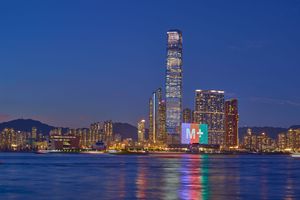
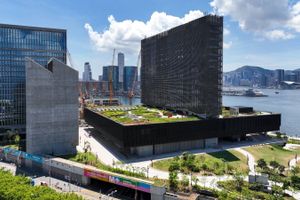
Other major Hong Kong cultural institutions already operate under different funding arrangements to those overseen by the LCSD, including M+ and the Hong Kong Palace Museum. Both spaces charge admission, alongside membership schemes and generate income through retail, dining, venue hire and private support, while remaining dependent on public investment and donations.
Despite this, the two institutions, both overseen by the non-governmental West Kowloon Cultural District Authority (WKCD), generated a combined income of $484.88 million HKD (£45.97 million) against expenditure of $951.08 million HKD (£90.18 million) in 2025–2026, according to newly released government data. Between the organisations, this equates to a deficit of more than $466 million HKD (£44.19 million).
Unlike LCSD-run museums, WKCD spaces include the costs of staff, research, programming and marketing in their expenditure figures.
At M+ and Hong Kong Palace Museum in 2025—2026, seven senior executives received a combined $20.9 million HKD (£1.98 million) in remuneration, including salaries, employer pension contributions and provisions for contract gratuities. Of this, $11.4 million HKD (£1.08 million) went to four M+ executives and $9.4 million HKD (£891, 510) to three executives at the Palace Museum.
Representatives of WKCD, M+ and Hong Kong Palace Museum did not respond to Ocula’s requests for comment.
Despite the focus on commercial activity across Hong Kong’s museums, international experience offers only limited support for the idea that such approaches can close large funding gaps without considerable government funding.
In Britain, 15 museums and galleries sponsored by the Department for Culture, Media and Sport, where permanent collections generally remain free to visit, received £484 million in government grants in 2024–2025, equal to 46 percent of their combined income, despite also earning money from exhibitions, events, fundraising and retail.
Singapore’s National Gallery also operates a more diversified model, drawing non-government income from admissions, philanthropy, retail leasing and investments. It nevertheless received S$50.4 million SGD (£29.02 million) in operating and rental support from the government in 2023–2024, equivalent to around 58 per cent of its $87.3 million SGD (£50.2 million) expenditure.
Chan commented that museum models varied across jurisdictions and that Hong Kong should learn from overseas experience without adopting it wholesale. “More importantly, it is necessary to formulate its own financial planning and operational objectives according to the actual situation of Hong Kong and the positioning of museums.”
A respected voice in contemporary art discourse.
Focusing on ambitious storytelling and insightful art-world commentary. Ocula Magazine publishes in-depth interviews, critical essays and timely analysis on the artists, exhibitions and ideas driving the global art world.
Learn more about Ocula Magazine
Showcasing the best of the art world.
Ocula partners with galleries from around the world to highlight their artists, artworks and exhibitions. Gallery membership is by application and invitation, with each member vetted by an independent panel.
Learn more about Ocula Membership
Specialises in the sale of major artworks.
Led by a team with deep ties to the world’s leading auction houses, galleries and collectors. Ocula’s advisory team offers bespoke services to high-net-worth clients from around the world who are looking to acquire the best of contemporary and modern art.
Learn more about our team and services