





DAVID HARRISON
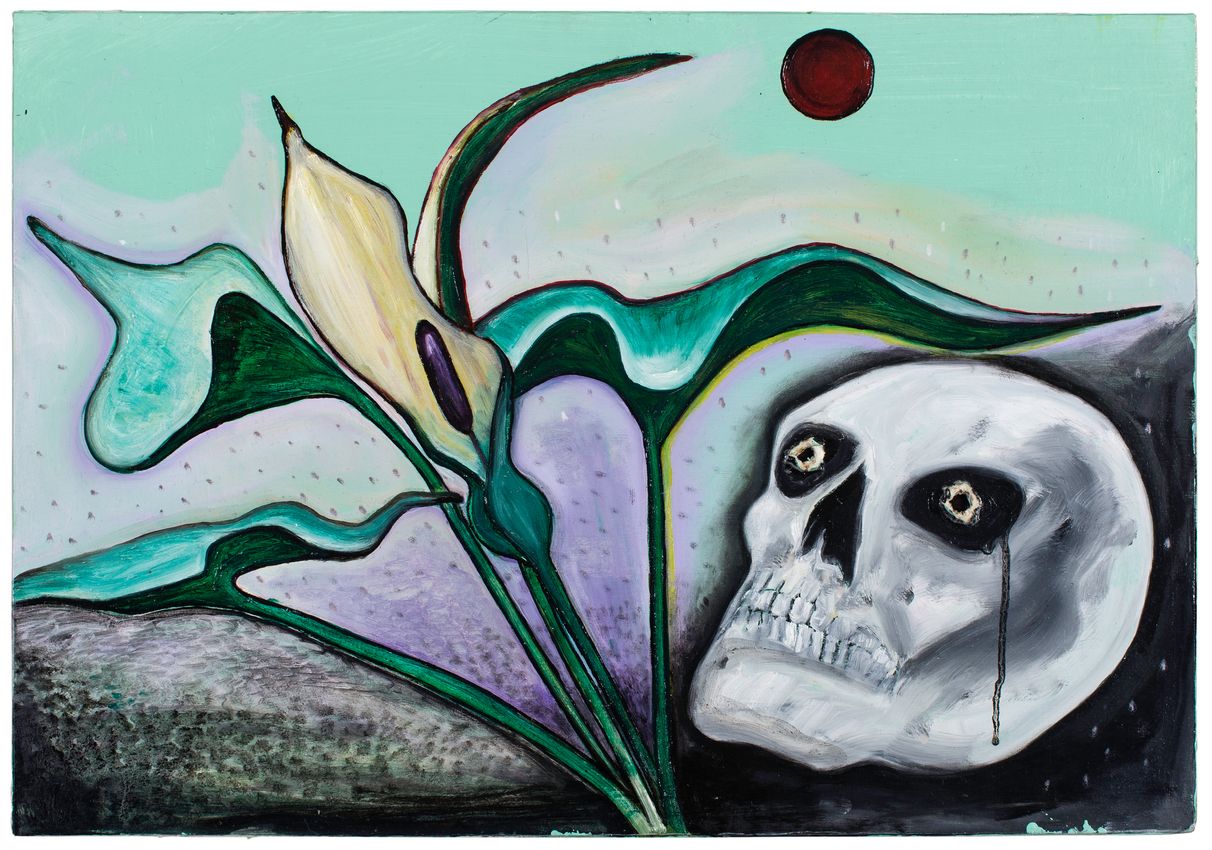
b. 1954, United KingdomTeetering on the cusp of ordinary perception, David Harrison’s paintings, drawings and sculptures present a world where the natural and supernatural go hand in hand. Harrison’s works expand the languages of contemporary painting and sculpture, drawing into play parts of the culture which are forgotten, buried, discarded or disregarded. The artist employs all that has lain outside of the mainstream of modern art–age-old symbols and fanciful myth, irrational beliefs, traditional genres like landscape, exuberant sexuality, barbed wit, and wonder at the natural world – in order to speak vividly about our own time, and to revivify the disciplines of painting and sculpture.
Harrison’s paintings give shape to a complete imaginative universe akin to those of earlier Romantic visionaries, ripe with references to the natural world and populated by a cast of animals and figures drawn from myths, legends, modern-day politics and from his own biography alike. They have featured a cast of potent female characters–including Foxglove, Belladonna and Wolfsbane fairies – that find echoes in the fairy painting of John Anster Fitzgerald and others of the Victorian era, whose scenes of fabulous revelry unfolding on the edge of social consciousness married a gothic interest in otherworldliness with an impulse to cleanse the doors of perception.
Such characters might seem to exist at the outer reaches of our ordinary sensory thresholds, as though momentarily illuminated by Harrison’s vivid powers of description. Though in his imagined world, each species struggles to co-exist with mankind, nature is unbowed. Animal life always maintains the upper hand, even when mankind’s avarice threatens everything else. While human presence is revealed to be ignorant, frivolous, or destructive, animal and plant life represents good sense and eternal knowledge.
Shaped from cheap, prosaic materials such as Sellotape, along with detritus recovered from the city, Harrison’s sculptures present us with symbolic figures from the past, from myth, or from fiction. They embody either man’s tragic folly or nature’s wisdom and life-force, by literally embodying our throw-away society and its effects upon the natural world. Harrison’s dexterity with such materials allows each object, despite its humble origins, to possess an alarming, talismanic potency, and an iconic simplicity.
Born in 1954, David Harrison lives and works in London. Harrison’s works have been exhibited at venues including Sargent’s Daughters, New York, 2016, TRAMPS, London, 2017 and 2014, VeneKlasen/Werner, Berlin, 2012, Vilma Gold, London, 2012 and 2003, Daniel Reich Gallery, New York, 2008, Galeria OMR, Mexico City, 2007, the Arts Centre St. Petersburg, Florida 2005, Northern Gallery for Contemporary Art, Sunderland, 2005, The Whitechapel Gallery, London, 2006 and 2004, Whitechapel Project Space, London, 2004 and 2003, Bloomberg Space, London 2004, and Cubitt Gallery, London 2001.
Courtesy Victoria Miro









Explore and Follow Artists Shaping Contemporary Art
A respected voice in contemporary art discourse.
Focusing on ambitious storytelling and insightful art-world commentary. Ocula Magazine publishes in-depth interviews, critical essays and timely analysis on the artists, exhibitions and ideas driving the global art world.
Learn more about Ocula Magazine
Showcasing the best of the art world.
Ocula partners with galleries from around the world to highlight their artists, artworks and exhibitions. Gallery membership is by application and invitation, with each member vetted by an independent panel.
Learn more about Ocula Membership
Specialises in the sale of major artworks.
Led by a team with deep ties to the world’s leading auction houses, galleries and collectors. Ocula’s advisory team offers bespoke services to high-net-worth clients from around the world who are looking to acquire the best of contemporary and modern art.
Learn more about our team and services