Press Release

Victoria Miro is delighted to announce Flowers of Evil, David Harrison’s third solo show with the gallery. This selection of new work presents a densely populated and fully realised universe, where the supernatural pull of the natural world is intertwined with a keen sense of modern civilisation’s insensitivities.

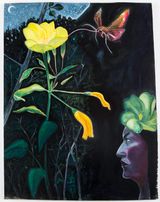
Foxglove, Belladonna and Wolfsbane fairies are among the cast of potent female characters at the heart of this body of work. Though they might be distant relatives to the flower fairies of twentieth-century artist Cecily Barker, who envisioned the flora native to English hedgerows and meadows as prepubescent children, Harrison’s exuberantly unsafe anthropomorphised flowers epitomise the threat of danger that makes modern society increasingly uneasy. Marginalised by sanitised landscapes in which barren office blocks and bland housing estates proliferate – peopled by briefcase-touting unprincipled property developers, trapped workers and disenfranchised youths – their luxuriant groves are at best surveyed from the safe remove of a bedroom window. The mutual effects of this estrangement resonate throughout Flowers of Evil, The Nature of Chaos, 2015, in which nature’s rhythms, the migratory paths of birds and life-cycles of insects, are thrown off-balance by pervasive wireless signals, and the threatened collapse of drained marshland on which a group of executive homes has been built is symbolised by an apocalyptic river of blood.

The meeting of these apparently antithetical, mythic and mundane worlds on Harrison’s picture plane finds an echo in the fairy painting of John Anster Fitzgerald and others of the Victorian era. Conceived during Britain’s industrial revolution, Fitzgerald’s scenes of fabulous revelry unfolding on the edge of social consciousness married a gothic interest in otherworldliness with an impulse to cleanse the doors of perception. Morning glory and bindweed, flowers well known for their mind-altering potential, are a telling presence in Fitzgerald’s work, though for Harrison the sensory potential associated with plants does not end with their ingestion. Just as Baudelaire describes smells ‘corrupt, and rich, triumphant, With power to expand into infinity’ in Fleurs du Mal, the collection of poems from which this exhibition takes its name, so heady, intoxicating, transporting perfume has long been a fixture of Harrison’s practice. Far from the saccharinely pleasant smells to which modern life habitually exposes us, these works embrace all the various odours of sexuality, and death, which jolt us from our numbed subsistence and bring us into the fullness of experience.

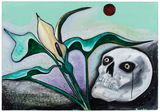
This acute attunement to the material and immaterial environment induces a synthesis of human, animal and vegetable life, imagination and reality, the empirical and the paranormal, in a wild and teeming ecology where plants are fertilised by decomposing skulls and sulphur yellow butterflies are on the lookout for decaying matter on which to feed. Teetering on the cusp of ordinary perception, Harrison’s works refuse not only the limitations of contemporary logic, which would firmly demarcate good and evil, harmful and beneficial (conveniently forgetful of the truth that, in the correct dosage, even deadly plants aid sleep), but also flout physical laws of scale, time and space. Flowers of Evil, The Congregation, 2015, comprises an idiosyncratic medley of ancient symbolism and contemporary narrative where swallows, worms and goldfinches keep company with a saint’s haloed remains and the ghostly inhabitant of, perhaps, a nearby new-build housing estate. Meanwhile, horned Pan commands a host of hares encircling the moon, over the new icons of London’s cult of finance and business. The corrugated ribcage of the cardboard on which the paint is applied is visible in places, this quotidian, useful substance buckling and transforming apparently with a will of its own.

The mood of Harrison’s paintings is sometimes portentous: blood-red suns, human ignorance and copulating corpses all feature, the latter in a mini-series titled Love Means Never Having to Say You’re Ugly. And yet, there is solace to be found in the ceaseless fertility of the natural world, whether coded in the tiny DNA structures visible in a bubbling pool of signs in Flowers of Evil, Enchanter’s Nightshade, 2015, or overtly declared in You Can’t Kill Me, 2013, its title a defiant graffiti slogan which seems more than applicable to Harrison’s inimitable flowers of evil.

Born in 1954, David Harrison lives and works in London. Harrison’s works have been exhibited at venues including TRAMPS, London (2014), VeneKlasen/Werner, Berlin (2012), Vilma Gold, London (2012 and 2003), Daniel Reich Gallery, New York (2008), Galeria OMR, Mexico City (2007), the Arts Centre St. Petersburg, Florida (2005), Northern Gallery for Contemporary Art, Sunderland (2005), The Whitechapel Gallery, London (2006 and 2004), Whitechapel Project Space, London (2004 and 2003), Bloomberg Space, London (2004) and Cubitt Gallery, London (2001).

Read More

Installation Views

About the Artist

Teetering on the cusp of ordinary perception, David Harrison’s paintings, drawings and sculptures present a world where the natural and supernatural go hand in hand. Harrison’s works expand the languages of contemporary painting and sculpture, drawing into play parts of the culture which are forgotten, buried, discarded or disregarded. The artist employs all that has lain outside of the mainstream of modern art–age-old symbols and fanciful myth, irrational beliefs, traditional genres like landscape, exuberant sexuality, barbed wit, and wonder at the natural world – in order to speak vividly about our own time, and to revivify the disciplines of painting and sculpture.

View Artist Profile David Harrison contemporary artist
About the Gallery
Since Victoria Miro founded her eponymous gallery in Cork Street, Mayfair, in 1985, the gallery has grown to represent over 40 artists and estates. With a reputation for presenting ground-breaking artists from around the world, Victoria Miro has exhibition spaces in London and a further gallery space in Venice.

View Gallery Profile
Address
16 Wharf Road
London
United Kingdom
Opening Hours
Tuesday – Saturday
10am – 6pm
(1)
London 16 Wharf Road
Victoria Miro
16 Wharf Road, London, United Kingdom
+44 207 336 8109
http://www.victoria-miro.com

Opening hours
Tuesday – Saturday
10am – 6pm
The art world in focus