





JOHN KØRNER
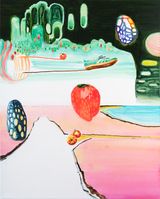
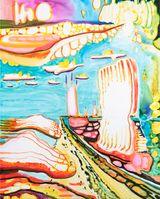
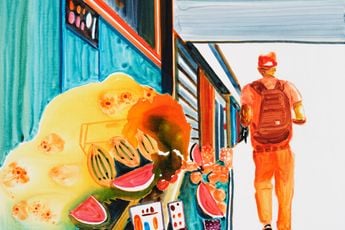
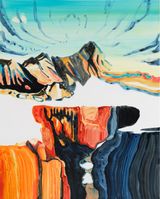
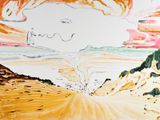
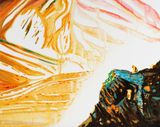
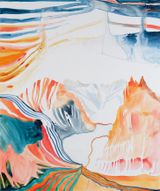
b. 1967, DenmarkWith lightness of touch and painterly dexterity, John Kørner explores his medium’s fundamental duality - its physical presence and its descriptive powers - and the potential for communication or miscommunication that ensues. Kørner has referred to his apparently cheerful paintings as Problems. The viewer is often presented with non-figurative forms including multicoloured ovals and dancing arabesques that symbolise a kind of pre-thought, and simple figurative elements that remind us of the ways in which paint can be used to evoke universally recognisable things: a bicycle, a crocodile, a ship, a person. When displayed simultaneously, often on grounds of intense colour in the works for which Kørner first became known, these abstract signs and nameable things cause the eye to dance between levels of recognition.
Kørner’s work encourages musings that can seem contradictory: on the one hand it is apparently open and easy-going, on the other it seems freighted with awkward questions about representation, knowledge, or faith. Whether asking fundamental existential questions or alluding to specific world events, the work speaks unquestionably to our own moment.
In 2008 Kørner completed War Problems, a series sixteen large-scale paintings, each representing a Danish solider killed in combat in Afghanistan and each bearing a single name, which function as a collective expression of the human tragedy imparted by this war. For his 2011 paintings Women for Sale, issues of prostitution and trafficking in Denmark were a point of departure. More recently, aspects of contemporary geopolitics including imbalances of wealth and the displacement of populations are alluded to with various degrees of abstraction and metaphor. For his 2013 Victoria Miro exhibition Fallen Fruit from Frisland, Kørner made reference to an ancestral landscape that over the centuries has been under constant attack from the elements, endlessly renewed. For his 2016 Victoria Miro Mayfair exhibition Apple Bombs, Kørner presented a constellation of seemingly incongruous pictorial elements that set in motion dialogues concerning wellbeing, human relationships, consumption and survival.
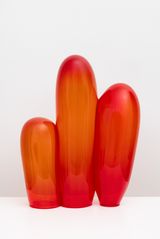
The social aspect of the viewing experience is of particular interest to Kørner who sometimes shows his work outside the traditional confines of the gallery and creates installations in which elements of theatre and performance add to a sense of collective experience. Expanding his repertoire into three dimensions, Kørner has created painted ceramics incorporating some of his motifs, as featured in tableaux such as Mr and Mrs Smith at Work, 2006. Ceramic forms also featured in Fallen Fruit from Frisland, where they appeared in a boat built by Kørner’s great-grandfather on a manmade ‘wave’ covered in a geometrically patterned carpet – a grandiose theatrical element designed to accentuate the drama of looking and thinking.
Born in Århus, Denmark in 1967, John Kørner lives and works in Copenhagen. He studied at the Royal Danish Academy of Fine Arts Copenhagen between 1992 and 1998. Kørner has had solo exhibitions at Brandts, Odense, Denmark, 2016; Museum Belvedere, Oranjewoud, Netherlands, 2016; Herning Museum of Contemporary Art, Denmark, 2003, 2013; The Workers’ Museum, Copenhagen, Denmark, 2011; ARoS Århus Kunstmuseum, Denmark, 2006 and Moderna Museet, Sweden, 2005. His work was recently included in group exhibitions at institutions including the Scandinavian Institute, New York, 2014; Palais De Tokyo, Paris, 2012; Herning Art Museum, Denmark, 2009, 2012 Hamburger Bahnhof, Berlin, 2011; 1st Berlin Kreuzberg Biennale for Contemporary Art (2010); Tate Modern, London, 2010; KUNSTEN Museum of Modern Art Aalborg, Denmark, 2010; U-Turn Copenhagen Quadriennial (2008); Kunshthal Charlottenburg, Copenhagen, 2008; and the Arken Musem of Modern Art, Denmark 2007.
Courtesy Victoria Miro

Works at Victoria Miro




Recently Exhibited




Works Elsewhere










Explore and Follow Artists Shaping Contemporary Art
A respected voice in contemporary art discourse.
Focusing on ambitious storytelling and insightful art-world commentary. Ocula Magazine publishes in-depth interviews, critical essays and timely analysis on the artists, exhibitions and ideas driving the global art world.
Learn more about Ocula Magazine
Showcasing the best of the art world.
Ocula partners with galleries from around the world to highlight their artists, artworks and exhibitions. Gallery membership is by application and invitation, with each member vetted by an independent panel.
Learn more about Ocula Membership
Specialises in the sale of major artworks.
Led by a team with deep ties to the world’s leading auction houses, galleries and collectors. Ocula’s advisory team offers bespoke services to high-net-worth clients from around the world who are looking to acquire the best of contemporary and modern art.
Learn more about our team and services