






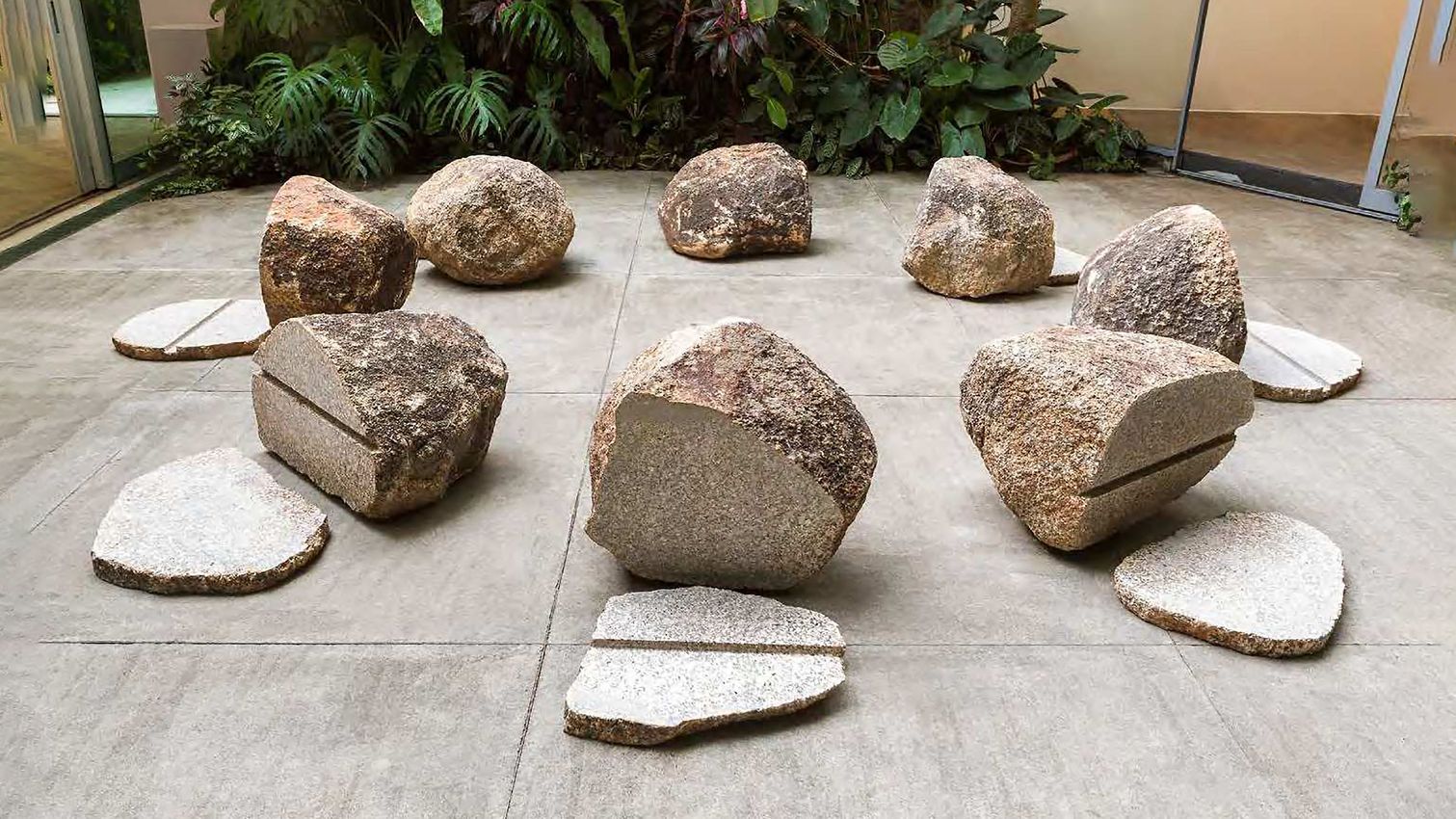
KISHIO SUGA
b. 1944, JapanKishio Suga is one of Japan’s most celebrated artists, whose diverse and influential practice spans site-specific installation, assemblage, and performance. Suga, just as the whole generation of artists his period came to reflect the tensions in a society in the midst of post-war changes.
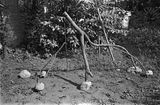
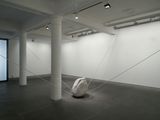
His career began in 1968 when he started making temporary installations out of natural and industrial materials such as wood, metal, wire, and concrete. He quickly gained recognition for works such as Parallel Strata (1969), a rectangular enclosure constructed out of slabs of paraffin wax. By introducing an incongruous yet defined structure of raw material into the gallery space, he sought to reveal the reality of mono (things/materials) and the jōkyō (situation) that holds them together. With these installations and influential essays such as The Start of Disappearance: As Things Deny Things (1969) and Existence Beyond Condition (1970), Suga was identified as a critical theorist within a loose group of like-minded artists that later came to be known as Mono-ha (School of Things). Though short-lived, this movement was a significant turning point in postwar Japanese art history, echoing the concurrent development of Land Art, Arte Povera, and Supports/Surfaces in the United States and Europe, yet rooted in a specifically Japanese intellectual and cultural context.
Kishio Suga was born in Morioka, Iwate Prefecture, in 1944, and lives and works in Ito, Shizuoka Prefecture.His recent solo exhibitions include Pirelli HangarBicocca, Milan (2016); Dia: Chelsea, New York (2016); and the Museum of Contemporary Art, Tokyo (2015). He is frequently included in global survey exhibitions. A re-creation of his groundbreaking outdoor installation Law of Situation (1971) was featured in the Gaggiandre shipyard at the 57th Venice Biennale until November 26, 2017, and his work was included in Japanorama. New vision on art since 1970 at the Centre Pompidou Metz (2018).
Recent group shows include: The Emergence of the Contemporary: Avant-Garde Art in Japan 1950–1970, Imperial Palace, Rio de Janeiro (2016); Karla Black and Kishio Suga: A New Order at the Scottish National Gallery of Modern Art, Edinburgh (2016); Prima Materia, Punta della Dogana, Venice (2013); Parallel Views: Italian and Japanese Art from the 1950s, 60s, and 70s, The Warehouse, Dallas (2013); and Tokyo 1955-1970: A New Avant-Garde, Museum of Modern Art, New York (2012).
His work is featured in many institutional collections, including the Centre Pompidou-Metz, Metz, France; Dallas Museum of Art, Dallas; Dia Art Foundation, New York; Glenstone Foundation, Potomac, MD; Guggenheim Abu Dhabi, Abu Dhabi; Long Museum, Shanghai; M+, Hong Kong; Museum of Contemporary Art, Tokyo; National Museum of Art, Osaka, Japan; National Museum of Modern Art, Tokyo; Pinault Collection, Venice; Rachofsky Collection, Dallas; Tate Modern, London; Tokyo Metropolitan Art Museum, Tokyo; and the Yokohama Museum of Art, Yokohama, Japan.
Courtesy Mendes Wood DM

Works at Mendes Wood DM

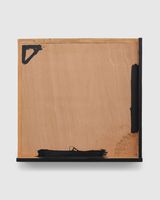


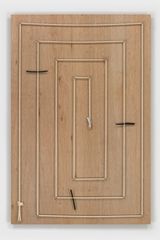


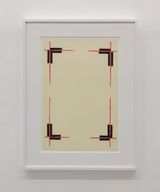



Recently Exhibited





Exhibiting Elsewhere


Works Elsewhere








Explore and Follow Artists Shaping Contemporary Art
A respected voice in contemporary art discourse.
Focusing on ambitious storytelling and insightful art-world commentary. Ocula Magazine publishes in-depth interviews, critical essays and timely analysis on the artists, exhibitions and ideas driving the global art world.
Learn more about Ocula Magazine
Showcasing the best of the art world.
Ocula partners with galleries from around the world to highlight their artists, artworks and exhibitions. Gallery membership is by application and invitation, with each member vetted by an independent panel.
Learn more about Ocula Membership
Specialises in the sale of major artworks.
Led by a team with deep ties to the world’s leading auction houses, galleries and collectors. Ocula’s advisory team offers bespoke services to high-net-worth clients from around the world who are looking to acquire the best of contemporary and modern art.
Learn more about our team and services